A garden room can make a superb place to throw, but only if the layout works before the board goes on the wall. Planning a garden room darts area starts with sight lines, safe clearance and a route through the space that does not cross the throw.
Think of it less as finding a blank wall and more as setting out a small playing zone. The best layouts make the oche easy to use, keep people away from the scoring area, and leave enough room for furniture, storage and garden-room habits such as muddy shoes, heaters and folding chairs.
Safety note: Mains electrical work for extra sockets, hard-wired lighting or cable routing in a garden room should be carried out by a qualified electrician to meet UK electrical safety requirements and relevant Building Regulations.
The short version
- Use the longest clear run in the room, ideally with the dartboard on a solid, flat wall.
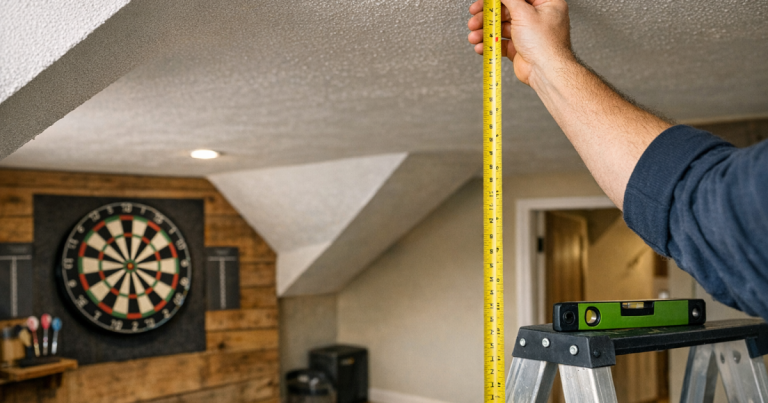
- Set a steel-tip board with the bullseye 1.73 m from the finished floor and the oche 2.37 m from the face of the board.
- Keep the walking route behind the thrower, not across the board or oche line.
- Plan lighting before furniture, because glare from glass doors and windows is common in garden rooms.
- Allow for storage, humidity control and a safe backboard or surround, especially if the room is multi-use.
Step 1: choose the wall before choosing the furniture
Start with the dartboard wall, not the sofa, bar table or storage unit. A good board wall is flat, stable, easy to light and not directly opposite a glass door where reflections can sit in the player’s eye line.
Measure from the finished floor surface. If you have rubber flooring, laminate, carpet tiles or a raised mat, take the bullseye height from the surface you will actually stand on. For a standard steel-tip setup, the bullseye should be 1.73 m from the floor. Measure the throwing distance from the face of the board, not from the wall, cabinet door or surround.
If the garden room has thin internal cladding, locate the battens or structural fixing points before mounting anything heavy. A dartboard on its own is not usually a major load, but cabinets, backboards and shelves can put more stress on the wall. If the wall construction is uncertain, use suitable fixings for that surface and avoid relying on decorative panelling alone.
Step 2: mark the oche line before anything becomes permanent
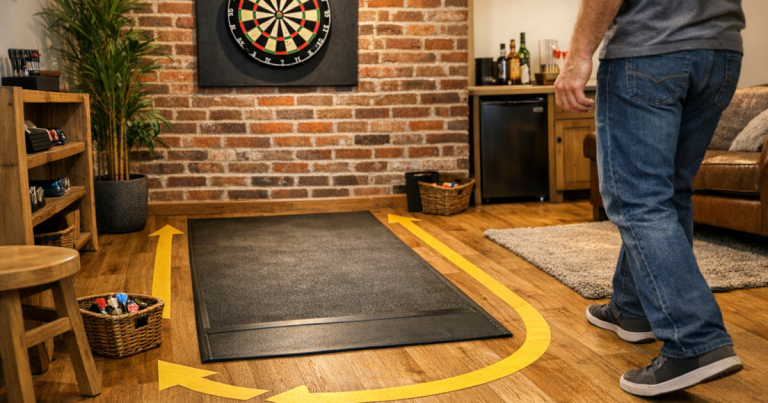
Once the board wall is chosen, tape out the throw line on the floor. For steel-tip darts, mark the oche at 2.37 m from the face of the board. For soft-tip and electronic boards, check the board manufacturer’s instructions, as the throw distance is commonly different.
The easiest way to avoid a measuring error is to temporarily hang the board, hold a tape measure from the face of the board, and mark the floor where the front edge of the oche will sit. Then stand there and test the room as if you are throwing. Can someone open the garden-room door? Can a person get to a seat without crossing in front of the player? Does the thrower have enough space behind them to step back naturally?
For a room that also needs to work as an office, gym corner or family space, a fixed raised oche can be awkward. A taped line, slim threshold strip or removable mat can work better. If you need a no-drill or flexible approach, the ideas in this guide to removable darts oche setups also translate well to garden rooms.
Step 3: create a clear throwing lane
The throwing lane is the invisible area that keeps darts, players and bystanders from competing for the same space. As a practical home-planning allowance, aim for a clear zone centred on the board, with enough width for the thrower’s stance and arm movement. More space is always more comfortable, especially if players stand at different angles.
Behind the oche, leave room for the player to step back, pass darts to the next player and move away without clipping a chair or table. If the back wall is very close to the oche, the room may still function, but it will feel cramped during games with several people.
Avoid placing the board where the natural route to the door runs between the oche and the dartboard. In garden rooms this happens surprisingly often because doors are usually positioned on the most convenient wall, not the safest wall for darts. If the only good board wall faces the entrance, set a simple house rule that the throw stops when anyone enters.
Step 4: plan the lighting as part of the layout
Garden rooms can be bright in the daytime and awkward at night. Glass doors, roof lights and pale internal cladding can all create reflections around the board. A single ceiling light behind the thrower often casts a shadow over the trebles, while a light directly in front of the player can cause glare.
A dedicated dartboard light or well-positioned wall lighting usually gives a more even view of the board. The aim is to illuminate the board face without putting a bright source in the player’s eyes. If the room has a large set of glazed doors, test the board position at different times of day before fixing the final layout.
For more detail on placement and beam angle, use the advice on how to light a dartboard without creating glare. It is especially relevant in garden rooms because reflected daylight and evening indoor lighting can produce two very different playing conditions.
Step 5: place seats and storage outside the danger zone
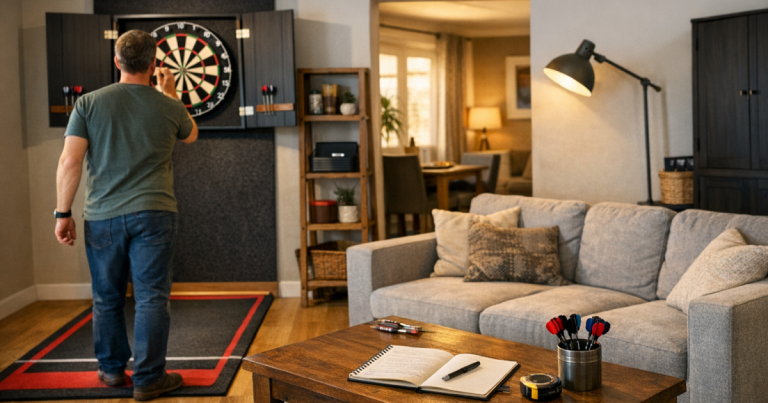
A garden-room darts setup often shares space with stools, a small sofa, a drinks fridge, tool storage or exercise kit. The safest arrangement keeps people seated to the side or behind the thrower, not beside the board and not between the oche and the wall.
Low furniture is not automatically safe just because it sits below throwing height. A dart can bounce out, hit a wire, land short or deflect sideways. Keep valuable items, glassware and screens away from the board wall, and use a surround or backboard if the wall finish matters to you.
Storage should be reachable without stepping into the throwing lane. A small drawer unit, wall shelf or cabinet beside the board can hold flights, stems, chalk, pens and spare points, but avoid putting it where someone will stand while scoring. For a wider safety check, the principles in this piece on how to arrange furniture around a dartboard safely are useful before you settle on the final layout.
Step 6: account for the floor, doors and garden-room climate
Flooring affects both comfort and measuring accuracy. A hard floor gives a clean stance and makes it easy to use a mat, but it can be unforgiving on dropped darts. Carpet tiles or rubber flooring can be kinder underfoot, provided they stay flat and do not create a trip point at the oche.
Garden rooms also bring in moisture, dirt and temperature swings. Keep a doormat at the entrance so grit and damp shoes do not end up around the throw line. If the room is unheated for long periods, store darts and accessories somewhere dry and avoid leaving paper score sheets or cardboard packaging against cold external walls.
Think about door swing as well. French doors, bifolds and side doors can eat into the safe area when open. If the door opens towards the throwing lane, mark the oche with the door open and closed before deciding that the room works.
Example layouts that usually work well
Long, narrow garden room
Put the board on one of the short end walls and run the oche down the length of the room. This usually gives the cleanest throw and leaves a side wall for a bench, small table or storage. Check that the entrance does not open directly into the throwing lane.
Square garden room
A square room can work, but it needs firmer zoning. Put the board on the wall with the least glare and use furniture to define a seating area behind or diagonally behind the oche. Avoid the temptation to put seats on both sides of the board wall, as people will drift too close to the scoring area.
Garden office with occasional darts use
Use a removable oche and keep the desk out of the board’s direct line. If the desk must sit near the dartboard wall, place it to the side rather than underneath the board. Wall protection matters more in a dual-use room because office walls, monitors and shelving are less forgiving than a dedicated games space.
Bar-style garden room
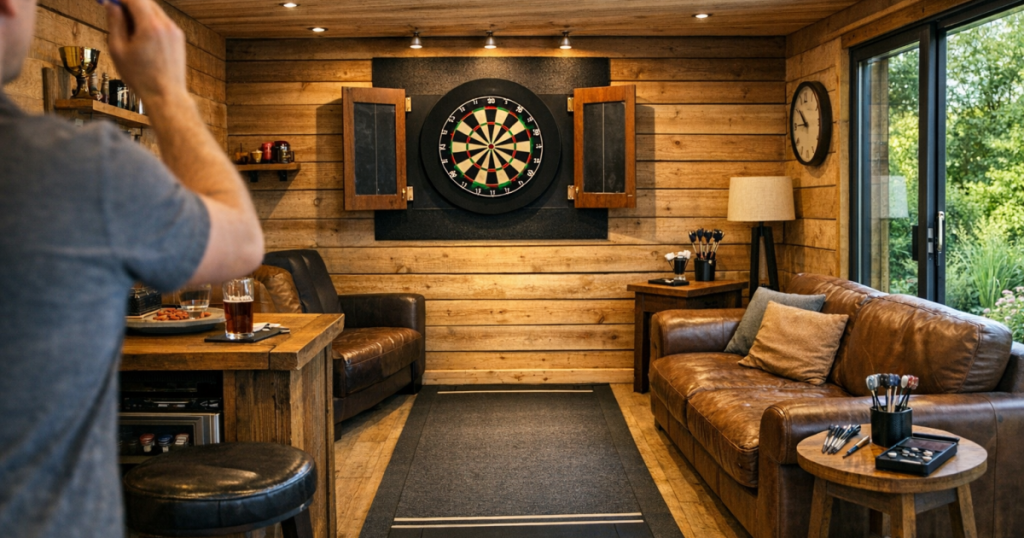
Keep the bar or counter behind the oche if possible. It gives spectators somewhere to stand without entering the throwing lane and makes game flow feel more natural. Avoid placing stools near the board just because the wall looks empty.
Final checks before the first proper game
- Confirm the bullseye height from the finished floor surface.
- Confirm the oche distance from the face of the board.
- Stand at the oche and check that your throwing arm is not close to a side wall, heater, curtain or shelf.
- Walk the normal route from the door to the seating area and make sure it does not cross the throw.
- Switch the lights on at night and check for shadows on the 20, 5 and 1 segments.
- Look for reflections from windows, doors and glossy wall finishes.
- Check that darts accessories can be reached without stepping in front of another player.
- Make sure children, pets and guests have a clear place to wait while someone is throwing.
Things readers ask
How much length does a garden room need for darts?
For steel-tip darts, you need 2.37 m from the face of the board to the oche, plus the space taken by the board projection and some standing room behind the thrower. A room can be technically long enough but still feel tight if the oche sits against a wall or door.
Can I put a dartboard on a garden-room door?
It is rarely the best option. Doors move, flex and bring people into the danger area. A solid wall with proper fixings, a surround and a clear approach is usually safer and more comfortable.
Is an electronic board better in a garden room?
It can be useful where you want automated scoring or soft-tip play, but it still needs safe clearances, suitable mounting and access to power if required. Always follow the manufacturer’s setup instructions for height, distance and power placement.
Do I need a surround or backboard?
In most garden rooms, yes. Even accurate players miss, and bounce-outs happen. A surround or backboard protects cladding, plasterboard and painted finishes, and it makes the darts zone feel more intentional.
Where should spectators sit?
Behind the oche or well to the side of the thrower is best. They should not sit beside the board, stand near the scoring area, or walk between the oche and dartboard during a throw.
What to remember
A good garden-room darts layout is built around the throw, not around whatever wall happens to be empty. Choose the board wall first, measure from the board face, protect the wall, control glare and keep furniture out of the throwing lane.
The most comfortable setups feel simple once finished: the player has a clear stance, spectators naturally wait in the right place, accessories are close but not in the way, and the room still works when nobody is playing darts.