Low ceilings do not automatically rule out a home darts setup, but they can make a well-measured board feel cramped once someone actually starts throwing. The key is to check dartboard ceiling height alongside bullseye height, throwing stance, follow-through space and the shape of the room before you drill anything into the wall.
This matters most in loft rooms, garages, converted sheds, under-stairs spaces and older UK homes where ceiling lines are not always flat. A few minutes with a tape measure can save you from a board that is technically mounted correctly but awkward to use.
At a glance
- The standard bullseye height for a dartboard is 1.73 m from the floor to the centre of the bullseye.
- The ceiling does not need to match an official darts measurement, but it must allow a comfortable throwing action.
- Measure the tallest regular player, not just the room.
- Check the ceiling above the thrower as well as above the board.
- Sloping ceilings, pendant lights, beams and door frames can all affect the final position.
Step 1: Mark the correct bullseye height first
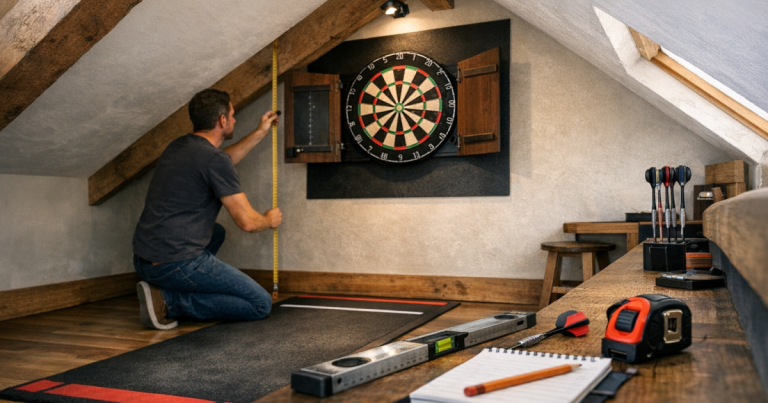
Start with the non-negotiable measurement: the centre of the bullseye should be 1.73 m from the finished floor. Use the exact floor surface you will stand on, including any darts mat if it will stay permanently in place. Do not measure from skirting boards, uneven garage thresholds or the top of a temporary rug.
Make a light pencil mark at 1.73 m on the wall where the bullseye would sit. This is your reference point. If the wall is shared with shelving, cabinets or a picture rail, check whether the board and surround can sit flat without being pushed forward unevenly.
At this stage, do not worry about the ceiling yet. If the bullseye mark is wrong, every later clearance check will be based on a false starting point.
Step 2: Measure the ceiling height at the board position
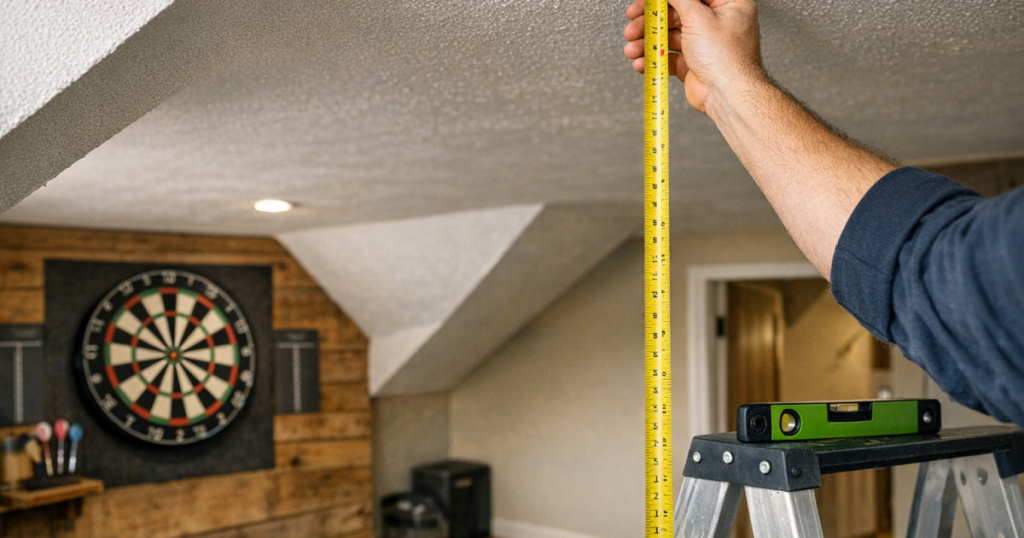
Next, measure vertically from the floor to the ceiling directly above the proposed board. In a normal square room, this is straightforward. In a loft, garage or outbuilding, take several measurements because the ceiling may slope or bow slightly.
Write down the lowest measurement, not the most generous one. A sloping ceiling may look fine at the wall but drop into the player’s line of movement as you step back towards the oche. If there is a beam, exposed pipe, garage door runner or low pendant shade, measure to the underside of that obstruction, not to the plasterboard above it.
As a simple comfort check, there should be clear space above the top of the dartboard and above the natural arc of the throwing arm. You are not trying to create a sports hall; you are making sure the setup does not force players to shorten their throw, duck, or release the dart unnaturally.
Step 3: Check the thrower’s real arm clearance
Ceiling clearance is not only about the board. The thrower usually needs more usable space around the oche than the board itself does. Stand where the throw line will be and copy a normal throwing motion without releasing a dart. If more than one person will play regularly, use the tallest player as the test case.
A useful method is to stand naturally at the oche, raise your throwing arm through its normal preparation and follow-through, then ask someone to note the highest point your hand reaches. Measure from the floor to that point and compare it with the ceiling height above the stance area.
A cramped ceiling often shows up in the follow-through rather than the backswing. If the player instinctively lowers their elbow, changes their stance or leans away from the ceiling, the space is too compromised for comfortable practice.
Step 4: Measure the oche position, then check the ceiling there
For steel-tip darts, the throwing distance is commonly measured as 2.37 m from the face of the dartboard to the oche. Soft-tip setups are often played at 2.44 m, but check the rules or board guidance for the setup you use. The important room-planning point is that the measurement is from the board face, not simply from the wall.
Once you have the throw line marked, measure the ceiling height directly above it. This is where many low-ceiling rooms fail, because the board wall may be full height while the player stands beneath a slope, beam or low light fitting.
If the ceiling drops near the oche, move the whole setup sideways or choose a different wall if possible. Moving only the throw line is not a fix, because it changes the playing distance and makes practice less useful.
Step 5: Allow for stance, foot movement and shared space
A dart throw is small, but the room around it still needs to work. Players step in, step out, collect darts and swap positions. If the ceiling is low near a doorway or storage unit, the issue may not appear until someone moves around between turns.
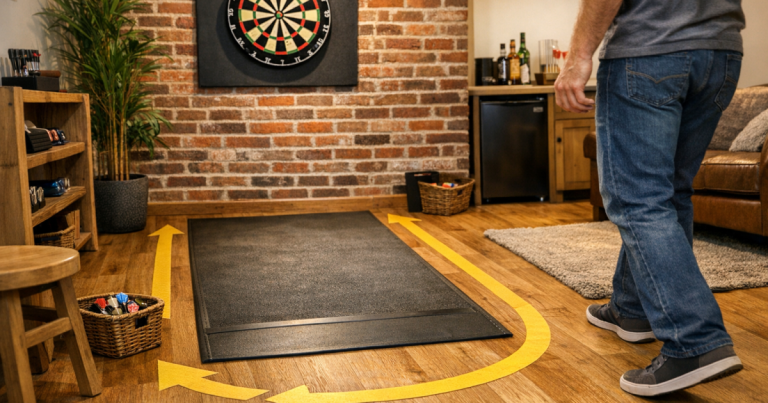
Check the full route from the throw line to the board. You should be able to walk forward without ducking, twisting around furniture or stepping into another person’s path. If the setup is in a lounge, spare room or garage, consider how the space works when chairs, bikes, laundry racks or toolboxes are in their normal places.
For a wider layout check, the guide to planning safe walkways around your dartboard is a useful next step once your ceiling clearance looks workable.
Step 6: Account for cabinets, surrounds and wall protection
A cabinet or surround does not usually change the ceiling height you need, but it can affect where the board sits on the wall and how much space the setup appears to occupy. A cabinet with open doors may feel tight under a sloping ceiling, especially if the top edge sits close to a beam or shelf.
Before fixing anything permanently, hold the cabinet, surround or paper template against the wall at the correct bullseye height. Check the top edge, side clearance and whether doors can open without hitting a ceiling slope or adjacent fitting.
If your wall protection pushes the board face forward, remember that the oche measurement should still be taken from the board face. That small difference is easy to miss in compact rooms.
Step 7: Watch for lights, beams and visual distractions
Ceiling height is not just a matter of physical clearance. A low pendant light, exposed beam or uneven ceiling line can distract you at release, cast shadows over the treble bed or make the board look off-centre even when the measurements are correct.
Stand at the oche and look at the board as if you are about to throw. If the ceiling line cuts across your field of view, or a light fitting appears close to the dart path, adjust the board position before drilling. Good lighting should illuminate the board evenly without hanging into the player’s movement area.
If shadows are part of the problem, read the guide to the best lighting for a dartboard before settling on the final wall position.
Step 8: Test the setup before making permanent holes
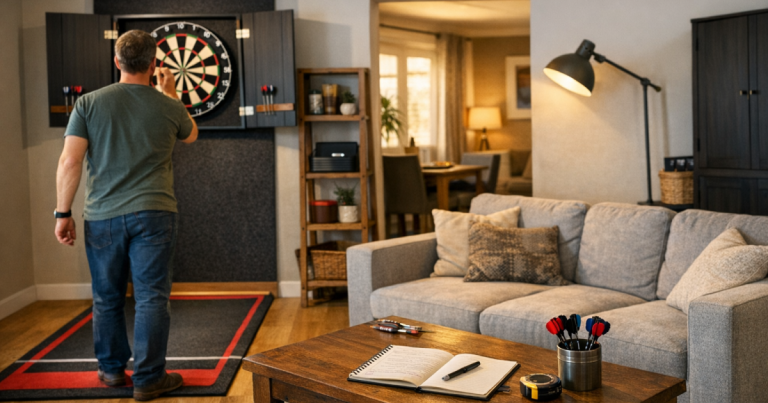
Once your measurements look right, run a dry fit. Use masking tape to mark the board outline, bullseye point and throw line. If you have a spare board bracket template, use that; if not, a paper circle or light pencil marks are enough for the planning stage.
Then stand at the throw line and go through several slow practice throws without releasing a dart. Check whether your shoulder, elbow or hand feels constrained. Ask another regular player to do the same, especially if they are taller or have a higher throwing action.
If the board appears visually uneven after marking, do not assume the ceiling is level. Older properties, garages and loft conversions can have lines that trick the eye. The guide on why your dartboard looks crooked and how to fix it explains how to separate true level from optical illusion.
Common room examples
Spare bedroom with a standard flat ceiling
This is usually the easiest setup. Mark the 1.73 m bullseye height, measure the ceiling above the board and oche, then check door swing and furniture clearance. The main issue is often not height but whether the bed, wardrobe or desk blocks the throw line.
Loft room with a sloping ceiling
Measure along the full throwing lane, not just at the wall. The board might fit neatly on the gable end, but the thrower may stand under the slope. If the tallest player’s throwing hand approaches the ceiling during follow-through, the room is likely to feel restrictive.
Garage or outbuilding
Garages can have useful wall space but awkward overhead obstructions such as tracks, shelves, beams or open rafters. Measure to the lowest fixed point above the board and oche. Also check whether the garage door position changes the usable space when open.
Under-stairs or alcove setup
These spaces often look tempting because they have a clear wall, but the ceiling line can drop sharply. If a player has to stand beneath the lowest point, it is usually better to use the space for storage and place the board elsewhere.
Key checks before you drill
- Confirm the bullseye centre is marked at 1.73 m from the finished floor.
- Measure the ceiling above the board, above the oche and along the route between them.
- Use the lowest obstruction as your real ceiling limit.
- Check the tallest regular player’s natural throwing motion.
- Make sure cabinets, surrounds or lights do not interfere with the ceiling line.
- Mark the layout temporarily and test it from the throw line before making permanent fixings.
- Avoid solving a clearance problem by changing the official board height or throwing distance.
Things readers ask
Is there an official minimum ceiling height for a dartboard?
There is no single standard ceiling-height rule for a typical home darts setup. The important official measurement is the bullseye height of 1.73 m, while ceiling clearance is a practical comfort and safety check.
Can I install a dartboard in a low-ceiling loft?
Sometimes, but only if the throwing area has enough clearance for a natural arm movement. Measure above the oche, not just above the board, because that is where a sloping loft ceiling often causes problems.
Should I lower the dartboard if the ceiling is too low?
No. Lowering the board changes the playing setup and makes practice less consistent. It is better to choose another wall, move to a roomier part of the space, or use the area for darts storage instead.
Does a darts mat affect the ceiling check?
Yes, slightly. If the mat will stay in place while you play, measure bullseye height and arm clearance from the top surface you stand on, not from the bare floor underneath.
What if only one tall player has a problem with the ceiling?
Plan for the tallest regular player if they will use the board often. A setup that works only for shorter players may be fine for casual use, but it will not feel comfortable for everyone in the household.
Key takeaways
Checking ceiling height before installing a dartboard is really about checking the whole throwing lane. Start with the correct 1.73 m bullseye height, then measure the ceiling above the board, the oche and the player’s natural follow-through.
If the room forces players to duck, shorten their throw or stand awkwardly, the wall is not the right choice, even if the board itself fits. A good home darts setup should feel natural from the first throw, with enough clearance to play, retrieve darts and move around without thinking about the ceiling.