A good darts corner feels relaxed, but the layout still needs clear boundaries. The safest way to arrange furniture around a dartboard is to treat the throwing lane, the board wall and the recovery area as working space, not spare space. Once those zones are protected, seating and storage can sit close enough to be useful without getting in the way.
This matters most in UK homes where darts setups often share a living room, garage, dining room or spare room. A sofa that feels well out of the way when no one is playing can become a trip hazard once people are retrieving darts, swapping players or watching from the side.
At a glance
- Keep the throwing lane completely clear from the board to behind the oche.
- Place seating to the side of the board, not beside the oche or forward of the thrower.
- Leave room for players to walk to the board without crossing behind someone mid-throw.
- Use low, stable furniture near the play area rather than tall, narrow items that can be knocked.
- Protect nearby walls, skirting and furniture if the board is in a shared room.
Start by mapping the playing lane
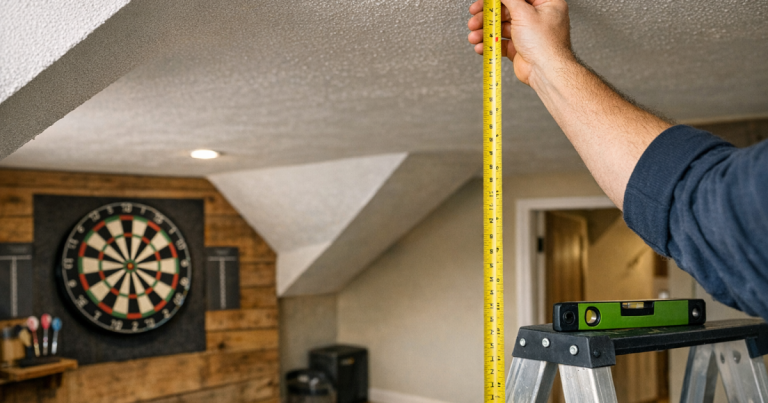
Before moving furniture, mark out the proper playing space. For a standard steel-tip home setup, the bullseye is commonly set at 1.73 m from the floor and the oche is measured 2.37 m from the face of the board. The furniture plan should work around that measured lane, not around where furniture currently happens to fit.
Imagine a straight corridor running from the dartboard face to at least a step behind the throw line. That corridor should be free of coffee tables, footstools, rugs that bunch up, toy boxes, gym gear and loose storage. Even small items can become awkward because a darts stance involves balance, rhythm and a clean follow-through.
If the board is not yet fixed, the furniture plan may help you decide where it should go. A board on the wrong wall can force people to throw towards a doorway, sit too close to the scoring area or walk through the playing lane to reach the room. If you are still deciding, it is worth reading about choosing the right wall for your dartboard before you settle the final layout.
Keep seating out of the forward zone
The most important rule is simple: nobody should be sitting forward of the thrower. That includes chairs placed level with the oche, stools beside the board wall, or a sofa angled towards the board but partly inside the lane.
For casual home play, the safest seating position is usually to one side and slightly behind the thrower. This keeps spectators close enough to chat and score, but away from the dart’s path and away from the board when players retrieve their darts. If the room is narrow, one side bench or a couple of chairs against the opposite wall normally works better than several seats scattered around the board.
Avoid placing a favourite armchair directly beside the dartboard. It may look convenient, but it encourages people to sit near the landing area, lean forward to see the score, or reach for fallen darts while another player is preparing to throw.
Plan the route to the board
Retrieving darts is where many cramped room layouts become awkward. Players need a clear route from the oche to the board and back again. Ideally, this route is the same clear lane used for throwing, with no need to squeeze between a sofa and a table.
Leave enough space for a player to step forward, pull darts from the board, check the score and return without brushing past seated guests. If people must cross in front of a television, cabinet or doorway every visit, the setup may work for a few legs but will quickly feel irritating.
In a shared living room, try placing the main sofa behind the throwing position rather than along the dartboard wall. In a garage or games room, keep storage units on the side walls and leave the central line free. In a dining room, move chairs fully under the table or shift the table to one side before playing, rather than leaving a half-clear route.
Set the throw line so furniture does not creep in
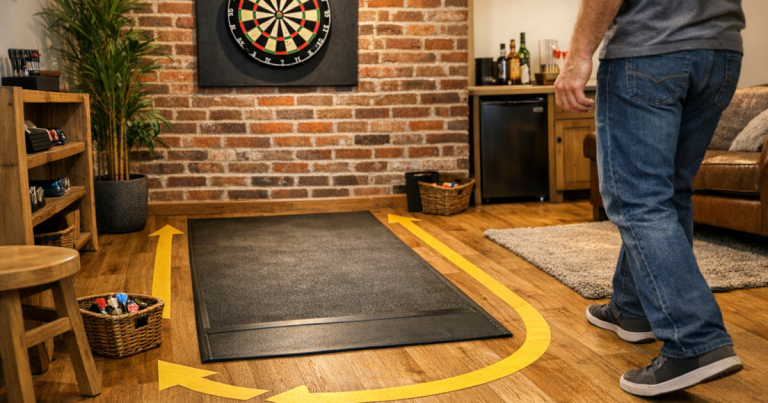
Once you know where the oche belongs, make it visible enough that the room does not gradually drift back into the playing space. A clear throw line also stops spectators from standing too close to the player without realising it.
For rented homes or rooms with good flooring, avoid anything that leaves residue or damage. A mat, removable floor marker or carefully chosen non-permanent strip can work well, depending on the surface. If you want a neat method that suits laminate, vinyl, carpet or tiles, see how to mark a throw line without damaging flooring.
When furniture is close to the oche, use the throw line as the boundary. Chair legs, side tables and storage boxes should sit behind it or outside the lane. Do not rely on people remembering to move things each time; a stable layout is safer than a temporary tidy-up.
Use side furniture carefully
Side furniture can make a darts area more comfortable, but it needs to be chosen and positioned sensibly. A slim sideboard for flights, stems and chalk can be useful. A tall shelving unit right beside the board is less helpful, because bounce-outs and stray darts can hit it, and players may end up standing too close while reaching for accessories.
Good side-zone furniture tends to be:
- Low enough not to loom into the playing area.
- Stable, with no wobble when someone brushes past.
- Set back from the board face rather than level with the trebles.
- Free of glass fronts, delicate ornaments or loose items near the throwing lane.
- Easy to move only if it has a clear storage position away from the oche.
A small cabinet, compact shelving unit or closed storage box is usually better than open piles of darts gear. Keep spare points, stems and flights in containers rather than on a nearby coffee table, where they can be knocked to the floor during play.
Protect walls and nearby furniture
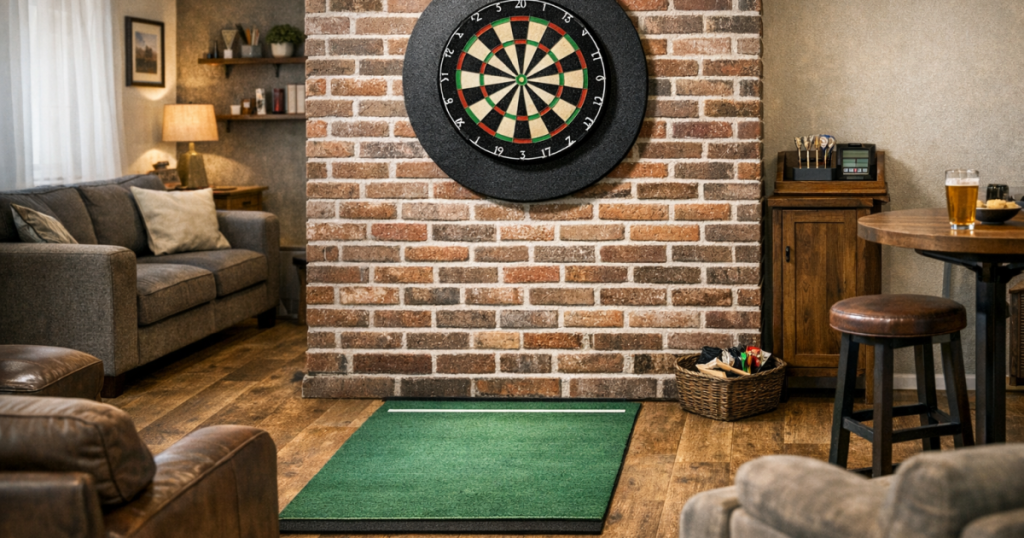
Even confident players miss. In a family home or shared room, wall and furniture protection should be part of the layout rather than an afterthought. A surround or cabinet can help reduce marks around the board, while the furniture plan should keep vulnerable items away from the likely miss area.
Do not place fabric chairs, curtains or soft furnishings tight against the dartboard wall. Darts can snag material, and repeated contact can leave visible damage. If the board is close to a corner, think about the side wall too, not just the wall directly behind the board.
For a clearer idea of how protection fits around the board, this dartboard surround review shows the kind of fit and coverage questions worth considering before relying on a surround alone.
Room examples that work
Living room setup
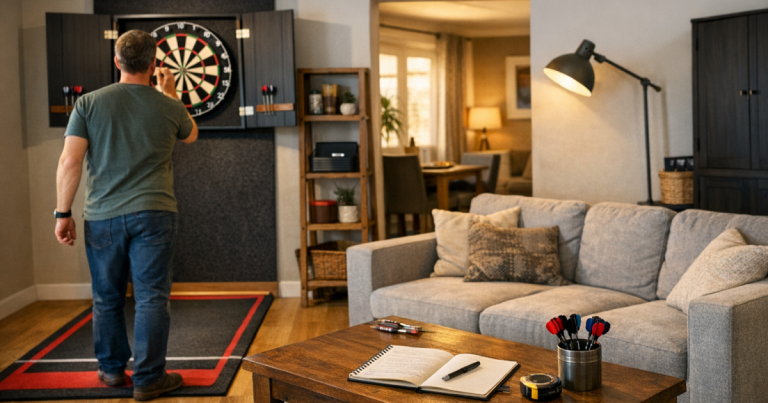
Put the board on a solid wall away from the main doorway. Keep the sofa behind the thrower or along a side wall, with a clear central lane to the board. Avoid a coffee table in the lane during play; if you keep one in the room, choose a fixed position outside the throw path rather than moving it every time.
Garage setup
Garages often have good length but awkward clutter. Place shelving and tools along one side, not behind the oche. Keep bikes, ladders and storage tubs outside the direct route to the board. If the garage is also used for laundry or DIY, make the darts lane obvious so it does not become temporary storage.
Spare room setup
A spare room can be excellent for darts if the bed, desk or sofa bed is not too close to the board. Put larger furniture behind the throwing area where possible. If there is a desk, place it to the side and keep the chair pushed in before play.
Dining room setup
Dining rooms work only if the table can sit well outside the lane or be moved consistently. Do not throw over the table. It disrupts stance, encourages bad habits and puts people at risk if they reach across it. If the table cannot move, a different wall or a portable setup may be the better answer.
Safety checks before the first leg
- Stand at the oche and check whether any furniture touches your stance, elbow space or follow-through.
- Walk to the board and back as if retrieving darts, making sure the route is clear both ways.
- Sit in every spectator seat and check whether the person would be forward of the thrower or too close to the board.
- Check door swings, cupboard doors and drawers so they do not open into the throwing lane.
- Remove loose rugs or secure them properly if they move underfoot.
- Keep pets and young children out of the playing area while darts are being thrown.
- Move drinks away from the oche so players are not stepping around glasses or mugs.
If a layout fails one of these checks, change the room rather than asking players to be careful every time. Good room planning reduces the number of things people have to remember during a game.
What people usually ask
Can a sofa sit behind the oche?
Yes, if it leaves enough room for the thrower to stand naturally and step back without tripping. Keep the front edge of the sofa clearly behind the throwing position, not level with the player’s feet.
How much side space does a home darts setup need?
There is no single furniture rule, but each side of the throwing lane should feel clear enough for balance, movement and retrieval. If a player has to twist around furniture, the room is too tight.
Is it safe to put a dartboard above furniture?
It is usually a poor idea. Throwing over a cabinet, sofa or table makes dart retrieval awkward and increases the chance of damaging furniture or encouraging unsafe reaching.
Where should spectators sit?
Spectators should sit to the side and behind the thrower, never close to the board or forward of the oche. They should also have a clear view without needing to lean into the playing lane.
What if the only suitable wall is in a busy room?
Create a setup that can be cleared fully before play, with movable seating and a visible oche. If the room cannot be made clear, use a different space rather than compromising the throwing lane.
What stands out
The safest darts furniture layout is not about creating a huge dedicated games room. It is about protecting the lane, keeping people out of the forward zone and making the route to the board simple. Once those basics are right, the room can still feel comfortable, social and easy to live with.
Arrange furniture around a dartboard with the same logic every time: board wall first, clear lane second, seating third, storage last. That order prevents the common mistake of squeezing darts into leftover space and hoping it works.