A shared lounge, spare room or rented flat can still work well for darts if the throw line is clear, repeatable and easy to pack away. A removable darts oche gives you that consistency without fixing anything permanently to the floor, which is useful when you need to protect laminate, carpet, tiles or a tenancy deposit.
The aim is simple: create a line that stays put while you throw, does not become a trip hazard, and can be lifted when the room goes back to normal. The right approach depends less on how serious your darts are and more on the floor surface, storage space and how often the board is used.
At a glance
- Most renter-friendly setup: a roll-out dart mat with a visible throw line, stored flat or loosely rolled when not in use.
- Most consistent feel: a low-profile raised oche placed on top of a mat, so your front foot has a physical stop.
- Best for occasional games: temporary floor markers that are easy to remove and do not leave residue.
- Biggest mistake: measuring from the wall rather than the face of the dartboard.
- Shared-space priority: keep the throwing lane clear before, during and after play.
Start with the fixed points
Before choosing the marker, get the playing position right. For a standard steel-tip setup, the bullseye is usually set at 1.73 m from the floor, with the throwing line 2.37 m from the face of the dartboard. That face measurement matters because a cabinet, backboard or thick surround can change the distance if you casually measure from the wall.
If you are refreshing the whole board area, it is worth checking the board itself at the same time. The number ring, doubles, trebles and bull area all shape how the board is read during a leg, and our dartboard layout explainer is a useful companion if you are setting up from scratch or helping newer players understand the board.
For shared spaces, mark the final line only after the board height and distance are confirmed. A few millimetres will not ruin a casual evening, but a line that drifts each time you set up can make practice frustrating and scoring feel inconsistent.
Why removable setups suit rented homes
Permanent oche rails and fixed floor strips can be satisfying in a dedicated darts room, but they are not always sensible in a rented flat, student house, shared family lounge or multipurpose garage. The issue is not just permission; it is daily use. People need to walk through the space, furniture moves, rugs shift, and floors need cleaning.
A removable setup solves three problems at once. It gives players a repeatable reference point, protects the surface beneath the thrower, and keeps the room flexible. It also avoids the awkward compromise of using a chair leg, skirting board or carpet pattern as the throw line, which rarely lines up properly and can encourage players to stand at slightly different distances.
Four ways to create a temporary throw line
Roll-out dart mat
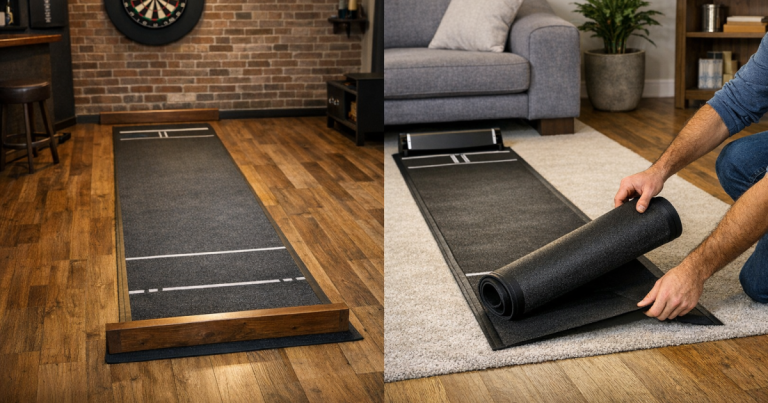
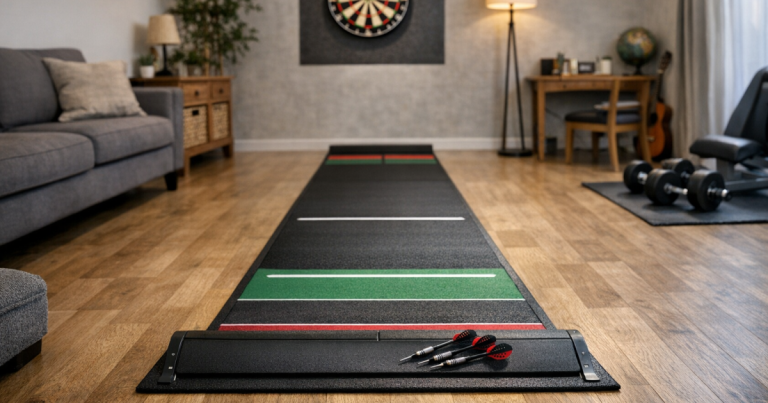
A dart mat is the cleanest solution for many rented spaces because it combines floor protection with a visible oche line. Rubber-backed and carpet-style mats are common, and familiar examples include the Winmau Xtreme Dart Mat and Target World Champions Dart Mat. Treat named mats as examples rather than automatic answers: check the printed distance markings, backing type, thickness, storage needs and whether the underside is suitable for your floor.
- Works well when: you want one item to roll out before play and pack away afterwards.
- Can struggle when: the floor is uneven, the mat curls at the ends, or people regularly cross the throwing lane.
- Useful habit: roll the mat with the top surface outward only if the manufacturer allows it; otherwise store it as instructed to reduce curling.
Low-profile raised oche on a mat
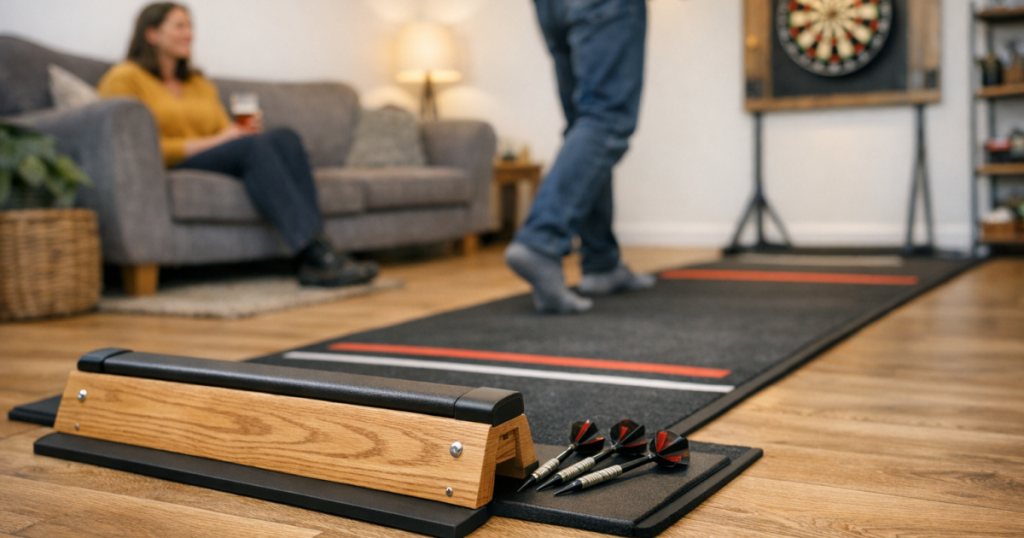
A raised toe line gives a more definite stopping point than a printed line. For players who practise doubles or scoring routines regularly, that physical edge can make the setup feel closer to a club or pub board. In a rented room, the safest approach is usually to place the raised oche on a mat rather than attaching it directly to the floor.
The trade-off is space. Anything raised needs to be obvious enough not to catch people out, but not so bulky that it dominates the room. If the board is used only once a week, a raised piece that stores behind a cabinet or under a sofa can be more practical than something larger that is always in the way.
Temporary floor tape or removable markers
For occasional play, a strip of low-tack removable tape or a reusable floor marker can work, particularly on hard flooring. The important word is removable. Avoid anything that bonds aggressively, stains, lifts finish, or leaves a sticky outline after a few weeks in sunlight.
Test any tape in a hidden corner first and remove it slowly. On older varnished boards, delicate laminate, vinyl or painted floors, even products sold as low-tack can behave differently depending on heat, cleaning products and surface condition. This is a good short-term answer, not a fit-and-forget solution.
Freestanding toe line
A freestanding strip can be as simple as a purpose-made oche bar or a neat, weighted marker placed at the correct distance. The appeal is that nothing touches the floor for long. The downside is that it can move if kicked or nudged, so it needs checking between games.
This approach suits social play where the board is set up only for the evening. It is less convincing for focused practice because a line that creeps forward or backward over several legs undermines the point of measuring carefully in the first place.
Making it work in a shared room
In a dedicated darts space, the board area can stay ready. In a shared room, the setup has to earn its place. The oche should be easy enough to lay down that you actually use it, but quick enough to remove that it does not annoy everyone else.
- Clear the lane first: move coffee tables, stools and drying racks before anyone starts throwing.
- Keep storage obvious: use the same cupboard, drawer or hook every time so the mat or marker does not disappear.
- Watch the edges: curled mat corners and raised bars are the most common trip points.
- Agree the playing mode: when darts are out, people should avoid walking between the oche and board.
- Reset after play: pack darts, mat and scoreboard items away together rather than leaving small accessories around the room.
The furniture layout matters as much as the oche itself. If the board shares space with seating, shelves or a doorway, use our guide to arranging furniture around a dartboard safely before settling on the final playing position.
Floor surfaces change the best answer
Different UK homes throw up different problems. A mat that behaves perfectly on a garage floor might slide on laminate, bunch on carpet or feel lumpy over a deep rug. The best setup is the one that remains flat and predictable on your actual surface.
- Laminate and engineered wood: prioritise non-marking backing and check for slipping before play. Avoid abrasive undersides that could scuff when stepped on.
- Carpet: heavier mats usually sit better than very light ones, but thick pile can still cause movement. Recheck the oche position during longer sessions.
- Tiles: impact noise and sliding can be more noticeable. A mat helps soften foot placement and gives dropped darts a less harsh landing area.
- Rugs: use caution. A rug on top of a smooth floor can move as a whole, taking the throw line with it.
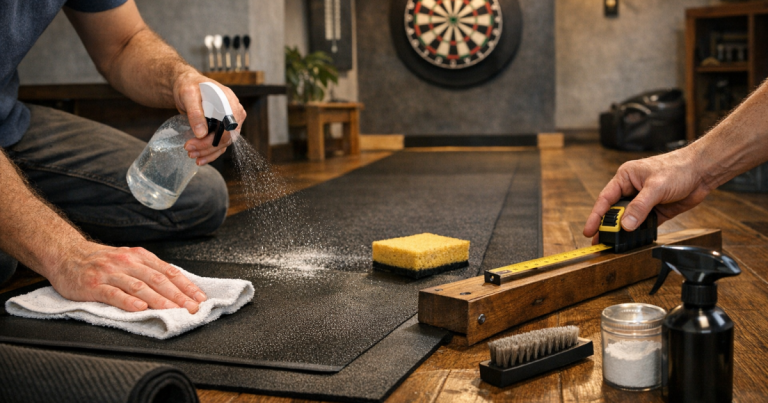
- Garage or utility floors: dust and grit can reduce grip, so sweep the area before rolling a mat out.
Do not forget the wall area
Renters often focus on the floor because the oche is the obvious problem, but the wall around the dartboard matters too. A removable throw line will not help much if missed darts are marking plaster, door frames or furniture.
A surround, cabinet or backboard can make the whole setup feel more acceptable in a shared home. If you are using a cabinet, the fixing method depends heavily on the wall type and the weight being supported; the dartboard cabinet fixing guide explains the practical differences between common wall surfaces.
For renters, it is sensible to separate two decisions: how the board area is protected and how the oche is marked. The oche can be removable while the board area uses whatever fixing method is allowed in your home.
Keeping the line consistent
The best temporary setup is one you can repeat without a full measuring session every time. Once the distance is correct, create a simple reference system that does not damage anything.
- Measure from the board face to the front edge of the oche, not to the middle of a mat.
- Use a small, removable reference point at the side of the room if the floor finish allows it.
- Line the mat up with a skirting board, cabinet edge or wall feature only after confirming it is square to the board.
- Check the distance again after moving furniture or changing the board, cabinet or surround.
- Keep a tape measure with your darts accessories so nobody has to guess.
If you share the board with less experienced players, make the rule simple: toes behind the front edge. That is easier to follow than explaining different mat markings or asking people to interpret a faded line.
Raised edge or flat line?
Players often disagree on whether a raised oche is worth it at home. A flat line is easier to store, safer in a busy room and usually enough for casual games. A raised edge feels more precise, helps stop creeping forward, and can make practice routines feel more deliberate.
The middle ground is a removable raised edge used only during proper practice or match nights. For family games, parties or quick legs after dinner, a flat mat line may be the better social choice. In shared spaces, the neatest technical answer is not always the easiest one to live with.
Shared-space etiquette that prevents arguments
A home darts setup works best when everyone knows what happens before, during and after play. That is especially true in rented houses, flats with limited storage, and rooms used by children, housemates or visitors.
- Do not leave darts in the board when the room is unsupervised.
- Pack away the oche marker as soon as play ends.
- Keep the mat dry and clean before rolling it up.
- Do not block exits, cupboards or regular walkways with the throwing lane.
- Agree quiet hours if darts are played near bedrooms or adjoining walls.
These small habits make the setup feel considerate rather than intrusive. They also help protect the equipment, because mats that are tripped over, folded badly or left under furniture tend to age quickly.
Helpful questions
Can I use masking tape as an oche in a rented room?
Only as a very short-term marker, and only after testing it on a hidden area. Masking tape can leave residue or lift delicate finishes, especially if left down for days.
Will a dart mat move on carpet?
It can, particularly on thick pile or uneven carpet. Use a heavier mat where possible and recheck the distance during longer sessions rather than assuming it has stayed in place.
Is a raised oche safe in a living room?
It can be, but only if it is obvious, stable and removed after play. In a room where people walk through regularly, a flat mat line is often less disruptive.
What if my board is inside a cabinet?
Measure from the face of the dartboard, not the cabinet doors or wall. If the board sits proud of the wall, that changes where the oche should be placed.
How do I store a dart mat without ruining it?
Follow the mat maker’s storage advice. As a general habit, avoid tight folds, keep it dry, and do not trap it under heavy furniture.
Why it matters
A removable darts oche is not just a renter-friendly compromise. Done properly, it gives you a reliable throw line, protects the room and makes darts easier to share with other people in the home. The best setup is the one you can place accurately, use safely and pack away without fuss.
For most shared spaces, start simple: confirm the board height and distance, choose a mat or marker that suits the floor, and keep the throwing lane clear. If you later find yourself practising more seriously, add a removable raised edge for a firmer match-style feel without turning the room into a permanent darts venue.