A shared living room darts setup has to work twice as hard: it needs to play properly when the board is up, then disappear enough for normal family use. The aim is to protect walls and floors, keep the throw safe, and avoid turning the room into a permanent pub corner unless everyone wants that.
Start with the room, not the board. Once you know the throw line, door swings, seating position and storage route, the rest of the setup becomes much easier to plan.
The short version
- Use the official board height and throw distance as your fixed points, then design the furniture layout around them.
- Keep the throwing lane clear of foot traffic, open doors, pets, low tables and TV viewing routes.
- Add wall and floor protection before regular play, not after the first bounce-out or stray dart.
- Choose removable or low-profile accessories if the room needs to feel like a living room most of the time.
- Plan storage for darts, flights, chalk, scoreboard items and spare points so nothing is left on the coffee table.
Step 1: Pick the least disruptive wall
The best dartboard wall in a shared living room is not always the biggest blank wall. Look for the wall that gives you a straight throw without blocking the sofa, main walkway, radiator access or doorway. A board above a sideboard can work if the throw line clears the furniture, but a board behind a frequently used chair usually becomes annoying very quickly.
Check what happens when the room is being used normally. Can someone walk to the kitchen without crossing the throw? Does the door open into the playing area? Is the television directly behind the thrower, creating glare or distraction? Shared rooms work best when darts has a defined zone rather than spreading into every activity in the room.
If the setup needs to vanish between sessions, treat it as a foldaway zone from the start. The planning ideas in creating a foldaway darts area in a shared room are useful when you want the board, mat and accessories to have a home without dominating the space.
Step 2: Mark the official playing measurements
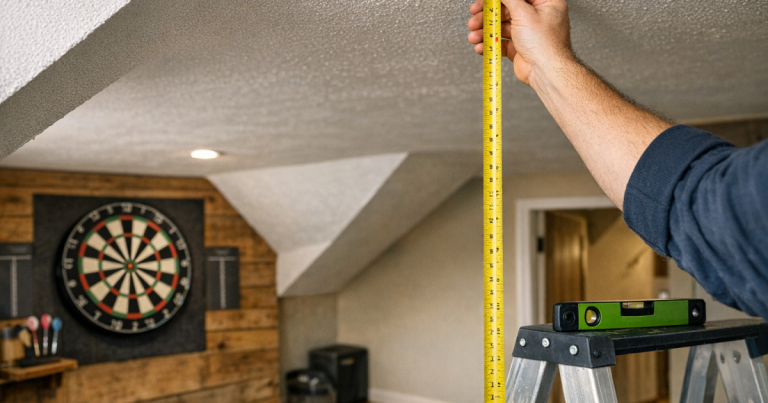
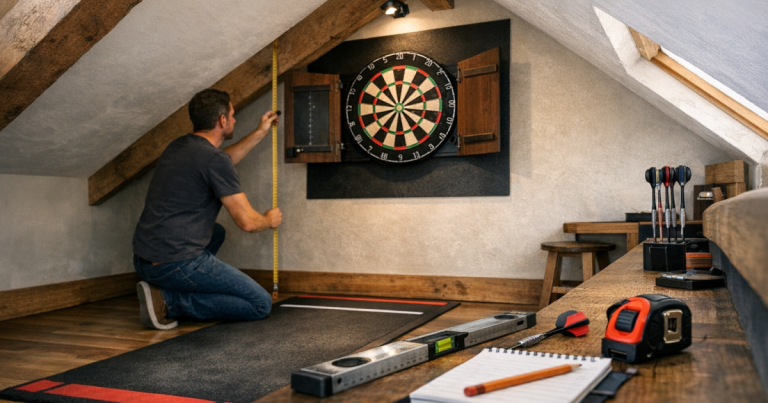
For a standard steel-tip board, the centre of the bull should sit 1.73 m from the floor. The throwing distance is 2.37 m from the face of the board to the oche line. Because the measurement starts at the board face rather than the wall, allow for the board thickness and any cabinet, mounting plate or backing panel.
A quick way to check the diagonal is to measure from the bull to the oche line on the floor; for standard steel-tip play, it should be about 2.93 m. Use this as a cross-check rather than your only measurement, as skirting boards, uneven floors and thick surrounds can make rough measuring less reliable.
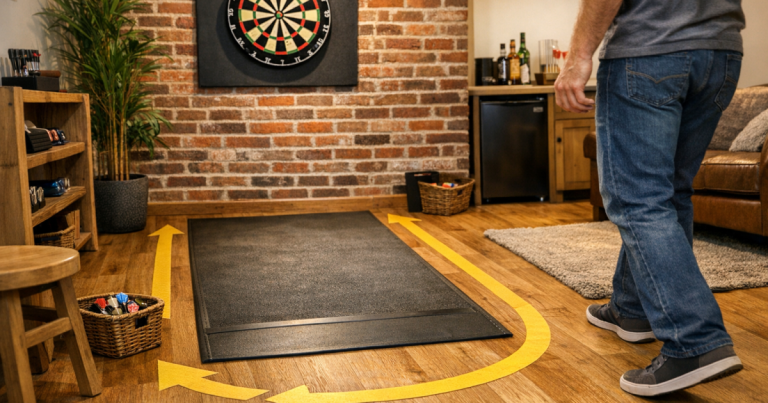
Do not mark the oche permanently until you have tested the room. Lay masking tape on the floor, stand at the line, and check whether the thrower has enough room behind them to step back naturally. In a living room, the space behind the oche matters almost as much as the distance to the board.
Step 3: Keep the throwing lane genuinely clear
A clear lane is more than a narrow strip from thrower to board. You need space for the throwing arm, a small step back, and other people to avoid crossing the path while someone is throwing. If the oche sits just in front of a sofa, make sure seated people are not within the natural swing or follow-through area.
Think about living room habits. A coffee table may be easy to move once, but irritating to move every evening. A rug may creep into the oche area. Children’s toys, footstools and pet beds can reappear in the lane unless there is a simple reset routine before play.
For most shared rooms, a removable oche marker is better than a permanent raised strip. A mat, tape marker or low-profile throw line gives the room more flexibility. For more layout ideas, see these portable darts mat and oche setups for multipurpose rooms.
Step 4: Protect the wall before it becomes a problem
Wall protection is essential in a living room because a few missed darts can make the area look scruffy fast. A surround is the simplest option for many homes, but it still needs enough coverage for the player’s level. Beginners, guests and casual family games usually need more protection than experienced throwers.
A cabinet can look tidier because it hides the board when closed, but check the open-door width and whether the cabinet corners sit close to picture frames, shelving or curtains. A wider backing panel can be useful where the board is near plasterboard, painted walls or any surface you want to keep clean.
Also protect what sits below the board. Hard floors, tiles and thin laminate can show damage from bounce-outs. A mat helps define the playing area and catches some dropped darts, but it should sit flat and not create a trip edge in a shared walkway.
Step 5: Make lighting comfortable for both darts and normal use
Good lighting makes the board easier to read and reduces shadows around the treble beds. In a living room, the trick is to light the board without making the whole room feel like a sports bar. Avoid relying only on a ceiling pendant behind the thrower, as it can cast a shadow across the board.
Dedicated dartboard lighting, cabinet-mounted lighting or carefully positioned wall lighting can all work, but keep cables tidy and avoid trailing leads through walking routes. If you are using plug-in lighting, plan the route from socket to board before fixing anything in place.
The shape of the room affects the answer. A cabinet, freestanding stand and bare wall setup all throw shadows differently, so use the examples in dartboard lighting layouts for cabinets, stands and wall setups before deciding where the light should sit.
Step 6: Decide what stays out and what packs away
A shared room feels calmer when every darts item has an obvious place. Decide which items can remain visible and which should be packed away after play. The board might stay inside a closed cabinet, while darts, spare flights, stems, chalk, marker pens and cleaning cloths live in a small case or drawer.
Avoid storing loose darts in a bowl or on a shelf, especially if the room is used by children or visitors. Keep points covered or enclosed, and make the pack-away routine part of finishing the match. It only takes a minute, but it stops the setup spreading across the room over time.
If you score on a phone, tablet or small scoreboard, decide where it sits before you play. The scorer should be visible without forcing players to step into the lane after every visit. A side wall, small shelf or movable stand often works better than balancing everything near the board.
Step 7: Test the room with a real practice session
Before committing to holes, hooks or permanent marks, run a proper trial. Put the board at the intended height, mark the oche, move the furniture into its playing position and throw for 20 minutes. Include the people who normally share the room, because they will notice issues you may miss.
During the test, ask practical questions: Can someone still watch TV? Is the lamp glare distracting? Does the mat slide? Does the oche line land where people naturally walk? Is the board too close to a door, window or curtain? The best shared living room darts setup is the one that still feels sensible after the novelty wears off.
Common layouts that work well
The cabinet-on-feature-wall layout
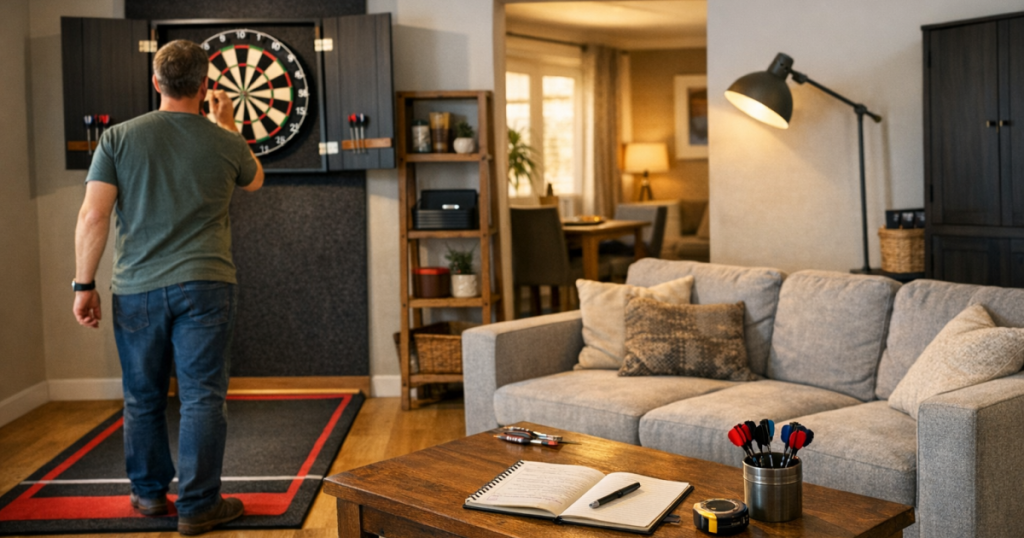
This suits rooms where one wall can become the darts zone without clashing with the main seating. The cabinet keeps the board tidy, while the surround or backing panel protects the wall when the doors are open. Check that cabinet doors do not hit shelves, pictures or curtains.
The removable-board-and-mat layout
This works in flats, rented homes or rooms where permanent fixtures are not ideal. A removable board mount or stand, combined with a roll-out mat, lets the room return to normal quickly. The trade-off is that setup takes a little longer and measurements need checking each time.
The corner-adjacent layout
A board near a corner can save wall space, but only if the throwing line remains straight and the player has enough shoulder room. Avoid placing the board so close to the side wall that right-handed or left-handed throwers feel cramped.
House rules that keep everyone happy
- Agree when darts can be played, particularly in flats or terraced homes where impact noise may carry.
- Keep drinks, glassware and ornaments away from the board area during play.
- Reset the furniture after every session so the room does not slowly become less usable.
- Use one storage spot for all darts accessories, rather than scattering spares across drawers.
- Stop play when someone needs to cross the lane; do not rely on people ducking past between throws.
Straight answers
Can you put a dartboard in a small living room?
Yes, if you can achieve the correct board height, throw distance and a clear lane without blocking everyday use. If furniture has to be moved every time, keep the setup quick and repeatable.
Is a dartboard cabinet better for a shared room?
Often, yes. A cabinet hides the board and can make the room look tidier, but it does not replace proper wall protection if missed darts are likely.
What is the easiest oche for a living room?
A flat mat or removable floor marker is usually easiest. It gives you a clear line without creating a raised edge that gets in the way when darts is packed away.
How do you stop a darts area looking messy?
Limit what stays visible, use closed storage for darts and spares, and choose wall protection that suits the room rather than looking like an afterthought.
Should the TV be near the dartboard?
It is better to keep the TV outside the direct board area. Reflections, distraction and the risk of stray darts make the combination awkward in many living rooms.
What to remember
A good living room darts area is not just about fitting a board on the wall. It is about planning the throw, protecting the room, keeping walkways clear and making pack-away simple enough that people actually do it.
Measure carefully, test the layout before making anything permanent, and design around the way the room is used every day. When the darts zone feels deliberate rather than improvised, it is much easier for everyone to enjoy the space.