Good dartboard lighting makes the trebles easier to read, keeps shadows off the scoring bed and stops the thrower staring into a harsh bulb. The aim is not simply to make the board brighter; it is to light it evenly from the right angle so the wire, sisal and surrounding wall stay clear without reflections.
Mains electrical work, new sockets and fixed lighting connections should be carried out by a qualified electrician to ensure compliance with UK electrical safety requirements and current wiring standards.
The short version
Use soft, even light aimed at the face of the board rather than at the thrower. Keep bulbs and fittings out of the direct eyeline from the oche, avoid glossy nearby surfaces, and check the setup from both the throwing position and beside the board before calling it finished.
- Light the board from above, around it, or from both sides rather than from one low side angle.
- Avoid exposed bulbs that can be seen directly from the throw line.
- Use diffused light where possible; harsh points of light create bright spots and hard shadows.
- Check for glare on the wire, number ring, cabinet doors and nearby framed pictures.
- Test the light with your normal darts, at your normal throw line, not just while standing close to the board.
Step 1: Start with the wall and the line of sight
Before choosing a lamp or moving fittings, stand on the oche and look at the board as if you are about to throw. Glare is usually caused by one of three things: a bulb in your direct eyeline, light bouncing off a shiny surface, or light striking the board from such a steep angle that the wire throws shadows across the segments.
If the board is on a wall opposite a bright window, a mirror, gloss paint, a television, or a glass-fronted cabinet, you may be fighting reflections before you even add a lamp. Daylight can be useful, but low sun through a side window can create uneven brightness across the board face. For a permanent setup, it is worth revisiting the wall choice rather than trying to solve every problem with brighter lighting. If the position is still undecided, use the checks in how to choose the right wall for your dartboard before fixing anything in place.
Step 2: Aim for even coverage, not maximum brightness
A dartboard does not need to be floodlit like a stage. Too much brightness can be just as annoying as too little, particularly in a small spare room, garage or dining area where the thrower stands fairly close to the fitting. The useful target is balanced visibility across the whole scoring area: single segments, trebles, doubles, bull and number ring should all be readable without one side looking washed out.
Walk through these checks with the room lights on and off:
- Can you read the numbers clearly from the throw line?
- Are the trebles at the top of the board darker than the lower half?
- Does the bull look dull compared with the outer ring?
- Do the wires cast visible shadows into neighbouring segments?
- Can you see the bare bulb, LED strip or reflected light source while aiming?
If the answer is yes to the last two, adding more power is unlikely to help. Change the angle, diffuse the source, or shield it from the player instead.
Step 3: Pick a lighting position that suits the room
Most home setups work best with one of four approaches. None is automatically perfect, because the surrounding furniture, ceiling height, cabinet depth and wall finish all affect the result.
Overhead light above the board
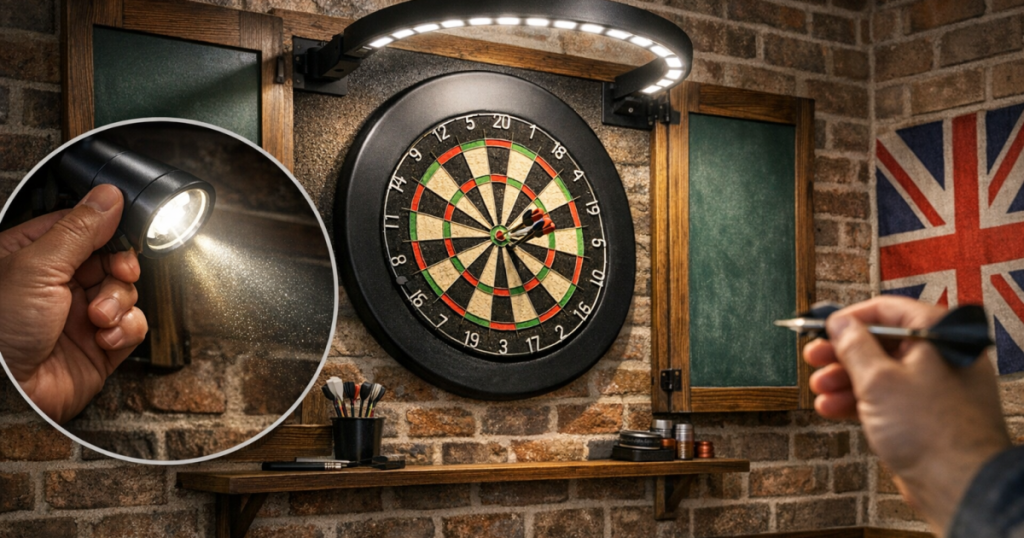
A light mounted above the board is simple and tidy, but it must be far enough forward and diffused enough to avoid casting a heavy shadow down the lower half of the board. If the light is tucked close to the wall, the wires and darts can throw shadows towards the lower segments. If it is too far forward, the player may see the fitting directly from the oche.
This approach can work well in a cabinet setup if the lamp is shielded and aimed at the board face rather than out into the room. Watch for reflections from cabinet doors, varnished wood and glossy surrounds.
Ring or halo-style lighting
Purpose-made circular lighting can give very even coverage because the board is lit from multiple angles. Examples include the Winmau Plasma Dartboard Light, Target Corona Vision Dartboard Light and Mission Torus 270 Dartboard Light. These are useful references because they show the principle: spread light around the board so no single direction creates the dominant shadow.
Before using this style, check how it fits with your surround, cabinet, wall clearance and board rotation routine. Some setups are beautifully clean with a ring light; others become awkward if the cabinet doors cannot open properly or the surround sits too proud of the board.
Side lighting from two directions
Two balanced lights, one to either side of the board, can reduce harsh shadows if they are matched in brightness and aimed carefully. The danger is creating glare from one side, particularly if one lamp is closer to the thrower or mounted lower than the other. Side lighting works best when the fittings are diffused and kept outside the direct throwing lane.
General room lighting plus a board light
In many UK homes, the neatest result is a normal room light for background visibility and a dedicated board light for detail. This avoids the tunnel effect where the board is bright but the rest of the room feels gloomy. A little ambient light also helps players move safely around furniture, mats and drinks tables between turns.
Step 4: Remove the common causes of glare
Once the board is lit, stand at the throw line and move your head slightly left, right, up and down. Glare often appears only from a particular stance, so check from where you actually throw rather than from the centre of the room.
- Exposed light source: if you can see the LED chips, bare bulb or shiny reflector from the oche, shield it or move it.
- Glossy wall paint: a satin or gloss finish can bounce light back towards the player. A matt wall behind the board is usually kinder on the eyes.
- Cabinet reflections: open cabinet doors can reflect a lamp back into your sightline. Check with the doors open and closed.
- Bright number ring: some number rings catch light more than the sisal. Adjust the lamp angle until the ring is readable but not sparkling.
- Nearby screens: televisions and monitors can reflect board lights, especially in compact rooms.
Furniture can also create awkward sightlines. A lamp that looks fine when the room is empty may become distracting once a tall cabinet, shelving unit or glass picture frame is nearby. If the board sits in a shared living space, use safe furniture arrangement around a dartboard as part of the same room check.
A simple dartboard lighting plan for different home setups
Spare room or box room
Small rooms often suffer from lights being too close to the player. Use a diffused board-focused light rather than a bare ceiling bulb directly between the thrower and the board. If the ceiling pendant is in the sightline, turn it off during play and rely on a board light plus softer background lighting from elsewhere in the room.
Garage or outbuilding
Garages can be darker, colder and more reflective than indoor rooms, especially with white doors, painted concrete floors or metal storage units. The board needs consistent light, but so does the floor around the oche. Avoid trailing cables across walking routes, keep portable lamps stable, and make sure any plug-in equipment is suitable for the environment in which it is being used.
Living room or dining space
The challenge here is usually comfort rather than raw brightness. You want the board clear without turning the whole room into a practice hall. A tidy board-specific fitting can reduce the need for harsh overhead lighting, while warm background lamps keep the space pleasant for others in the room.
Electronic dartboard setup
Electronic boards and soft-tip setups can have reflective plastic areas, displays or surrounding panels. Use light that falls onto the board rather than directly across the display surface. If your setup includes power leads or wall-mounted electronics, pair the lighting check with safe electronic dartboard setup at home so the whole area is tidy and practical.
Step 5: Test it with real throwing conditions
A lighting setup can look perfect while you are standing next to the board and still feel wrong once you start playing. Do a short test session before fixing cable clips, mounting brackets or furniture positions permanently.
- Throw from your normal oche position, not a step closer.
- Use the darts you actually play with, as different flights and barrel finishes can catch light differently.
- Score a few visits around the board, including doubles at the top and bottom.
- Ask a second player to check from their stance if more than one person uses the setup.
- Check the view in daylight and after dark if the room is affected by windows.
Pay attention to eye comfort. If you find yourself squinting, blinking more than usual, losing the wire in bright patches or stepping sideways to avoid a reflection, the lighting is not settled yet. Small angle changes often make a bigger difference than changing the fitting.
Key questions answered
Is a ceiling light enough for a dartboard?
Sometimes, but it depends where the fitting sits. A ceiling light behind the thrower can work as background light, while one directly above or behind the board may create shadows. If the trebles or doubles look uneven, add or reposition a board-focused light.
Should the light be warm white or cool white?
Either can work, but consistency matters. Very warm light can make some segment colours look dull, while very cool light can feel harsh in a small room. Choose a comfortable tone and check that the red, green, black and pale segments remain easy to distinguish.
How do I stop darts casting shadows on the board?
Use light from more than one angle or a diffused fitting that spreads light around the board. A single strong light from above or one side is more likely to produce obvious dart and wire shadows.
Can I use clip-on or portable lamps?
Yes, for testing or temporary setups, provided they are stable, positioned outside the throwing area and do not leave cables where players walk. They are handy for finding the right angle before committing to a more permanent arrangement.
Why does my board look clear close up but glary from the oche?
Glare is angle-dependent. From close range you may not see the reflected light source, but from the throw line it can bounce directly towards your eyes. Always make final adjustments from the actual playing position.
The big picture
The best setup is not the brightest one; it is the one that makes the whole board readable without pulling your eyes towards the lamp. Start with the wall and sightline, use diffused and balanced light, check reflections from the oche, and test the arrangement during real play. Once the glare is gone, the board feels calmer, scoring is easier to read, and the room becomes much more enjoyable for regular home darts.