A tidy board area is not just about looking neat; it decides whether people can move past the game safely while darts are being thrown and retrieved. Good dartboard walkways give the thrower a clear stance, keep spectators out of the flight path, and stop mats, cables and furniture becoming trip points.
Start with the path people already use through the room, then plan the board, oche and storage around that route rather than squeezing the route around the darts setup.
The short version
- Keep the throwing lane separate from the normal route through the room wherever possible.
- Allow enough space behind the oche for the thrower to step back without bumping into furniture or people.
- Keep spectators to the side or behind the thrower, never in the lane between the oche and board.
- Use mats, floor protection and cable routing in a way that removes trip edges rather than adding them.
- Make dart retrieval a controlled path: throw, pause, collect, return, then let the next player step up.
Step 1: Map the real route through the room
Before measuring the board height or oche distance, watch how the room is actually used. In many UK homes, the darts area shares space with a sofa, doorway, sideboard, patio doors, dining table or route to the kitchen. Those everyday routes matter because people will still use them once the board is up.
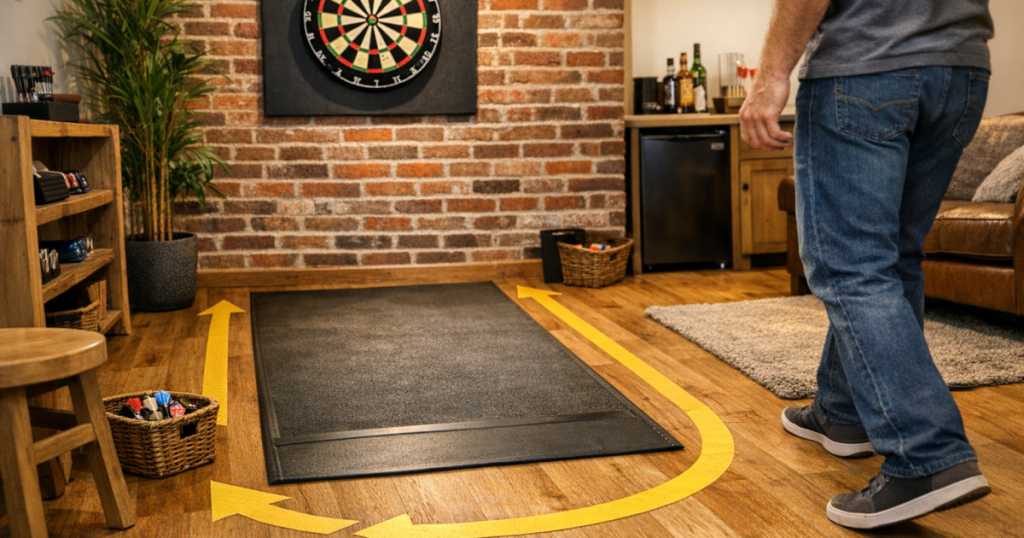
Stand where the board will go and identify three zones: the throwing lane, the household walkway and the waiting area. The throwing lane runs from the oche to the board. The household walkway is the normal path through the room. The waiting area is where players and spectators stand between throws. If these three zones overlap heavily, the setup will feel awkward and less safe, even if the board itself is mounted correctly.
As a practical home target, try to keep a main walking route around 80 to 90 cm wide where the room allows. Narrower spaces may still work, but they need stricter habits, such as pausing play when someone needs to pass.
Step 2: Keep the throwing lane clear
The safest lane is boring: no coffee table, no loose laundry basket, no trailing cable, no shoe rack and no half-overlapping rug. A clear lane helps the thrower settle into a repeatable stance and reduces the chance of someone stepping into the flight path.
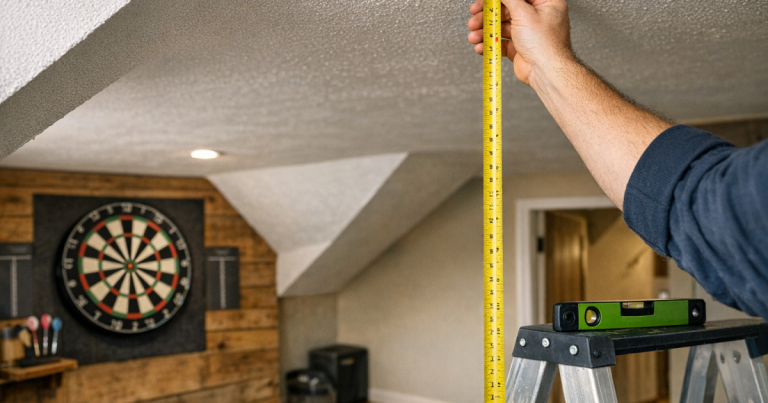
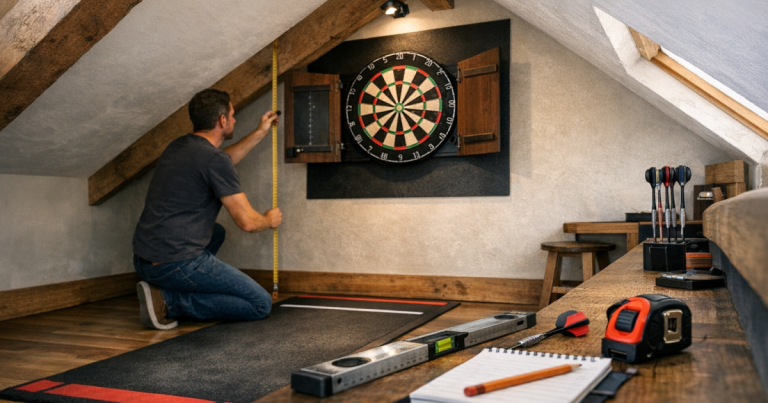
For a standard steel-tip home setup, the usual throw distance is 2.37 m from the face of the board to the oche, with the bullseye at 1.73 m from the floor. If you use an electronic or soft-tip board, check the manufacturer’s guidance because the throwing distance can differ. The safety point is the same either way: measure from the correct point and keep that rectangle free of clutter.
Do not treat the oche as the end of the safety zone. Players often step back after a throw, rotate slightly, or move sideways to let the next person in. Leave usable space behind and beside the mark rather than placing the oche tight against a sofa, radiator cover or doorway.
Step 3: Decide where people wait
A darts setup becomes much safer when everyone knows where to stand. The waiting area should be behind the thrower or well to the side, not near the board and not halfway along the lane. This is especially important when casual players, children or guests are involved, because people unfamiliar with darts often drift towards the board too early.
A simple household rule works well: nobody walks forward until the thrower has finished all three darts and stepped away from the oche. If the route to another room crosses the lane, pause the game while someone passes. It is less frustrating to stop for ten seconds than to create a habit of people squeezing through mid-throw.
In a shared lounge, the best waiting spot is often a corner beside or behind the sofa, with drinks kept away from the throwing lane. If your board lives in a family space rather than a dedicated games room, the room flow tips in planning a darts setup in a shared living room are a useful next step.
Step 4: Choose an oche and mat arrangement that does not create a trip point
A visible oche helps players stand consistently, but it should not become an obstacle for everyone else. Raised oches feel good underfoot, yet they are less suitable where people regularly cross the area. A flat mat, floor tape or removable marker may be safer in a multi-use room.
If you use a dart mat, place it so the edges sit flat and do not curl into the walking route. Avoid laying it over thick carpet edges or uneven rugs. A mat that creeps during play is annoying for accuracy and risky for footwork, so check it after a few legs rather than assuming it will stay put.
Removable setups are often better for living rooms because the route can return to normal after play. Fixed setups suit garages, spare rooms and dedicated darts corners where people are not walking across the oche all evening. For a deeper look at that choice, see the guide to fixed and removable darts mat setups.
Step 5: Plan the retrieval route to the board
Retrieving darts sounds simple, but it is one of the moments when walkways matter most. Players usually walk straight down the lane, pull darts from the board, turn, and come back. That route should be clear, well lit and free from furniture corners.
Leave enough space at the board end for a player to stand squarely while removing darts. If the board is squeezed between a cabinet and a tall unit, the player may twist awkwardly or step sideways into the room. That is when walls, skirting boards and nearby furniture take extra punishment.
Also think about bounce-outs. A dart that drops or kicks out can land in front of the board or slightly to either side. Keep that floor area clear of bare feet, pet beds and delicate items. Floor protection is not only about preserving carpet or laminate; it also helps define the danger zone visually. The article on protecting floors beneath a dartboard from bounce-outs covers the main surface choices.
Step 6: Tidy storage before it blocks the route
Loose darts accessories have a habit of spreading: spare flights on the sideboard, cases on the floor, score sheets on a stool, and drinks on any flat surface nearby. Storage should sit close enough to be useful but not in the path between the oche and board.
Good places for storage include a wall-mounted cabinet, a small shelf outside the throwing lane, or a drawer beside the waiting area. Avoid storing dart cases on the floor beside the oche, because that is exactly where players step back and turn.
If you use a cabinet or surround, check that open doors do not project into a walkway. A cabinet can protect the wall and hide accessories neatly, but only if it does not create shoulder-height obstacles in a narrow room.
Step 7: Check lighting and cables from a walking perspective
Lighting should make the board easier to see without putting cables across the floor. If you use plug-in lighting, route the cable along the wall and keep it away from the oche, retrieval path and doorway. Cable clips, trunking or a nearby socket can help keep the route tidy.
Do not run extension leads across the throwing lane or under a loose rug. That may look neat at first glance, but it creates a hidden ridge underfoot. If the room layout means a cable has to cross a walking route, rethink the board position or choose a lighting arrangement that keeps the floor clear.
Step 8: Test the setup with normal room use
Once everything is in place, test the room as it will actually be used. Have one person stand at the oche, one person wait for their turn, and another person walk through the room as they normally would. Open the door, move around the sofa, reach for a drink, and retrieve darts from the board.
Look for pinch points rather than perfect measurements. Does someone have to step into the throwing lane to reach the kitchen? Does the waiting player block the doorway? Does the mat edge catch when someone turns? Does the thrower step back into a coffee table? Small adjustments can make the room feel much calmer.
If the layout fails the test, move the easiest item first. That might be a side table, storage basket, freestanding lamp or spare chair. Only move the board if the whole route is wrong, because remounting can leave unnecessary holes and patching work.
Common layout examples
Living room board beside a sofa
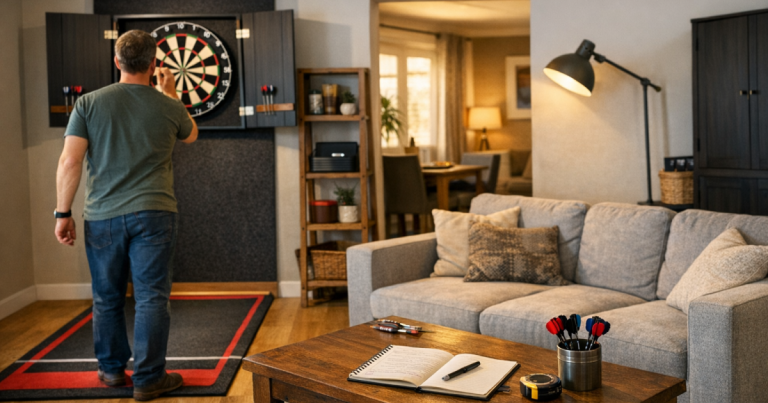
Keep the oche parallel with the sofa rather than pointing straight across the main seating route. Spectators can sit or stand behind the thrower, and anyone walking through the room should wait until the throw is complete. Use a removable mat if the same floor space is needed every day.
Hallway or narrow room setup
A narrow space can work if it is not a busy route. If people must pass regularly, it becomes frustrating and less safe. The best hallway setups are usually in low-traffic areas where play can stop completely when someone needs to move through.
Garage or spare room setup
These spaces often give better separation, but they still need clear walkways. Keep tools, bikes, storage boxes and laundry airers out of the throwing and retrieval routes. A dedicated room can become cluttered quickly because it feels less formal than a living room.
Quick safety checks before a game
- Is the floor between the oche and board completely clear?
- Are mat edges flat, with no curling corners or raised ridges?
- Can the thrower step back without hitting furniture?
- Are spectators standing behind or to the side, not near the board?
- Are children and pets away from the lane while darts are being thrown?
- Are cables, bags, cases and drinks outside the walking route?
- Is there enough light to retrieve darts without stepping awkwardly?
FAQ
How much space should I leave around a dartboard?
Allow the correct throw distance first, then add space for stepping back, waiting and dart retrieval. Where possible, keep a clear walking route of around 80 to 90 cm outside the throwing lane.
Can a dartboard go in a busy hallway?
It can, but only if play stops whenever someone needs to pass. A hallway that is constantly used is usually a poor choice because the walking route and throwing lane compete with each other.
Is a raised oche safe in a living room?
A raised oche can work in a dedicated area, but it is not ideal across a normal household walkway. A flat mat or removable marker is usually easier to live with in a shared room.
Where should people stand while waiting to throw?
They should stand behind the thrower or well to the side, away from the board and out of the lane. Nobody should walk forward until all three darts have been thrown.
What is the biggest trip hazard in a home darts setup?
Loose mat edges, trailing cables and accessories left near the oche are the usual problems. Check the floor before each session, especially in rooms used for more than darts.
The big picture
Safe darts room planning is mostly about respecting movement. The board, oche, mat, storage and seating all need to support the same simple routine: stand, throw, wait, retrieve and return without crossing paths unnecessarily.
When the walkway is clear, the whole setup feels better. Players throw with fewer distractions, guests understand where to stand, and the room can still work as a normal part of the home when the darts are packed away.