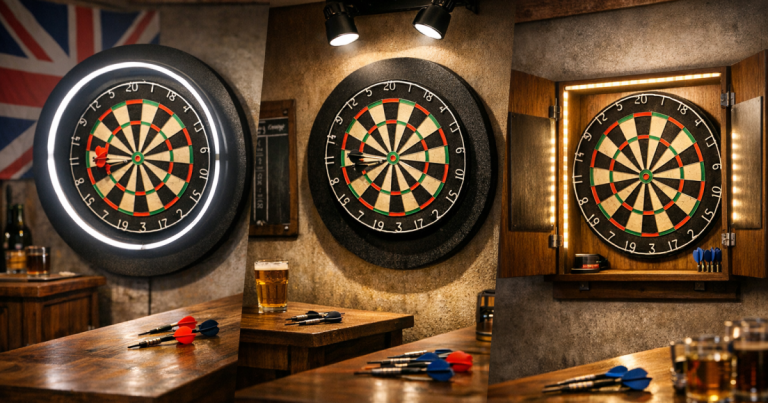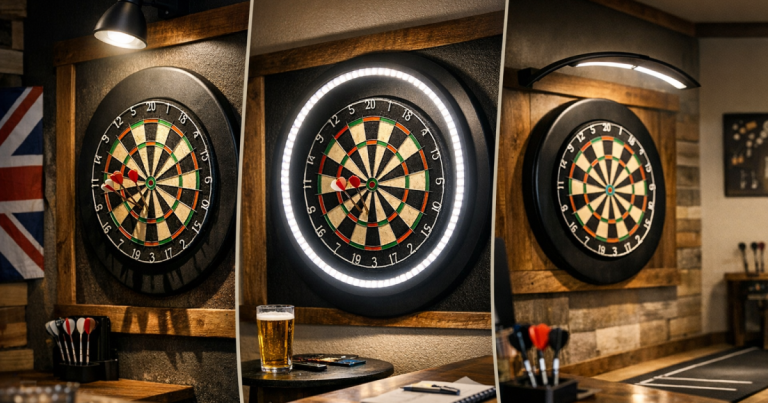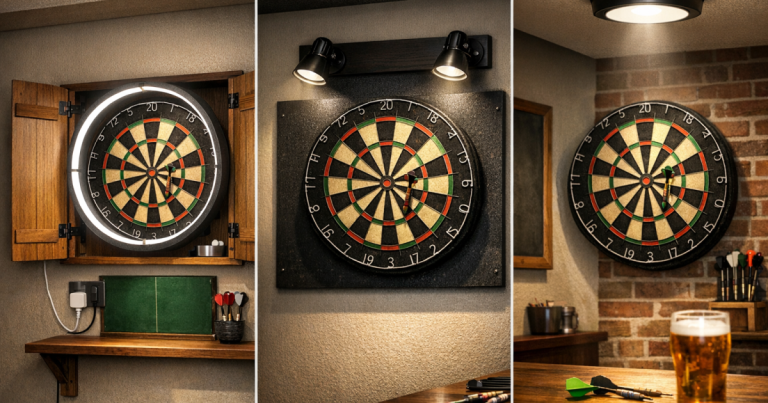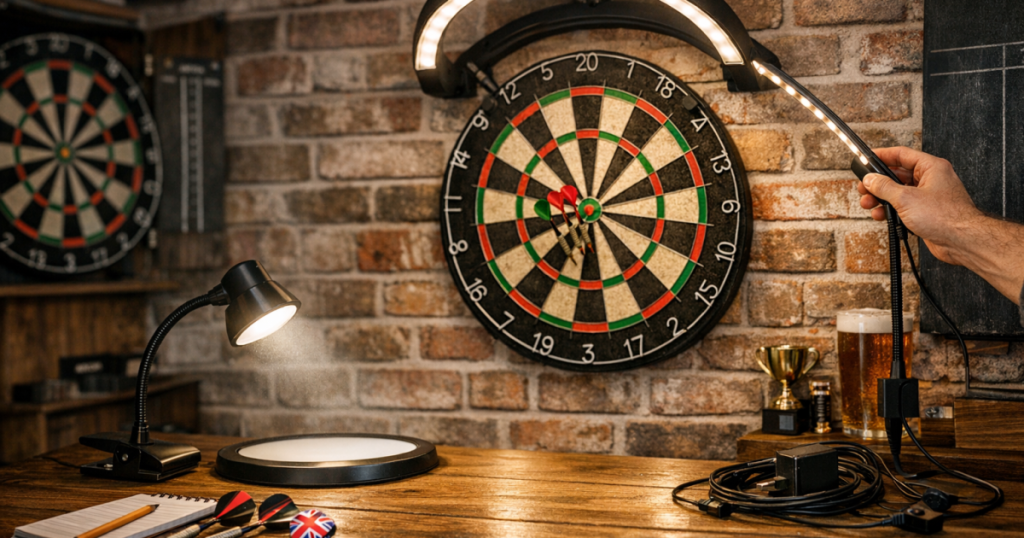
Buying a dartboard light is not just about making the board brighter. A good setup removes shadows, keeps the treble bed clear, and stops glare bouncing into your eyes just as you release. This dartboard lighting buyer’s guide focuses on the features that genuinely change how a home oche feels: coverage, mounting, brightness control, room fit and day-to-day practicality.
Fixed mains wiring for a wall light, ceiling fitting or concealed power spur should be carried out by a qualified electrician to meet UK electrical safety requirements and applicable Building Regulations.
The short version
The best dartboard lighting for most home setups gives even coverage across the full board, sits securely without blocking the throw, and avoids creating bright reflections on the number ring, cabinet doors or surrounding wall. A neat light that throws shadows across the double bed is not doing its job, however smart it looks.
Before paying attention to brand names or style, check five things: whether the light covers the whole board, whether it creates glare from your normal throwing position, how it mounts to your wall or cabinet, where the cable will run, and whether it still leaves the setup easy to use for scoring, retrieving darts and closing a cabinet.
What good dartboard lighting actually needs to do
A dartboard light has a simple job: make the scoring area clear without distracting the player. That means the single, double, treble and bull areas should be visible from the oche, and the wire or blade system should not cast heavy shadows over nearby segments.
Poor lighting usually shows up in predictable ways. A ceiling pendant behind the player can throw a hand or shoulder shadow across the board. A side lamp can make one half of the board bright and the other half dull. A bare bulb or exposed LED strip can glare at eye level. These problems do not just make the room look less polished; they make tight grouping, finishing practice and accurate scoring more frustrating.
If you are still planning the board position, it is worth checking the basics of segment visibility and scoring zones in the dartboard layout explained guide before deciding where the light should sit.
Coverage matters more than raw brightness
Brightness is useful, but evenness is more important. A very bright light placed badly can make the centre of the board look sharp while leaving the lower doubles gloomy. For darts, the aim is balanced illumination across the full circular face of the board.
When assessing a light, look for signs that it is designed to cover the board from several angles rather than blasting light from one point. Full-ring and halo-style lights are popular because they surround the board and reduce directional shadows. Arc lights and overhead lights can work well too, but placement becomes more important because the beam comes from a smaller area.
For a practical home check, stand at the oche and look at the board as you would during a game. If the 20, 3, 19, 11 and 6 areas all look similarly clear, coverage is doing its job. If the top looks crisp but the bottom doubles look flat or dull, the light needs repositioning or a different style of coverage.
Glare is the feature people notice too late
Glare is not always obvious when you are standing beside the board. It becomes obvious when you step back to the throw line and the light source sits in your line of sight. Glossy cabinet finishes, pale walls, metal number rings and nearby picture frames can all reflect light back towards the player.
A good dartboard light should shield the LEDs or bulbs enough that you see the board, not the light source. Diffusion, angled beams and careful positioning all help. If a product photo only shows the setup from the side, look for owner photos or retailer images from the throwing position where available.
For deeper placement advice, the guide to lighting a dartboard without creating glare explains how wall colour, ceiling lights and beam angle can change what you see from the oche.
Mounting style: match the light to the wall, cabinet and room
There is no single mounting style that suits every home darts setup. The right choice depends on whether your board is fixed directly to the wall, housed in a cabinet, mounted on a stand, or surrounded by a protective ring.
Ring and halo lights
Ring-style lights sit around the dartboard and are designed to light the board evenly from multiple directions. They are often a strong choice for a dedicated bristle board setup because they keep the lighting close to the board and reduce reliance on the room’s main light. Check how the light attaches, whether it works with your surround, and whether it leaves enough clearance for removing the board when rotating it.
Cabinet-friendly lighting
If you use a cabinet, the main question is whether the light will interfere with the doors, scoreboard, hinges or wall fixing. Some players prefer a light above the cabinet, while others use a board-mounted option inside or around the cabinet opening. The key is to check the whole movement of the cabinet, not just the board face. If your cabinet is going onto plasterboard, brick or another awkward surface, read the dartboard cabinet fixing guide before adding extra weight or fittings.
Overhead, wall and room lighting
General room lighting can support the setup, but it rarely solves everything on its own. A central ceiling light may illuminate the room nicely while still leaving dart shadows on the board. Wall lights can look tidy in a games room, but fixed placement makes them less flexible if you later move the board.
For rented homes or shared spaces, a non-permanent solution may be more sensible. The trade-off is that freestanding or clip-on lighting needs careful cable management and stable positioning so it does not become an obstacle around the throw area.
Brightness control and colour: useful, but do not overrate them
Adjustable brightness can be genuinely helpful, especially in rooms that change from daylight to evening play. A light that is comfortable during the day may feel harsh at night once the curtains are closed. Dimming gives you more control, but only if the lowest and highest settings are both usable from the oche.
Colour tone also affects comfort. Very warm light can make the board feel cosy but may reduce contrast. Very cool light can look crisp but may feel clinical in a living room. For most home players, a clean neutral tone is easier to live with than an extreme warm or cool look. Where a product lists colour settings, treat them as a comfort feature rather than a substitute for good positioning.
Also think about flicker and eye comfort. You do not need to become an electrical expert, but if a light appears to shimmer on camera or feels tiring during a longer practice session, it is not ideal for regular play.
Power, cables and everyday tidiness
A dartboard light can be excellent on paper and annoying in practice if the cable runs across the playing area or dangles beside the board. In a UK home, plug socket position often decides how neat the setup can be. Before choosing a light, map the cable route from the board to the nearest socket and check whether furniture, skirting boards or doorways get in the way.
Cable clips or trunking can keep things tidy, but they should not create trip points or make it awkward to retrieve darts. Avoid running loose cable across the floor near the oche. If the only socket is on the opposite side of the room, think carefully before relying on extension leads as a permanent-looking solution.
For multifunction rooms, keep the setup easy to reset. If you have to move a chair, uncoil a cable and adjust a lamp every time you play, the lighting may become the part of the setup you stop using.
Room layout can make or break the result
Lighting is tied closely to room planning. A narrow spare room, garage wall, hallway end or dining area each creates different issues. Pale walls can bounce light back towards the player. Dark walls can absorb light and make the board surround look flat. Low ceilings can make overhead fittings feel too close, while high ceilings may leave the board underlit unless the light is board-mounted.
Stand at the throw line and check the whole field of view, not just the board. Are there mirrors, frames, TV screens or cabinet doors reflecting light? Is the scorer standing in a shadow? Can players walk safely to retrieve darts without brushing past the light or cable?
If your darts area shares space with sofas, tables or storage units, the guide to arranging furniture safely around a dartboard is a useful companion because safe movement and clean sightlines matter just as much as brightness.
Examples of real lighting styles
Named products are useful as reference points, but the feature fit matters more than the badge. A product that works beautifully on a plain bristle-board wall might be awkward in a cabinet or too intrusive in a small rented flat.
- Unicorn Solar Flare Dartboard Light: a recognisable example of a board-surround lighting approach. Check compatibility with your board, surround and wall space before assuming it will drop straight into your setup.
- One80 Illumina Dartboard Light: another real dartboard lighting example to compare for mounting method, coverage style and how it sits around the board area.
Use examples like these to understand the category rather than to shortcut the decision. Retail listings, manufacturer instructions and owner photos can reveal practical details such as how the unit fixes, where the cable exits and whether it leaves space for a cabinet or surround.
Checks to make before you buy
Work through these checks before choosing a light. They are simple, but they prevent most of the common home setup regrets.
- View from the oche: can you see every scoring area clearly without looking directly into the light?
- Shadow control: does the design reduce dart and hand shadows across the treble and double beds?
- Mounting fit: will it work with your board, surround, cabinet, stand or backboard?
- Wall suitability: can the fixing method be used safely on your wall type?
- Cable route: can the power lead reach a socket without crossing the throw area?
- Room use: will the light get in the way when the room is used for anything other than darts?
- Maintenance: can you still rotate the board, clean around it and replace accessories without dismantling half the setup?
- Glare surfaces: are there glossy cabinet doors, mirrors, frames or screens near the board?
Questions people ask
Do I need a dedicated dartboard light if the room is already bright?
Not always, but many bright rooms still create shadows from the player’s arm, ceiling light position or furniture. If the board is evenly lit from the oche and there is no glare, a separate dartboard light may not be necessary.
Is a ring light better than an overhead dartboard light?
A ring light usually gives more even board coverage, while an overhead light can be neater in some cabinet or room layouts. The better choice is the one that lights the full board without glare and fits your mounting space.
Can I use a normal lamp for darts?
You can, provided it is stable, aimed safely and does not shine into the player’s eyes. The drawback is that ordinary lamps often light from one side, which can leave uneven shadows across the board.
Will dartboard lighting work with a cabinet?
Some lighting styles work well with cabinets, but others can block doors or clash with the frame. Check door movement, fixing points, cable position and the depth of the cabinet before buying.
What is the biggest mistake when choosing dartboard lighting?
The most common mistake is judging the light from close to the board rather than from the throw line. Always assess brightness, shadows and glare from the position where you actually release the dart.
Main points
Good dartboard lighting is about control, not just brightness. Prioritise even coverage, low glare, secure mounting and a tidy cable route. Match the light to the room rather than copying a setup that only works in a different space. If you can stand at the oche, see every scoring zone clearly, retrieve darts safely and leave the room looking tidy afterwards, the lighting is doing what it should.