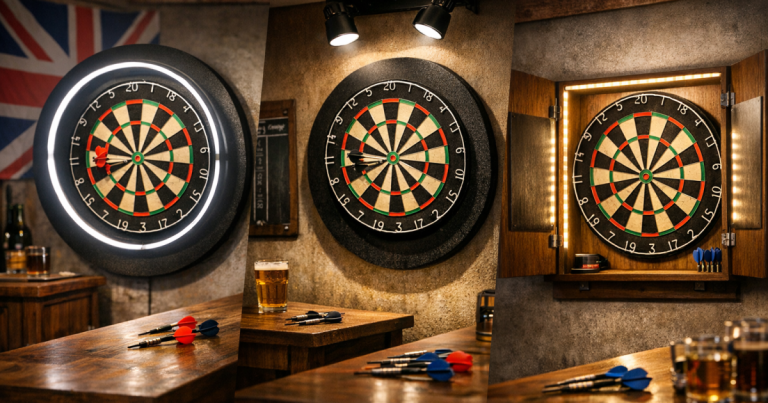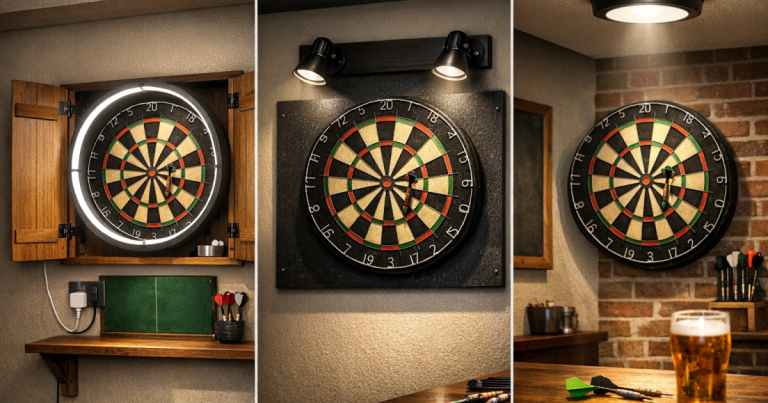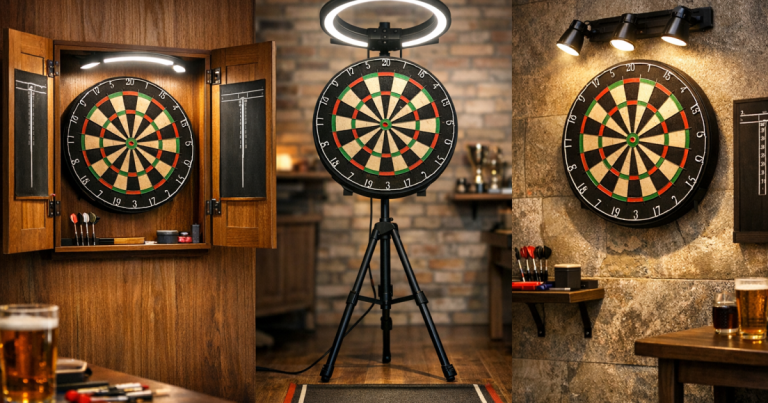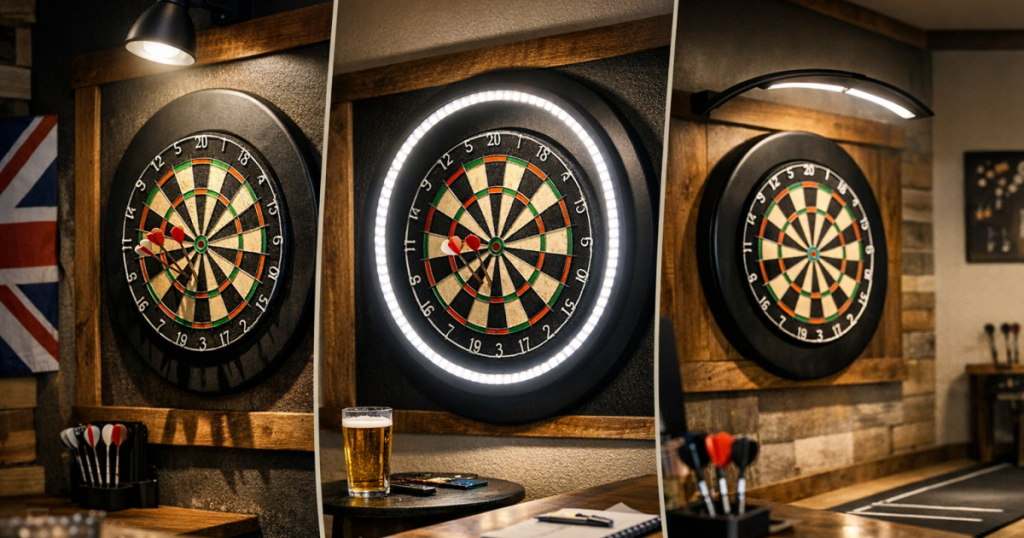
A dartboard can be perfectly mounted and still feel frustrating if the treble bed sits in shadow. The best dartboard lighting gives even, glare-free visibility across the whole board without spilling harsh light into the thrower’s eyes or making the room feel like a showroom.
For most home setups, that means a dedicated board light rather than relying on the main ceiling pendant. The right answer depends on your wall, surround or cabinet, nearby sockets, shared walls and how permanently you want the setup to live in the room.
Mains electrical wiring for wall-mounted or ceiling-mounted lighting should be carried out by a qualified electrician to comply with UK electrical safety standards and Building Regulations requirements.
The short answer
The strongest all-round choice for a home dartboard is usually a dedicated ring or surround-style light that sits around the board and throws light evenly from multiple angles. It reduces the classic problem of one dart casting a shadow over another, which is common when the only light source is above or behind the thrower.
A simple spotlight can work in a casual room, but it needs careful positioning. A ceiling light in the middle of the room is rarely ideal on its own because the thrower’s body can block it, and a wall light above the board can create a shadow below the darts.
Think of good lighting as part of the playing area, not just decoration. The board face should be bright, the number ring should be easy to read, and the area around the oche should remain comfortable enough for a relaxed evening session.
What good dartboard lighting needs to do
Good board lighting has three jobs: show the segments clearly, minimise shadows, and avoid glare. If it fails at any one of these, the setup can feel worse than it looks in photos.
- Even coverage: the 20, 3, 17 and lower scoring areas should all be similarly visible, not bright at the top and dull at the bottom.
- Low shadowing: darts already in the board should not throw heavy shadows across the treble or double beds.
- No eye-level glare: the player should not be looking into an exposed bulb or harsh reflection while standing at the oche.
- Room compatibility: the light should work with your cabinet, surround, wall colour and available space.
- Practical control: you should be able to switch it on easily without rearranging the whole room every time you play.
For most readers, best dartboard lighting is less about maximum brightness and more about balanced light. A board that is too harshly lit can be tiring, while a dim board leads to missed calls, squinting and more disagreement during friendly games.
The main lighting styles for a home dartboard
Ring and surround-style lights
Ring lights and surround-style lights are designed specifically for dartboards. They typically sit around the outside of the board or around a compatible surround, shining light inwards from several directions. That multi-angle coverage is why they are so effective at reducing dart shadows.
Recognisable examples include the Target Corona Vision Dartboard Lighting System and the Winmau Plasma Dartboard Light. The key point is not the brand name alone, but the design principle: light from around the board rather than one narrow beam from a single point. Before choosing this style, check how it attaches, whether it works with your board and surround, and whether a cabinet door or nearby shelf will get in the way.
Spotlights
A focused spotlight can be a neat option where you want the board to sit within a normal living room, garage or spare room rather than looking like a dedicated darts lane. The downside is that one directional light can create stronger shadows, especially if it is too close to the wall or aimed steeply downwards.
If you use a spotlight, the aim is to light the board face rather than the wall above it. Two softer spotlights from slightly different angles usually work better than one harsh beam. Avoid placing the light directly behind where the thrower stands, as this can put the player’s own shadow across the board.
Ceiling lights
General ceiling lighting is useful for the room, but it rarely solves board visibility on its own. Many UK homes have a single central pendant, which can leave the dartboard in partial shadow depending on where the board wall is positioned.
Ceiling-mounted options can work well when they are planned around the board rather than the centre of the room. If you are thinking about a more permanent fitting, it is worth reading the dartboard lighting installation guide before deciding between plug-in, wall and ceiling approaches.
Cabinet lights
Some players like lighting integrated with or mounted near a dartboard cabinet. This can look tidy in a dining room, office or snug, especially where the board is hidden when not in use. The trade-off is that cabinet doors, shelves and frames can interrupt the light path if the fitting is not positioned carefully.
If your board sits in a cabinet, open the doors fully and check the throw of light from normal playing height, not just close up. A cabinet can frame the board beautifully, but it can also deepen shadows if the light sits too high or too far forward.
How room layout changes the answer
A dedicated darts corner in a garage can handle a more functional setup than a shared lounge. In a garage or utility space, a bright ring light and visible cabling may be perfectly acceptable. In a living room, you may care more about how the light looks when the board is not in use.
Wall colour matters too. A pale wall reflects light back towards the board area, while a dark feature wall can absorb light and make the edges of the board feel duller. This does not mean dark walls are wrong; it just means the board light may need to work a little harder.
Also consider what surrounds the board. A bulky cabinet, thick surround or decorative panelling can all affect shadows and clearance. If you are still deciding how to protect the wall, the comparison of a dartboard cabinet versus a surround is a useful next step because lighting and wall protection often need to be planned together.
Common lighting mistakes that make a board harder to play on
- Using only the room’s main pendant: this often leaves the board dependent on where the ceiling rose happens to be, not where the darts setup needs light.
- Mounting a light too close above the board: this can brighten the top numbers but leave the lower doubles and outer ring less clear.
- Choosing a very narrow beam: it may look dramatic, but it can create hard shadows and uneven contrast across the board.
- Ignoring glare from glossy surfaces: glass-fronted cabinets, shiny paint and reflective picture frames near the board can bounce light back at the thrower.
- Forgetting the rest of the room: a board that is bright but surrounded by darkness can feel uncomfortable during longer sessions.
It is also worth thinking about noise and vibration if your lighting is part of a wall-mounted setup. Where the board is on a party wall or shared internal wall, lighting brackets, cabinets and backboards should not make the wall more resonant. The guide to reducing dartboard noise through a shared wall is helpful if you are planning a setup in a terrace, flat or semi-detached home.
A simple way to test your current lighting
You do not need specialist tools to spot most lighting problems. Stand at the oche with the room lights set as you would use them in a normal game, then check the board from the player’s viewpoint rather than from directly in front of it.
- Look at the treble 20, treble 19 and bull to see whether any areas are noticeably darker.
- Put three darts in different parts of the board and check whether they cast heavy shadows over scoring segments.
- Step slightly left and right at the oche to see whether glare appears from either side.
- Ask another player to stand at the throw line while you look from the side, as their body may reveal shadows you missed.
- Check the board in evening conditions, not just during daylight, because many home setups feel completely different after dark.
If the board looks clear only when the main room light, a lamp and daylight are all helping, the dedicated board lighting is probably doing too little. If it looks clear with the board light alone and the rest of the room softly lit, you are much closer to a dependable setup.
What stands out
The best answer for most home players is a dedicated light designed to illuminate the board evenly from more than one direction. Ring and surround-style lights are popular because they solve the shadow problem neatly, but a carefully positioned pair of spotlights can also work in rooms where appearance matters as much as performance.
Try not to judge lighting only by how bright it looks. Judge it by whether you can read the numbers easily, see dart positions at a glance, and play without glare or harsh shadows. A comfortable, consistent view of the board is what turns a decent home setup into one you actually want to use.
Questions people ask
Can I use a normal ceiling light for a dartboard?
You can, but it is rarely the best sole light source. A central ceiling light often sits behind or above the thrower, which can cast shadows across the board.
Is a ring light better than a spotlight?
For shadow control, usually yes. A ring or surround-style light sends light towards the board from multiple angles, while a single spotlight is more likely to create hard shadows.
Will dartboard lighting work with a cabinet?
It can, but you need to check clearance around the doors, frame and any shelves. Some lights are easier to pair with open surrounds than enclosed cabinets.
Should the area around the oche be lit too?
Yes, but softly. The board should be the clearest point, while the throw line and walkway should still be visible enough for safe, comfortable movement.
Do electronic dartboards need different lighting?
They still need even, glare-free light, but the board surface and display areas can reflect light differently. Check visibility from the oche with the board switched on and the room lit as normal.