Poor lighting makes a good board feel worse: trebles blur, shadows creep in from your throwing arm and the room looks flat on a casual night. The main dartboard lighting types are rings, spotlights and LED strips, and each solves a slightly different problem in a home setup.
Fixed mains wiring for dartboard lights, additional sockets or hard-wired switches should be carried out by a qualified electrician to meet UK electrical safety requirements and relevant standards.
The big picture
Good dartboard lighting is not about making the whole room brighter. It is about putting even light on the face of the board without glare, harsh shadows or distracting reflections. A ceiling pendant behind the thrower can look fine when you walk into the room, then become useless once your arm blocks the beam.
Before judging any lighting layout, make sure the board itself is correctly positioned. Height, distance and sightline all affect how natural the setup feels, so it is worth checking the correct dartboard height and oche distance before building the rest of the room around it.
As a rough rule, ring lights give the most consistent coverage, spotlights can work well in rooms where a ring is awkward, and LED strips are better as support lighting than as the only light source. The right answer depends on wall space, ceiling height, surrounding furniture, power access and how serious the setup needs to feel.
Ring lights: the most even option for most boards
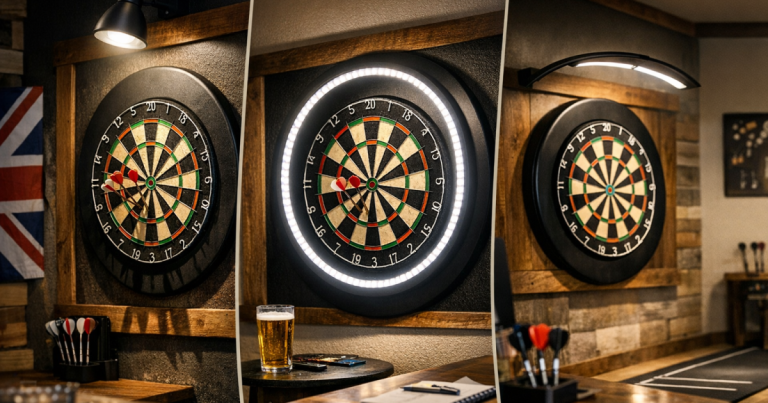
A dartboard ring light sits around the board and throws light back towards the playing surface from several directions. This is why it has become so common in home darts spaces: it reduces the classic side shadow that appears when a single ceiling or wall light hits the board from one angle.
Well-known examples include the Target Corona Vision Dartboard Lighting System, the Winmau Plasma Dartboard Light and the Mission Torus 270 Dartboard Light. These are useful reference points because they show the broad idea: a dedicated light mounted around or near the board rather than a general room lamp pressed into service.
The main advantage is consistency. When the light surrounds the board, the number beds, wires and scoring segments are easier to read from the oche. It also gives a neat, purpose-built look, which suits a garage, spare room or pub-style corner where the dartboard is the focal point.
The trade-off is physical space. A ring adds bulk around the board, so it needs to work with your cabinet, surround, wall protection and any nearby shelving. Some designs are a full circular frame; others use a partial ring or arms. Before fitting one, check how it attaches, whether it interferes with a surround, and whether you can still rotate the board without dismantling half the setup.
Spotlights: flexible, but less forgiving
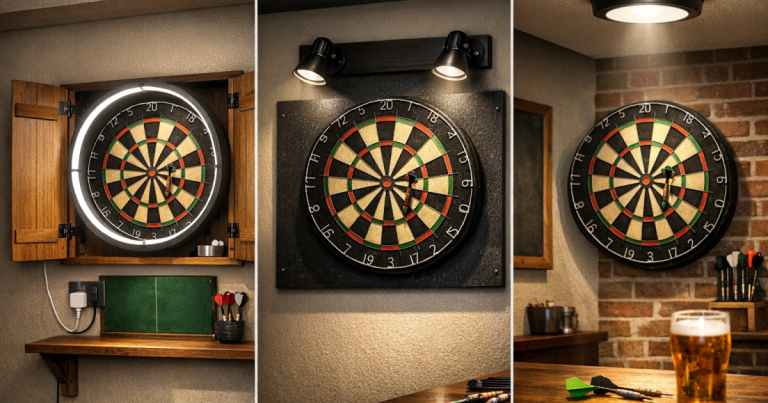
Spotlights can be a smart choice where a ring light looks too bulky or the board is part of a wider room rather than a dedicated darts wall. A small track light, wall-mounted spotlight or directional ceiling fitting can light the board cleanly if it is aimed carefully.
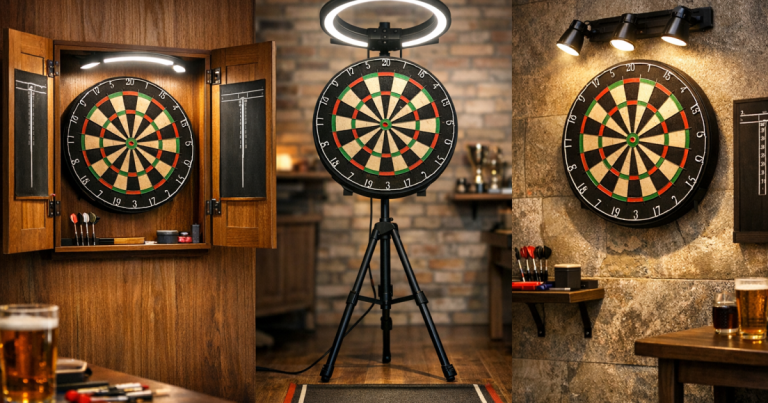
The strength of spotlights is flexibility. They can be positioned to suit sloped ceilings, alcoves, multipurpose rooms or setups where the board sits inside a cabinet. They also keep the area around the board visually cleaner, which some players prefer.
The weakness is shadow control. A single spotlight can create a hard shadow from the dart, wire or player’s throwing arm. Two angled lights are often better than one central beam, because they balance each other and reduce the dark patches around the trebles and doubles. The beam should light the board face, not shine into the player’s eyes from the oche.
Ceiling height matters here. A low ceiling can force the light too close to the throwing line or create a steep angle onto the board. If your board is going into a garage, loft room or under stairs area, check the practical clearance with this guide to ceiling height before installing a dartboard.
LED strips: useful atmosphere, limited as the main light
LED strips are popular because they are discreet, inexpensive in feel compared with many dedicated systems, and easy to hide behind cabinets, shelves or wall panels. They can make a darts corner look much more finished, especially in a social room.
For actual scoring visibility, though, strips need careful handling. A strip placed behind a cabinet or around a feature wall may create a nice glow without putting enough direct light on the board. If the light is mainly decorative, the board face can still look dull while the wall around it looks bright.
LED strips work best as secondary lighting: behind a cabinet, under a shelf, along a media wall or around a room edge. They help the setup feel more inviting without doing all the work. If you want them to contribute to board visibility, position them so light falls towards the board face rather than simply washing the wall behind it.
Also think about colour. Very warm or coloured lighting can look good for atmosphere but make segment edges harder to read. For play, a clean white light is usually more practical than a coloured effect.
How the main dartboard lighting types differ in use
- Ring lights: usually the strongest answer for even board coverage and reduced shadows, provided your wall setup has enough space around the board.
- Spotlights: good for flexible rooms and cleaner-looking installations, but placement and angle are critical.
- LED strips: excellent for ambience and background glow, but rarely the best sole light for the board face.
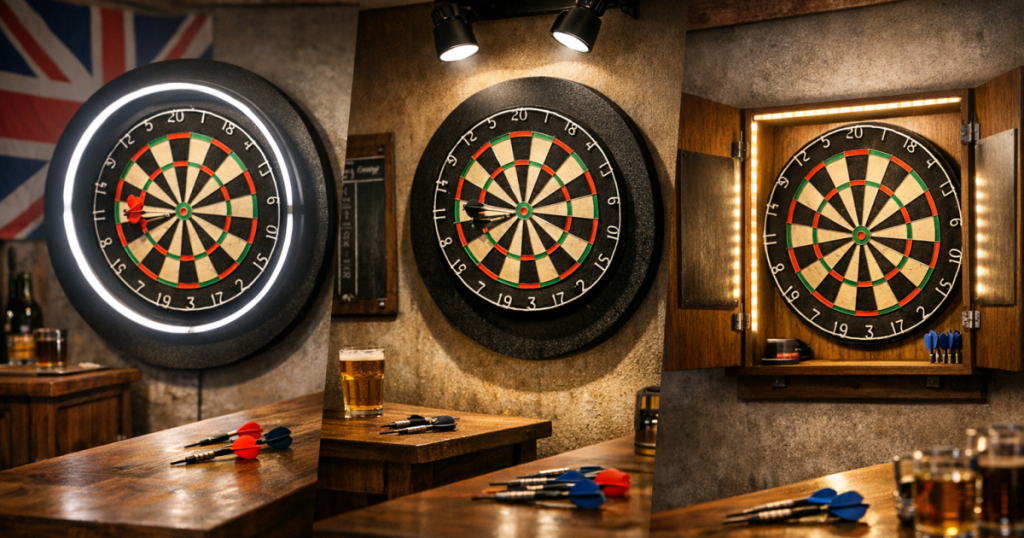
- Mixed setups: often work well, such as a ring or spotlight for the board plus strips for atmosphere.
The clearest test is standing at the oche, not judging from next to the board. Look at the treble 20, treble 19 and both side doubles. If any area looks noticeably dull, or if your dart casts a heavy shadow over the target bed, the lighting needs adjusting.
Why players disagree about the “right” light
Lighting preference is partly practical and partly emotional. Some players want a clean tournament-style feel, where the board is brightly and evenly lit. Others want the room to feel like a relaxed pub corner, with softer light and more atmosphere.
There is also a difference between occasional play and regular practice. If you throw for twenty minutes with friends, a slightly imperfect light may not bother you. If you practise doubles, scoring routines or finishing drills several nights a week, small shadows become irritating quickly.
Room use matters too. A board in a living room has to share space with normal seating, television viewing and general lighting. A board in a garage or games room can be lit more directly because the dartboard is the main purpose of the space.
Small checks that prevent lighting frustration
- Check glare from the throw line: stand at the oche and look naturally at the board, rather than testing from the side.
- Look for wire shadows: heavy shadows across trebles and doubles are a sign the light is too directional.
- Allow for wall protection: surrounds, cabinets and backboards can block, reflect or visually crowd a light.
- Keep the board accessible: you still need to rotate the board and clean around the area.
- Avoid over-bright ambience: a glowing room is not the same as a clear board face.
If you want a broader view of brightness, placement and common mistakes, the dedicated guide to the best lighting for a dartboard is a sensible next read.
Test the setup in the conditions you will actually use it. A board can look perfectly clear in daylight, then feel uneven in the evening when the rest of the room lights are lower. If you play both solo practice and social games, check it with someone standing nearby as well, because people moving around the throw line can change shadows and reflections more than expected.
Think about left- and right-handed throwers too. A light that behaves well for one player can cast a different arm shadow for another, especially with spotlights mounted slightly to one side. If family members or friends use the board regularly, ask them to stand at the oche before you fix brackets permanently or hide cables.
- Check cable routes early: a neat light can become annoying if the lead hangs across the wall, gets trapped behind a cabinet or needs an extension trailing near the oche.
- Watch for shiny surfaces: gloss paint, glass cabinet doors and framed pictures near the board can bounce light back towards the player.
- Be cautious with dimmers: some LED lights flicker, buzz or behave oddly on incompatible dimmer switches, so check compatibility before buying.
- Leave room for small adjustments: a few centimetres of movement in angle or height can make a bigger difference than changing the light itself.
If you are fitting the board in a garage, shed or outbuilding, also consider damp, dust and temperature changes. The lighting does not need to be overcomplicated, but connectors, plugs and controls should be positioned where they stay dry, easy to reach and unlikely to be knocked during play.
Helpful questions
Is a ring light always better than spotlights?
No. A ring light is usually more consistent for shadows, but spotlights can work well in rooms where a ring would clash with a cabinet, surround or room style.
Can LED strips light a dartboard properly?
They can help, but they are usually better as background or accent lighting. For serious visibility, the board face needs direct, even light.
Will better lighting improve my scoring?
It will not fix technique, but it can make practice more reliable by helping you see wires, segments and dart angles clearly.
Should the room lights stay on as well?
Usually, yes. A softly lit room with a clearly lit board feels more comfortable than a bright board in an otherwise dark space.
What to remember
For most home players, the simplest hierarchy is clear: use a ring light when even board coverage matters most, use spotlights when the room layout demands flexibility, and use LED strips to add atmosphere rather than as the only source of playing light.
The best setup is the one that lets you stand at the oche, see every target bed clearly and throw without glare or heavy shadows. Once that is right, the rest of the room can be tuned for comfort, style and the kind of darts nights you actually enjoy.