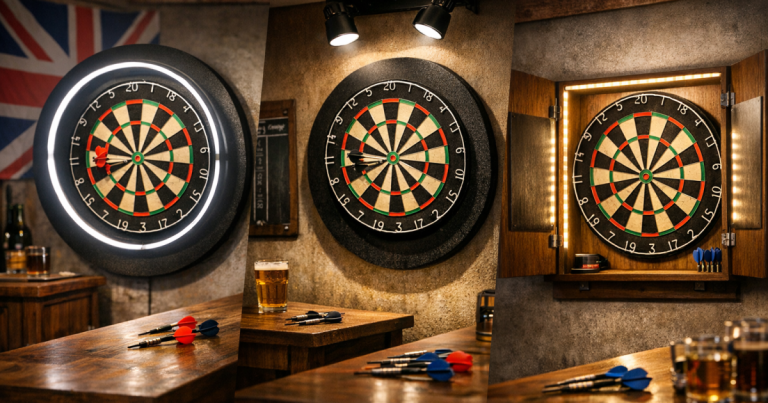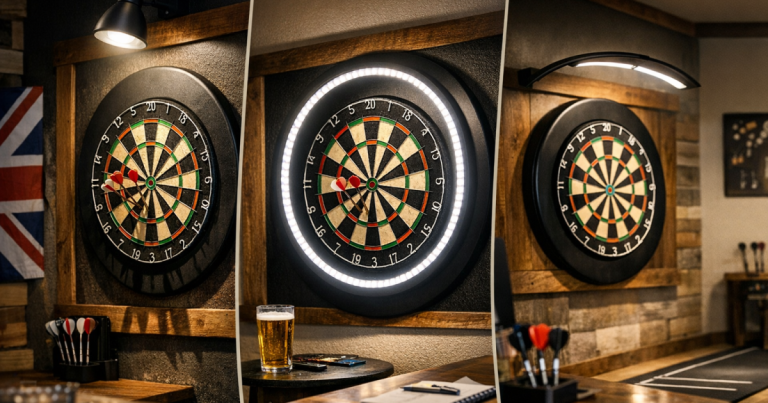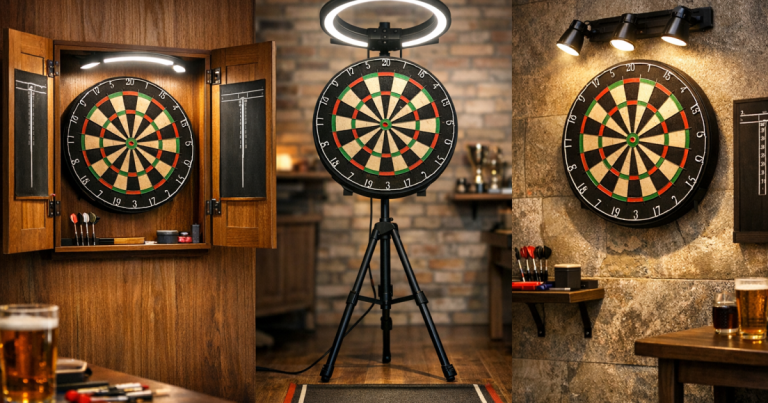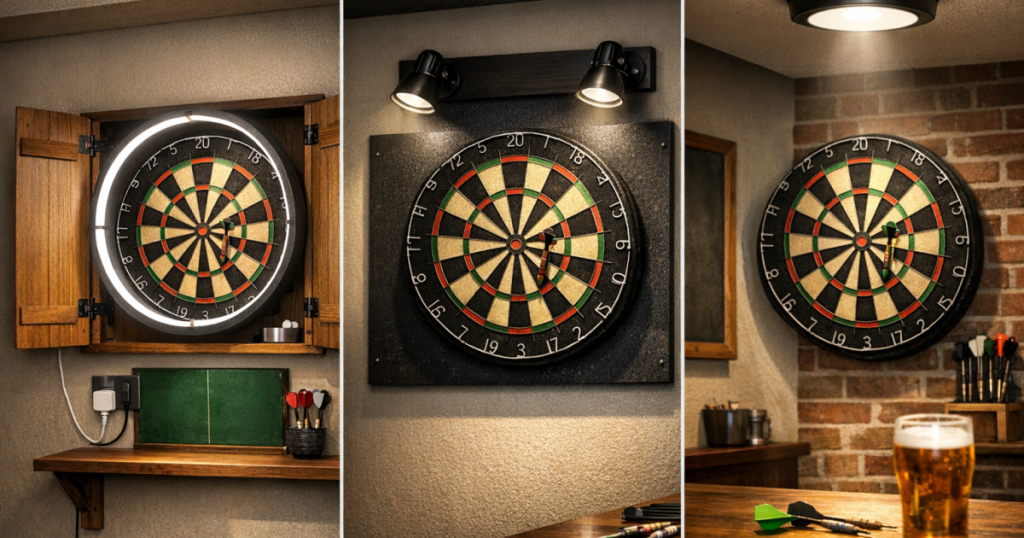
Good lighting makes a home board feel calmer, clearer and more consistent. A tidy dartboard lighting installation should illuminate the whole scoring face, avoid harsh glare, and leave the thrower free from distracting shadows. The right route depends on how permanent your setup is: a plug-in light for flexibility, a wall-mounted option for a cleaner board area, or a ceiling-mounted fitting when the room is being planned more deliberately.
Safety note: hard-wired wall or ceiling lighting and any new mains electrical connections should be carried out by a qualified electrician to meet UK wiring regulations and safety requirements.
At a glance
- Plug-in lighting is the easiest route for renters, multipurpose rooms and quick upgrades.
- Wall-mounted lighting suits a dedicated board wall, especially where a cabinet, surround or scoreboard is already fitted.
- Ceiling lighting can look the neatest, but it needs careful positioning so the thrower does not cast a shadow over the board.
- Ring-style board lights are popular because they place light close to the dartboard face and reduce uneven coverage.
- Test before fixing is the golden rule: check glare, shadows and cable routes from the oche, not just from beside the board.
Why darts lighting needs more thought than normal room lighting
A central ceiling pendant can make a room look bright without making the treble bed easy to see. Darts needs light aimed at a vertical target, not just general brightness across the room. If the main light is behind the thrower, their head and arm can throw a shadow across the board. If the light sits too low or too close to eye level, it can cause glare on the wires or make the numbers harder to read.
The goal is even light across the board face. You want the 20 segment, outer doubles and lower board to be equally visible, without one bright hotspot and one dull corner. This is where the layout matters as much as the fitting itself. For more room-shape examples, see our guide to dartboard lighting layouts for cabinets, stands and wall setups.
Plug-in lighting: the simplest upgrade
Plug-in lighting is usually the most practical starting point. It avoids permanent electrical work, can be moved when the room changes, and is useful in rented homes where drilling and wiring may be limited. It also suits players who set up in a spare room, garage, dining area or shared living space rather than a dedicated darts room.
Purpose-built board lights
Purpose-built dartboard lights sit around or close to the board and are designed to brighten the scoring area more evenly than a normal room lamp. Examples include the Target Corona Vision, Mission Torus 270 and Winmau Plasma Dartboard Light. Check how the light attaches, whether it suits your board surround or cabinet, and whether the cable route works neatly from your nearest socket.
With plug-in lights, cable management is often the real installation challenge. Avoid loose trailing leads across the floor or near the oche. A neat route down the side of the board area, secured with suitable cable clips or trunking, usually looks better and reduces trip hazards. If you use an extension lead, keep it away from the throwing lane and avoid overloading sockets.
Clip-on and adjustable lamps
An adjustable lamp can work for casual play, but it needs careful aiming. Position it so it lights the board rather than shining towards the thrower. A single lamp from one side may create strong shadows from darts already in the board, so two softer sources or a purpose-made board light usually gives a more balanced result.
Wall-mounted options for a cleaner board area
Wall-mounted lighting is a good fit when the dartboard has a permanent place. A compact fitting above the board, a wall arm, or a light attached around a cabinet area can keep the floor clear and make the setup feel more intentional. The key is to keep the light high enough to avoid glare but close enough to brighten the board rather than the whole wall.
If you have a cabinet, check door clearance before choosing a light position. Cabinet doors need to open fully without hitting the fitting, and the light should not block access to chalkboards, whiteboards, darts storage or a scoreboard. If you are planning the full wall at once, our guide to building a tidy dartboard wall with cabinets and surrounds is a useful companion.
Wall-mounted plug-in fittings can offer a halfway house between a loose lamp and a hard-wired installation. They still need safe cable routing, but they can look tidy with surface trunking and sensible placement. For permanent hard-wired fittings, use a qualified electrician rather than trying to adapt the circuit yourself.
Ceiling-mounted lighting: neat, but placement is critical
Ceiling lighting can be the most discreet option in a dedicated darts area, but it is also the easiest to get wrong. A light directly between the thrower and the board can create shadows during the throw. A light too far behind the oche may brighten the player more than the board. A fitting too close to the wall may create harsh shadows from the board wires or cabinet edges.
As a starting point, think about the light path from above and in front of the board area rather than behind the player. The aim is to wash the face of the board evenly without shining into the thrower’s eyes. In rooms with low ceilings, avoid fittings that hang too low into sightlines or make the playing area feel cramped.
Ceiling work is also where permanence matters. Once a fitting is wired and decorated around, moving it is more hassle than repositioning a plug-in board light. Mark the dartboard position, stand at the oche, and use a temporary lamp or torch to test possible angles before committing to a final ceiling point.
Placement checks before you fix anything
Do these checks from the actual throwing position, not just from close to the board. Small issues become more obvious when you are standing at the oche.
- Shadow check: stand in your throwing stance and raise your arm. The board face should remain clear, especially the 20, 19, 18 and bull areas.
- Glare check: look at the wires, number ring and any glossy cabinet surfaces. If you are squinting or seeing bright reflections, adjust the angle.
- Coverage check: make sure the lower doubles are not noticeably darker than the top of the board.
- Cable route check: keep leads away from feet, chairs, doors and the throwing lane.
- Door and furniture check: open nearby cupboards, cabinet doors and room doors fully to ensure nothing catches the light or cable.
- Scoreboard visibility: if you use a chalkboard, whiteboard or electronic scorer, check that it remains readable without creating a distracting bright patch beside the board.
Matching the lighting to the room
A spare room or garage can usually cope with a more permanent wall or ceiling approach. A shared living room often needs a softer, tidier solution that does not dominate the space when nobody is playing. In that situation, a plug-in ring light, removable oche and tidy cable route can be easier to live with than a large permanent fitting.
Think about how the room is used outside darts. Will people watch television nearby? Does the board sit close to a sofa, bookcase or bay window? Are there children or pets moving through the space? If darts has to share the room gracefully, pair lighting decisions with furniture layout and storage. Our advice on planning a darts setup in a shared living room covers those compromises in more detail.
Common mistakes that spoil visibility
- Relying only on the room’s main light: the room may look bright while the board still has shadows.
- Mounting the light too low: this can put glare in the thrower’s eyeline or make the setup feel cluttered.
- Ignoring the cabinet doors: a neat light position is not useful if the doors hit it every time they open.
- Leaving cables loose: untidy leads look poor and can become a trip hazard near the oche.
- Testing without darts in the board: darts already thrown can cast shadows, so test with a few darts grouped around the treble and doubles.
FAQ
Can I use a normal ceiling light for darts?
You can, but it rarely gives the best result on its own. A normal ceiling light often lights the room rather than the board face, and it may put the thrower’s shadow across the scoring area.
Is plug-in lighting enough for a serious home setup?
Yes, if the light gives even coverage and the cable is routed safely. Many home players use plug-in board lights because they are simple, tidy and easy to reposition.
Where should the light sit if I use a dartboard cabinet?
It should illuminate the board without blocking the cabinet doors, storage or scorer. Test with the doors fully open before fixing brackets, clips or trunking.
Do I need an electrician for every dartboard light?
No. Plug-in lights do not normally need electrical work. Hard-wired wall or ceiling fittings and new mains connections should be handled by a qualified electrician.
How do I know if the lighting is bright enough?
Stand at the oche and check whether every segment, number and double is clear without squinting. If the board has dark patches or glare, adjust the angle or position.
Main lessons
The best lighting setup is the one that makes the board easy to read from the oche without adding clutter, glare or awkward shadows. Plug-in options are flexible and renter-friendly, wall-mounted lights suit a more settled board area, and ceiling lighting can look very neat when planned properly. Test the position before committing, keep cables tidy, and treat any mains electrical work as a job for a qualified professional.