The usual cause of darts scoreboard glare is not the scoreboard itself; it is light hitting the writing surface at the same angle your eyes view it from. Once you understand where that reflection is coming from, you can usually fix it with small changes to position, lighting and writing contrast.
This matters most in home setups where the scoreboard sits on a side wall, cabinet door, painted board or dry-wipe surface. A board that looks fine close up can become hard to read from the oche, a sofa, or the scorer’s usual standing position.
The quick fix, before you move anything
Start with a simple viewing test. Stand where players and the scorer normally look from, then slowly move your head left, right, up and down. If the reflection changes sharply as you move, the problem is angle rather than brightness.
- Dim or switch off one light at a time to find the source of the reflection.
- Check the scoreboard from the oche, from the scorer’s position, and from any seating area used during games.
- Look for glossy surfaces: dry-wipe boards, cabinet doors, laminated score sheets and framed glass are common culprits.
- Try holding the scoreboard slightly tilted downwards or sideways before drilling, sticking or remounting anything.
- Use darker, thicker writing and avoid pale marker colours under warm or uneven room lighting.
If that quick test tells you the glare is mainly angle-based, the fix is usually straightforward. If every surface looks washed out, the issue is more likely poor contrast or light placement.
Step 1: Check the scoreboard from real playing positions
Do not judge glare while standing directly in front of the scoreboard. In a proper home darts layout, most people read the score from the oche, from just behind the thrower, or from a small scoring spot beside the board. Those angles can reveal reflections you would miss at close range.
Stand at the throw line and read a mock score. Then stand where the scorer normally writes. If your setup is still being arranged, it is worth checking your board, lane and scorekeeping position together; our guide to setting out your darts throwing area and oche helps you plan that overall layout without squeezing the scorer into an awkward corner.
For the most accurate test, write a few realistic scores rather than a single large number. Include small marks such as legs, sets, initials or checkout notes. Glare often becomes a problem when you are trying to read fine detail, not when you are looking at a big total.
Step 2: Find the light source causing the reflection
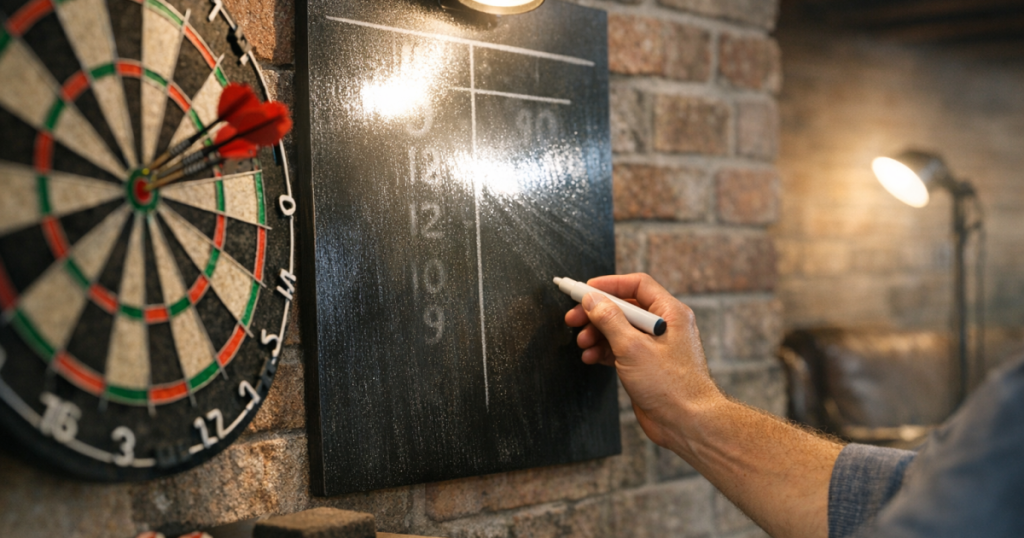
Most scoreboard reflections come from one of four places: a ceiling pendant, a bright window, a wall light, or a dartboard lighting ring spilling light sideways. The aim is not to make the room darker; it is to stop light bouncing directly from the scoreboard into your eyes.
Try this method:
- Turn on the lights exactly as they are during a normal game.
- Stand at the oche and look at the scoreboard without moving it.
- Cover or switch off one light source at a time.
- Notice whether the glare disappears, softens, or simply moves.
- Repeat the test at night if the first test was done in daylight.
Windows can be misleading. A scoreboard that is clear in the evening may be unreadable on a bright afternoon, especially if it faces a patio door or pale wall. Curtains, blinds, or a slight change in scoreboard angle can make a bigger difference than replacing the board itself.
Step 3: Tilt or reposition the scoreboard
A small tilt can remove a large reflection. If the scoreboard is wall-mounted, try placing a thin temporary spacer behind the top or one side to test a new angle. You are looking for the point where the bright patch moves away from the normal viewing line.
For many home setups, the best scoreboard position is slightly to the side of the dartboard rather than directly underneath bright lighting. If it is mounted on a cabinet door, open and close the door while checking the reflection. Cabinet doors can behave like shiny panels when they sit square to a ceiling light.
Good positions usually have these traits:
- The scorer can write without standing in the throwing lane.
- The thrower can glance at the score without turning fully away from the board.
- The scoreboard is not directly opposite a bright window.
- The surface is not square-on to a ceiling lamp or spotlight.
- Writing remains readable from roughly the same height as a player’s eyeline.
If you play in a rented home or a shared room, temporary fixing methods may be enough. Use the same glare checks before committing to adhesive strips, hooks, or a free-standing score display.
Step 4: Improve the dartboard light without flooding the scoreboard
Board lighting should make the treble bed clear without creating a harsh reflection on nearby surfaces. A common mistake is to make the whole corner brighter, which can leave the scoreboard shining back at you while the board itself still has shadows.
A focused, even dartboard light is usually better than a bare bulb in the middle of the room. If your lighting is being planned from scratch, read our guide to planning dartboard lighting without glare or shadows before finalising where the scoreboard sits. The board light and score area should work together, not compete.
As a rule of thumb, keep bright light aimed at the dartboard face rather than across the scoreboard. If the score surface is beside the board, a slight sideways repositioning can stop the light from skimming across it. If you use a desk lamp or clip-on light for scoring, aim it down at the writing rather than out towards the room.
Step 5: Use a less reflective scoring surface
Surface finish makes a big difference. Glossy dry-wipe boards are convenient, but they can reflect ceiling lights strongly. A matt chalkboard, painted scoring panel or lower-sheen dry-wipe surface can be easier to read in awkward rooms.
That does not mean every glossy board is wrong. A dry-wipe scoreboard can work well if it is angled correctly and written on with strong, dark lines. The problem is usually the combination of a shiny surface, pale marker ink and direct light.
Common scoreboard surfaces and glare behaviour
- Gloss dry-wipe board: easy to clean, but often the most reflective under ceiling lights.
- Matt dry-wipe board: usually softer on the eyes, though still worth testing from the oche.
- Chalkboard: often reduces sharp reflections, but faint chalk can be hard to see in low light.
- Painted wall panel: can work well if the paint finish is not too shiny and the writing contrast is strong.
- Paper score sheets: low glare if unlaminated, but less durable for regular home play.
If you already own a glossy board, try position and lighting changes before replacing it. Many glare problems disappear once the board is no longer catching the main room light head-on.
Step 6: Make the writing easier to read
Sometimes the issue is not just reflection, but weak contrast. Thin blue or green marker lines can disappear under warm lamps, especially on small wall-mounted scoreboards. Use bold, dark marks and keep the writing area clean.
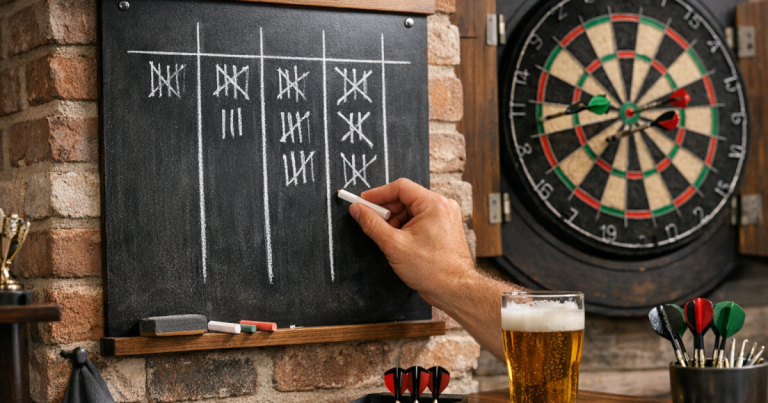
For dry-wipe boards, black marker is usually the clearest choice. For chalkboards, white chalk tends to be easiest to read, with yellow as a useful accent for headings or player names. Avoid using too many colours for totals, legs and sets; the scoreboard should be quick to scan during play.
If you track more than the running score, organise the board consistently. Clear layout reduces the time spent staring through reflections trying to work out what has changed. For home match nights, our guide to marking legs and sets clearly on a home darts scoreboard is a useful next step.
Step 7: Control daylight and background brightness
Daylight glare can be harder to notice because it changes through the day. A scoreboard may be fine for evening league-style games but awkward for weekend afternoon practice. If the score area faces a window, check it in bright weather as well as under artificial light.
Simple fixes include closing blinds during play, moving the scoreboard away from the window-facing wall, or using a slightly darker background behind the scoring area. Pale walls can bounce light onto the scoreboard, so a small darker backing panel may help readability without changing the whole room.
Also check what sits behind the player’s line of sight. A bright mirror, picture frame or glass cabinet can reflect light towards the scoreboard area and make the score harder to read. Removing one reflective object is sometimes enough.
Step 8: Test the setup during an actual leg
A static test is helpful, but a real leg exposes practical problems. Ask one player to score while another throws, then swap roles. Notice whether the scorer casts a shadow, whether players can read the total quickly, and whether anyone has to step into the thrower’s space to see properly.
Use this short checklist:
- Can both players read the score from the oche without squinting?
- Can the scorer write comfortably without blocking the dartboard?
- Is the score still clear when the main room lights are on?
- Does the scoreboard remain readable in daylight?
- Are legs, sets and player names as clear as the main totals?
If glare only appears from one seat or one corner of the room, decide whether that position actually matters during play. Fix the view that players and scorers use most, rather than chasing a perfect result from every possible angle.
Main points
Darts scoreboard glare is usually solved by changing the relationship between light, surface and viewing angle. Before buying a different scoreboard, test the view from the oche, identify the light source, tilt the board, and improve writing contrast.
A good home scoring area should be easy to read, easy to write on, and safely out of the throwing lane. Once the reflection is gone, you will spend less time checking totals and more time staying in rhythm during the leg.
FAQ
Is a chalkboard better than a dry-wipe scoreboard for glare?
Often, yes. A matt chalkboard usually reflects less sharply than a glossy dry-wipe board, but it still needs strong contrast and enough light to keep the writing readable.
Should the scoreboard be on the left or right of the dartboard?
Use the side that keeps the scorer out of the throwing lane and gives the clearest view from the oche. The better side depends on your room lighting, windows and whether most scorers are right- or left-handed.
Can marker colour affect glare?
The colour does not cause glare, but weak colours make glare more noticeable. Black dry-wipe marker or white chalk is usually easier to read than pale blue, green or thin faded lines.
Why is the scoreboard clear at night but not during the day?
Daylight changes direction and intensity, especially near windows and patio doors. Test the scoreboard in the conditions you actually play in, then use blinds, angle changes or a new position if daytime reflections are the issue.
Will moving the dartboard light fix the scoreboard too?
Sometimes. If the dartboard light spills across the scoring surface, adjusting its direction or moving the scoreboard slightly can help. The goal is even light on the dartboard without a bright reflection on the score area.