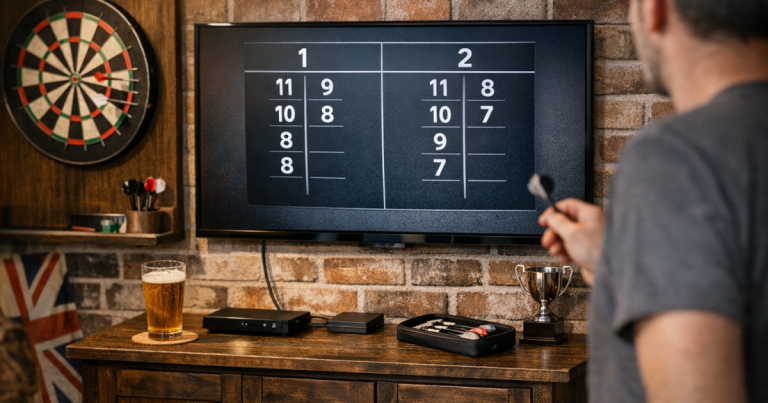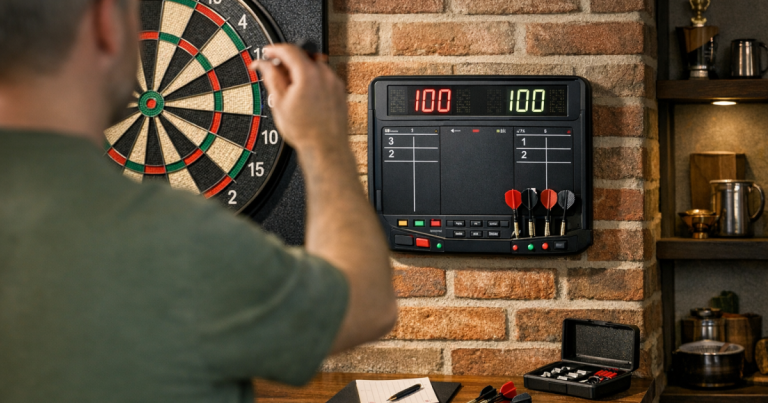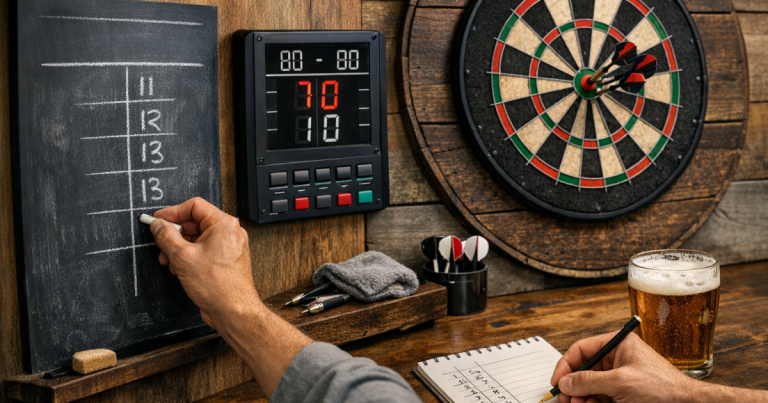
A wall scoreboard makes Cricket feel much calmer because everyone can see what is open, what is closed and who is actually ahead. Cricket darts scoring is easiest when you separate the board into marks and points, then update it after every visit rather than trying to remember the whole turn afterwards.
The aim is not just to hit big numbers. You are trying to close the Cricket targets while scoring only on numbers your side has opened and your opponent has not yet closed.
The short version
- Cricket uses the numbers 20, 19, 18, 17, 16, 15 and bull.
- Each player or team needs three marks to close each target.
- A single counts as one mark, a double counts as two marks and a treble counts as three marks.
- You only score points on a target after you have opened it and before your opponent has closed it.
- The winner is the player or team that has closed every Cricket target and is level on points or ahead.
Set up the wall scoreboard before the first throw
Start with a clean, simple layout. Write the two players’ or teams’ names across the top, leaving enough room under each name for marks. Down the middle, write the targets in order: 20, 19, 18, 17, 16, 15 and B for bull.
Leave a small scoring space near each name as well. Some players put total points at the top; others put points at the bottom. Either is fine, provided everyone can see it quickly from the oche. For a home setup, clarity beats tradition every time.
If your scoreboard sits beside the board, keep it close enough to update naturally between visits but not so close that players have to step into the thrower’s line. In tighter spare rooms, garages and dining-room setups, it is worth checking safe walkways around your dartboard before deciding exactly where the scorer stands.
Use the same mark symbols every time
Most wall scoreboards use a simple three-stage marking system. The first hit on a number is shown with a slash. The second hit turns it into an X. The third hit adds a circle around the X, which means that target is closed for that player or team.
A clear marking system looks like this:
- One mark: /
- Two marks: X
- Three marks, closed: circled X
You do not need decorative scoring. You need marks that are quick to read from a couple of metres away. If you are using chalk, press firmly enough that the mark is visible but not so hard that the board becomes messy. If you use a dry-wipe board, keep a cloth nearby so corrections do not turn into smudged arguments.
Step 1: mark the Cricket targets
After each three-dart visit, record the marks against the correct target and under the correct player or team. If a player hits a single 20, add one mark on 20. If they hit double 18, add two marks on 18. If they hit treble 17, add all three marks on 17 and close it immediately.
For bull, the outer bull counts as one mark and the inner bull counts as two marks. If a player hits inner bull and outer bull in the same visit, that is three bull marks, so bull is closed for that side.
The important habit is to record marks before calculating points. That keeps the game easy to follow and helps prevent mistakes when someone hits a double or treble on a number that is partly open.
Step 2: decide whether the hit scores points
A hit scores points only when the throwing side has already closed that target and the other side has not closed it. The value is the face value of the number hit. So a single 20 scores 20 points, a double 20 scores 40 and a treble 20 scores 60.
For bull, outer bull scores 25 points and inner bull scores 50 points, but only if your side has opened bull and your opponent has not closed it.
If both sides have closed the same number, further hits on that number score nothing. If neither side has closed it yet, hits usually add marks rather than points. If one side closes a number and has spare marks in the same visit, those extra marks can score if the opponent has not closed it.
Step 3: handle spare marks correctly
Spare marks are where many home games go wrong. A double or treble can close a number and still leave extra scoring value in the same throw.
Imagine your side already has two marks on 20 and your opponent has only one mark on 20. You hit treble 20. The first mark closes 20 for your side. The two remaining marks are scoring marks because your opponent has not closed 20. That means you add 40 points.
Now change the example slightly. Your side has two marks on 19 and your opponent has already closed 19. You hit treble 19. One mark closes it for you, but the remaining marks score nothing because the opponent has already shut that target.
When in doubt, ask two questions in order: did the throw close the number for the thrower, and was it still open for the opponent after that closure? That usually solves the dispute.
A worked example on a wall board
Say Alice and Ben are playing singles. Alice starts with treble 20, single 19 and single 18. On the wall board, Alice gets a circled X on 20, one slash on 19 and one slash on 18. She scores no points yet because those hits were used to create marks, not to score beyond closure.
Ben then hits single 20, single 20 and treble 19. Ben now has two marks on 20 and a circled X on 19. Again, no points are added because he has not scored on an already open target with Alice still unclosed.
Alice returns and hits single 20, treble 20 and single 17. Alice already had 20 closed, while Ben only had two marks on 20. Her single 20 scores 20. Her treble 20 scores 60. Then she adds one slash on 17. Alice’s points total becomes 80.
If Ben later closes 20, Alice can no longer score on 20. The wall board should make that obvious at a glance: once both sides have the circled X on a number, that row is dead for scoring.
Keeping the scoreboard readable during the game
A good Cricket scoreboard is a shared reference point, not a puzzle. Keep player names short, make marks bold and update totals straight after the visit. If you are playing pairs, put both names at the top or use team names such as Kitchen Side and Window Side so nobody forgets which column is which.
For busy family games, it can help to nominate one scorer per leg. That person should stand clear of the thrower, watch the darts land, call the visit back clearly and then update the wall board. If a dart falls out before it is retrieved, agree house rules before you start rather than debating it mid-leg.
Lighting matters too. A scoreboard placed in shadow can cause as many mistakes as a poor throw. If you are building a cleaner home layout, think about how the board, surround, cabinet and score area work together; a tidy scoring position often fits naturally into a broader dartboard wall with cabinets and surrounds.
Common scoring mistakes to avoid
- Adding points before the number is open: you must have three marks on that target before it becomes a scoring number for your side.
- Forgetting the opponent’s status: you can only score if the other side has not closed the target.
- Miscounting trebles: a treble is three marks, not automatically points.
- Ignoring spare marks: extra marks after closure can score if the other side is still open.
- Ending the game too early: closing all numbers is not enough if you are behind on points.
When to use a wall board rather than a digital scorer
A wall scoreboard suits Cricket because it shows the whole shape of the leg. You can see which numbers are still live, who is chasing points and whether someone needs to close bull or attack an open 18. That makes it excellent for casual home games and practice sessions where you want to build better decision-making.
Digital scoring can be handy if you regularly host groups, run mini-leagues or want fewer manual calculations. A wall board, though, is quicker to understand for visitors and keeps the game visible without everyone looking down at a device. If you later want a more automated setup, the next step is to set up an electronic darts scoreboard at home while keeping the same basic Cricket logic.
Finishing the leg correctly
To win Cricket, you must close 20, 19, 18, 17, 16, 15 and bull, and you must not be behind on points. If you have closed everything but trail by 20, the leg continues. You need to score enough on any target that remains open to your opponent, or wait for the opponent to make a mistake if they still have work to do.
If both players have closed all targets and the points are level, the game is over only if your house rules allow a draw. Many home players continue until one side edges ahead before completing the final close, but that needs agreeing before play starts. The standard approach is simple: closed everything and equal or ahead wins.
Common questions
Do you have to close the numbers in order?
No. You can target any Cricket number at any time. Many players start on 20 because it offers the highest scoring value, but switching to a less contested number can be smarter if your opponent is close to closing 20.
Does a treble always close a number?
A treble gives three marks on that number. If you had no marks already, it closes the number. If you already had one or two marks, the spare marks may score, provided your opponent has not closed that number.
How do you mark bull on a wall scoreboard?
Use the bull row in the same way as the number rows. Outer bull is one mark, inner bull is two marks. Once a side has three bull marks, bull is closed for that side.
Can you score on a number your opponent has closed?
No. Once your opponent has closed that target, you cannot score points on it. You may still need to close it yourself, but any extra hits there will not add to your total.
What is the simplest way to avoid disputes?
Update the wall board after every three darts, call out the marks and points clearly, and agree the marking symbols before the first leg. Most confusion comes from delayed scoring or unclear spare marks.
What to remember
Cricket is straightforward once the wall board shows three separate ideas clearly: marks, open scoring numbers and total points. Record the marks first, check whether the opponent has closed that number, then add any points that genuinely count.
For home darts, the best scoreboard is the one everyone can read quickly from the oche. Keep the layout consistent, write boldly and treat the board as part of the playing area rather than an afterthought. The result is a quicker, friendlier game with fewer pauses and far fewer scoring debates.