A tidy darts area starts with a clear throwing lane and oche, not just a board on the wall. If the line is cramped, angled, slippery or poorly marked, even a good board can feel frustrating to use.
The aim is simple: set the board at the correct height, measure from the right point, give the thrower enough clear floor space, and make the oche easy to return to every time.
Main points
- For steel-tip darts, set the bullseye centre 1.73 m from the floor.
- Measure 2.37 m horizontally from the face of the dartboard to the front of the oche.
- Keep the lane straight, level and free from furniture, rugs, door swings and trip hazards.
- Allow practical clearance around the thrower, not just the minimum throwing distance.
- Mark the oche in a way that suits the room: tape, a mat, a raised strip or a movable marker.
Start with the board position
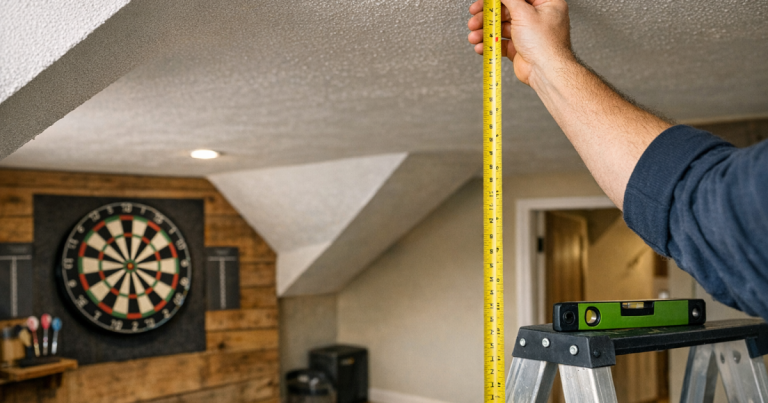
The board position controls the whole layout, so set it before you mark anything on the floor. The bullseye centre should be 1.73 m from the finished floor surface. That means the floor you stand on, not the subfloor, not the top of a loose mat, and not a point that changes when a rug moves.
Use a tape measure and a spirit level rather than judging by eye. If the board is inside a cabinet, surround or recess, check that the playable face still sits square and that the cabinet doors do not project into the side space where darts might land.
The board should sit on a stable wall, stand or cabinet with enough background protection for missed darts. If the wall is shared with neighbours, thin partition walls can also make impact noise more noticeable, so layout is not only about measurement. A quieter room choice or added backing can make home play more sociable.
Measure the oche from the board face, not the wall
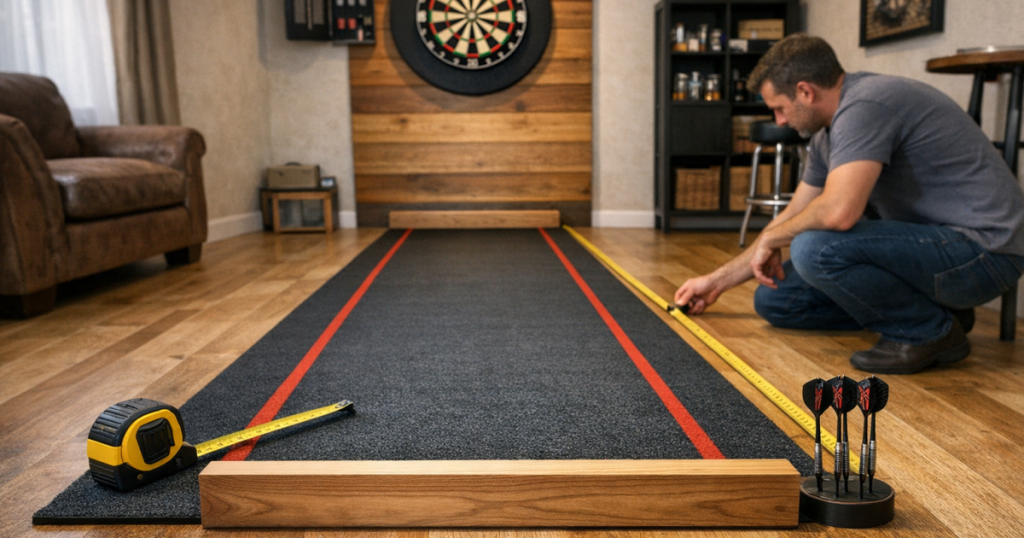
The most common home setup mistake is measuring from the wall instead of the board face. A dartboard has thickness, and the regulation throwing distance is measured from the face of the board to the front edge of the oche. For steel-tip darts, that horizontal distance is 2.37 m.
If you want a detailed measurement check, including how to use the diagonal bull-to-oche method, see this guide to setting the correct oche distance at home. For most rooms, a straight floor measurement is enough as long as the board is flat to the wall and the tape is pulled square to the board face.
A useful cross-check is the diagonal measurement from the bullseye centre to the front of the oche, which is commonly given as 2.93 m for a standard steel-tip setup. This can help if skirting boards, uneven walls or a bulky surround make the horizontal line awkward to measure.
Set a straight throwing lane
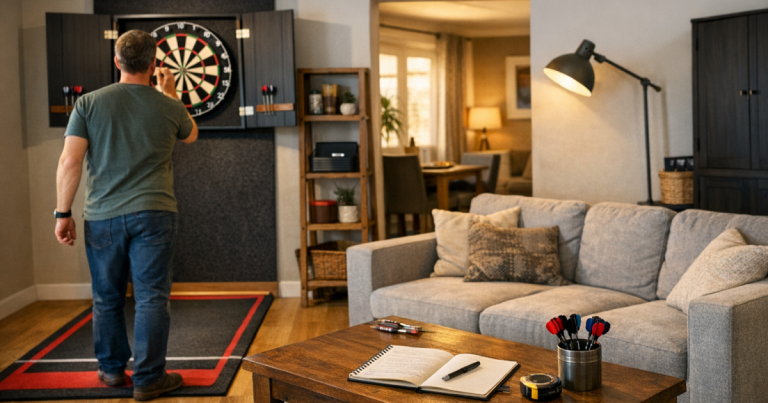
Once the board and oche are measured, stand behind the mark and look directly at the board. The throwing lane and oche should feel naturally aligned, with the thrower facing the centre of the board rather than twisting around furniture or standing at a slight angle.
Use the 20 segment as a visual centre line. Drop an imaginary line down from the bullseye to the floor, then run your tape straight out to the oche. If the room shape forces the lane to sit close to a wall, wardrobe or garage shelving, give the thrower extra space on their throwing-arm side.
For a comfortable home lane, aim for a clear standing width of about 1 m around the oche where possible. You do not need a formal boxed-in lane, but the thrower should be able to set their feet, lean forward and retrieve darts without squeezing past chairs, storage boxes or exercise equipment.
Choose the right oche marker for the room
The oche must mark the front limit of the throw. Your foot can be behind it or touching it, but not over it. At home, the best marker is the one that stays in place and is obvious enough that nobody creeps forward without realising.
Low-profile tape
Floor marking tape is simple and cheap, and it works well on smooth, clean floors. It is better for a casual setup than for heavy use, because corners can lift and the line may need replacing. Avoid using tape that leaves residue on rented flooring or delicate finishes.
Dart mat
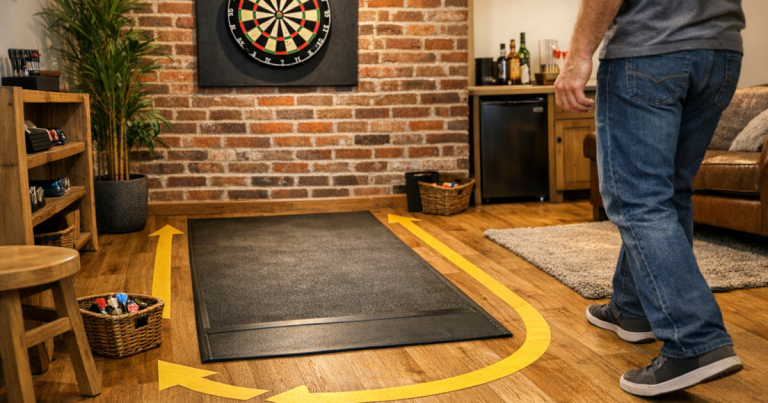
A dart mat helps define the lane and often gives a clear standing line. It can also protect the floor from bounce-outs and dropped darts. The main check is movement: if the mat slides, curls or bunches, it becomes more of a nuisance than a help.
Raised oche strip
A raised oche gives the most definite foot reference. It suits a dedicated darts space, garage or games room, but it can be a trip point in a shared room. If you use one, make sure it is visible, secure and not placed where people regularly walk across it.
Movable marker
For living rooms and rented homes, a removable strip, slim timber marker or portable mat can be enough. The key is repeatability: mark a discreet reference point so the oche returns to exactly the same distance each time.
Check clearance before you commit
Before sticking anything down permanently, do a dry run. Put a temporary line on the floor, stand at the oche, go through a normal throw, then walk forward to retrieve the darts. This tells you more than a tape measure alone.
- Check that doors do not open into the lane while someone is throwing.
- Keep the route behind the thrower clear so nobody has to pass through the lane mid-throw.
- Move coffee tables, stools and loose storage out of the path.
- Leave enough space to step back from the oche without hitting a wall or sofa.
- Avoid placing the lane across a main household walkway.
If you are planning the setup in a garage, remember that bikes, tools, laundry racks and car doors can change the usable space from week to week. In a spare room or living room, the bigger issue is usually shared use: the lane may be technically measured, but awkward if it blocks access to seating or storage.
Think about missed darts and bounce-outs
A good lane layout also accounts for where darts go when they miss. Beginners, guests and tired players will not always hit the board or surround, so the area around the board needs realistic protection.
Protect the wall immediately around the board and think about the floor below it. Hard floors can blunt points more quickly, while soft flooring can be marked by falling darts. If you are still deciding how much coverage you need, the room-planning steps in protecting floors and walls around a dartboard are a useful next read.
Do not assume a narrow surround solves every problem. It reduces common misses, but it will not catch every stray dart from a new player. If the board is near plasterboard, windows, radiators, tiles or furniture, give yourself a bigger safety margin.
Make the floor line easy to see
A faint oche mark is one of those small annoyances that makes scoring and match play feel sloppy. The line should be visible from standing height, under the room’s normal lighting, without the player needing to look hard for it.
Contrast matters. A black line on a dark mat, or clear tape on patterned flooring, is easy to lose. A neat strip in a contrasting colour usually works better. If you want the setup to look tidy in a living space, use a straight, clean-edged marker rather than several small pieces of tape.
For players who use different darts formats, label the lines carefully. Steel-tip and soft-tip distances can differ, so avoid having two unlabelled strips on the floor. If there is more than one line, make the main home setup obvious and keep any secondary mark discreet.
Keep lighting out of the throwing path
Lighting affects the lane as much as the board. A bright board with a shadow across the treble bed is irritating, but a badly placed lamp can also sit in the thrower’s sightline or create glare on the floor marker.
Stand at the oche and look at the board before fixing any light position. Check for shadows from your arm, head, cabinet doors and surrounding furniture. The board face should be evenly lit, while the oche remains visible enough for foot placement. For a deeper layout check, use the advice on planning dartboard lighting without glare or shadows.
Test it like a real playing session
Once everything is marked, play a few legs before making the setup permanent. A measured layout can still feel wrong if the room does not flow well. You are checking comfort, safety and repeatability, not just numbers.
- Throw from your normal stance and check that your lead foot naturally sits behind the oche.
- Retrieve darts several times and notice whether you step on loose edges, cables or raised flooring.
- Ask another player to use the lane, especially if they are left-handed or taller than you.
- Check whether spectators have a safe place to stand without crowding the thrower.
- Play under the lighting you normally use in the evening, not just in daylight.
If something feels tight, adjust before you commit. Moving a chair or shifting a cabinet slightly is much easier than living with a lane that always feels compromised.
Common layout mistakes to avoid
- Measuring from the wall: always measure from the dartboard face to the front of the oche.
- Ignoring skirting boards: they can stop your tape sitting square if you are measuring too close to the floor.
- Using a movable rug as the reference: the oche will drift as the rug moves.
- Placing the oche in a walkway: it increases interruptions and trip risk in shared rooms.
- Forgetting the retrieval route: the lane must work when walking to the board as well as when throwing.
- Underestimating missed darts: give the wall and floor more protection than your best player needs.
FAQ
How wide should a home darts throwing lane be?
There is no single fixed home-lane width, but about 1 m of clear standing space around the oche is a sensible target. Add more if the lane sits close to a side wall or furniture.
Can I use tape for the oche?
Yes, tape is fine for many home setups as long as it stays flat, visible and accurately placed. Check that it will not damage or mark the floor surface.
Should the oche line be measured to the front or back of the strip?
Measure to the front edge of the oche, meaning the edge closest to the dartboard. That edge is the limit the player must not step over.
What if my room is just short of the full distance?
Do not squeeze the board into an unsafe or awkward position. A stand in another room, a garage setup or a removable layout may be better than playing at a compromised distance.
Does a dart mat replace measuring?
No. A mat can help mark the lane, but you should still measure from the board face and confirm that the printed or marked oche line is correct for your setup.
Why it matters
A well-set oche makes home darts feel consistent. You can practise properly, guests know where to stand, and the room works without constant adjustment. Get the board height, distance, clear lane and floor marking right first, then build the rest of the setup around that fixed line.