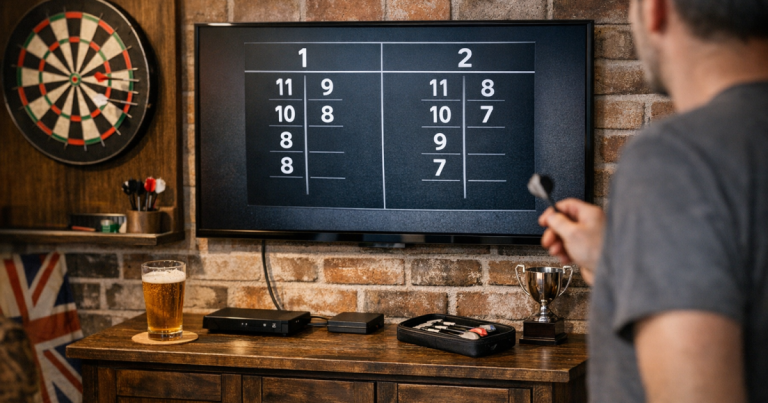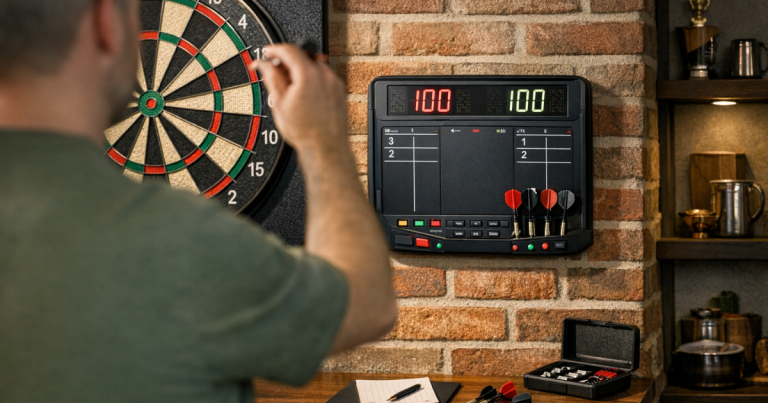
Close games are much easier to enjoy when everyone can see the match state at a glance. A clear darts scoreboard stops arguments over whether you are playing the third leg of the first set, the first leg of the decider, or something in between. The aim is not to make the board look busy; it is to separate score, legs and sets so the next thrower always knows where the match stands.
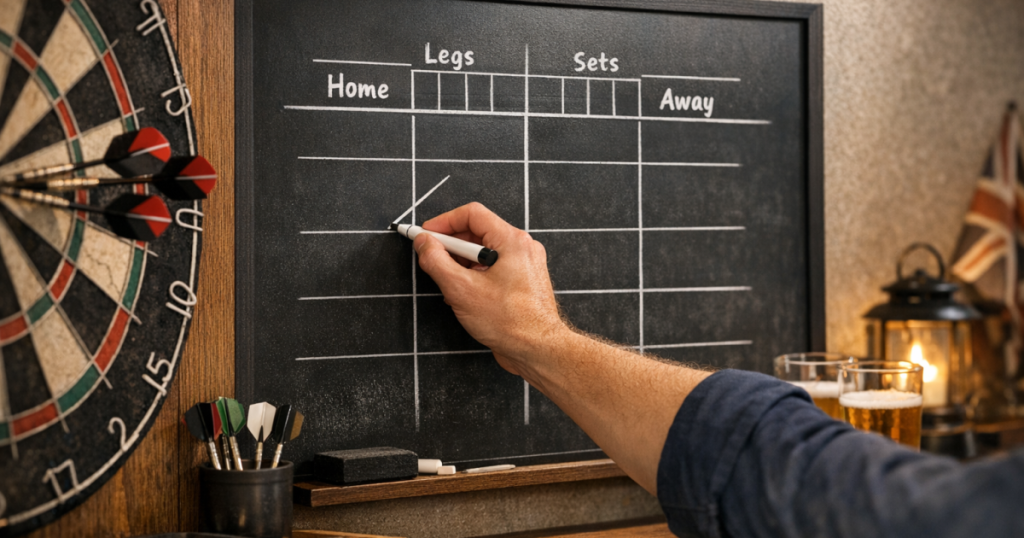
For most home matches, the simplest layout is three zones: running score in the centre, legs underneath each player’s name, and sets either above the names or in a small separate box. Keep the marks consistent from the first leg, use one symbol for legs and one symbol for sets, and wipe only the running score when a leg finishes.
The cleanest scoreboard layout
Before the first dart is thrown, write the two players’ names or initials at the top. Under each name, leave a clear vertical column. The middle or largest part of the writing area should be reserved for the remaining score, because that changes every visit and needs the most space.
A good home layout looks like this in practice:
- Top row: player names or initials, with set marks close to each name.
- Main area: the current remaining score for each player.
- Lower row: leg marks for the current set.
- Side note: optional format reminder, such as first to 3 legs or best of 5 sets.
This separation matters because a running score and a match score behave differently. The remaining score resets every leg. Leg marks reset when a set is won. Set marks normally stay in place until the match is over. If those three things are squeezed into the same space, someone will eventually wipe off the wrong mark.
Step 1: agree the match format first
Clear marking starts before anyone scores a treble. Decide whether you are playing legs only, sets and legs, or a short practice race. Casual home games often use first to 3 legs, best of 5 legs, or best of 3 sets with each set first to 3 legs. The exact format is less important than making sure everyone understands it.
Write the format on the board in small text before the match starts. For example, use simple labels such as first to 3 legs, best of 5 legs, or sets: best of 3, legs: first to 3. This gives you a quick reference when the match gets tight and saves the usual mid-game question of whether a player has already won enough legs.
If your home setup is used by different people, keep the format note in the same place every time. Regulars soon learn where to look, and new players do not have to ask after every leg.
Step 2: give legs their own row
Legs are the most commonly muddled part of home scoring because they change often. The easiest method is to put leg marks directly below the player’s name, separate from the running score. A short vertical line, tick or small dot is enough. Avoid writing full numbers in the same area as the remaining score, because a quick glance can make a leg total look like part of the checkout maths.
For a first-to-3-legs set, leave space for three small marks under each player. When a player wins a leg, add one mark under their column. When one player reaches the required number of legs and wins the set, move to the set area and reset the leg row for the next set.
If you are using a whiteboard or chalkboard, draw a faint horizontal line between the running score and the leg marks. It does not need to be neat enough for a pub league match; it just needs to stop the eye drifting between the wrong areas.
Step 3: mark sets away from the running score
Sets should be even more separate than legs because they change less often and are more important to the match result. Put set marks above each player’s name, beside the initials, or in a small labelled box at the top corner of the board. The best position is one that stays visible when the score area is being wiped.
Use a different symbol for sets than you use for legs. For example, use short lines for legs and circles for sets, or ticks for legs and boxed numbers for sets. The actual symbols do not matter, but mixing them does. If one player uses ticks and the other gets dots, the board becomes harder to read as the match goes on.
Once a set is won, add the set mark first, then wipe the leg marks. That order helps avoid one of the most common errors: clearing the leg row, chatting for a moment, then forgetting who actually won the set.
Step 4: reset only what needs resetting
A tidy reset routine keeps the board reliable. At the end of a leg, wipe the running scores and return both players to the starting score, usually 501 or whatever you agreed. Then add the leg mark to the winner’s column. Do not touch the set marks.
At the end of a set, add the set mark to the winner’s column, then clear the leg marks for both players. The running score should also return to the starting score for the first leg of the next set. Saying the update out loud helps: one nil in sets, legs reset, first leg of the next set. It sounds simple, but it is a useful habit when several people are chatting around the board.
For doubles, use team names or pair initials rather than trying to fit four names into a small panel. The same logic applies: team score in the main area, team leg marks below, team set marks above.
Step 5: place the board where players can read it
Even the clearest marking system fails if the board is tucked too far to the side or hidden by a cabinet door. Place it where the scorer can update it comfortably and both players can check it without stepping into the throw. A wall-mounted whiteboard, chalkboard panel, cabinet scoreboard or magnetic option can all work, provided the layout has enough space.
If you rent or do not want permanent fixings, a removable setup is worth planning carefully. For wall-friendly ideas, see how to mount a magnetic darts scoreboard without wall damage. It is particularly useful when you want a visible scoring area without drilling into plaster or fitted storage.
Keep the writing surface close enough to the oche that scores can be checked quickly, but not so close that the scorer stands in the throwing lane. If your throw line still needs sorting, use our guide on setting the correct oche distance at home before deciding the final scoreboard position.
Marking examples for common home formats
First to 3 legs
This is the easiest format to mark. Write each player’s name, then put up to three leg marks underneath. There are no set marks unless you choose to count the match as one set. When a player reaches three marks, the match is over. It is quick, tidy and ideal for a short evening game.
Best of 5 legs
Best of 5 legs means the first player to win three legs wins the match. Mark it exactly like first to 3 legs, but write best of 5 legs somewhere small on the board so nobody thinks five legs must be completed. Once someone has three leg marks, stop the match.
Best of 3 sets, first to 3 legs per set
This is where clear separation becomes important. Put set marks at the top, leg marks at the bottom and running scores in the middle. A player wins a set by taking three legs. Once they do, add one set mark, clear both leg rows, and begin the next set. The first player to two set marks wins the match.
Practice races
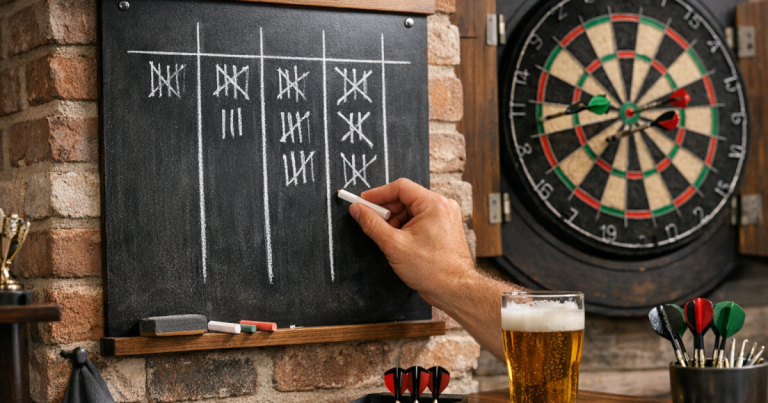
If you are playing a practice race, such as first to 10 legs, skip sets and use a simple leg tally. Group marks in fives if the race is long. Four vertical lines with a fifth crossing line is still one of the clearest ways to count quickly, especially when a match stretches beyond a handful of legs.
Small habits that prevent scoring disputes
The best scoring systems are boringly consistent. Everyone knows where the current score is, where the leg count is, and where the set count is. That makes the game feel smoother and reduces the chance of a good leg being spoiled by a scoring debate.
- Update immediately: mark the leg winner before retrieving darts or starting a conversation.
- Use one handwriting style: large, plain numbers beat tidy but tiny writing.
- Keep symbols consistent: do not swap between ticks, lines and numbers mid-match.
- Leave empty space: a cramped board invites mistakes, especially with sets and legs together.
- Confirm close moments aloud: say two legs each or one set all before the next leg starts.
Lighting also affects scoring clarity. Glare on a glossy whiteboard or shadows across a cabinet panel can make marks hard to read from the oche. If the whole area feels dim or uneven, the advice in planning dartboard lighting without glare or shadows will help you keep both the board and the scoring area visible.
What to avoid
A few common habits make scoreboards harder to follow than they need to be. The biggest one is using the same area for everything. If 301, two leg marks and a set tally all sit in one corner, it is only a matter of time before someone misreads the state of play.
Another problem is over-marking. You do not need arrows, underlines, boxes, initials, totals and notes for every visit. The more marks you add, the less obvious the important information becomes. A simple layout with repeated positions is faster to read than a clever one that changes every leg.
Finally, avoid wiping too much. When clearing the running score, protect the leg and set areas with your other hand or wipe in a controlled direction. On smaller boards, a stray sleeve or cloth can remove the one mark that matters.
Questions people ask
Do legs or sets go at the top of the board?
Sets are usually better at the top because they change less often and represent the bigger match score. Put legs below each player’s name or below the running score so they can be reset cleanly when a set ends.
What is the simplest symbol for leg wins?
A short vertical line is hard to beat. It is quick to add, easy to count, and does not look like part of a remaining score. For longer races, group the lines in fives.
Should I write leg scores as numbers instead of marks?
You can, but small marks are usually clearer for casual home play. Numbers can be confused with scoring totals, especially when the board is busy or the writing area is small.
How do I score sets when playing doubles?
Treat each pair as one side. Write team names or initials, then use one running score, one leg row and one set row per team. Avoid squeezing all four player names into the scoring columns.
What should I do if the scoreboard is too small?
Use fewer written notes and separate the areas more deliberately. If there still is not enough room, keep sets as small marks beside the names and reserve the main area for scores and legs.
Main points
A clear darts scoreboard is really about consistency. Put the running score in the main space, legs in a dedicated row, and sets somewhere that will not be wiped between legs. Agree the format before starting, use different symbols for legs and sets, and reset the board in the same order every time.
Once the system becomes familiar, players stop thinking about the board and get back to the match. That is the goal: fewer interruptions, fewer recounts and a scoring area that supports the game rather than becoming part of the argument.