A clear board changes how relaxed your throw feels. Good dartboard lighting should make every segment easy to read without putting a bright lamp in your eyes, casting dart shadows across the treble bed, or making a small room feel more cluttered. Start by planning the light path, not by buying the brightest fitting you can find.
Hard-wired light fittings, altered ceiling wiring and new electrical circuits should be carried out by a qualified electrician to meet UK electrical safety requirements and Building Regulations.
In brief
- Light the board from the front and sides, not from behind the player.
- Avoid exposed bulbs at eye level, reflective cabinet doors and shiny nearby surfaces.
- Check shadows with darts in the board, not just with an empty board.
- Keep the throwing lane clear so lighting does not make an already tight space feel tighter.
- Test the view from the oche, from both sides of the throw and from the scorer’s position.
Step 1: Fix the board position before thinking about lamps
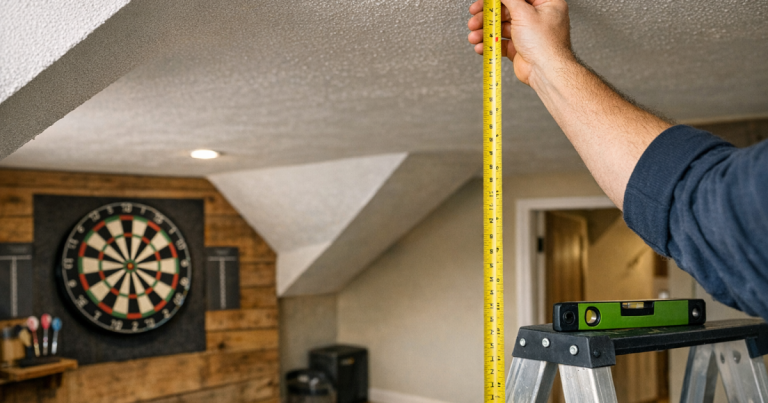
Lighting is much easier to plan once the board location is settled. If you move the board later by even a small amount, the angle of the light can change enough to create new shadows or glare.
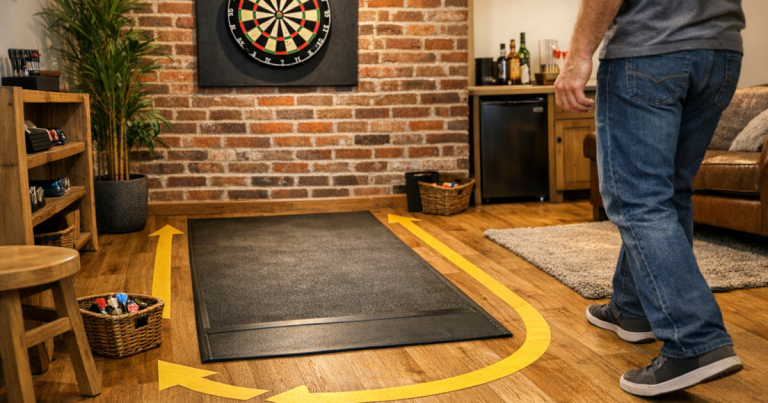
Start with the basics: board centre at the correct height, enough room behind the oche, and a throwing lane that is not shared with doors, cupboards or furniture. If the oche is still being marked out, sort that before judging the light. The board may look fine from close up but feel completely different from throwing distance. For the official steel-tip layout and home measuring tips, use the guide to setting the correct oche distance at home.
Once the board and oche are fixed, stand at the throw line and look for three things: whether the numbers are easy to read, whether the wire shadows cross the scoring beds, and whether any light source is visible in your direct line of sight.
Step 2: Understand where shadows usually come from
Most annoying shadows are caused by light coming from one dominant direction. A ceiling light behind the player throws the player’s arm and darts towards the board. A single lamp above the board can cast downward shadows from the wires and barrels. A side lamp can make one half of the board look clear while the opposite half looks dull.
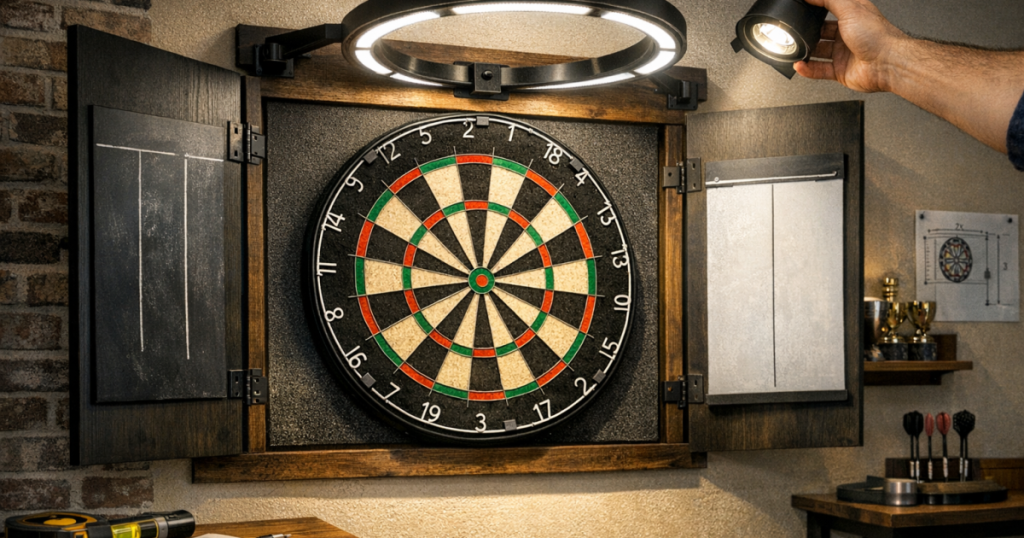
The aim is not simply more brightness. It is even coverage across the full face of the board. The best home setups tend to use light that reaches the board from the front, or from a ring-like position around the board, so darts do not create a strong single shadow.
To test this properly, place three darts in different areas: one near the 20, one around the 3 or 17, and one lower on the board. Step back to the oche and check whether any shadow hides the wire, segment edge or target bed. If the shadows move dramatically depending on where the dart lands, the light is probably too directional.
Step 3: Keep glare out of the thrower’s eyes
Glare is different from brightness. A board can be well lit but still uncomfortable if you can see a bare bulb, a bright LED strip, or a reflection bouncing off a glossy cabinet or framed print.
From the oche, look slightly above and around the board. If your eyes are drawn to the light itself rather than the scoring area, adjust the position. Useful checks include:
- Can you see an exposed bulb or harsh LED points from the oche?
- Does the light reflect off cabinet doors, painted gloss surfaces or glass nearby?
- Does the room light shine straight into your eyes when you lean or step sideways?
- Does the board look comfortable after several minutes, not just for a quick glance?
Diffused light is usually easier to live with than a bare, intense lamp. A shade, purpose-made board light, or well-positioned fitting can soften the view without making the board dull.
Step 4: Choose a lighting approach that suits the room
There is no single correct dartboard lighting setup for every home. A spare room, garage, hallway end and rented flat all create different limits. The right approach is the one that gives an even board view while leaving the space usable.
Purpose-made board lights
Ring and surround-style board lights are popular because they put the light close to the board and spread it more evenly than a single room bulb. Real examples include Target Corona Vision, Mission Torus 270 and Winmau Plasma Dartboard Light. Before using any of them, check compatibility with your board, surround, cabinet, stand and available wall depth. Do not assume a light will fit neatly inside a cabinet setup or work with every surround.
Ceiling or wall-mounted room lighting
Room lighting can work if it is positioned carefully, but it is more likely to create shadows if the main light sits behind the thrower. If your only ceiling fitting is behind the oche, consider whether an additional front-facing source is possible rather than relying on the room light alone.
Garage and utility spaces
Garages often have harsher overhead lighting, darker corners and more reflective surfaces such as tools, shelving or painted doors. If your board is going into a garage, plan the whole corner rather than treating the light as an add-on. The broader guide to planning a darts area in a garage is a useful next step if you are also juggling floor space, storage and protection.
Step 5: Test the light from real playing positions
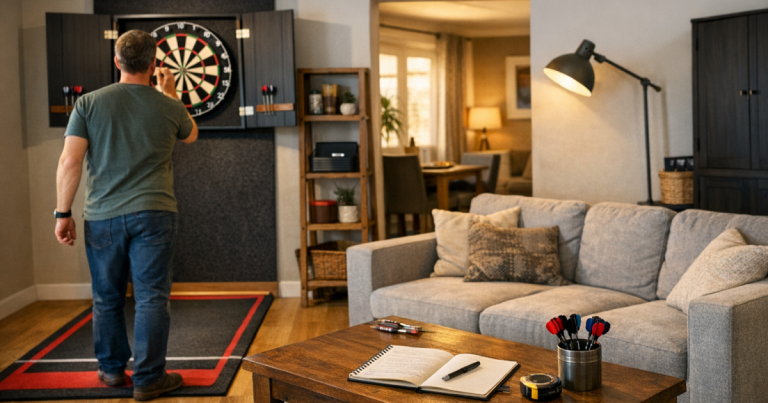
A common mistake is standing right in front of the board to judge the result. That tells you whether the board is lit, but not whether it plays well. Your eyes need to judge the board from the oche, because that is where contrast, glare and shadows matter.
Run through this quick test:
- Stand on the centre of the oche and aim at 20, bull and 19.
- Shift slightly left and right, as many home players naturally do during a session.
- Put darts in the board and check shadows across the scoring beds.
- Ask someone else to stand at the oche if possible; different heights can reveal glare you missed.
- Check the scorer’s view if a scoreboard or tablet stand sits to one side.
If the board only looks good from one exact spot, the lighting may be too narrow. A comfortable setup should give a clear view across normal stance variations.
Step 6: Leave enough physical space around the board
Lighting should not make the playing area feel busy. A bulky fitting, low shade or awkward cable can distract you even if the board itself is bright. Keep the throwing lane visually simple: board, protection, score area and clear floor.
Watch for fittings that project too far forward in narrow rooms. They can make the board wall feel crowded, especially if you already have a cabinet, surround, shelves or a scoreboard. If the room feels tight before you add lighting, solve the layout first. The advice on fixing a cramped darts setup will help you decide whether to move storage, alter the oche area or simplify the board wall.
Cables matter too. Keep them away from foot traffic and avoid running loose leads across the throw line. If you are using a plug-in light, route the cable so it does not pull on the fitting or invite trips when people move around the room.
Step 7: Fine-tune brightness and colour
Once glare and shadows are controlled, judge the feel of the light. Too dim and you strain to see segment edges. Too harsh and the board can feel clinical or tiring, particularly in a small room with pale walls.
Many players prefer a neutral-looking light over a very warm yellow or a very cool blue-white effect. Product listings often describe colour tone and brightness differently, so check the details rather than assuming one light will feel the same as another. If you are using ordinary room fittings, try the board in the evening as well as during the day; natural light through a window can hide problems that appear during actual night-time play.
Also consider wall colour. Dark paint around the board can reduce reflections, while glossy or very bright surfaces can bounce light back towards the oche. You do not need a full room makeover, but small changes near the board can improve comfort.
Common planning mistakes to avoid
- Using the main room light only: it may illuminate the room but still leave dart shadows across the board.
- Placing a lamp behind the thrower: this often creates moving shadows from your arm and body.
- Ignoring cabinets and surrounds: doors, edges and raised surrounds can affect how light reaches the board.
- Testing without darts in the board: shadows from barrels and flights are part of real play.
- Forgetting other players: a setup that works for one height or stance may glare for someone else.
Helpful questions
Is a ceiling light enough for a home darts setup?
Sometimes, but only if it lights the board evenly from the front and does not sit behind the thrower. In many rooms, a ceiling light alone creates visible dart or arm shadows.
Should the light be above the board or around it?
Around the board often gives more even coverage, while a single light above the board is more likely to cast downward shadows. The room layout and fitting design still matter.
Can I use a dartboard cabinet with a board light?
Possibly, but check clearances, door movement and how the light attaches. Some cabinet setups restrict the space where a surround-style or ring-style light would normally sit.
How do I know if glare is a problem?
Stand at the oche for a few minutes, not just a few seconds. If your eyes keep noticing the lamp, reflection or bright edge instead of the target, the setup needs adjusting.
Does daylight from a window help or hurt?
It can do either. Side daylight may brighten the board during the day but create uneven contrast or reflections, so always test the setup under the lighting you will use most often.
Main lessons
Plan the board position first, then shape the light around how the setup is actually used. The best result is not the brightest board; it is a board that stays readable from the oche, with no harsh glare, no heavy dart shadows and no clutter added to the throwing lane.
Once the light passes the real-play test with darts in the board, different stances and evening conditions, you can make the setup feel finished rather than improvised.