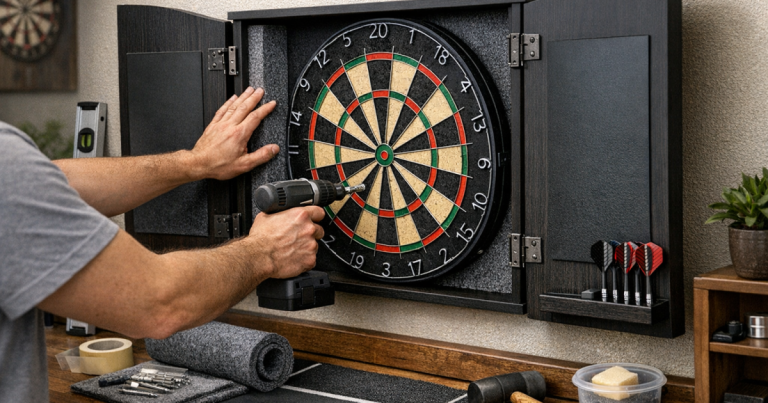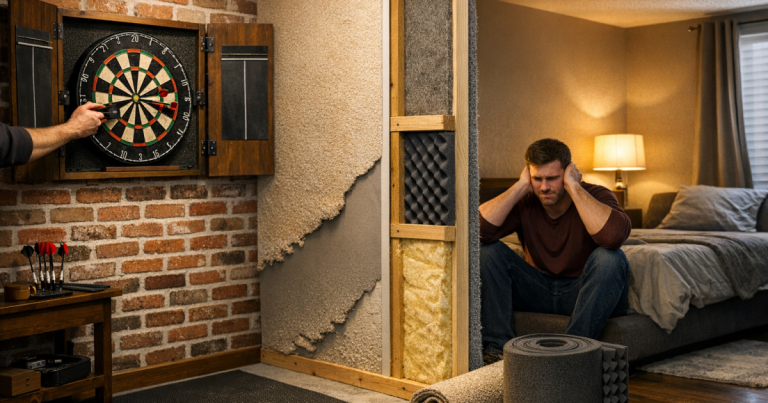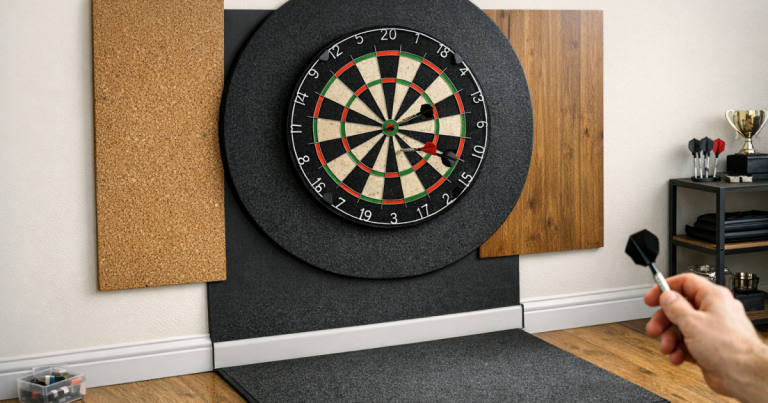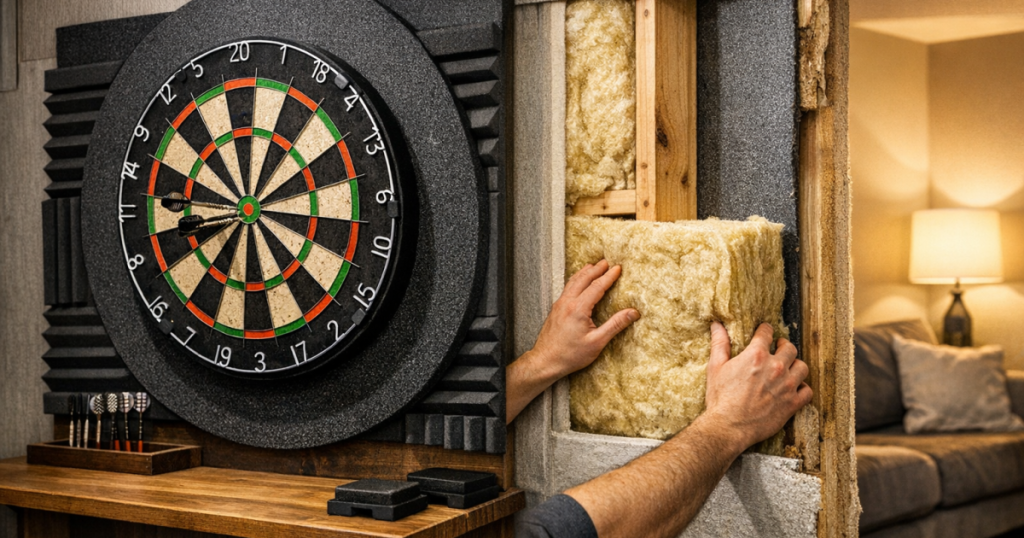
A dartboard on a party wall can sound far louder next door than it does in the room you are playing in. For dartboard noise shared wall problems, the aim is not just to quieten the board; it is to break the path that carries impact vibration into the wall. Small changes can help, but the biggest gains usually come from moving the board, isolating the mount and adding mass behind it.
The familiar thud of a dart hitting sisal is not only airborne sound. A lot of the irritation comes from structure-borne vibration: the board moves, the bracket moves, the wall moves, and the wall then behaves like a large sounding surface on the other side. That is why a board can seem acceptable in a garage but become a neighbour issue in a terrace, semi-detached house or flat.
The short version
- Best fix: move the board off the shared wall if the room layout allows it.
- Next best: mount the board on a heavier backing panel with some separation between the board, panel and wall.
- Do not rely on decorative acoustic foam alone; it is poor at stopping impact vibration travelling through a wall.
- A surround protects the wall from missed darts, but it will not usually solve neighbour-side thudding by itself.
- Test one change at a time so you know which adjustment actually made the difference.
Why the sound travels through a shared wall
Dartboard noise has two main parts. The first is airborne noise: the click, thud and chatter you hear in the playing room. The second is vibration passed into the wall through the board bracket, screws, cabinet, backing panel or any hard surface touching the wall.
Shared walls are particularly awkward because they often connect directly to the room next door. Even if the wall feels solid, it can pass low-frequency impact noise surprisingly well. A lightweight partition can drum. A masonry wall can still carry knocks through fixings and contact points. In either case, the problem is less about the volume of your voice in the room and more about the repeated impact of darts landing in the same mounted object.
If you want a deeper look at how board choice and mounting affect sound, the guide to quiet dartboards, mounting and board choice is a useful companion to this fix-focused approach.
Step 1: Work out whether the wall is the main route
Before adding panels or changing the whole setup, do a simple listening test. Ask someone to stand in the adjoining room, hallway or outside the shared side while you throw a few darts at normal pace. Then repeat the test by tapping the wall near the board bracket, tapping the board surround, and gently pressing a hand against the board while another dart is thrown.
You are listening for the character of the sound. A sharp room noise suggests airborne sound is part of the issue. A dull, repetitive knock on the other side suggests the wall is carrying impact vibration. If the thud becomes quieter when the board is steadied, the mount is likely passing movement into the wall.
Also check for avoidable rattles. Loose number rings, a lightweight cabinet door, a hard scoreboard touching the wall, picture frames nearby or a dartboard light bracket can all make the setup sound worse. Fixing these will not fully isolate the board, but it removes easy noise before you tackle the bigger work.
Step 2: Move the board away from the party wall if possible
The cleanest solution is often to use a different wall. A non-shared internal wall, an external wall, a garage wall or a freestanding setup can reduce the amount of sound that reaches a neighbour. This is not always possible in a UK living room, spare room or rented flat, but it is worth checking before spending time on damping layers.
When moving the board, keep the playing area practical. The standard steel-tip throw distance is 2.37 m from the face of the board to the oche, with the bull at 1.73 m from the floor. Make sure doors, windows, radiators and furniture do not force players to stand awkwardly or walk across the throw line. If the new position is tight, the advice on planning a darts area around doors and windows will help you judge whether the alternative wall is genuinely usable.
If a full move is not available, even shifting the board away from a chimney breast, alcove edge, pipe boxing or hollow-sounding section can change how vibration travels. Test the new position temporarily before committing to a permanent mount.
Step 3: Decouple the board from the wall
Decoupling means reducing hard, direct contact between the dartboard and the shared wall. If the board bracket is screwed straight into the wall, every dart impact has a simple route into the structure. A better approach is to mount the board onto a separate backing panel and reduce rigid contact wherever you reasonably can.
A practical home setup might use a sturdy backing board, with a resilient layer or rubber isolation pads between the panel and the wall contact points. The dartboard then fixes to the backing board rather than directly to the wall. The backing board should be secure, flat and strong enough for the board and repeated impact, but it should not be so tightly clamped to the shared wall that it simply becomes part of the wall.
Avoid very thin, lightweight panels. They can resonate and make the knock more noticeable. Heavier, denser materials tend to behave better than flimsy board, provided they are mounted safely and do not rock. If you rent, check your tenancy terms before making holes or attaching large panels. A freestanding dartboard stand may be a better route where wall fixings are not allowed.
Step 4: Add mass behind the board
Mass helps because it is harder to move. A bare dartboard on a small metal bracket has little to absorb the repeated impact. A broader, heavier backing area can reduce the concentrated knock and spread the energy across a larger surface.
The backing does not need to look like a studio wall. A neat timber panel, a purpose-made backboard, a dense wall protection panel or a cabinet-backed arrangement can all help if they are fitted sensibly. The important point is that the panel should be more than decoration. Lightweight felt tiles or soft foam squares may make the room sound less echoey, but they do not usually stop the low thud passing through the wall.
Think in layers: dartboard, board bracket, backing panel, small isolation points, then wall. Each layer should either add mass or reduce direct vibration transfer. If everything is screwed hard together with no give, the setup may look tidy but still transmit impact.
Step 5: Separate wall protection from noise control
Wall protection and noise reduction overlap, but they are not the same job. A foam surround is excellent for catching stray darts around the board and preventing small holes in plaster. It can also soften some local impact noise from missed darts. However, it does very little for the main thud of darts landing in the board if the board itself remains hard-mounted to the shared wall.
A cabinet can add a little mass and may contain some room-side noise, but many cabinets are still fixed directly to the wall. If the back of the cabinet is rigidly connected to the shared wall, impact can still pass through. The comparison of cabinet versus surround wall protection is helpful if you are deciding how much of your issue is missed-dart damage and how much is neighbour-side sound.
For a shared wall, treat surrounds and cabinets as supporting measures. They can tidy the setup and protect the décor, but the noise fix comes from location, isolation and mass.
Step 6: Reduce room resonance as well
Once the wall path is under control, deal with the room itself. Hard floors, bare walls and empty rooms make every dart impact feel sharper. A darts mat, carpet, rug, curtains, bookcase or soft furnishings can reduce echo and make the playing room less harsh. This is particularly useful in converted garages, spare bedrooms and modern living spaces with laminate flooring.
Floor treatment will not stop vibration travelling through a wall-mounted bracket, but it can make the overall session less intrusive. It also helps with footfall, chair movement and players collecting darts. If the neighbour complaint is a mix of board thuds, voices and general evening noise, softening the room can make the setup feel more considerate.
Be sensible with playing times too. Even a well-isolated board may be annoying late at night if the receiving room is a bedroom. A good home setup is not only about equipment; it is about making the board easy to use without creating friction with the people around you.
Step 7: Test changes in the right order
Make one change, then listen again from the other side. If you add foam, a cabinet, a new backboard and a mat all at once, you will not know what actually worked. Start with the biggest likely gains: moving the board, reducing direct wall contact and adding a heavier backing panel.
A simple test routine works well:
- Throw six darts at normal force and note how loud the thud is next door.
- Repeat after tightening rattles and checking the board bracket.
- Repeat after adding or adjusting the backing panel.
- Repeat with the room door open and closed, as doors can change how airborne sound moves.
- Ask the listener to describe the sound, not just rate it. A lower, duller thud may need more isolation, while a sharper click may be room echo.
If a change makes no noticeable difference, do not keep adding more of the same material. Foam that failed as a single layer is unlikely to become a miracle solution when doubled. Change the method instead: more mass, less rigid contact, or a different wall.
Common mistakes that make the thud worse
- Mounting a board directly onto a shared wall and then only adding a surround.
- Using a large but flimsy panel that drums when hit.
- Letting a cabinet, light bracket or scoreboard touch the wall and rattle.
- Assuming acoustic foam is the answer to impact vibration.
- Ignoring the room layout and trying to fix a poor wall position with accessories.
- Playing against a bedroom wall late in the evening, even after improving the setup.
Key questions answered
Will acoustic foam stop dartboard noise going next door?
Usually not by itself. Acoustic foam can reduce echo in the playing room, but the main shared-wall problem is impact vibration. Use mass and isolation first, then use softer room materials for comfort.
Is a freestanding dartboard stand quieter than a wall mount?
It can be, because it avoids fixing the board directly to the shared wall. The stand still needs to be stable, and it should not touch skirting, furniture or the wall behind it.
Does a dartboard cabinet reduce noise?
A cabinet may reduce some room-side sound and improve wall protection, but it will not reliably stop thudding next door if it is fixed rigidly to the shared wall.
Can a different dartboard solve the issue?
A quieter-feeling board may help slightly, especially if your current board is hard, loose or rattly. Mounting and wall contact usually matter more than the board alone.
What should I try first in a rented flat?
Try a different wall, a freestanding stand, a darts mat and removable room-softening measures before drilling or attaching heavy panels. Check your tenancy terms before altering walls.
What to remember
To stop dartboard noise travelling through a shared wall, focus on the route the impact takes. A tidy surround, cabinet or foam panel may make the setup look better, but the real improvements come from moving the board where possible, reducing direct contact with the wall, adding a solid backing layer and testing each change from the neighbour side.
The best home darts setups are the ones people can use regularly without causing arguments. If the thud is still obvious after basic fixes, rethink the board location before adding more accessories to a wall that is doing too good a job of carrying sound.