A loud thud through a party wall can spoil home practice faster than a missed double. The useful truth about quiet dartboards is that most noise comes from the whole setup: dart impact, wall vibration, room acoustics and how firmly the board is mounted. You do not need a silent board; you need a controlled board area that stops impact energy travelling into the wall and floor.
The short answer
The quietest home darts setup is usually a quality bristle board mounted on a solid internal wall, with a secure bracket, a little vibration isolation and enough soft furnishing in the room to reduce echo. Electronic boards, hollow doors, lightweight stud walls and bare rooms tend to make darts sound louder, even when the board itself is not especially noisy.
There is no single fix because noise travels in different ways. The dart hitting the board creates impact sound. The board and bracket pass vibration into the wall. The wall can then act like a speaker, sending the thud into the next room or through a shared wall. Hard floors and empty walls add reflected sound, which makes the whole area feel harsher.
Where quiet dartboards actually get noisy
Most players notice two different sounds: the immediate hit at the board and the dull knock that travels into the structure behind it. The first is airborne sound, and the second is vibration. Airborne sound is what people in the same room hear. Vibration is what a neighbour, flatmate or sleeping child may hear through the wall, ceiling or floor.
A board fitted tightly to a resonant surface can be louder than a board fitted carefully to a better wall. A thin plasterboard wall, hollow door or flimsy cabinet back can amplify impact. A masonry wall, a solid timber backing board or a well-supported stud wall can feel calmer because there is less flex and less drum-like resonance.
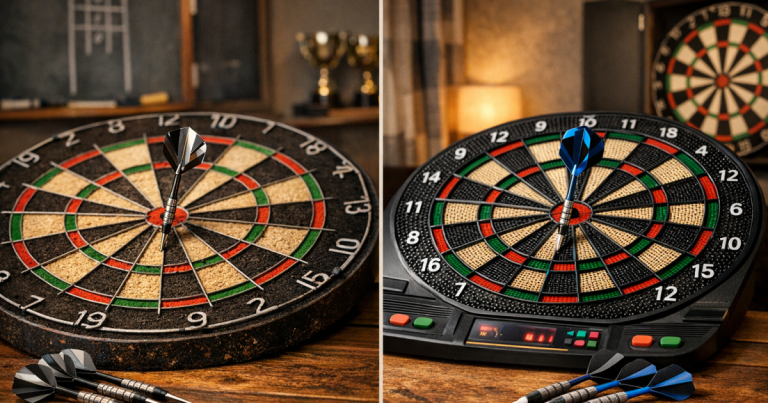
The darts themselves also matter, although not as much as the wall. Steel-tip darts entering sisal fibres create a firm, low thud. Soft-tip darts hitting plastic segments on many electronic boards can create a sharper click. Heavier darts can sound more forceful on impact, but mounting and wall choice usually have a bigger effect than a small change in dart weight.
Board type and noise: bristle, paper and electronic
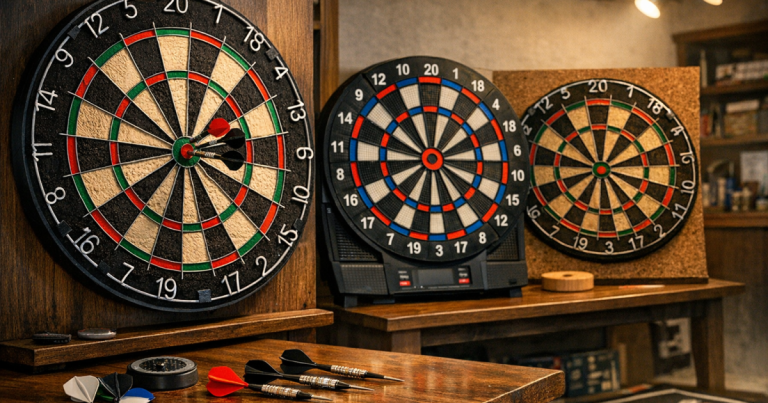
A traditional bristle board is normally the best starting point for a quieter home setup. Sisal fibres close around the point and absorb some of the energy from the throw. A recognised bristle board such as the Winmau Blade 6 Triple Core is a familiar example of the category, but the key point is the board material rather than the name on the wire. A firm, even bristle surface tends to sound more muted than a hard plastic target face.
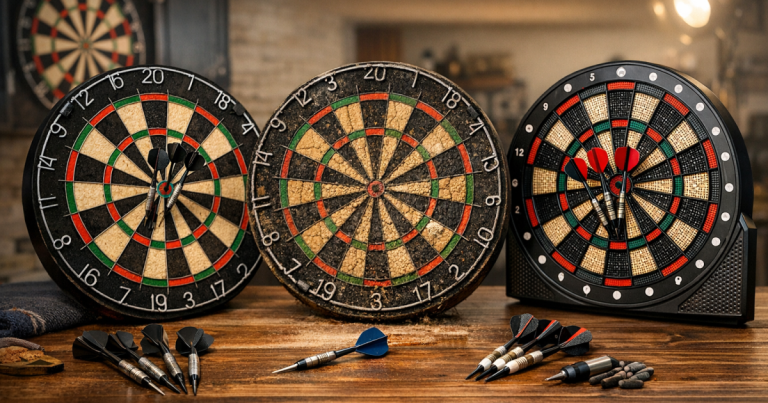
Entry-level paper or coiled-paper boards can be inconsistent. Some feel dull and soft, while others transmit a surprisingly hollow knock because the board body is light. They can be fine for occasional casual play, but they are rarely the best route if noise control, durability and regular practice all matter.
Electronic dartboards are useful for automatic scoring and soft-tip family play, but they are not automatically quieter. The sound of soft tips striking plastic segments can be crisp, and some boards add beeps or voice prompts unless these can be turned down or muted. If household noise is the concern, always check how the scoring sounds, whether volume controls are available and how the board is mounted, rather than assuming soft-tip means silent.
Mounting makes more difference than most players expect
A dartboard hung loosely will rattle, rotate and pass uneven force into the wall. A board fitted too directly to a hollow surface can create a bassy knock. The goal is to hold the board securely while reducing the amount of vibration that reaches the structure behind it.
Start with a flat, stable wall. Avoid hollow doors, lightweight room dividers and surfaces that visibly flex when pressed. If the only convenient spot is a stud wall, try to fix into a timber stud or use a suitable backing panel so the load is spread rather than concentrated on a small patch of plasterboard. Do not rely on a weak fixing that lets the board move with each throw.
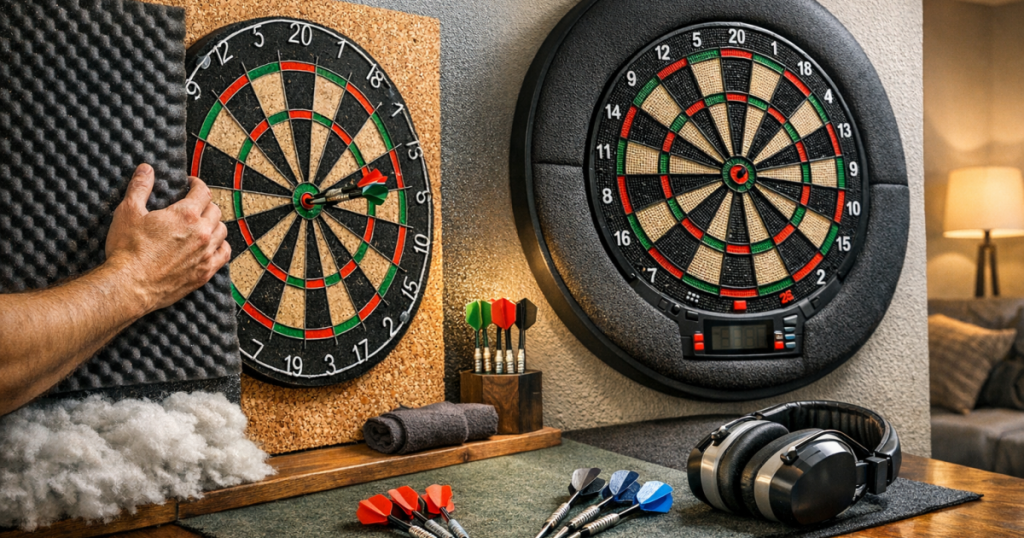
Small changes can help. Rubber or felt pads behind the board can reduce rattle where the board touches the wall. A backing board can add mass and spread vibration. A cabinet can alter the sound by adding timber around the board, although it may also create a boxy resonance if it is thin or loosely fitted. The best result is usually a secure mount with no wobble and no hard, loose contact points.
Wall choice is also a safety and comfort issue, not just a noise issue. If you are deciding between a hallway, spare room, garage wall or living room corner, use the room layout as part of the decision. The guide on how to choose the safest wall for a dartboard is a sensible next step before you drill anything.
Cabinet, surround or backing board?
A cabinet, surround and backing board all change the way a darts area behaves, but they do different jobs. A surround mainly protects the wall around the board from missed darts. A cabinet hides the board and gives a more furniture-like look when closed. A backing board adds a larger surface behind the dartboard, which can help with wall protection and may reduce some vibration if it is fitted well.
For noise, the important detail is not simply whether you use a cabinet or surround. It is whether the product is solid, secure and fitted without rattling. A loose cabinet door, thin back panel or poorly fixed surround can add extra buzzes and knocks. A snug surround on a stable board is often quieter than a decorative cabinet that behaves like a small echo chamber.
If the board is in a living room, a cabinet can still make sense because it keeps the setup tidy and helps the board blend into the room. If the priority is pure sound control, though, do not assume timber doors are the answer. Think about mass, fixings and contact points. The detailed cabinet versus surround comparison is useful if you are balancing noise, wall marks and room appearance.
Room acoustics: the overlooked part of a quieter setup
Even a well-mounted board can feel loud in the wrong room. Bare plaster walls, laminate flooring, glass doors and minimal furniture all reflect sound. A carpeted spare room with curtains, shelving and soft furnishings will usually feel quieter than a hard-floored kitchen-diner, even with the same board.
You do not need to turn the room into a studio. A thick rug, curtains, a sofa, a fabric wall hanging or stocked bookcase can soften reflected sound. If the board is in a garage, rubber floor matting can take some harshness out of foot movement and dropped darts, although it will not stop impact travelling through the wall behind the board.
Open-plan rooms need a bit more thought because darts noise travels across the whole space. Try to avoid placing the board on a wall directly behind a television, work desk or seating area. If the throw line crosses a family walkway, noise is only one of the problems; the area will also be harder to use safely and consistently.
Practical checks before changing the board
If your current setup is too loud, do these checks before replacing the board:
- Listen from the next room. Ask someone to throw while you stand behind the wall or upstairs. This tells you whether the problem is impact noise in the room or vibration travelling through the structure.
- Press the wall. If it flexes or sounds hollow, the wall may be amplifying the dart impact.
- Check the board for movement. A board that shifts, rattles or rocks at the bottom needs better support.
- Look for hard contact points. A board, cabinet or backing panel knocking directly against the wall can create a louder thud.
- Soften the room. Add a rug or curtains before blaming the dartboard itself, especially in hard-floored rooms.
- Mute electronic sounds. On electronic boards, check the volume settings, button beeps and game sounds as well as the impact noise.
If you use a mat, make sure it sits flat and does not become a trip hazard. It can help define the throw area and reduce floor noise from movement, but it will not solve a resonant wall on its own. For a more permanent setup, the guide to planning an oche and dart mat will help you think through the room layout as a whole.
Good setups for common UK homes
Terraced house or flat
Avoid party walls where possible. If you must use one, add a well-secured backing board and avoid flimsy cabinets that can resonate. Practise at sociable times and test how much sound travels through the wall rather than judging only from inside the room.
Spare bedroom
This is often one of the easiest places to create a calmer board area. Carpet, curtains and furniture already help. The main check is whether the board wall backs onto a bedroom, nursery or neighbour’s wall.
Garage or outbuilding
Garages can be good for household noise because they are separate from living areas, but bare blockwork and concrete floors can make the room sound harsh. Add a mat underfoot and consider a stable backing board if the wall surface is uneven.
Living room corner
Focus on tidy mounting and wall protection. A surround may be quieter and simpler than a rattly cabinet, while a well-fitted cabinet may be better if the board needs hiding between sessions. Keep the throw path away from doors, sofas and regular foot traffic.
Main points
- The board alone does not determine noise; the wall, mount and room matter just as much.
- Bristle boards are usually the best starting point for a quieter steel-tip setup.
- Electronic boards can still be noisy because plastic segments and scoring sounds add sharper noise.
- Solid mounting reduces rattle and helps stop impact energy travelling through the wall.
- Soft furnishings, rugs and curtains reduce echo in the room but do not fix a poor wall choice.
- A cabinet is not automatically quieter than a surround; fit and rigidity matter more than the label.
Common questions
Can a dartboard ever be silent?
No. A dart hitting a target always creates impact sound. The realistic aim is to reduce thud, rattle and echo so practice is less intrusive for the rest of the home.
Is a heavier dartboard quieter?
Not automatically. Extra mass can help reduce vibration, but the mounting surface and bracket matter more. A solid board on a poor wall can still sound loud.
Will foam behind the dartboard help?
Thin foam may reduce minor rattle, but it can make the board feel unstable if overused. Firm rubber or felt contact pads and a solid backing board are usually more useful.
Are soft-tip boards better for flats?
They can be safer for some casual settings, but they are not always quieter. Check impact sound, volume controls and whether the board clicks loudly when darts land.
Should I use a cabinet for soundproofing?
Use a cabinet for appearance and wall coverage, not as a guaranteed soundproofing fix. A poorly fitted cabinet can add resonance, while a simple surround may be quieter.
What to remember
A quieter darts area is built from several small decisions: a sensible wall, a secure mount, a board material that suits your play, and a room that does not amplify every throw. Start by fixing rattle and vibration before replacing equipment. If the wall is wrong, even a good board will sound worse than it should; if the mounting is solid, a normal home dartboard can be far more neighbour-friendly and comfortable to use.