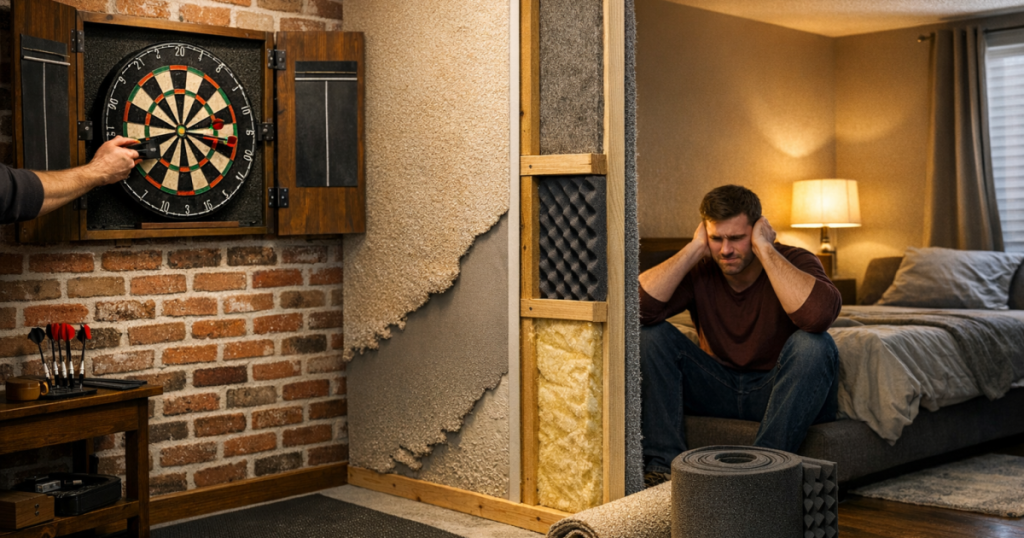
Hearing every dart land through a shared wall is frustrating for neighbours and awkward for the player. The aim is to reduce dartboard noise by separating the board from the wall, softening the impact path, and moving as much vibration as possible away from the adjoining structure.
Structural alterations, electrical relocation, or building a secondary acoustic lining on a shared wall should be handled by qualified professionals so the work complies with UK safety requirements, building standards, and any tenancy or party-wall conditions.
The short version
- Move the board first if you can. A dartboard on an internal non-shared wall is usually easier to quieten than one fixed directly to a party wall.
- Treat vibration, not just sound. The dull thud from darts is often structure-borne vibration travelling through the wall, not simply airborne noise in the room.
- Decouple the board. A freestanding stand, isolated backing board, or carefully mounted cabinet can reduce the force transferred into the wall.
- Stop rattles early. Loose doors, metal brackets, scoreboards, lights and badly seated boards can make a small noise problem feel much worse.
- Test one change at a time. Throw a consistent set, listen from the adjoining room, then decide whether the next fix is worth doing.
Work out what kind of noise is travelling through
Dartboard noise is not one single problem. The fix depends on whether the neighbour hears a low thud, a sharp tap, a rattle, or general room noise from people talking and moving around.
Low thud from dart impact
This is the common shared-wall complaint. The dart hits the board, the board transfers energy into its mounting bracket, and the wall behaves like a sounding board. Solid masonry, dot-and-dab plasterboard, and studwork can all carry vibration, but they behave differently. Adding a thin soft layer behind the board rarely solves this on its own because the force is still being pushed into the same structure.
Sharp clicks and rattles
These usually come from hardware rather than the wall itself. A loose number ring, cabinet door, lighting bracket, scoreboard, or board that is not sitting firmly can add higher-pitched noise. Before adding sound treatment, check the simple mechanical issues. A stable board also makes practice more consistent; for more on the role of board condition, see how dartboard quality affects scoring, wear and practice.
Airborne room noise
Conversation, celebrations, footfall and music are different from dart impact. Soft furnishings can help with echo inside the room, but they will not fully stop impact vibration passing through a shared wall. Treat them as supporting measures, not the main solution.
Step 1: move the dartboard away from the shared wall if possible
The most effective change is often the least glamorous: use a different wall. If your dartboard is fixed to a party wall in a terraced house, semi-detached home or flat, every throw is feeding vibration into the wall your neighbour shares. Moving the board to an internal wall can make a noticeable difference before you buy or build anything.
Check the practical layout before moving it:
- Throwing distance: keep your oche measurement accurate after the move, not roughly close.
- Ceiling clearance: make sure your throwing arc and lighting still work comfortably.
- Walkways: avoid placing the oche across a doorway, kitchen route, or route to a staircase.
- Background surface: choose a wall where missed darts can be managed with a surround or backing panel.
- Neighbouring rooms: avoid putting the board against a wall that backs directly onto a bedroom if you practise in the evening.
If the shared wall is the only usable wall, the next best approach is to keep the board from behaving as though it is bolted straight into the structure.
Step 2: separate the board from the wall
Decoupling is the key idea. Instead of allowing the dartboard bracket to transfer impact directly into the shared wall, you create a mounting arrangement that absorbs, spreads or redirects some of that energy.
Use a freestanding dartboard stand
A stand takes the board off the wall entirely. That can be a strong option in rented homes, flats, spare rooms and multipurpose rooms where drilling into a party wall is awkward. The trade-off is that vibration may move into the floor instead, so it is worth using the stand on a mat or rug and checking whether downstairs rooms hear it.
Set the stand up carefully. A wobbly stand can make noise worse because the board rocks after every impact. Use it on a flat surface, check the height, and make sure the oche line still gives you a comfortable and legal throw.
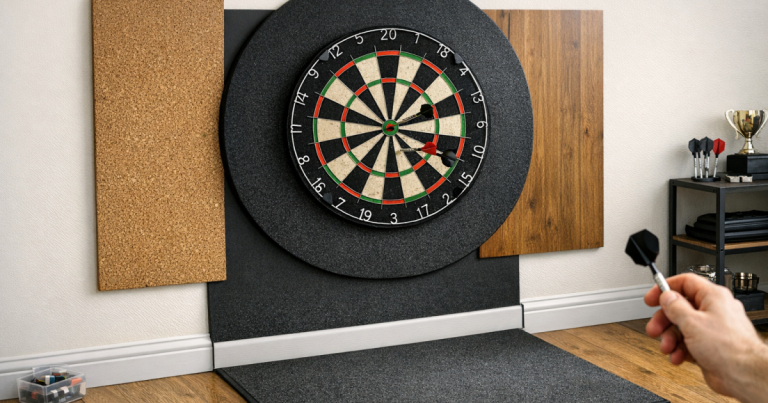
Mount the board to a larger backing panel
A backing panel can spread the impact over a larger area rather than concentrating it through a small metal bracket. The panel should be solid enough to hold the board securely, but the important detail is what sits between that panel and the wall. Rubber isolation pads, dense felt, or purpose-made anti-vibration fixings can reduce direct transfer better than a hard board screwed tight to the plaster.
Do not overtighten every fixing until the panel is crushed hard against the wall. If every layer is clamped rigidly together, you have rebuilt the same vibration path. The fixings still need to be secure, but the isolation layer has to be allowed to do some work.
Use a cabinet with care
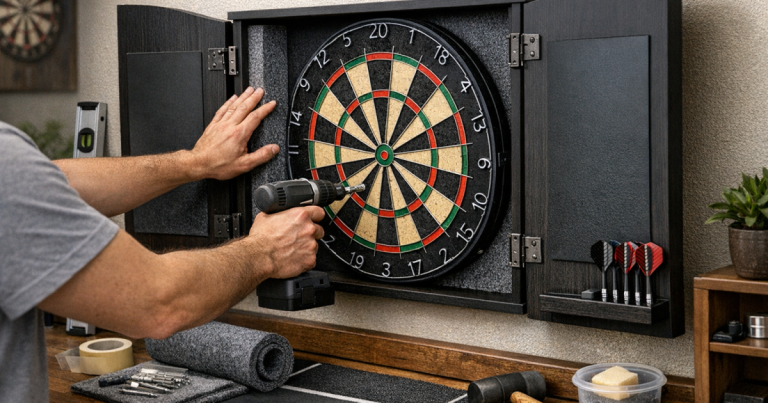
A dartboard cabinet can help by adding mass, storage and a wider mounting surface, but it can also introduce rattling doors if fitted poorly. Use soft pads where doors close, check hinges, and avoid loose accessories inside the cabinet during play. If you are planning a full board area rather than a quick fix, the ideas in building a tidy dartboard wall with cabinets and surrounds are useful for keeping the setup neat as well as quieter.
Step 3: quieten the board before changing the room
Small mechanical faults can travel surprisingly well through a wall. Spend ten minutes checking the board area before adding acoustic materials.
- Seat the dartboard properly on the bracket. It should not rock when pressed gently at the edges.
- Use board wedges if needed. Wedges can reduce movement between the board and the wall or cabinet surface.
- Tighten the number ring carefully. A loose ring can create a metallic buzz on impact.
- Remove loose items nearby. Spare shafts, flights, chalk, coins and keys in a cabinet can rattle with every throw.
- Check the surround. A poorly fitted surround can tap against the wall or cabinet rather than absorbing misses cleanly.
- Rotate and maintain the board. A very worn section can sound harsher and behave less consistently than a fresh segment.
This stage is not glamorous, but it is cheap, quick and easy to reverse. It also helps you identify whether the wall is really the problem or whether the setup itself is amplifying the impact.
Step 4: soften the surrounding area
Once the board and mount are stable, treat the room around it. This will not fully isolate a shared wall, but it can reduce sharp reflections and make practice sessions less intrusive overall.
- Add a darts mat or rug. This helps with footfall, dropped darts and the general feel of the oche area.
- Use a proper surround. It protects the wall from missed darts and can soften some edge impacts.
- Avoid bare, echoey rooms. Curtains, fabric seating and rugs can tame the room sound better than hard floors and empty walls.
- Protect skirting and lower wall areas. Misses and bounce-outs can create separate impact noise lower down the wall.
Noise control and damage control often overlap. If you are also trying to keep the room looking presentable, these methods pair well with protecting walls and skirting boards around a dartboard.
Step 5: test from the neighbour’s side of the wall
Do not judge the result only from inside the darts room. The player may hear a fairly normal board impact while the adjoining room hears a dull knock through the wall. If you can, ask someone to stand in the next room while you throw a consistent set of darts at a normal pace.
A phone recording can help you compare before and after changes, but treat it as a rough comparison rather than a precise sound test. Use the same throwing position, same darts, same time of day and same number of throws. Write down what changed and what the listener noticed.
Try this order:
- Throw ten darts with the current setup and note the sound from the other side.
- Remove obvious rattles and repeat the test.
- Add wedges, pads or cabinet door buffers and repeat.
- Test a temporary soft layer or isolated backing panel before making permanent fixings.
- If possible, test a freestanding stand in the same room before committing to a wall-mounted solution.
This stops you spending time on changes that only make the playing room quieter while the shared wall still carries the main thud.
What not to rely on
Some common fixes sound promising but do little for the real problem. Thin foam tiles stuck around a dartboard may reduce echo in the room, but they do not usually stop impact vibration travelling through a wall. Egg boxes are not proper acoustic treatment and are not a sensible material for a darts setup.
Heavier darts are not a guaranteed answer either. A heavier dart can land differently, but it can also deliver more impact energy into the board. Changing dart weight should be about throw comfort and scoring consistency, not as your main noise-control method.
Soft-tip electronic boards are not automatically silent. They remove the steel-tip bristle-board impact, but they can introduce plastic impact clicks, cabinet noise and electronic scoring sounds. In a shared-wall situation, the mounting and room layout still matter.
Example fixes for common UK home setups
Terraced house lounge on a party wall
First choice: move the board to an internal wall. If that is not workable, use a cabinet or backing panel with isolation pads and remove all cabinet rattles. Avoid late-night practice against the party wall if the adjoining room is likely to be a living room or bedroom.
Spare bedroom backing onto a neighbour’s bedroom
Focus on timing as well as materials. Even a well-isolated setup can be noticeable in a quiet bedroom at night. A freestanding stand on a rug, positioned away from the shared wall, is often more considerate than a direct wall mount.
Garage conversion or outbuilding wall
Check whether the noise is reaching the house through the wall or through the floor and structure. Hard floors and bare walls can make the room loud, so a mat, soft furnishings and a better mounting layer can work together. If the wall is external rather than shared, the priority may be comfort and echo rather than neighbour disturbance.
Flat with neighbours above, below or beside
Wall impact may not be the only issue. Dropped darts, footsteps and stand vibration can travel through floors. Use a mat, keep the board stable, and test from the rooms most likely to be affected. If you rent, avoid permanent alterations that breach the tenancy agreement.
Common questions
Can I reduce dartboard noise without moving the board?
Yes, but the results depend on the wall. Start by removing rattles, adding board wedges, isolating the mounting point and using a backing panel or cabinet with soft contact points. Moving the board is still the strongest fix when the shared wall is the main path.
Will acoustic foam behind a dartboard stop the thud?
Usually not on its own. Foam can reduce reflections in the room, but the thud is often vibration travelling through the mount and wall. Isolation and secure mounting matter more than decorative foam tiles.
Is a dartboard stand quieter than wall mounting?
It can be quieter through a shared wall because the board is not fixed to that wall. However, a poor stand can wobble, and vibration may travel into the floor, so test it with a mat and check nearby rooms.
Do cabinets make dartboards quieter?
A cabinet can help if it spreads the load and is fitted with soft buffers, but it can also rattle if the doors, hinges or stored accessories are loose. Fit and stability decide whether it helps.
What time should I avoid practising in a shared-wall home?
There is no single rule for every household, but evenings and late nights are when impact noise is most likely to annoy neighbours. If the board backs onto a bedroom or living room, agree sensible practice times where possible.
What stands out
The best results come from treating the dartboard as a vibration problem, not just a noisy object. Move it off the shared wall if you can. If you cannot, isolate the mount, stop rattles, soften the surrounding room and test from the other side of the wall before making permanent changes. A quieter setup is usually built from several small improvements rather than one miracle material.