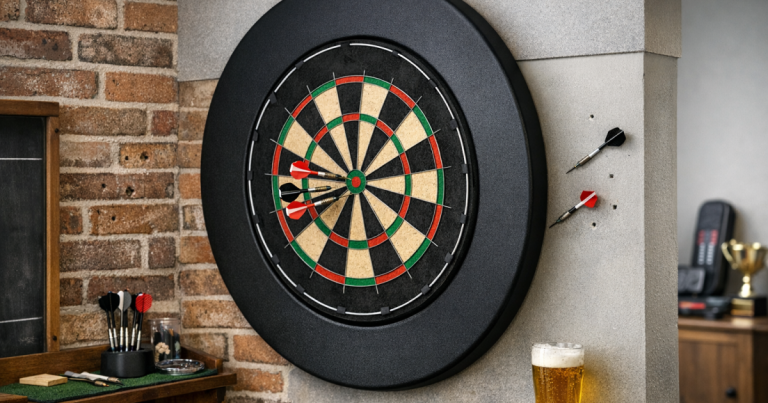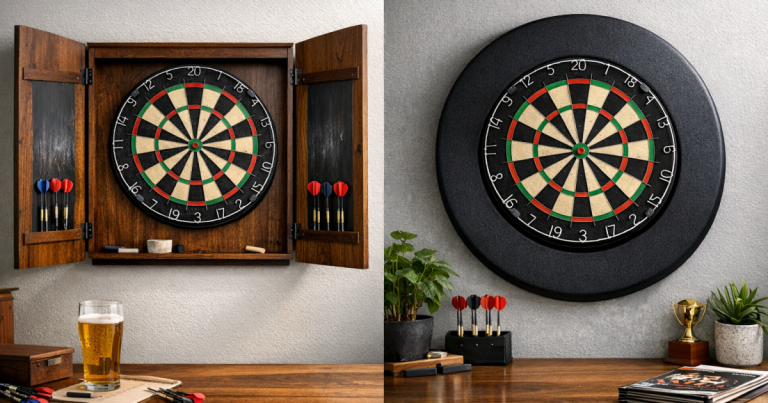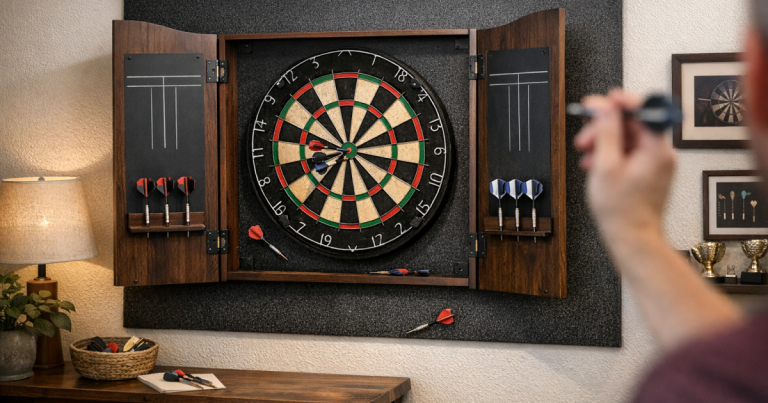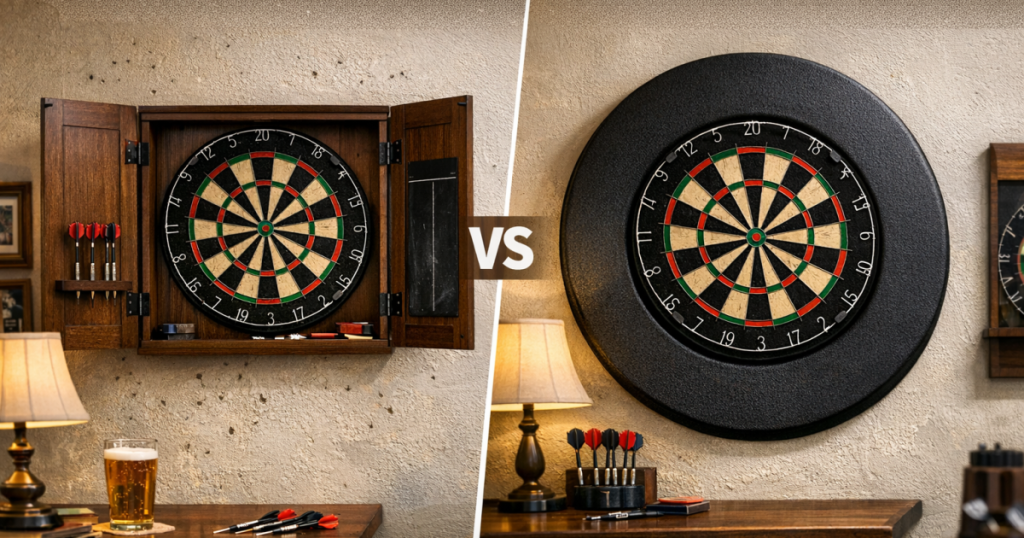
For most home setups, dartboard cabinet vs surround comes down to the type of misses you need to protect against. A surround usually gives better protection immediately around the board, while a cabinet gives useful side coverage, storage and a neater closed look. The strongest wall protection often comes from using the right one for your room, your throwers and the wall surface behind the board.
Drilling, fixing or mounting into walls near electrical routes, plumbing or uncertain wall construction should be carried out by a qualified tradesperson to meet UK safety requirements and the relevant fixing guidance.
At a glance
- Choose a surround if most missed darts land just outside the double ring, especially above, below or diagonally around the board.
- Choose a cabinet if you want side panels, a tidy closed board area, scoreboards inside the doors and somewhere to store darts or chalk.
- Use both if you have enough clearance and want a more complete setup, but check that the cabinet doors still open fully.
- Protect beyond the board if beginners, children under supervision, guests or lively doubles games will use the setup.
- Think about the wall first, because plasterboard, painted masonry, wallpaper and rented-home walls all respond differently to impact and fixing holes.
What a surround actually protects
A dartboard surround is the ring or frame that sits snugly around the board. Its main job is to catch near misses: darts that skim outside the scoring area, hit beside the doubles, or drop slightly low when a thrower releases late. This is the most common damage zone in a normal home darts setup.
Because a surround wraps around the board, it normally gives more consistent close-in coverage than cabinet doors. It helps protect the top, bottom, left and right edges of the danger area. That matters because not all missed darts go sideways. Newer players often miss high and low, and tired throwers can pull darts diagonally across the face of the board.
The limitation is that a surround only protects the area it covers. A dart that flies well wide, bounces off a wire and ricochets, or lands below the board can still mark the wall. A surround also does not hide the board when not in use, and it does not give you built-in scoring panels or storage.
What a cabinet actually protects
A dartboard cabinet is a wall-mounted unit that holds the board and closes over it when play has finished. When the doors are open, they sit either side of the board and can catch some left and right misses. That side coverage is useful in narrow rooms where players tend to pull darts across the board, or where the surrounding wall is painted and easy to mark.
Cabinets are less effective for high, low and diagonal misses unless the design includes extra backing around the board. The doors do not normally protect below the board, and they do not form a full ring around the playing area. If your main problem is chips and pinholes just outside the scoring bed, a surround is usually the more direct solution.
The cabinet’s other advantage is presentation. It can make a board look more deliberate in a living room, dining room or spare room. Closing the doors hides the bristle board, wiring marks from the mounting bracket and any chalkboard or whiteboard panels inside. That is not wall protection in the impact sense, but it can help a darts area sit more comfortably in a shared home space.
Step 1: map where your missed darts really go
Before choosing, spend a couple of sessions noticing your miss pattern. This is more useful than guessing from product photos. Use a temporary sheet of cardboard, cork or thick paper behind the board for a short test period, then check where the marks appear.
If marks cluster close to the board
A surround is the better first line of defence. Near misses around the doubles are exactly what it is designed to handle. This is common when throwers are generally accurate but still clip the outer edge, or when players practise doubles and leave darts just outside the target bed.
If marks sit mainly left and right
A cabinet may help, particularly if the doors open wide enough to create useful side panels. This pattern often appears with right-handed players dragging darts left, left-handed players dragging right, or guests who are still finding a consistent stance.
If marks appear far from the board
Neither a standard cabinet nor a standard surround is enough on its own. You may need a wider backing panel, a dedicated darts wall area, or a rethink of the board position. This is where room planning matters more than the accessory itself.
Step 2: check the wall and room before deciding
The safest setup is the one that protects the wall and gives the thrower a clear, repeatable line. Start with the basics: the bull should be centred at the correct height, the throwing line should be measured from the face of the board, and the area around the oche should be free from furniture, door swings and walk-through traffic.
If you are still choosing the location, use the principles in choosing the safest wall for a dartboard before worrying about cabinet style or surround colour. The wrong wall can leave you fighting problems that no accessory fully solves.
For UK homes, the wall finish matters. Painted plaster can show pinholes and scuffs quickly. Wallpaper can tear around impact points. Exposed brick may shrug off marks but can damage dart points. Plasterboard can need suitable fixings for a cabinet, especially if the board and frame have noticeable weight. A surround has the advantage of being simpler around the board, but the dartboard itself still needs a stable mount.
Where a surround gives better protection
A surround is usually the stronger choice when the main aim is impact protection around the scoring area. It suits regular practice because most serious missed doubles land close to the board rather than across the room. If you are working on finishing, grouping or pressure games, a surround protects the area that takes the most repeated punishment.
It also suits shared rooms where a bulky cabinet would feel too dominant. A plain black or neutral surround can make the board look tidy without adding doors. In a compact flat or spare bedroom, that can be enough to protect the wall while keeping the setup visually simple.
Surrounds are also easy to remove when redecorating, moving house or changing board. The important check is fit. Do not assume every surround fits every board and every lighting ring. Check the board diameter, whether the surround grips firmly, and whether any light, cabinet frame or scoreboard will get in the way.
Where a cabinet gives better protection
A cabinet earns its place when you want side protection plus a cleaner-looking darts station. It can be especially useful in multi-use rooms where the board is visible from the sofa, dining table or home office desk. Close the doors and the setup looks more contained.
Cabinets also help organise the area. Score panels, chalk, spare flights and darts can live in one place, reducing the temptation to place accessories on nearby shelves or furniture. That is handy in family spaces where the darts area needs to reset quickly after a game.
The trade-off is coverage shape. Cabinet doors protect the sides better than the top and bottom. If your ceiling height is low, your throwers are inconsistent, or your wall already has marks underneath the board, a cabinet alone may leave the most vulnerable area exposed. You may also need to check door clearance if the board is near a corner, shelving unit or curtain pole.
Can you use a cabinet and surround together?
Yes, but compatibility is the deciding factor. Some cabinets have enough internal space for a slim surround around the board; others do not. The surround may stop the doors closing, push against the cabinet frame, or make it awkward to rotate the board. Measure the available space inside the cabinet and compare it with the surround’s outer size before committing.
If both fit well, the combination can be excellent. The surround protects the full close-in impact zone, while the cabinet doors add side coverage and tidy the setup when closed. It is a good solution for enthusiastic home players who use the board often but still need the room to look presentable.
Be realistic about thickness and access. You still need to remove the number ring or rotate the board when required, and you do not want the cabinet frame to interfere with darts landing near the edge. If the setup becomes fiddly, it will be harder to maintain properly.
Rented homes and removable setups
In a rented home, wall protection is not just about dart holes. It is also about fixing holes, scuffed paint, adhesive residue and how easy the setup is to remove cleanly. A surround can reduce impact marks, but the board still needs a secure mounting point. A cabinet may create a tidier footprint but can require more substantial fixings.
Before drilling, check your tenancy terms and think about how the area will look when the board comes down. If you need a lower-impact approach, the advice in dartboard cabinets and surrounds for rented homes is a useful next step, especially if you are trying to balance protection with removability.
For many renters, a freestanding backing panel or a removable board stand may be worth considering alongside a surround. It will not suit every room, and it needs to be stable, but it can reduce the number of wall fixings involved.
Open-plan rooms need wider thinking
Open-plan spaces create different problems. The board may share a wall with a dining area, kitchen walkway or lounge furniture. In that setting, a neat cabinet can help the darts area feel contained, but a surround may still be needed to protect the wall from regular play.
Think about sight lines, lighting, traffic and where people naturally stand during a game. A missed dart is not the only risk; players also need enough room to retrieve darts without stepping into furniture or brushing past people. For layout decisions, the room-planning approach in planning a darts area in an open-plan room will help you position the board before choosing the finish around it.
Practical checks before fitting either option
- Measure the board area: check the space above, below and beside the board, not just the board itself.
- Check door swing: cabinet doors need room to open fully without hitting walls, shelves or lights.
- Confirm surround clearance: make sure the surround does not clash with a cabinet frame, light ring or scoreboard.
- Look below the board: low misses and bounce-outs can mark skirting boards, radiators or furniture.
- Plan the oche: a clear throwing line helps players stand consistently, reducing wild misses over time.
- Test lighting: shadows around the doubles can increase near misses, making wall protection work harder than it should.
- Keep the setup maintainable: you should still be able to rotate the board and clean around the mount without dismantling half the area.
Common mistakes that lead to wall damage
The biggest mistake is treating wall protection as an afterthought. Once a board is mounted, players start throwing, and the wall tells the truth very quickly. It is much easier to plan coverage before the first proper session than to patch paint afterwards.
Another common mistake is protecting only the sides because cabinets look wide in photos. Side doors are helpful, but they do not replace a full close-in ring if your misses are above, below or around the doubles. Equally, a surround does not make the wider room safe if beginners are missing by a large margin.
Finally, avoid choosing purely by appearance. A cabinet that looks smart but leaves the lower wall exposed may disappoint in daily use. A surround that protects well but clashes with door clearance may become annoying. The best answer is the one that matches your miss pattern, wall surface and room layout.
Common questions
Does a cabinet protect the wall better than a surround?
Not usually for close misses around the board. A surround gives more even coverage around the scoring area, while a cabinet mainly adds side protection and a neater closed appearance.
Is a surround enough for beginners?
It depends how wide the misses are. If darts are landing just outside the board, a surround helps a lot. If they are missing by a large distance, use wider backing or rethink the board location.
Will a surround fit inside any dartboard cabinet?
No. Cabinet depth, internal width and door clearance vary. Measure the cabinet space and check the surround’s outer size before trying to combine them.
What is best for a living room setup?
A cabinet looks tidier when closed, but a surround gives stronger close-in protection during play. In a shared living room, the best arrangement is often a cabinet plus a compatible surround.
How do I stop darts damaging the wall below the board?
Look beyond cabinets and surrounds. A wider backing panel, better lighting, a stable oche and practice consistency all help reduce low misses and bounce-out damage.
What to remember
If your priority is pure protection around the dartboard, choose a surround first. It covers the most common impact zone and is the simpler fix for regular home practice. If your priority is a smart, contained setup with side panels and storage, a cabinet makes sense. If the room allows it, combining the two gives the most balanced result.
The best wall protection is not the biggest accessory; it is the setup that matches how people actually throw in your room. Watch the miss pattern, check the wall surface, measure the clearances and choose the option that solves the real problem rather than the one that only looks right in product photos.
Quick Buying Links
Dartboard Cabinet
For most home setups, dartboard cabinet vs surround comes down to the type of misses you need to protect against.
Surround: Which Gives Better Wall Protection?
Worth considering if its strengths better match your needs.