Planning a darts area around doors and windows is mainly about controlling movement, sightlines and missed-dart risk before you worry about decoration. A good layout keeps the throw clear, stops people walking through the line of play, and avoids putting glass, handles or opening doors in the danger zone.
Start with the fixed measurements, then test how the room actually behaves: which way doors swing, how windows open, where people pass, and where furniture naturally gets pushed during daily life.
At a glance
- Keep the dartboard away from any door that can open into the throwing lane or board area.
- Avoid placing the board directly on, beside or opposite fragile window glass unless there is a reliable solid backing and a safe miss zone.
- Allow the standard steel-tip oche distance of 2.37 m from the face of the board, plus comfortable standing room behind the thrower.
- Check the full door swing, not just the door frame, because the handle edge often reaches further into the space than expected.
- Think about normal household movement: pets, children, visitors, kitchen traffic and anyone entering the room mid-leg.
Step 1: mark the official playing footprint first
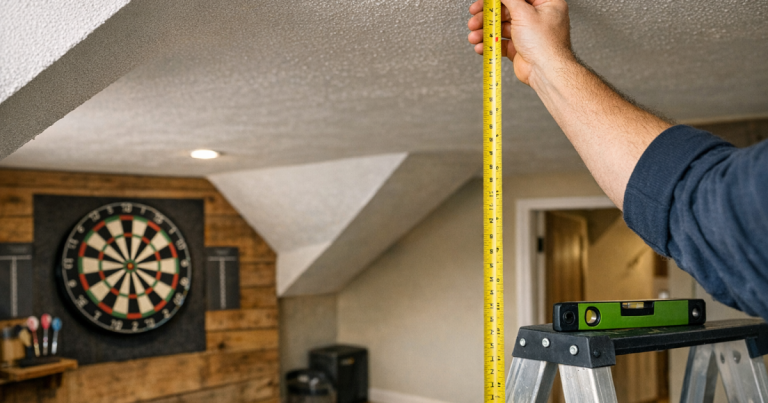
Before judging doors or windows, mark the playing footprint. For a standard steel-tip home setup, the bullseye sits 1.73 m from the floor, measured to the centre of the bull. The oche is 2.37 m from the face of the board, not from the wall behind it. If the board sits in a cabinet or on a mounting bracket, measure from the board face.
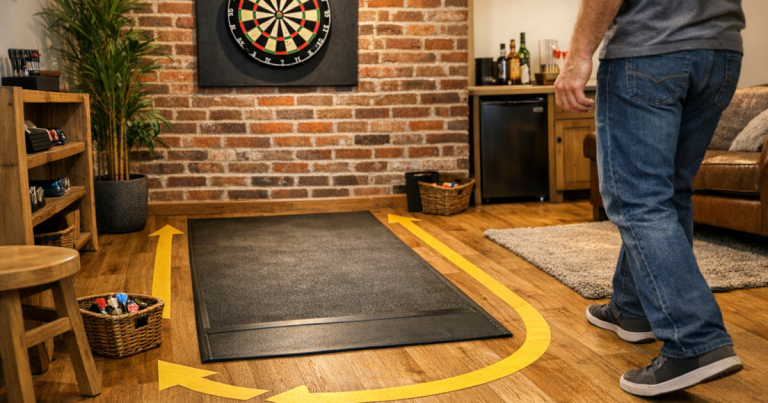
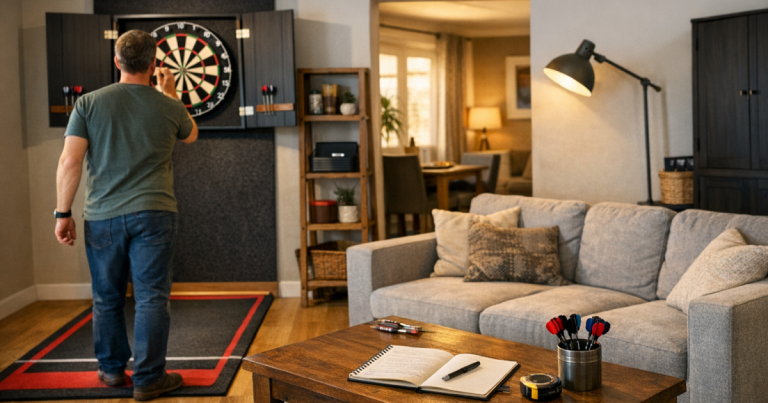
Use low-tack tape, a removable marker or a mat to show the throw line. Then stand at the oche with your normal stance. You need enough room to lean, step back, collect your darts and let another player stand clear without being squeezed into a doorway. If the oche lands in a route between rooms, the layout will feel awkward even if the tape measure says it technically fits.
A mat can help make the boundary obvious, especially in a lounge or dining space where people are used to walking through. For more detail on fitting that boundary around sofas, chairs and sideboards, see our guide to planning a darts mat zone around everyday furniture.
Step 2: test every door before choosing the board wall
Doors cause two common problems: they swing into the board area, or they bring people into the line of throw without warning. Both are layout problems rather than equipment problems, so deal with them early.
Open each nearby door fully and mark its swing arc on the floor. Include the handle, because it can be the part that intrudes furthest into the room. Then stand at the proposed oche and imagine someone opening the door while a dart is in hand. If the door edge, handle or person entering the room would cross the throwing lane, do not use that position for live play.
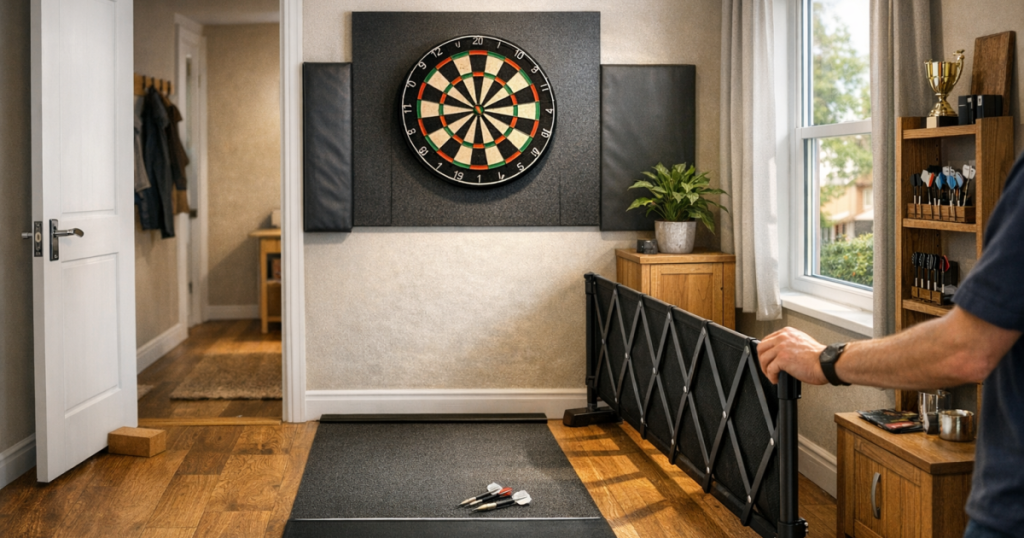
The safest door arrangement is usually a door behind and to the side of the thrower, with the person entering clearly visible before they reach the oche. A door directly beside the dartboard can work only if it opens away from the board area and does not encourage people to pass close to the wall while darts are being thrown. A door behind the board is rarely ideal, because missed darts and bounce-outs can travel into a zone where someone may appear unexpectedly.
Step 3: treat windows as a hard boundary, not spare wall space
Windows are tempting in smaller UK rooms because the wall either side may be the only uninterrupted space. The issue is not just broken glass. A window can create glare, reflections, cold draughts, awkward curtains and a poor sense of depth behind the board.
A dartboard should not be mounted directly over a window or onto a surface that is not designed to take the board securely. If the window is adjacent to the board, allow a generous miss area so that a wide dart cannot strike the glass, handle, blind rail or frame. Remember that beginners, guests and tired players miss by more than regular throwers expect.
Also check how the window opens. A side-hung casement can swing into the room and become a hard edge near the board. A top-hung opener may not affect the throw, but it can change light and airflow. Curtains can bunch into the board surround, while blinds may rattle or sit too close to the missed-dart area. If the only available wall sits near glazing, test the setup with the curtains, blinds and window in their normal positions, not just when the room is tidied for measuring.
Step 4: keep the throwing lane out of household traffic
A technically correct oche is not enough if it runs across the path to the kitchen, hallway, patio door or stairs. The throwing lane should feel like a temporary play zone that everyone in the home can recognise quickly.
Look for routes people use without thinking. In a lounge, that might be the path from the sofa to the door. In a kitchen-diner, it might be the route from the back door to the worktop. In a spare room, it may be the line from the door to a wardrobe. If the oche sits on one of these routes, players will constantly pause for interruptions, and non-players may forget that a throw is about to happen.
Open-plan layouts need extra care because there is often no obvious doorway to define the play zone. If your space blends lounge, dining and kitchen areas, our advice on planning a darts area in an open-plan room will help you think through sightlines and shared movement.
Step 5: choose the least risky wall, not just the neatest one
When doors and windows limit your options, rank each wall by what sits behind, beside and opposite it. A clear internal wall with no glazing nearby is usually easier to manage than a visually attractive spot between a door and a window. The best-looking wall can be the worst playing wall if it puts the board in a busy corner.
Use this order of preference as a quick filter:
- A solid wall with no door swing, no window glass and a clear oche directly in front.
- A wall near a door where the door opens away from the board and does not cross the oche.
- A wall near a window only if the glass is outside the realistic miss zone and light can be controlled.
- A wall opposite a door only if people entering can see the board and stop before the throw line.
- A wall between a door and a window only when there is enough side clearance for missed darts and normal movement.
If you are still deciding between two possible positions, it is worth working through the broader safety checks in our piece on choosing the safest wall for a dartboard.
Common room examples
Board on the wall beside a lounge door
This can work if the door opens outwards or away from the board, and if the person entering does not step straight across the throw. Add a clear pause habit: no one enters the playing area while a player is on the oche. If the door opens inwards towards the board wall, look for another wall or adjust the room layout so the board is no longer in the swing arc.
Board near French doors or patio doors
Be cautious. Large glass doors create a wide fragile background and often sit on a high-traffic route to the garden. They can also add glare during daytime play. If the throw line points towards the doors, the position is usually unsuitable. If the board is on a solid side wall nearby, check that bounce-outs and wide misses cannot reach the glass.
Board in a bay-window room
Bay windows can make measurement awkward because the room shape narrows and widens. Do not measure only the longest line in the room. Stand at the oche and check shoulder room, collection space and the path back to seating. A bay may also push curtains into the side area, so keep fabrics and cords away from the board and miss zone.
Board in a hallway or through-room
Hallways often look long enough, but they are usually poor choices because they are built for movement. Doors open onto them, people appear suddenly, and there is rarely a safe waiting area behind the thrower. If a hallway is the only possible spot, use it only when the route can be fully closed off during play.
Practical checks before you commit
Once you have a likely position, run through the room as it is actually used, not as an empty floor plan. A few minutes of testing can save you from drilling, re-measuring or constantly moving furniture later.
- Stand at the oche and ask someone to open each nearby door slowly; nothing should enter your throwing space.
- Check whether a person entering the room can see the player before stepping into the lane.
- Throw imaginary darts and collect them, making sure you do not have to step around a door, chair or window recess.
- Close curtains and blinds, then open them again, checking for glare, fabric movement and side obstruction.
- Look at the wall from a beginner’s miss pattern, not just your own accuracy.
- Confirm that pets and children can be kept out of the playing area while darts are in use.
- Check evening lighting as well as daytime light, because windows can reflect lamps and make the board harder to read.
Small adjustments that make the space easier to live with
You do not always need a dedicated games room. In many homes, the best setup is one that can switch neatly between daily living and darts. A visible oche line, a clear waiting spot and a habit of closing nearby doors during play can make a shared space feel much more controlled.
Wall protection helps with missed darts, but it does not make an unsafe door or window position safe. A surround or cabinet can reduce marks around the board; it cannot stop someone walking through the throw or protect a window that sits in the line of a bad miss. Treat protection as a finishing layer after the layout has passed the movement checks.
If window glare is the only problem, test the room at the times you actually play. Evening darts under room lighting can feel very different from a bright weekend afternoon. Sometimes a slight board shift along the same wall is enough to avoid reflection without changing the whole setup.
Helpful questions
Can I put a dartboard on the back of a door?
It is usually a poor choice for steel-tip darts. Doors move, flex and bring people into the board area. A fixed wall is normally safer, quieter and easier to measure from accurately.
How far should a dartboard be from a window?
There is no single universal distance because it depends on the angle, glass position and player accuracy. As a rule, keep glass well outside the realistic miss zone and avoid any setup where a wide dart could hit the window, frame or handle.
Is it safe to play with a door behind the thrower?
It can be, if the door is behind and offset so nobody steps into the throwing lane. If someone entering would cross the oche or distract the player mid-throw, choose a different layout.
What if the only clear wall is between a door and a window?
Test the full door swing, window opening, curtains and miss zone before fitting anything. If either side creates a realistic hazard, the wall is not truly clear enough for regular play.
Should I plan for guests who are less accurate?
Yes. A home darts area should work for the least accurate regular player, not just the best one. Wider miss zones make the setup more relaxed for family games and league-night practice alike.
What stands out
The best position is the one that keeps the board, oche and retrieval path away from opening doors, glass and everyday traffic. Measure the official playing distance, then test the room in motion: doors opening, people entering, curtains moving and light changing. If a layout feels safe only when everyone remembers a complicated rule, it is probably the wrong spot. A clear, boring wall with predictable movement around it will usually beat a neater-looking corner that fights the way the room is used.