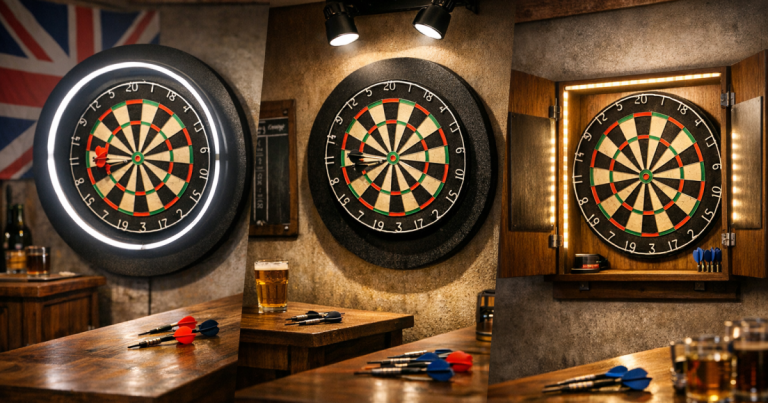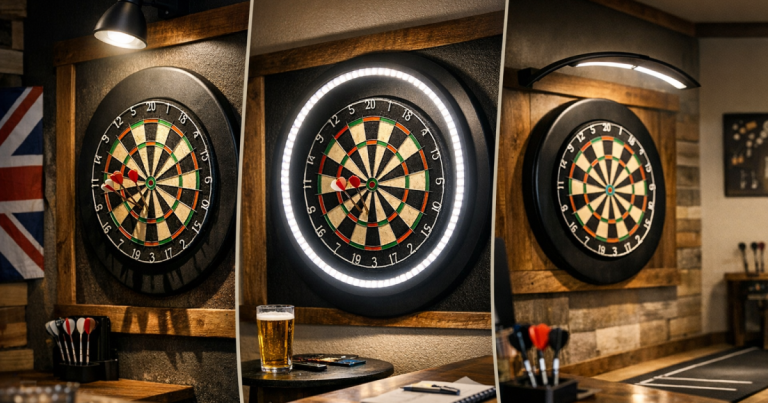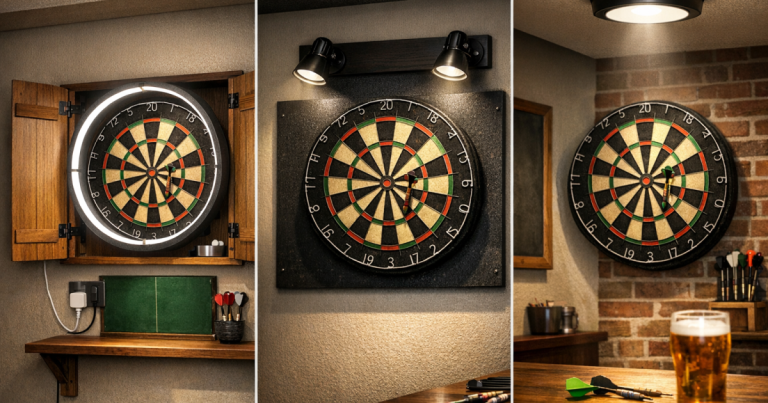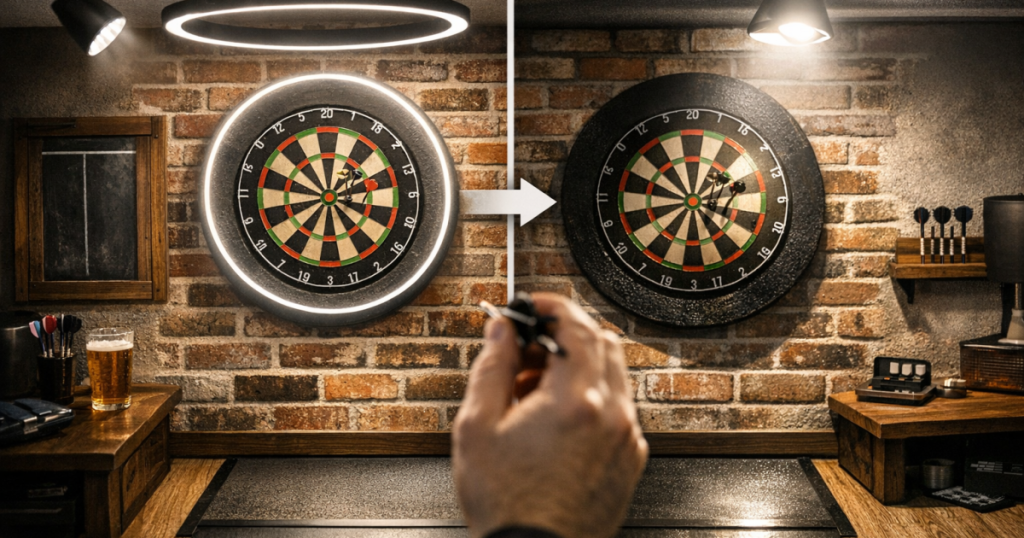
Good lighting makes a home oche feel calmer, safer and easier to read, but glare-free darts lighting is not just about making the board brighter. The real aim is to light the scoring bed evenly without shining into the player’s eyes, throwing hard shadows across the treble ring, or creating trip hazards around the throw line.
Fixed mains electrical installation, new ceiling fittings and hard-wired lighting controls should be carried out by a qualified electrician to comply with UK electrical safety requirements and applicable Building Regulations.
Main points
- Light the board first, then the room. The dartboard needs clear, even visibility, while the rest of the space only needs enough light for safe movement.
- Avoid bare bulbs, exposed spotlights and low fittings that sit in the player’s sightline.
- Check the throw from the oche, not just the view from in front of the board, because glare often appears only when you stand back.
- Control shadows by lighting from more than one angle or by using a dartboard-specific light that wraps illumination around the scoring area.
- Keep cables, plugs and loose floor lighting away from the walking route and throwing stance.
What glare actually does to a darts setup
Glare is not always obvious when you first switch a light on. It can show up as a bright reflection on the wires, a white hotspot near the bull, a harsh shine on a cabinet door, or a lamp that catches your eyes just as you start your throw. In a home setup, it is often caused by using normal room lighting for a very specific task.
Darts asks for a clear view of narrow scoring segments from a fixed distance. If the board is dim, you strain to read the bed. If the light is too harsh or badly placed, your eyes adapt to the bright source rather than the target. Either way, the throw feels less natural.
There is also a safety angle. Poor lighting makes it easier to step on a fallen dart, misjudge the oche, or walk into furniture around the playing area. A bright but badly positioned lamp can be just as awkward as a gloomy corner.
Start with the board, then balance the room
The board is the priority. You want the scoring face to be evenly visible from the throw line, with the numbers, doubles, trebles and bull all easy to distinguish. A single ceiling pendant in a typical UK spare room or garage often leaves one side of the board brighter than the other, especially if the player stands between the light and the board.
A good first check is to stand at the oche and look for three things: whether the top of the board is brighter than the bottom, whether your throwing arm casts a shadow, and whether any lamp or reflection sits directly behind the board in your line of sight. For a deeper look at brightness, colour temperature and placement, see the guide to dartboard lighting levels and colour temperature.
Room lighting still matters, but it has a different job. It should help people move around safely, find dropped darts and keep the space comfortable between throws. It does not need to flood the board from every direction. In many home setups, the best result comes from combining soft general lighting with more focused board lighting.
Task light, room light, or both?
A task light is aimed at the dartboard or playing zone. Room lighting is the general light that makes the rest of the space usable. Treating those as separate jobs helps avoid over-bright rooms and under-lit boards.
- Task-first setups: Useful in garages, sheds and alcoves where the board is the main focus. The risk is creating a bright target in an otherwise dark room, so add enough background light for safe walking.
- Room-first setups: Common in lounges and multi-use rooms. They feel natural for everyday use, but may cast shadows over the board unless the light source is well placed.
- Balanced setups: Often the most comfortable for regular practice. The board is clearly lit, while the room remains softly illuminated rather than gloomy.
If you are unsure which approach fits your room, the difference is covered in more depth in task lighting versus room lighting for darts setups.
Placement matters more than raw brightness
Brighter is not automatically better. A very bright lamp in the wrong place can flatten the board, create hard shadows, or make the wires sparkle. Placement, diffusion and angle usually make a bigger difference than chasing the highest output figure on a box.
For most home players, the safest starting point is to avoid lights that shine towards the thrower. Wall-mounted or board-mounted lighting should direct light onto the board, not back into the room. Ceiling lights should not hang so low that they enter the player’s eye line or feel intrusive during the throw.
Shadows usually appear when the main light is behind the player or strongly off to one side. If you can see your arm shadow moving across the board during practice, the light is fighting your throw. A wraparound or multi-angle board light can reduce this effect, but you should still check how it behaves from your exact oche position.
Colour, diffusion and reflections
Colour temperature affects how comfortable the board feels to look at. Very warm light can make the board look cosy but slightly muted, while very cool light can feel crisp but harsh in a small room. Many players prefer a neutral white balance because it keeps the board clear without making the space feel clinical. Always judge it in the actual room, because wall colour, cabinet finish and daylight can change the effect.
Diffusion is just as important. A shaded or diffused fitting spreads light more softly than a bare bulb or narrow spotlight. This helps reduce hotspots on the metal dividers and makes the board easier to read over a longer session.
Reflections often come from glossy surroundings rather than the board itself. Cabinet doors, glass frames, polished shelves and bright wall paint can all bounce light back towards the oche. If the board sits inside a cabinet, test with the doors both open and closed, because the light pattern can change noticeably.
Dedicated dartboard lights in context
Dartboard-specific lighting can be a tidy solution because it is designed around the target rather than the whole room. Familiar examples include Target Corona Vision Dartboard Lighting System, Winmau Plasma Dartboard Light and Mission Torus 270. The point is not that every home oche needs a named lighting system, but that these products show the value of lighting the board evenly from close to the target.
Before using any dedicated light, verify how it mounts, whether it works with your surround or cabinet, how close it sits to the board, and whether it leaves enough space for removing darts comfortably. Do not assume that every board light suits every wall layout. A compact setup in a hallway alcove has different constraints from a full darts wall in a garage.
Safety checks around the oche
Safe lighting is partly about visibility and partly about the physical setup. A neat cable route matters more than it might seem, because darts sessions involve repeated walking between the oche and the board. Loose leads, extension blocks near the throw line and temporary lamps on the floor are all easy to catch with a foot.
- Keep cables away from the oche and the direct walking path to the board.
- Use stable fittings rather than balancing lamps on shelves, stools or cabinet tops.
- Make sure any plug-in lighting can be switched on and off without reaching across the board.
- Avoid placing light sources where a missed dart could strike a fragile shade or exposed fitting.
- Check that the area around the board remains visible enough to find bounce-outs and dropped darts.
It is also worth confirming the basics of your throwing position before judging the light. If the board or oche is slightly wrong, shadows and sightlines can be misleading. Use the guide to dartboard height and throwing distance to make sure the setup is correct before fine-tuning the lighting.
How to test a lighting setup before settling on it
A quick test session tells you more than standing by the board and looking at it. Set the lights as you normally would, stand at the oche, and throw a few visits at different targets: 20s, 19s, bull, doubles at the sides, and the lower segments. You are looking for comfort, not just brightness.
- Check the eye line: Pause before throwing and notice whether any lamp is pulling your attention away from the board.
- Watch your arm shadow: If it crosses the treble bed as you release, change the angle or add softer support light.
- Read the numbers: The number ring should be easy to see without squinting, even after several minutes.
- Look for hotspots: Bright patches on wires or cabinet edges usually mean the light is too direct.
- Test with the room in its normal state: Evening practice, curtains closed and doors open can all change how the light behaves.
If several people use the setup, test from different heights and stances. A light that feels fine for one thrower may sit directly in another player’s eye line.
Common home setup scenarios
Spare room or office
These rooms often have one central ceiling light and pale walls. The challenge is usually shadows from the player and reflections from furniture. A board-focused light plus softer room lighting can work well, provided the cables are tidy and the fitting does not dominate the room.
Garage or shed
Garages and sheds can be darker, colder-looking and more unevenly lit. Avoid relying on a single harsh strip or exposed lamp if it leaves the board patchy. Background light is useful here, because you also need to see the floor, storage items and any steps or thresholds.
Lounge or shared family space
The aim is usually to keep the setup comfortable without making the room feel like a practice hall. Soft ambient lighting can stay, but the board may need its own controlled light to avoid shadows from sofas, doorways or people moving behind the oche.
Cabinet or surround setup
Cabinets and surrounds change how light falls around the board. Cabinet doors can block or reflect light, while a dark surround may make the board appear brighter by contrast. Test the lighting with the setup exactly as you play, not with parts removed.
Helpful questions
Can normal ceiling lights be enough for darts?
Sometimes, but only if they light the board evenly from the oche and do not put your throwing arm in the way. Many rooms need extra board-focused lighting to remove shadows.
Is a ring-style dartboard light safer than a lamp near the board?
It can be neater and less likely to create glare, but safety depends on correct fitting, cable routing and compatibility with your board area. Always follow the manufacturer’s instructions.
Should the area behind the player be dark?
No. A little background light helps with movement, dropped darts and comfort. The board should be the clearest part of the setup, but the rest of the room should not be blacked out.
Why does my board look fine close up but poor from the oche?
The viewing angle changes. From the oche, you may see reflections, shadows or lamp glare that are invisible when standing beside the board.
Do cabinets make glare worse?
They can if the doors or finishes reflect light towards the thrower. Matte finishes and careful light angles usually reduce the problem.
Main lessons
Good darts lighting should make the board clear without making the light source noticeable. The most reliable approach is to set the board and oche correctly, light the scoring face evenly, keep the wider room safe to move through, and test the result from the actual throwing position.
Safe, glare-free darts lighting is less about buying the brightest fitting and more about controlling where the light goes. If your board is easy to read, your eyes feel relaxed, your arm shadow stays off the target, and the floor around the oche is clear, the setup is doing its job.