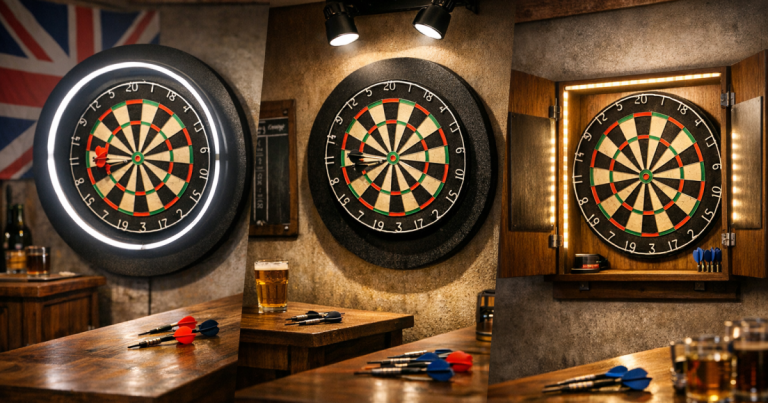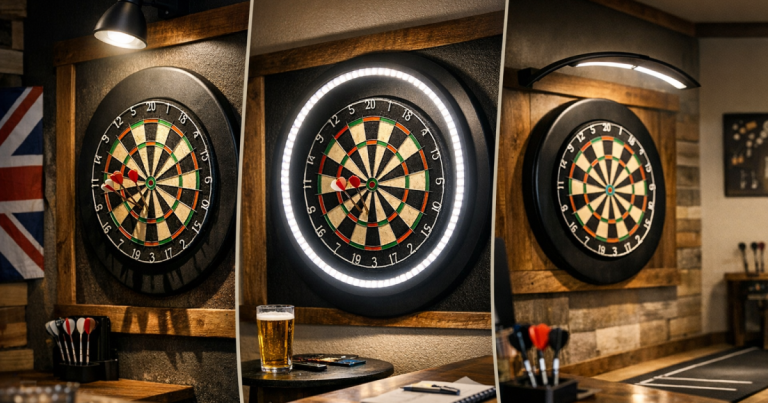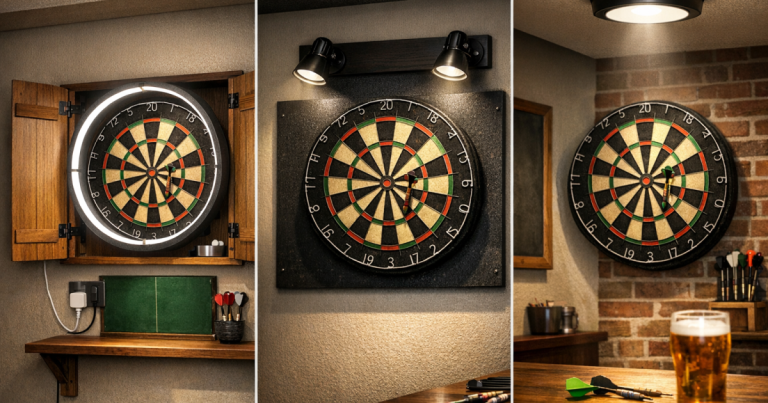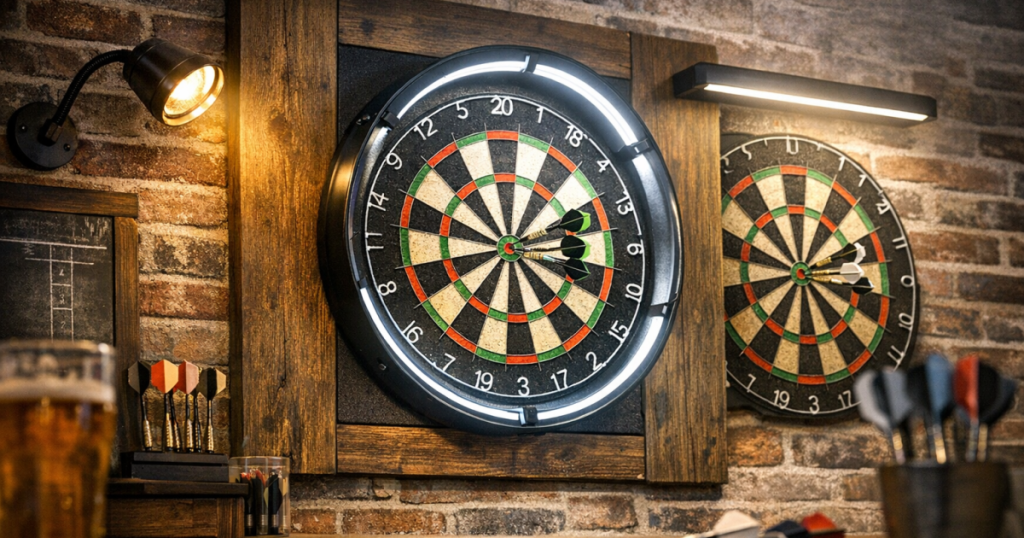
Good lighting makes a home board feel sharper, fairer and easier to enjoy. The aim with dartboard lighting levels is not to flood the whole room with brightness; it is to light the board face evenly enough that you can see the segments, wire and dart positions without glare, harsh shadows or eye strain.
Mains wiring for fixed wall lights, ceiling spotlights or cabinet lighting should be carried out by a qualified electrician to ensure compliance with UK electrical safety requirements and relevant standards.
The short version
For most home darts setups, the best lighting is even, neutral and positioned so the darts do not cast heavy shadows across the scoring area. A dedicated dartboard light ring is usually the simplest route, while ceiling spots and cabinet lights can work well if they are placed carefully and tested from the throw line.
- Brightness: aim for a clearly visible board face rather than a dazzling room. Around 500 to 1,000 lux at the board is a useful home benchmark, provided the light is even.
- Colour temperature: neutral white, often around 4,000K, tends to show the board clearly without feeling too yellow or too stark.
- Placement: put light in front of and around the board, not directly behind the thrower.
- Shadows: check the treble 20, bull and lower segments with darts in the board, because problems often appear only during play.
- Room feel: keep surrounding light softer so the board remains the visual focus without creating a harsh contrast.
If shadows are your main problem, the more detailed shadow-free dartboard lighting guide for small UK rooms is a useful next step, particularly for box rooms, alcoves and garage setups.
Brightness: enough light without glare
Darts lighting is about controlled brightness. A board can be in a bright room and still be poorly lit if the light is coming from the wrong direction. Equally, a modest lamp can make a big improvement if it covers the full board face evenly.
As a practical home target, think in terms of a well-lit task area rather than full sports-hall lighting. The segments should be easy to distinguish from the oche, the number ring should be readable, and darts already in the board should not hide the target bed behind a dark shadow. If you find yourself leaning forward after each throw to confirm the score, the board face needs more usable light.
Too much light creates its own problems. A very intense lamp close to the board can make the wires sparkle, wash out pale colours, or produce a hard reflection from a cabinet or number ring. If the board looks harsh, the fix is not always less brightness; sometimes it is better diffusion, a wider light source or a different angle.
Colour temperature: warm, neutral or cool?
Colour temperature describes whether a light looks warm and yellow, neutral, or cool and bluish. It is measured in kelvin, written as K. In a darts setup, the right colour temperature helps the board look clear without making the room feel clinical.
- Warm white, around 2,700K to 3,000K: comfortable for living rooms and pubs, but it can make some board colours look a little softer and less crisp.
- Neutral white, around 3,500K to 4,500K: a strong all-round choice for home darts because it keeps the board clear while still feeling natural.
- Cool white, around 5,000K and above: can look very sharp, but in a small room it may feel stark, especially if the rest of the room lighting is much warmer.
For most UK home setups, neutral white is the safest starting point. It works well in spare rooms, garages and garden rooms because it gives good contrast without making the space feel like a workshop. If your board is in a lounge or dining area, slightly warmer surrounding lights can still be used, but the light aimed at the board should remain clean and consistent.
Placement matters more than most players expect
The most common lighting mistake is placing a single ceiling light behind the thrower. It may make the room bright, but it sends the player’s body and arm shadow straight towards the board. You then get darker patches that move with every throw.
A better approach is to light from the board side of the room. Ring lights sit around the board and cast light inwards, which is why they are so popular for home setups. They keep the light source close to the target and reduce the long shadows that come from ceiling fittings. Examples include the Target Corona Vision Dartboard Lighting System, the Mission Torus 270 Dartboard Light and the Winmau Plasma Dartboard Light. Check fit, board surround compatibility and mounting method before choosing any specific light.
Spotlights can also work, especially in a room where a permanent ring light is not wanted. The key is symmetry. Two angled lights, one from each side or from above-left and above-right, usually create a more even board face than one strong central beam. The lights should be far enough forward to avoid throwing dart shadows down the board, but not so far forward that they shine into the player’s eyes.
Cabinet lighting is more variable. Some cabinets help frame the board and hide fittings neatly, but a small light at the top of a cabinet may brighten the upper half while leaving the lower board dull. If you use a cabinet, test the bull and lower doubles carefully, not just the treble 20.
How different lighting styles behave
The right setup depends on the room, the board area and how permanent you want the arrangement to be. The main options behave differently in real homes.
Ring lights
Ring lights are designed specifically for dartboards. They surround the board or sit close to its edge, spreading light evenly over the face. Their biggest advantage is shadow control. They are also tidy in smaller rooms because they do not rely on carefully positioned ceiling fittings.
The checks are practical rather than complicated: make sure the light fits around your board, does not clash with a surround or cabinet, and leaves enough clearance for stray darts. Some players prefer a full ring, while others like open-ring designs that leave more access around the board.
Ceiling spots
Ceiling spots suit rooms where you want the darts area to blend with normal room lighting. They can be effective, but the board must be tested from the actual throwing position. A light that looks fine while standing beside the board can create strong shadows once a player steps to the oche.
If you are weighing up rings, spots and cabinet-based lighting, the broader dartboard lighting options guide explains the practical differences in more detail.
Cabinet and wall-mounted lights
Cabinet lights and wall-mounted picture-style lights can look neat in a shared living space. They are best when they spread light widely rather than focusing a narrow beam on one section of the board. Watch for top-heavy lighting, where the upper segments are bright but the lower board looks flat.
Testing your setup from the oche
Lighting should be judged from the throw line, not from directly in front of the board. Stand at the oche, put three darts in different parts of the board, and check whether each dart casts a distracting shadow over common targets. Try the treble 20, treble 19, bull and lower doubles, because each area reveals different lighting weaknesses.
Then look for glare. If the number ring, cabinet edge or wire catches the light sharply, adjust the angle before increasing brightness. A slightly wider, softer beam is usually easier to play under than a narrow bright one.
It also helps to test the room in the conditions you actually play in. Evening sessions in a spare room feel different from afternoon practice with daylight coming through a side window. If daylight hits the board at an angle, blinds or curtains may do more for consistency than adding another lamp.
Match the lighting to the board and surroundings
Bristle boards, electronic boards and training boards can all respond slightly differently to light. A traditional sisal board usually benefits from even, front-facing illumination that shows the segment colours and wire clearly. Electronic boards may have plastic surfaces that reflect certain light angles more noticeably. Training boards with extra markings or reduced target areas need particularly clean contrast.
If you are still deciding which board type fits your room and practice style, the guide to bristle, electronic and training dartboards will help you understand how the board itself affects the setup.
Surroundings matter as well. A white wall close to the board can bounce light back and make the area feel bright, while a dark painted alcove can absorb light and make the board seem duller. Cabinets, foam surrounds and backboards can change the way shadows fall, so lighting is best planned after the main board area is in place.
Common problems and simple fixes
- The player’s arm shadow crosses the board: move the main light source towards the board side of the room or add balanced light from both sides.
- The treble 20 is clear but the lower board is dim: the light is probably too high or too narrow. Widen the spread or adjust the angle down the face.
- The board looks washed out: reduce harsh direct light, use a more neutral colour temperature, or soften the beam.
- The room feels gloomy but the board is bright: add gentle background lighting away from the board so your eyes are not constantly adapting between bright and dark areas.
- Darts cast small hard shadows: try a wider light source, a ring-style setup, or symmetrical lighting rather than one tight beam.
Things readers ask
Is 4,000K good for dartboard lighting?
Yes, 4,000K is a sensible neutral white choice for many home boards. It usually gives clear contrast without looking as yellow as warm white or as stark as very cool white.
Do I need a dedicated dartboard light?
Not always. A well-positioned pair of spotlights can work, but a dedicated dartboard light is often easier because it is designed to reduce shadows across the board face.
Can normal room lighting be enough?
It can be enough for casual play if the board is evenly lit and there are no distracting shadows. For regular practice, a dedicated or carefully aimed board light is usually more consistent.
Should the light be above the board?
It can be above the board, but it should not create a dark lower half or throw shadows from darts across the scoring beds. Test from the oche before settling on the position.
Does lighting change how I should set up the rest of the area?
Yes. Board surrounds, cabinets, wall colour, daylight and the throw line all affect how the lighting behaves. Treat the board area as one complete setup rather than choosing the light in isolation.
What to remember
Good dartboard lighting levels are about even visibility, not maximum brightness. Start with a neutral white light, aim for full coverage of the board face, and check shadows from the throw line with darts already in the board. Ring lights are the simplest solution for many home players, but spots and cabinet lighting can work well when they are placed thoughtfully.
The best test is practical: if you can stand at the oche, see every scoring segment clearly, read dart positions without stepping forward, and throw without glare in your eyes, the lighting is doing its job.