Getting dartboard height and distance right makes home practice feel consistent from the first throw. A board that is a few centimetres too high, or an oche measured from the wall instead of the board face, can subtly change your stance, release and grouping. The good news is that the standard setup is simple once you know exactly where to measure from.
Fixed electrical work for permanent dartboard lighting should be carried out by a qualified electrician to ensure compliance with UK safety requirements; before drilling any wall fixings, check for hidden cables and pipes and use fixings suitable for the wall type.
In brief
- The centre of the bullseye should be 1.73 m from the floor for a standard steel-tip setup.
- The throwing distance should be 2.37 m from the front face of the dartboard to the oche line.
- Measure to the board face, not the wall, because the board, bracket and cabinet can move the playing surface forward.
- A diagonal check from the bullseye to the oche should be about 2.93 m on a standard setup.
- Soft-tip electronic boards commonly use a 2.44 m throwing distance, but always check the board’s own instructions.
The standard measurements for a home oche
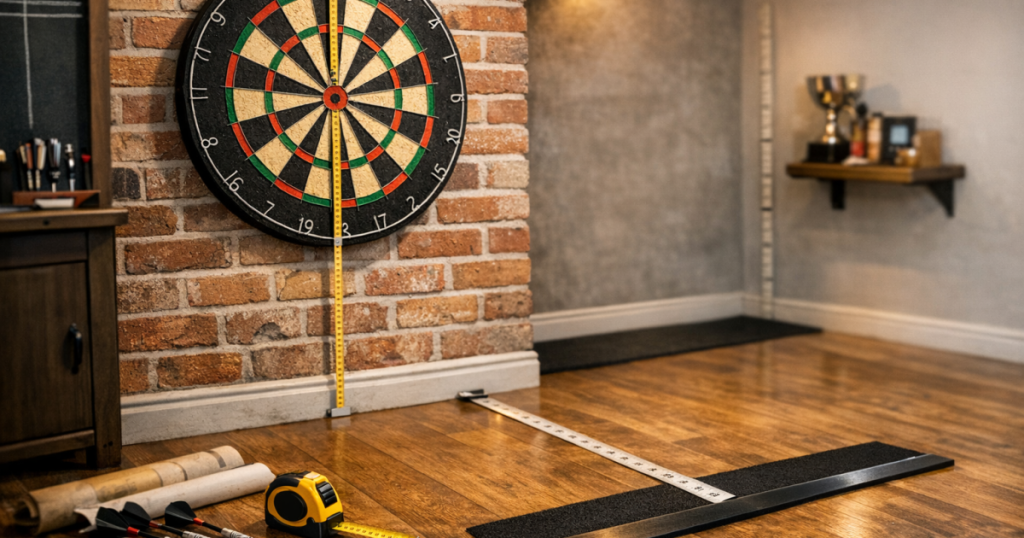
For a regulation steel-tip bristle dartboard, the bullseye centre sits 1.73 m above the finished floor. That means you measure from the floor surface where the player stands, straight up to the exact centre of the bull. Do not measure to the top of the board, the bottom of the board, the number ring or the cabinet.
The throwing line, or oche, sits 2.37 m from the front face of the board. This is the distance from the board surface to the front edge of the line, marker, mat or raised oche. The player’s toe must stay behind that front edge when throwing.
The most common mistake is measuring from the wall. A bristle board is not flush with the wall once it is mounted. Add a bracket, surround, cabinet or spacer and the actual scoring surface can sit further forward than expected. That difference may only look small, but it changes the effective throwing distance. For accurate dartboard height and distance, always take the horizontal measurement from the playing face.
Where exactly do you measure from?
Use three reference points: the finished floor, the centre of the bullseye and the front face of the board. The floor is whatever surface you will stand on during play. If you have a darts mat, measure from the top of the mat only if the mat is a permanent part of the setup and covers the standing area. If the mat is thin and removable, it is usually better to set the board from the normal floor level and use the mat simply as a marker and protector.
For the bullseye, fit the board first, rotate it so 20 is at the top, then check the bull centre with a tape measure. A small spirit level or laser level can help if you are working alone, but a normal tape measure is enough if you take your time.
For the oche, place the end of the tape at the board face, not against the wall. If the tape cannot sit flat because the board is in the way, use a straight edge held vertically against the board face and measure from that point along the floor. Mark the front edge of the line at 2.37 m.
Using the diagonal check
The diagonal measurement is a useful way to confirm the setup after the board and oche are in place. On a standard steel-tip setup, the distance from the centre of the bullseye to the front edge of the oche should be about 2.93 m.
This check is helpful in home rooms where skirting boards, carpets, uneven floors or cabinets make the horizontal measurement awkward. It should not replace the main measurements, but it can reveal obvious errors. If your bull height is correct and your diagonal is noticeably out, the oche position probably needs adjusting.
To do it cleanly, hold the tape at the bull centre and run it down to the front edge of the throwing line. Keep the tape straight rather than letting it sag. A second person makes this easier, but you can also tape the end lightly to the board centre while you check the distance.
Steel-tip, soft-tip and casual setups
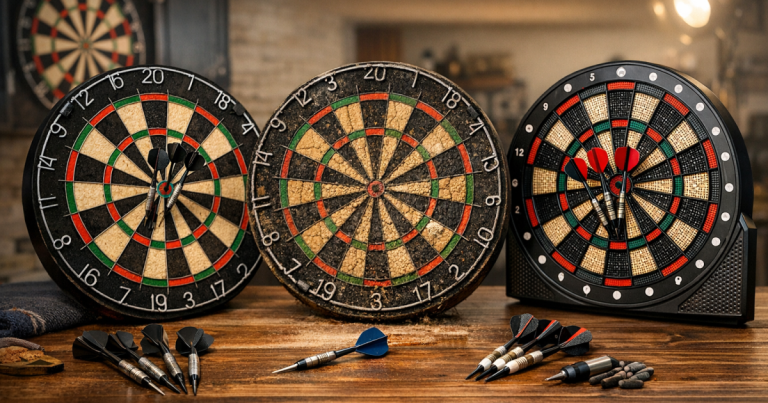
Most UK home setups use a steel-tip bristle board, so 1.73 m high and 2.37 m from board face to oche is the standard starting point. This is the measurement to use for league-style practice, serious scoring routines and general home play if you want your throw to transfer cleanly between venues.
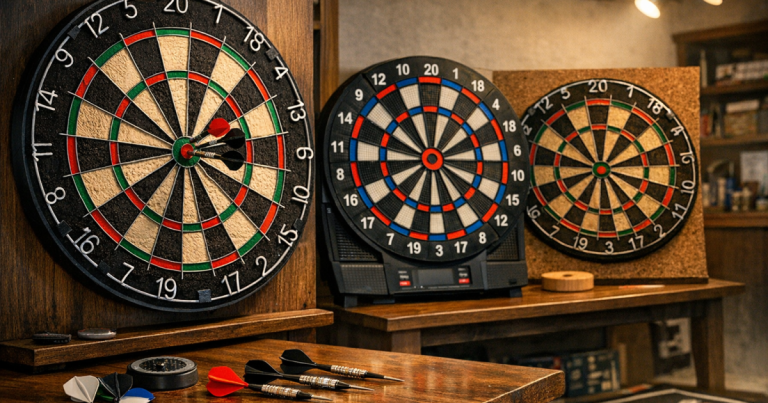
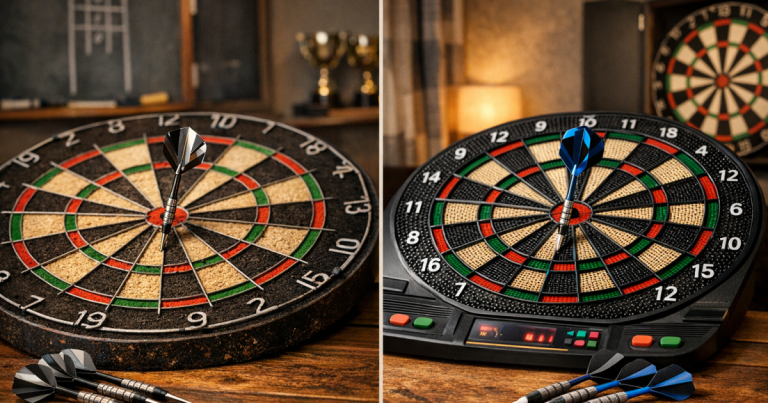
Soft-tip electronic boards are slightly different. Many use the same bull height of 1.73 m but a throwing distance of 2.44 m. However, electronic boards vary more in cabinet depth, segment design and manufacturer guidance, so the safest approach is to check the instructions supplied with the actual board. If your household uses both steel-tip and soft-tip boards, mark each oche clearly rather than relying on memory.
For children or casual family games, some people temporarily reduce the height or distance to make the game more accessible. That is fine for fun, but keep a separate standard mark if adults are practising seriously. Mixing adjusted and standard measurements can build habits that feel strange when you return to a regulation oche.
Setting the oche in a real UK room
A tape-measure-perfect setup still needs enough space around it. Before fixing anything permanently, stand at the proposed oche and go through your normal throwing motion. Check that your elbow, shoulder and follow-through are not cramped by a door frame, sofa, radiator, desk or low ceiling. Many home darts problems come from room layout rather than the measurements themselves.
Allow a clear standing zone behind the oche as well. You do not need a huge games room, but you do need enough space to step in, settle your stance and retrieve darts without bumping into furniture. If the only available wall is in a narrow hallway or shared room, think about whether people can pass safely while someone is throwing.
Floor protection matters too. A fixed oche line on bare laminate can wear, peel or be hard to see, while dropped darts can mark wood, vinyl and some tiles. A mat, raised oche or floor marker can solve both problems if it is placed accurately. For more detail on protecting the standing area and lining everything up, see our darts floor protection and oche positioning guide.
How to mark the throwing line neatly
The front edge of the oche is the important part. Whether you use tape, a mat, a sticker line or a raised block, the measurement runs to the edge nearest the board. If you measure to the back of a thick raised oche, you will accidentally give yourself extra distance.
For a simple home setup, painter’s tape is useful while testing the room because it can be moved without committing to a permanent mark. Once you are happy with the position, a proper floor marker or darts mat looks tidier and is easier to reset after cleaning. Raised oches give a more defined foot stop, but they can be a trip point in a shared living room, so think about how the space is used when darts are packed away.
If the room has carpet, press the tape measure down gently rather than letting it ride over the pile. If the floor has an uneven threshold or a thick rug near the oche, avoid placing the throwing line across a change in level. A consistent stance is just as important as a correct number on the tape measure.
Common measuring errors that affect your throw
- Measuring from the wall instead of the board face. This is the classic mistake and usually makes the oche too far away or inconsistently placed after changing boards.
- Measuring to the wrong part of the board. The bullseye centre is the reference point for height, not the outer edge or number ring.
- Forgetting the cabinet or surround depth. A board inside a cabinet may sit further forward than a bare wall-mounted board.
- Marking the back of the oche. The front edge is the legal throwing line.
- Changing floor level after setup. Adding a thick mat or rug can slightly alter the practical height and stance.
- Not checking the board after rotation. Rotating a bristle board for wear is sensible, but make sure it sits properly back on the bracket afterwards.
Mounting height and board surroundings
Once the bull height is correct, think about what sits around the board. A surround, cabinet or backboard should not interfere with the board face or make the bull harder to align. If a cabinet door, shelf or light fitting forces the board off centre or too close to a corner, choose a different wall if possible.
Wall protection is worth planning before the first match, not after the first cluster of missed doubles. Steel-tip darts can damage plaster, paint and timber surfaces around the board, particularly when beginners are playing. A foam surround is quick and compact, while a cabinet gives a more traditional look and can hide the board when not in use. The practical differences are covered in our guide to wall protection around a dartboard.
Lighting can make correct measurements feel better
Even when the board is mounted perfectly, poor lighting can make the setup feel wrong. Shadows across treble 20, glare from a ceiling pendant or a dim corner can change how confidently you aim. In small UK rooms, the board is often fitted wherever there is a clear wall, not necessarily where the light is best.
The aim is even light across the scoring area without casting a strong hand or dart shadow. Ring lights, cabinet lights and carefully positioned spotlights can all work, but the right answer depends on ceiling height, room layout and whether the board lives in a lounge, garage, spare room or garden building. For a deeper look at brightness, colour temperature and placement, read our guide to dartboard lighting levels.
A simple setup sequence
- Choose a wall with enough clear space for the board, player and dart retrieval.
- Decide whether the board will sit bare on the wall, in a cabinet or with a surround.
- Fit the bracket or mounting system so the bullseye centre will sit 1.73 m from the floor.
- Hang the board and check that it is secure, level and correctly rotated.
- Measure 2.37 m from the front face of the board to the front edge of the oche.
- Mark the oche temporarily, throw a few practice visits, then make the marker permanent if the room feels comfortable.
- Use the 2.93 m diagonal check to confirm the final position.
Things readers ask
Is the throwing distance measured from the wall or the dartboard?
Measure from the front face of the dartboard. Measuring from the wall ignores the board depth, bracket and any cabinet, which can make the oche inaccurate.
What height should the bullseye be from the floor?
For a standard steel-tip setup, the centre of the bullseye should be 1.73 m from the finished floor where the player stands.
Can I use the same oche for steel-tip and soft-tip darts?
Only if the board instructions match. Steel-tip boards normally use 2.37 m from board face to oche, while many soft-tip boards use 2.44 m.
Does a darts mat change the measurement?
A thin mat used mainly as a marker usually has little practical effect. If a thick mat permanently raises the standing area, measure consistently from that finished playing surface.
What if my room is slightly too short?
Do not shorten the oche for serious practice. It is better to choose another wall, move furniture, or use the room for casual play only if the standard distance cannot be achieved safely.
What to remember
The standard setup is straightforward: bullseye at 1.73 m, oche at 2.37 m from the board face, and a diagonal check of about 2.93 m. The details that catch people out are usually practical ones: measuring from the wall, forgetting cabinet depth, marking the wrong edge of the oche, or fitting the board in a cramped space.
Take the time to measure twice before drilling or marking the floor. A properly set board gives you fair practice, a more natural stance and a home oche that feels familiar when you play elsewhere.