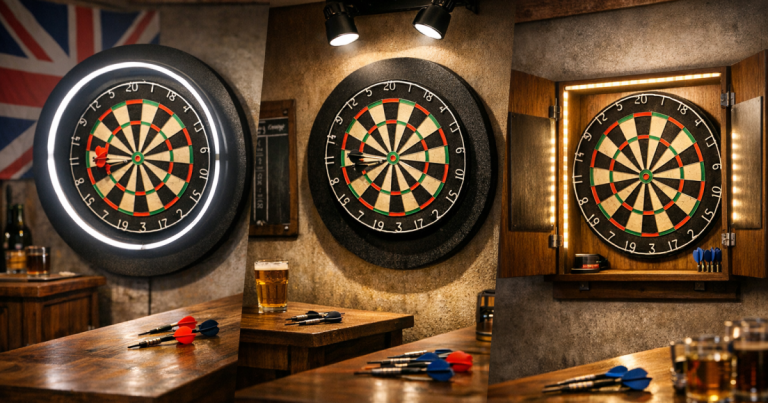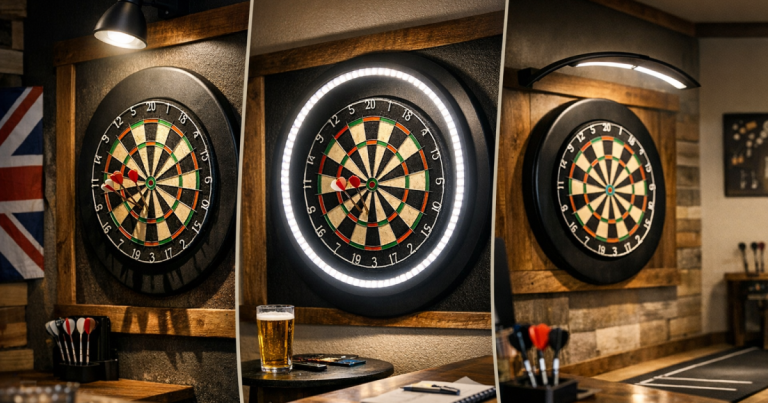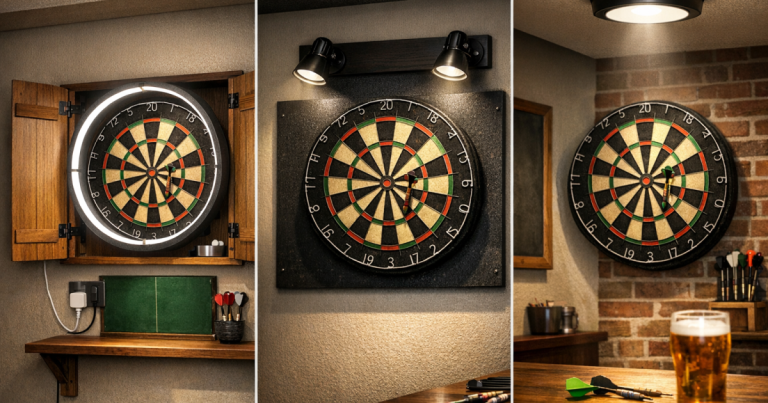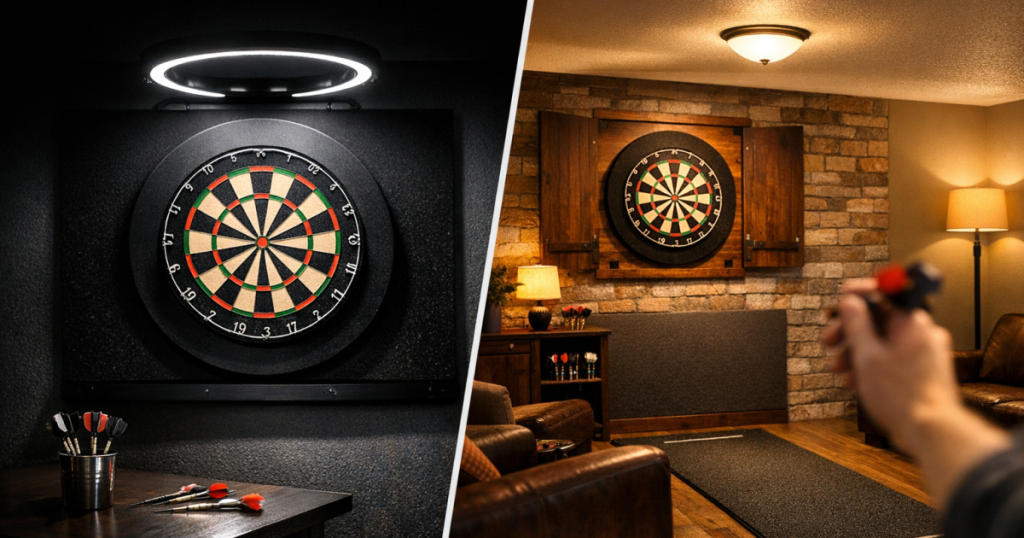
A home oche can look perfectly lit when the room lights are on, then still leave the treble bed dull once you step up to throw. The real decision is not simply how bright the space feels; it is task lighting vs room lighting, and how the two work together around the dartboard, the throw line and the people standing nearby.
Mains electrical work for fixed ceiling lights, wall lights or new wiring should be carried out by a qualified electrician to meet UK electrical safety requirements and applicable Building Regulations. Plug-in lights and clip-on fittings are simpler, but fixed installations need proper assessment and safe connection.
The short version
For most home darts setups, task lighting should do the precision work and room lighting should provide comfort. The dartboard needs an even, shadow-controlled light source that makes the segments, wires and darts easy to see. The room itself needs enough softer background light so the space does not feel like a dark stage with one harsh spotlight.
A good setup usually avoids relying on a single ceiling pendant, especially in smaller UK spare rooms, garages and garden rooms. One central room light often throws shadows from the player, dart barrels or cabinet doors. A dedicated dartboard light, used alongside modest ambient light, is normally easier on the eyes and more consistent for scoring.
What task lighting means at a dartboard
Task lighting is light aimed at a specific job. In darts, that job is seeing the board face clearly from the oche and reading where darts land without leaning in or squinting. It is not there to light the whole room. It is there to make the board usable.
Common task-light approaches include circular dartboard lights, compact over-board fittings, cabinet-mounted lights and adjustable spotlights positioned to wash the face of the board. The important detail is not the shape of the fitting; it is whether the board is evenly lit from top to bottom and side to side.
Useful task lighting should:
- Reduce shadows across the scoring beds.
- Keep the bull, trebles and doubles clear from the throw line.
- Avoid dazzling the thrower when they look up at the board.
- Work with surrounds, cabinets or backboards without creating dark edges.
- Stay consistent when players stand at different heights or slightly different positions.
If you want to go deeper on brightness, colour and placement, the guide to dartboard lighting levels, colour temperature and placement gives a more detailed breakdown of the technical side without turning the setup into a lighting design project.
What room lighting does differently
Room lighting is the general light that makes the space pleasant to use. It helps people move around safely, pick up darts, keep score, chat between legs and avoid the gloomy feel that can come from a single bright board light in an otherwise dark room.
In a living room, the room light might be ceiling spots, a pendant, wall lights or lamps. In a garage or outbuilding, it might be battens or simple overhead fittings. The issue is that general lighting is usually designed for the room, not for the board. It may be behind the player, directly above the throw line, off to one side, or blocked by shelves, doors and cabinets.
That is why room lighting can make a darts area feel bright while still producing a poor board view. A room can be well lit for sitting, storage or general use but still leave the dartboard unevenly lit. The eye notices this most when darts are close to the wire, when the room has darker wall colours, or when the board sits inside a cabinet.
Where the balance tends to go wrong
The most common mistake is treating brightness as the only goal. A very bright lamp aimed badly can be worse than a gentler light placed correctly. Glare, hotspots and hard shadows all make the board harder to read, even when the overall room feels bright.
Another common issue is placing the board under an existing ceiling light and assuming that is enough. If the player stands between the light and the board, the throwing stance can create a moving shadow. If the light is directly above the board, the dart barrels themselves can cast small but irritating shadows across the bed. If the light is off to one side, one half of the board may look clearer than the other.
Cabinets and surrounds also change the result. A cabinet can shield the board edges from side light, while a deep surround or decorative wall panel can change how shadows fall. If your setup includes wall protection or a styled board area, the lighting should be planned with the furniture and protection in place, not guessed before everything is mounted.
Small UK rooms need a slightly different approach
Many home oches are squeezed into box rooms, garages, converted sheds or one end of a dining space. These rooms often have lower ceilings, narrow throwing lanes and light fittings that were never chosen with darts in mind. That makes the split between board light and background light more important.
In a compact room, a strong exposed bulb can feel harsh because the player is close to every wall surface. Bright white walls can bounce light back at the eyes; dark paint can absorb light and make the board feel isolated. A dedicated board light can solve the scoring visibility problem, while a lower, softer room light keeps the space comfortable between throws.
For awkward spaces, shadow control matters more than raw brightness. The advice in the shadow-free dartboard lighting guide for small UK rooms is especially relevant if your board is close to a side wall, under a sloped ceiling or mounted near storage.
How board position affects lighting
Lighting cannot rescue a poorly planned board position. If the board is too close to a doorway, window, shelving unit or low ceiling feature, the light may always feel compromised. Before changing lamps, check that the board height, throwing distance and usable lane are correct.
For a standard steel-tip setup, the bull should be at 1.73 m from the floor, and the throwing distance should be 2.37 m from the face of the board to the oche. These measurements affect where the player stands in relation to ceiling fittings and where shadows are likely to fall. If you need a refresher, use the guide to dartboard height and throwing distance before finalising the lighting.
Also look at what happens behind and beside the thrower. A bright ceiling light behind the oche can reflect from glossy floors, polished cabinets or framed pictures. A lamp directly in the player’s peripheral vision can be distracting, even if it does not shine straight into the eyes.
Different lighting combinations that work
Dedicated board light with soft room lighting
This is the most balanced arrangement for many home setups. The board light gives reliable visibility, while the room light prevents eye strain from looking between a bright board and a dark room. It suits casual play, practice sessions and social games because the whole space remains usable.
Ceiling spots plus careful positioning
Ceiling spots can work if they are positioned to avoid the player’s throwing shadow and spread light evenly across the board. The risk is that one spot creates a strong highlight while another leaves a shadowed area. If the room already has adjustable spots, test the board view from the oche before changing anything permanently.
Cabinet or over-board lighting
Cabinet-mounted and over-board lights can be neat, especially where wall space is limited. The challenge is even coverage. A small light above the board can make the top half bright and the lower beds dull unless it is designed or positioned to spread light properly. Cabinet doors can also affect light spread when open.
Room light only
This can be acceptable for very casual play, but it is usually the least consistent route. It depends heavily on where the existing fitting sits, how high the ceiling is and whether players cast shadows. If you regularly practise doubles, grouping or finishing, room light alone often shows its limits.
How to judge your current setup
You do not need specialist equipment to spot the main problems. Stand at the oche and look at the board as you would during a normal throw. Check whether the numbers, segment colours, wires and dart points are easy to read. Then ask someone else to stand at the line and watch what happens to the shadows.
Run through these checks:
- Can you see the treble 20, treble 19 and bull clearly without leaning forward?
- Do shadows move across the board when a player raises their arm?
- Is one side of the board noticeably darker?
- Does the light shine into the thrower’s eyes from any normal stance?
- Can people safely walk around the room when only the board light is on?
- Does the room still feel comfortable after 30 minutes of play?
If the board is clear but the room feels harsh or gloomy, improve the background light. If the room feels pleasant but the board is patchy, improve the task light. If both are poor, start with board visibility first, then soften the room around it.
The useful way to think about task lighting vs room lighting
The simplest distinction is purpose. Task lighting protects the quality of the throw by making the board clear. Room lighting protects the comfort of the space by making the whole area pleasant and practical. A good home setup does not make these compete; it gives each one a job.
That also helps avoid over-lighting. You should not need a room that feels like a workshop just to see the doubles. Nor should the board be the only bright object in a dark corner. The best-feeling arrangements tend to have a clearly lit board, gentle surrounding light and no obvious glare from the throw line.
FAQ
Can I use normal ceiling lights for darts?
Yes, but only if they light the board evenly and do not put the player’s shadow across the scoring area. Many standard ceiling lights are fine for the room but weak for the board.
Should the dartboard light be brighter than the room light?
Usually, yes. The board should be the clearest point in the setup, but the contrast should not be so strong that the rest of the room feels dark or uncomfortable.
Do I need a circular dartboard light?
No. Circular lights are popular because they can give even coverage, but well-positioned cabinet lights, over-board lights or adjustable fittings can also work if they control shadows.
What colour light is comfortable for darts?
A neutral white light is often the easiest starting point because it keeps the board colours clear without feeling too yellow or too cold. The exact feel depends on your room colours and existing lamps.
Is it better to turn off the room lights during practice?
Not usually. A little background light helps reduce eye strain and makes the space easier to use between visits to the board.
Final thoughts
For a home darts setup, lighting is less about making everything brighter and more about putting the right light in the right role. Let the dartboard light handle accuracy and visibility. Let the room light handle comfort, movement and atmosphere. When both are planned together, the board is easier to read, the oche feels calmer, and the whole setup becomes more enjoyable to use.
Quick Buying Links
Task Lighting
The real decision is not simply how bright the space feels; it is task lighting vs room lighting, and how the two work together around the dartboard, the throw line and the people standing nearby.Mains electrical work for fixed ceiling lights, wall lights or new wiring should be carried out by a qualified electrician to meet UK electrical safety requirements and applicable Building Regulations.
Room Lighting for Darts Setups
Worth considering if its strengths better match your needs.