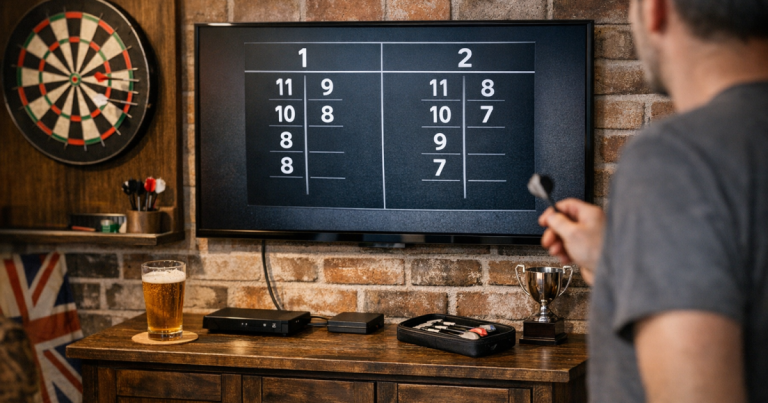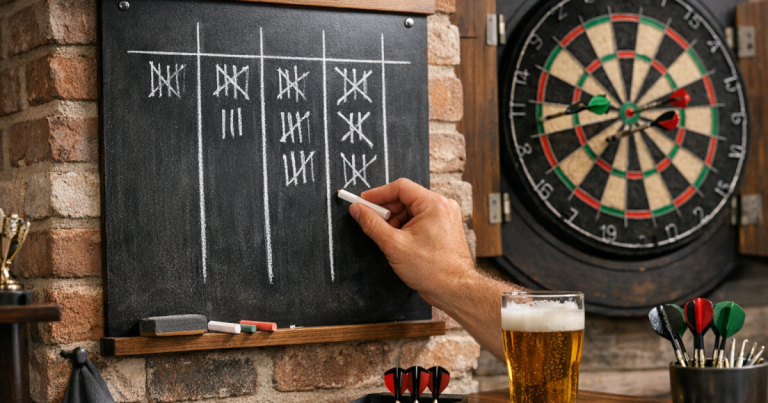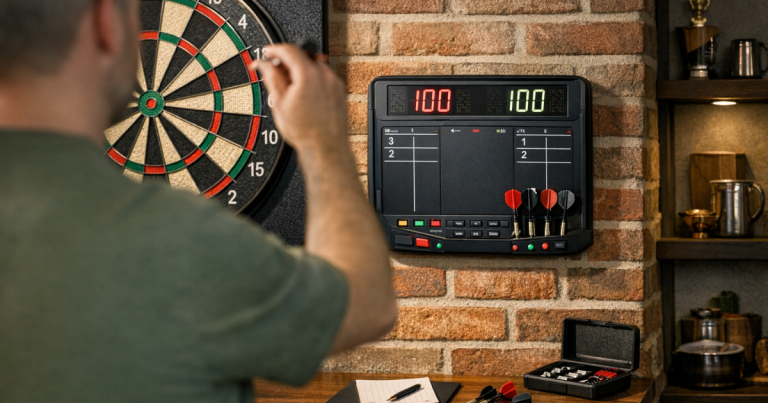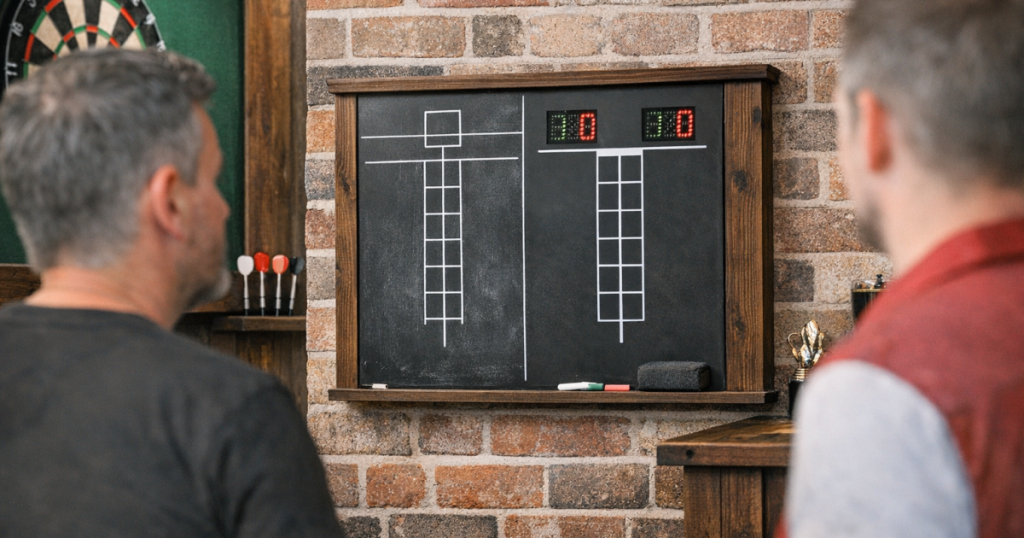
A clear scoreboard keeps a home darts game moving. The right darts scoreboard position lets the thrower check the score without stepping away from the oche, while spectators can follow the leg without asking what is left.
The aim is simple: put the scoreboard close enough to the board to feel part of the setup, but not so close that it distracts the thrower, catches glare, or disappears behind someone’s shoulder.
The short version
- Place the scoreboard on the same wall as the dartboard or on the player’s non-throwing side where possible.
- Keep it outside the likely missed-dart zone and away from the board surround.
- Set the writing area roughly around standing eye level for the scorer, usually about 140 to 170 cm from the floor depending on the room and users.
- Check sightlines from the oche, the scoring spot and the main spectator position before fixing anything permanently.
- Avoid glossy boards or awkward lighting angles that create reflections.
Step 1: Decide who needs to read it most
Scoreboard placement depends on how your home games actually work. In a two-player casual setup, the person waiting to throw may also be the scorer, so the board needs to be easy to read from just behind or beside the oche. In a busier garage, spare room or pub-style home setup, you may have a separate scorer and a few people watching from the side.
Start by standing in three places: at the oche, just off to the side where the next player waits, and wherever people naturally sit or stand. If the scoreboard cannot be read from at least two of those positions, it is probably too tucked away.
The thrower does not need to read every digit while aiming, but they should be able to glance across between visits. The scorer needs the clearest view because they will be writing, checking totals and recording finishes. Spectators need broad visibility, not perfection.
Step 2: Keep it near the board, but out of the firing line
The most familiar layout is a scoreboard to one side of the dartboard. This works because the player can look at the board, the score and the checkout area without turning completely around. For most right-handed throwers, placing the scoreboard to the left of the dartboard can feel natural because it leaves the throwing arm side less cluttered, but room layout matters more than handedness.
Leave enough space between the dartboard surround and the scoreboard so a stray dart does not mark the scoring surface or frame. If your wall has a protective surround, cabinet doors or shelves, check how everything opens and sits before choosing the final spot. For smaller rooms, a narrow vertical scoreboard beside a cabinet can be easier to read than a wide board squeezed into a corner.
If you are still planning the whole throw area, it helps to settle the oche first. Our guide to raised, recessed and marked oche types explains how the throw line affects the rest of the room layout.
Step 3: Set a readable height
A good starting point is to put the centre of the main writing area roughly between 140 and 170 cm from the floor. That range usually suits standing adults and keeps the score high enough to read across a room without forcing the scorer to write above shoulder height.
For a chalkboard, whiteboard or cabinet-mounted scoreboard, the lower third should still be comfortable to write on. If the board is too high, the top looks tidy but the writing becomes awkward. If it is too low, spectators may lose the bottom rows behind chairs, players or the scorer’s body.
Before fixing it, tape a sheet of paper to the wall at the intended height and write a few sample scores: 501, 140, 81 left, D16. Stand at the oche and check whether the numbers are readable without leaning forward. Then stand where the scorer will be and check whether writing feels relaxed.
Step 4: Choose the best side of the dartboard
There is no single correct side, but there are clear trade-offs. A scoreboard on the left or right of the dartboard keeps the scoring information close to the action. A board on an adjacent wall can work in tight rooms, but players may need to turn their head more often. A board behind the oche is usually less convenient because the thrower has to turn around between visits.
Beside the dartboard
This is the strongest choice for most home setups. It feels familiar, keeps the scorer facing the board, and makes it easy to update scores as darts are retrieved. The main check is whether the wall space is wide enough for a clear scoreboard without crowding the surround or cabinet.
Inside a dartboard cabinet door
Cabinet scoreboards look neat and save wall space, but they can be harder for spectators to read if the doors sit at an angle or the room lighting reflects off the surface. They also tend to be closer to the dartboard, so make sure the writing area does not sit where missed darts may land. For storage and layout ideas, see the dartboard cabinet storage and organisation guide.
On a nearby side wall
A side-wall scoreboard can be useful in narrow rooms where the dartboard wall is already full. It works best when the side wall is visible from both the oche and the waiting area. Avoid placing it too far behind the thrower, as that interrupts the rhythm of the game.
Step 5: Check lighting before you commit
Lighting can make a perfectly placed scoreboard surprisingly hard to read. Glossy whiteboards, laminated checkout charts and shiny cabinet surfaces can reflect overhead lights, windows or dartboard lighting rings. Before fixing the board, stand at the oche and look for glare across the writing area.
Natural daylight can also be a nuisance. A scoreboard that reads well in the evening may be washed out by a bright window during weekend afternoon games. If the room has strong side light, test the board at the time you usually play.
For the dartboard itself, bright and even lighting is important, but the scoreboard should not sit in harsh spill or shadow. If you are adjusting lights as part of the same upgrade, our guide to dartboard lighting brightness, colour temperature and placement covers the main checks.
Step 6: Make the numbers easy to read
Position matters, but so does the way you write. Use large numbers, clear columns and enough spacing between visits. A scoreboard that is technically visible can still cause confusion if the writing is cramped or the checkout section is mixed in with the running score.
For casual 501, keep the layout simple: player names at the top, scores underneath, and remaining totals in a consistent place. If you like a checkout reminder, put it to one side rather than squeezing it between score lines. This stops players from mistaking a suggested finish for a remaining total.
If younger players, older players or visitors use the setup, favour bigger writing over fitting more legs on the board. Wiping and rewriting is less annoying than repeated questions about what someone needs.
Step 7: Test it with a real leg
The best test is not staring at an empty board; it is playing a leg and noticing what feels awkward. During a trial game, watch for small problems: the scorer blocking the view, the thrower stepping across the room to check a total, or spectators asking for the score after every visit.
If you notice any of those, move the scoreboard temporarily and try again. Painter’s tape, removable hooks or a freestanding board can help you experiment before making a permanent decision. In rented homes, this is especially useful because you may want a layout that avoids unnecessary wall marks.
Common mistakes to avoid
- Putting it too close to the dartboard: it may look tidy, but it increases the chance of damage from stray darts.
- Mounting it too high: high boards can be readable but tiring to write on during longer sessions.
- Ignoring the scorer’s body position: if the scorer stands in front of the board, nobody else can see it.
- Using thin pens or faint chalk: weak contrast makes even a well-placed board hard to read.
- Forgetting cabinet doors: open doors can change the angle, shadows and visibility of built-in scoreboards.
Common questions
Should the scoreboard be on the left or right of the dartboard?
Either side can work. Choose the side with the clearest sightline from the oche, the easiest writing position for the scorer, and the least risk from missed darts.
How far from the dartboard should a scoreboard be?
There is no official distance for a home scoreboard. Leave enough space to keep it outside the regular missed-dart area and to stop it feeling cramped against the surround or cabinet.
Can I put the scoreboard behind the oche?
You can, but it is usually less convenient. Players have to turn around to check the score, and spectators may find it harder to follow the game if they are facing the dartboard wall.
Is a cabinet scoreboard harder to read?
It can be if the door angle, lighting or writing size is poor. Test it from the oche and spectator spot with real scores written on it before relying on it for regular games.
What is the best darts scoreboard position for a small room?
In a small room, the best darts scoreboard position is usually beside the board but slightly outside the surround area, with large writing and minimal glare. If wall space is tight, a cabinet door or nearby side wall can work.
Main points
A readable scoreboard is not just about neatness; it keeps the pace of the leg and reduces avoidable scoring arguments. Place it where the scorer can write comfortably, the thrower can glance across between visits, and spectators can follow without moving around the room.
Before fixing anything permanently, test height, side, lighting and real-game visibility. A few minutes of checking from the oche and the seating area will usually tell you more than measuring alone.