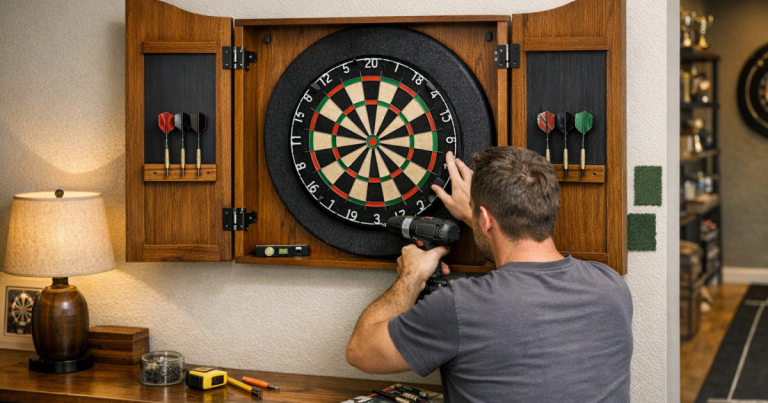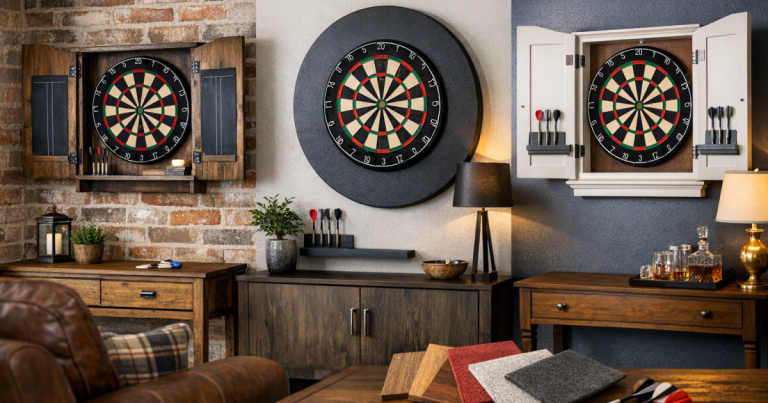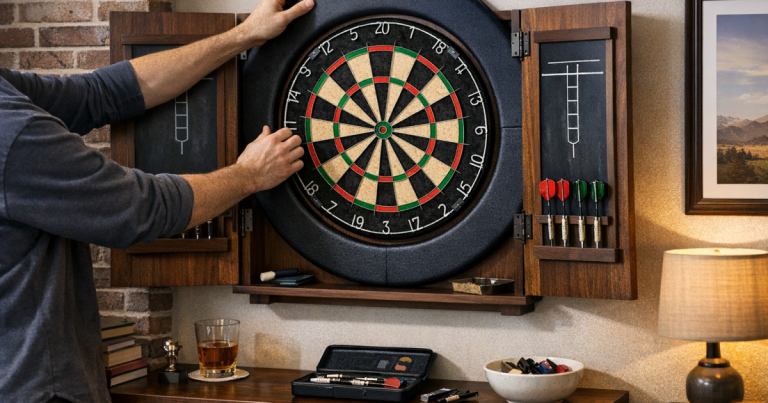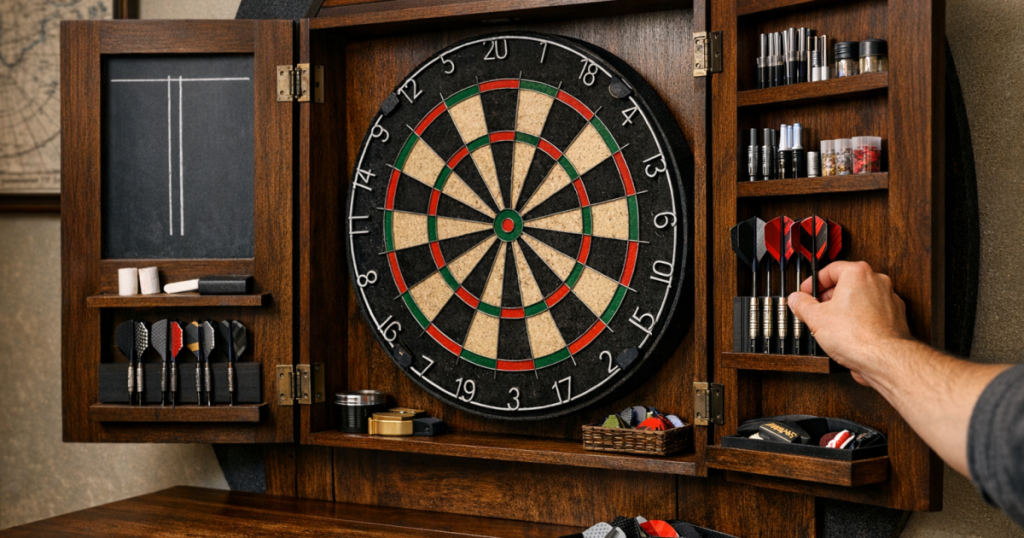
A darts cabinet should do more than hide the board between throws. Good dartboard cabinet storage keeps your darts, chalk, marker pens, flights, shafts and checkout notes in predictable places, so practice starts quickly and the room still looks tidy when you close the doors. The aim is not to cram every accessory inside; it is to make the cabinet work as the calm centre of a home darts setup.
The short version
The most useful cabinet layouts split storage into clear zones: match darts, spare parts, scoring tools, cleaning bits and small extras. Keep the most-used items at hand height, avoid loose clutter near the board face, and leave enough space for the doors to close without pressing against flights or stems.
- Store one or two complete sets of darts where they cannot roll or knock together.
- Keep spare flights and shafts in a small box or sleeve rather than loose on the shelf.
- Use door space carefully, especially if the cabinet includes scoreboards.
- Keep cleaning cloths, chalk and markers separate from sharp points.
- Do not overload the cabinet so much that it becomes awkward to use.
Why cabinet organisation matters at home
A home darts area often shares space with a living room, spare bedroom, garage or dining area. That makes organisation more important than it might seem. A cabinet hides visual clutter, protects small accessories from being misplaced, and makes the board feel like part of the room rather than a temporary hobby corner.
It also changes how often you actually practise. If darts, spare flights and a scoring pen are always ready, a ten-minute throw becomes easy. If everything is in different drawers around the house, the board gets used less. For a broader look at how cabinets and surrounds fit into a home setup, the guide to dartboard cabinets and surrounds for home players gives useful context before you refine the storage layout.
Start with zones, not piles
The best cabinet layouts are simple. Think in zones rather than trying to find a home for every individual item straight away. A typical home player can usually work with five zones: playing darts, scoring, spare parts, maintenance and occasional extras.
Playing darts
Your main darts should be the easiest item to access. If the cabinet has built-in dart holders, use them for the set you throw most often rather than for older darts that rarely leave the cabinet. Darts should sit securely with points protected and barrels separated enough that they do not scrape against each other each time the door opens.
If more than one person uses the board, give each regular player a consistent position. It avoids the usual rummaging before a leg starts and reduces the chance of points catching on flights, chalk or score markers.
Scoring tools
Scoring items are easy to underestimate. Chalk, whiteboard pens, erasers and checkout sheets get messy quickly if they live loose on a narrow shelf. Keep them in one small container, preferably shallow enough that you can see everything at once. If your cabinet has chalkboards on the doors, store chalk and a cloth on the same side as the board it serves.
Spare parts
Flights, shafts, flight protectors, spare points and O-rings should not all sit together in one mixed heap. Use small resealable bags, a slim compartment box or a flight case. The aim is speed: when a flight splits mid-practice, you should not need to empty the cabinet to find a replacement.
Use the doors intelligently
Cabinet doors are useful storage space, but they are also the easiest area to overload. Many cabinets include scoreboards, checkout charts or chalkboard panels, so anything added to the door must leave room for writing and cleaning. Door-mounted storage works best for flat or lightweight items: checkout notes, a pencil, a slim marker clip or a small cloth.
Avoid bulky add-ons that make the doors sit proud or swing unevenly. If the door has a scoreboard, check that your hand can move freely across the writing area without hitting stored items. It is better to keep one door clear and useful than to fill both doors until neither works properly.
If you are still choosing a cabinet or checking whether your current one is suitable, the guide on what to check before buying a dartboard cabinet is a helpful next step. Pay particular attention to internal clearance, door style and whether the storage is genuinely usable once the board is fitted.
Shelves, trays and small containers
A single open shelf can become chaotic quickly. The fix is not always more storage; it is better separation. Small trays and shallow boxes stop accessories spreading across the cabinet and make it easier to remove one group of items at a time.
- Use one tray for scoring: chalk, marker pens, eraser and a small cloth.
- Use one box for spares: flights, shafts, rings and small repair bits.
- Use one sleeve or case for guest darts: useful if friends or family play casually.
- Keep cleaning items separate: a dry cloth should not sit among sharp points or chalk dust.
Clear containers are handy because you can see what is inside, but they are not essential. What matters is that each container has one job. If you need labels to remember what belongs where, the zones are probably too complicated.
Hooks can help, but placement matters
Small hooks can be useful inside a darts cabinet, especially for hanging a checkout card, a lightweight measuring tape, a cloth or a small accessories pouch. They should not interfere with the dartboard, the cabinet doors or the throwing area. A hook that looks fine when the door is open can become annoying if it stops the door closing cleanly.
Before adding hooks, hold the item in position and close the door slowly to test clearance. Also check whether the hook could catch a sleeve, scratch a scoreboard or press against the board surround. If you want a more detailed method, see the step-by-step advice on fitting accessory hooks inside a dart cabinet.
What to keep out of the cabinet
Not every darts accessory belongs inside the cabinet. Overfilling it makes the setup look untidy and can make the board harder to use. Larger items often work better nearby rather than inside the cabinet itself.
- Darts mat: store it flat or rolled according to its design, away from the cabinet doors.
- Large lighting parts: keep lighting hardware separate unless the cabinet was designed to hold it.
- Drinks and glasses: avoid storing anything that could spill near the board, sisal or scoreboards.
- Heavy tools: keep them in a toolbox, not on a lightweight cabinet shelf.
- Excess sets of darts: rotate what you use rather than turning the cabinet into long-term storage.
A cabinet should support play, not become the only storage space for the whole hobby. If you have multiple sets, a separate darts case or drawer may be neater than trying to fit everything around the board.
Organisation for shared boards
Shared home boards need slightly different organisation. If children, guests or housemates use the setup, make the storage obvious and forgiving. Keep guest darts separate from your match set. Store sharper or more delicate accessories higher up inside the cabinet, while everyday scoring tools remain easy to find.
For family use, it helps to have a simple reset rule: darts back in holders, chalk or pen back in the tray, flights back in the spares box, doors closed. The fewer steps involved, the more likely everyone is to follow it.
Keeping the cabinet tidy over time
Most cabinet clutter builds slowly. One damaged flight gets left on a shelf, then an old shaft, then two dried-out pens, and soon the useful space disappears. A quick monthly reset keeps the cabinet practical.
- Remove broken flights and bent shafts rather than keeping them as emergency spares.
- Check that pens still write and chalk has not crumbled across the shelf.
- Wipe chalk dust from shelves and scoreboards with a dry cloth.
- Return guest darts, spare parts and checkout notes to their own zones.
- Look for anything touching the board face or preventing the doors from closing properly.
Be careful with moisture around wooden cabinets, paper checkout sheets and bristle boards. A dry wipe is usually enough for cabinet interiors. If the room is a garage or outbuilding, keep spares in closed containers so dust and damp air do not make the setup feel neglected.
Common layout mistakes
The most common mistake is treating the cabinet as a display case rather than a working part of the setup. A neat-looking arrangement is not much use if you need to move three items every time you want a marker pen.
- Putting rarely used items in prime space: keep the easiest spots for darts and scoring tools.
- Letting spares float loose: flights and shafts are small enough to vanish behind shelves and door edges.
- Storing items too close to the board: nothing should press against the sisal or sit where a missed dart could hit it.
- Ignoring door swing: added storage must work when the doors open, close and sit flat.
- Keeping too many old accessories: if you would not use it in a real leg, it probably does not need cabinet space.
FAQ
How many sets of darts should I keep in a cabinet?
For most home setups, one main set and one guest or spare set is enough. Extra sets are better kept in cases or drawers so the cabinet stays easy to use.
Can I store spare flights loose on a cabinet shelf?
You can, but they are more likely to bend, split or disappear behind other items. A small box, packet or flight case keeps them flatter and easier to find.
Should chalk, pens and erasers go on the door or shelf?
Use whichever position is easiest to reach without blocking the scoreboard. If the door has a writing surface, keep the matching chalk or pen close to that side.
Is it worth adding hooks inside a dartboard cabinet?
Hooks are useful for light items such as cloths or checkout cards, provided they do not stop the doors closing or interfere with scoring panels.
How often should I reorganise my darts cabinet?
A quick monthly tidy is enough for most players. Remove broken parts, test pens, wipe chalk dust and return spares to their containers.
Main lessons
A well-organised cabinet makes a home darts setup feel easier to use and better integrated into the room. Keep the layout simple: main darts close to hand, scoring tools together, spares contained, cleaning bits separate and bulky accessories elsewhere. When every item has a sensible place, the cabinet stops being a clutter trap and becomes the part of the setup that keeps everything ready for the next throw.