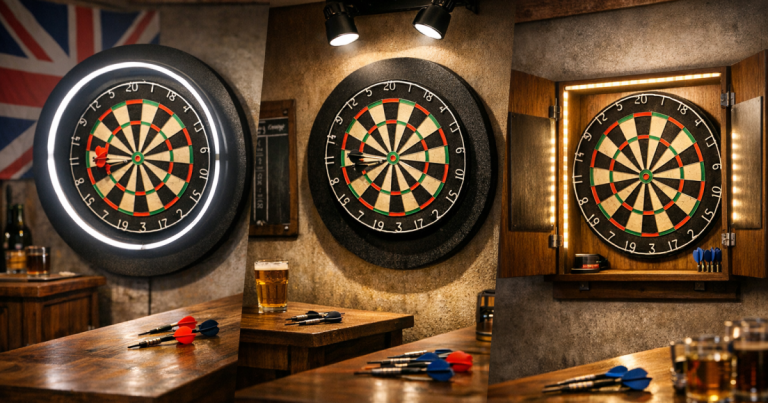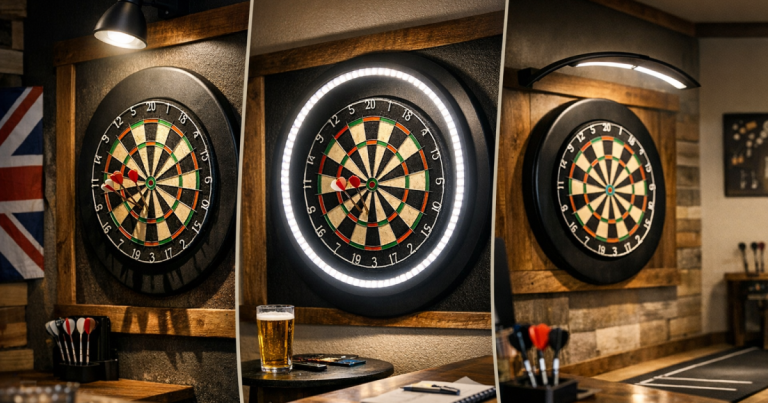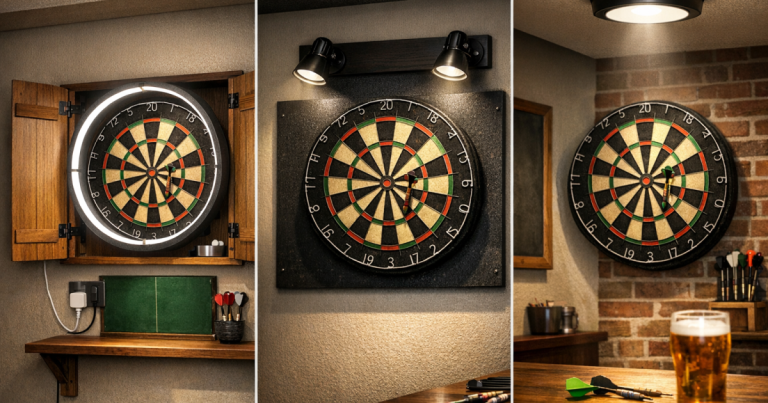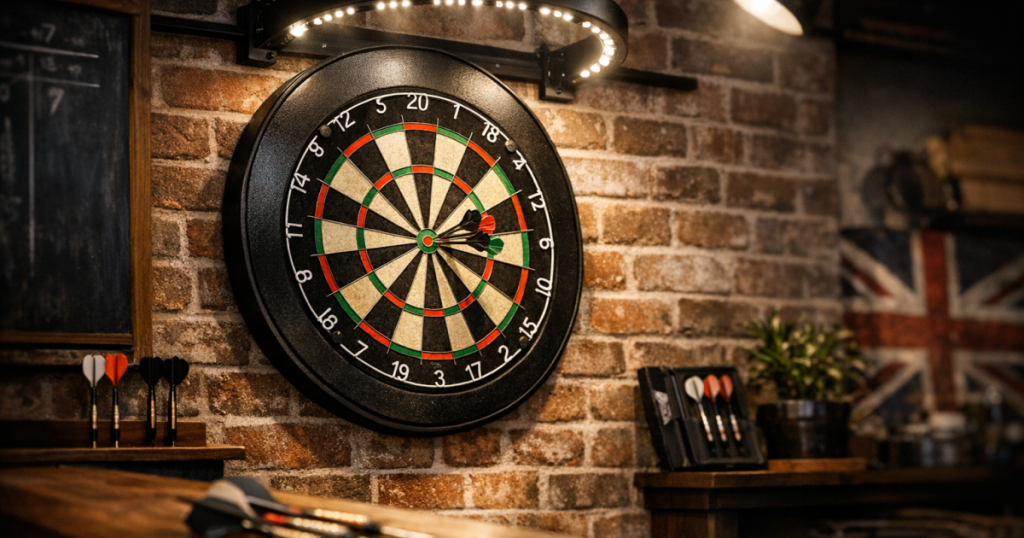
A good darts light should make the segments easy to read without making the board look washed out or throwing a dark wedge across the treble bed. Getting dartboard lighting brightness right is about three things working together: enough lumens, a comfortable colour temperature, and a position that keeps the dart, wire and number ring evenly visible.
Mains electrical wiring for ceiling lights, wall lights or fused spur connections should be carried out by a qualified electrician to ensure compliance with UK electrical safety requirements and applicable Building Regulations.
At a glance
- Aim for even light across the whole board, not just a bright patch around the bull.
- Lumens describe light output; they do not guarantee useful light on the board unless placement is right.
- Neutral white light is usually the easiest tone for reading segments without a harsh, clinical feel.
- Shadows usually come from light hitting the board from one side, from above only, or from behind the thrower.
- Glare is often caused by exposed bulbs, shiny cabinet interiors, reflective number rings or a light mounted too close to the sightline.
Why lumens matter, but do not tell the whole story
Lumens measure how much visible light a lamp produces. For darts, that matters because a dim board makes doubles, trebles and wire edges harder to read, especially in a garage, spare bedroom or evening living-room setup. But a high-lumen light in the wrong place can still perform badly. It might dazzle the thrower, bounce off a cabinet door, or create strong shadows under the darts already in the board.
As a sensible home starting point, many players find that the board area needs more focused light than the rest of the room. A single low-output ceiling bulb in the middle of the room is rarely ideal because your body can sit between the light and the board. Conversely, a very bright exposed lamp close to the board can feel uncomfortable and flatten the contrast between black, cream, red and green segments.
Think of lumens as the available light, not the final result. The useful question is: how much of that light lands evenly on the face of the board from an angle that does not interfere with your throw or your view?
Useful brightness ranges for a home board
There is no single lumen number that suits every home darts setup, because room size, wall colour, ceiling height, cabinet depth and ambient light all change the result. Still, practical ranges help you avoid the extremes.
- Low ambient-light rooms: a dedicated board light with moderate output can be enough if it surrounds or evenly covers the board. The surrounding room may remain dim, but the scoring area should be clear.
- Mixed-use rooms: if the board is in a lounge, dining room or spare bedroom, balance the dartboard light with the room lighting so the board does not feel like a spotlight in a dark corner.
- Garages and outbuildings: darker surfaces, bare walls and colder spaces can make the board feel dull. Extra ambient lighting may help, but the board still needs direct, even coverage.
- Cabinet setups: side doors and dark interiors can absorb light or cast edge shadows. Check the board with the doors open in the position you actually play.
If you are using a purpose-made ring or halo-style system, check the manufacturer’s published lumen information, but judge it in context. Products such as the Target Corona Vision Dartboard Lighting System are designed to light the board evenly from around the face, while other formats may use a partial ring or overhead bar. The design often matters as much as the headline brightness figure.
Colour temperature: warm, neutral or cool?
Colour temperature is measured in kelvin and describes the tone of the light. Lower numbers look warmer and more yellow; higher numbers look cooler and bluer. For darts, the aim is not mood lighting. It is clear segment visibility without eye fatigue.
- Warm white: comfortable in living rooms, but it can make cream and red areas look softer and less crisp if the light is too warm or too weak.
- Neutral white: often the safest middle ground for a dartboard because it keeps contrast clear without making the room feel stark.
- Cool white: can make edges look sharp, but it may feel harsh in a small room or when the light source is visible to the thrower.
For most home oches, neutral white is the practical choice. It gives enough clarity for scoring and checkout practice while still feeling comfortable for longer sessions. If your room already uses warm lamps, a neutral dartboard light can still work, but avoid creating a jarring contrast where the board feels overly bright and the rest of the room feels gloomy.
Placement: the real difference between clear and annoying
Light placement has the biggest effect on shadows and glare. A ceiling light behind the player can make the thrower’s head, shoulder or arm cast a shadow across the board. A single light above the board can leave the lower half dull or create shadows below darts. A lamp placed off to one side can make one side of the spider bright and the opposite side muddy.
The most reliable dartboard lighting brightness comes from even coverage around the board face. Full ring systems, well-positioned multi-point lights and carefully angled overhead fittings can all work, but they need to be tested from the oche, not just from close up. Stand at the throw line, look at the 20, 19, 3 and bull areas, then check whether darts already in the board cast distracting shadows.
For a deeper look at positioning mistakes, beam angles and glare control, read our guide on adding dartboard lighting without glare or shadows.
Common lighting problems and what causes them
The board is bright but the wires disappear
This often happens when the light is too direct or too cool, reducing useful contrast. Try softening the angle, increasing ambient room light slightly, or using a neutral tone instead of a harsh cool tone.
The treble 20 is clear but the lower board is dull
A top-mounted light may be doing most of the work. Move the light forward, add balanced side coverage, or consider a ring-style setup that spreads light around the board rather than from one point.
Darts cast strong shadows
Shadows are unavoidable to some degree because darts sit proud of the board, but they should not obscure the target. Strong shadows normally mean the light is too directional. Multi-point or surrounding light reduces the effect.
The number ring reflects glare
Glare can come from shiny numbers, cabinet hinges, satin paint or a lamp facing the player. Adjust the angle so the light lands on the board rather than reflecting towards your eyes. Our detailed breakdown of dartboard shadows and lighting setups covers the most common causes in more depth.
How room layout changes the answer
A spare bedroom setup behaves differently from a garage setup. In a compact bedroom, walls are close, ceilings may be lower, and a bright cool light can feel overpowering. In a garage, the board may sit on a darker wall with less reflective help from the surroundings, so the same lamp can feel weaker.
Wall colour matters as well. A pale matt wall can help the room feel brighter without causing much reflection, while gloss paint or framed pictures near the board can bounce light back into the sightline. If you are planning a dedicated room, it is worth treating lighting as part of the layout rather than something to fix at the end. Our spare-room planning guide explains how board position, storage and throw space fit together when converting a spare bedroom into a practical darts room.
Dedicated dartboard lights versus ordinary room lights
An ordinary ceiling light can support the room, but it rarely solves the board on its own. It may be behind you, too far from the board, or blocked by your throwing stance. A dedicated board light is more focused and can be placed to reduce shadows where it matters.
Ring lights are popular because they surround the board and reduce directional shadows. Partial-ring designs and overhead bars can also be effective when placed well, though they may need more careful positioning. A product such as the Mission Torus 270 Dartboard Light is an example of a dedicated dartboard light format rather than general room lighting; before relying on any specific model, check how it fits your board, cabinet, surround and available wall space.
If you use a cabinet, confirm that the light does not foul the doors, block scoreboards, or make access awkward. If you use a surround, check that the lighting frame or brackets sit securely without compressing or distorting the surround. The neatest setup is not always the brightest one; it is the one that stays consistent during normal play.
A simple test before changing anything
Before buying extra lamps or moving fittings, test the current problem carefully. Put three darts in different parts of the board, then stand at the oche and check the view. Look for shadows across the trebles, glare on the number ring, dull areas near the bottom, and whether your own body blocks the main light source.
Next, use a temporary lamp from a safe position to test different angles. Do not trail cables across the throw area, and do not place loose lamps where they can be struck by a dart or knocked over. Even a short test can show whether you need more brightness, better placement, a different colour temperature, or simply more balanced room lighting.
Take phone photos from the throw line as well. Cameras are not perfect judges of light, but comparing photos can reveal obvious dark zones and reflections that your eyes may adapt to while you are playing.
FAQ
How many lumens do I need for a dartboard?
There is no universal number, but the board should be brighter than the surrounding wall and evenly lit from top to bottom. Start with moderate dedicated board lighting, then adjust based on shadows, glare and room brightness.
Is cool white or warm white better for darts?
Neutral white is usually the most comfortable choice. Warm white can feel cosy but less crisp, while cool white can improve sharpness but may feel harsh in a small home setup.
Can I just use the ceiling light?
You can, but it often causes shadows because the thrower stands between the light and the board. A ceiling light works better as supporting room light, with dedicated board lighting doing the close work.
Why does my board still have shadows with a bright light?
Brightness alone does not remove shadows. If light comes from one direction, darts and wires will still cast marks across the board. More even placement usually matters more than adding more lumens.
Should the light be above the board or around it?
Both can work, but surrounding light usually gives more even coverage. An overhead light needs careful positioning so it does not leave the lower board dull or create glare from the number ring.
What stands out
The best dartboard lighting is not simply the brightest. It is controlled, even and comfortable from the throw line. Use lumens to avoid an underpowered setup, colour temperature to keep the board clear without eye strain, and placement to remove the shadows and glare that spoil practice.
If the board is easy to read, the darts do not cast heavy shadows, and the light does not pull your attention away from the target, the setup is doing its job.