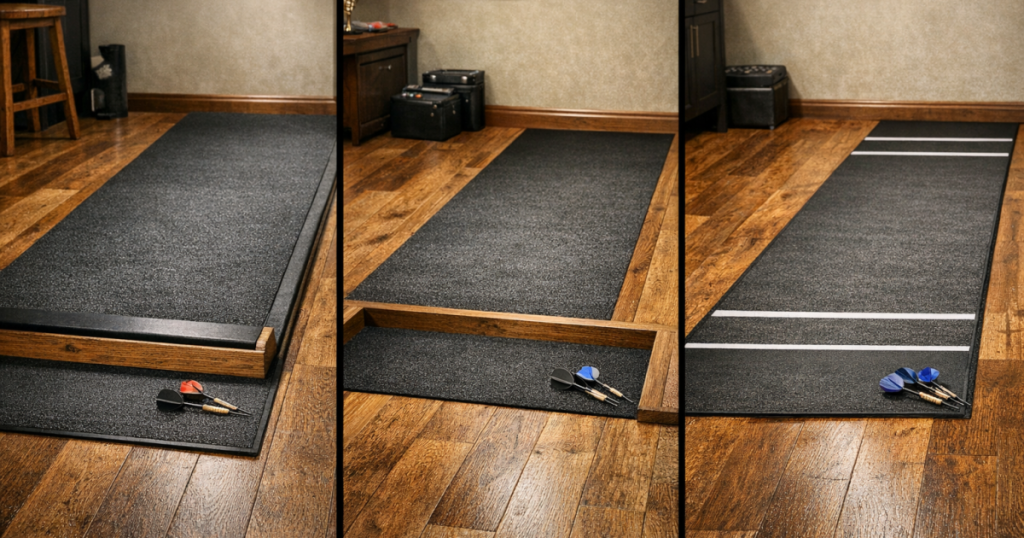
A reliable oche does more than mark where to stand: it gives every throw the same starting point, protects the rhythm of a match and stops players creeping forward without noticing. The main darts oche types are raised oches, recessed oches and marked lines, and the right choice depends on how permanent you want the setup to be, how much floor space you have and who uses the room.
Floor cutting, routing or fixed alterations for a recessed oche should be carried out by a qualified flooring or joinery professional to meet UK building, flooring and safety requirements.
At a glance
- Raised oche: the clearest physical stop for the front foot, useful for practice consistency and match-style play.
- Recessed oche: a neat, permanent floor detail that marks the throwing point without sitting proud of the surface.
- Marked line: the simplest option, often made with tape, vinyl, a mat marking or a painted line.
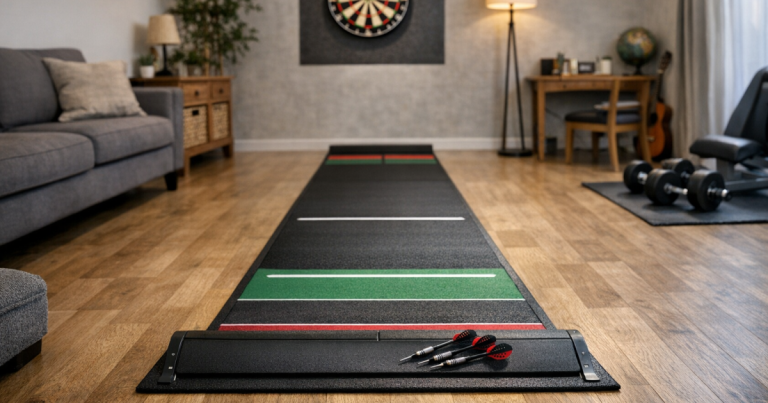
- Best all-round home choice: usually a mat with a built-in or attached raised oche, provided it lies flat and suits the room.
- Most discreet choice: a recessed or marked line, as long as everyone using the room can see it clearly.
What the oche actually needs to do
The oche marks the front edge of the legal throwing position. In a standard steel-tip setup, the front of the oche should be 2.37 m from the face of the dartboard, not from the wall behind it. The bullseye should be 1.73 m from the floor. A useful cross-check is the diagonal from the bullseye to the front of the oche, which should be about 2.93 m.
That measurement point matters. If you use a raised strip, players stand behind the front edge of the strip. If you use a line, the front edge of the line should be treated as the boundary. If the line is wide, inconsistent or vague, different players may interpret it differently, which is exactly what a good oche is meant to prevent.
For a broader view of mat length, stance space, floor protection and throwing distance, the companion guide on what makes a good darts mat and oche setup is a useful next step.
Raised oches: the most obvious foot stop
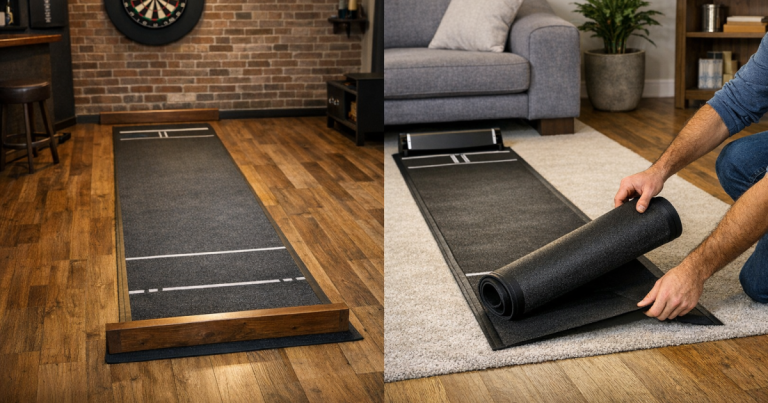
A raised oche is a physical bar, strip or lip that sits on top of the floor or mat. In home setups it is often part of a darts mat, fixed to a mat, or made from a slim timber, rubber or metal section. The key advantage is simple: you can feel it with your front foot without looking down.
Where a raised oche works well
Raised oches suit players who practise regularly and want repeatable foot placement. They are also useful when several people use the board, because the boundary is hard to miss. In a casual game, a strip on the floor quietly keeps everyone honest without constant reminders about stepping over the line.
The tactile feel is also helpful for rhythm. Many players settle into a stance by placing the lead foot lightly against the oche, then aligning the shoulder and throwing arm. A marked line can do the same job visually, but it does not give the same physical reference.
What to watch with raised oches
- Trip risk: anything raised from the floor should be obvious, stable and positioned where people expect it.
- Mat movement: if the mat slides, the oche moves with it, so the measurement stops being reliable.
- Height and shape: a bulky edge can feel awkward, while a very shallow edge may not give enough feedback underfoot.
- Room use: in a spare room, office or garage, a permanent strip may get in the way when the board is not in use.
A raised oche is often the most match-like option for home practice, but it needs to be placed carefully. If it is slightly skewed, loose or measured from the wrong point, it can create bad habits just as easily as it can improve consistency.
Recessed oches: neat, permanent and low-profile
A recessed oche is set into the floor surface rather than sitting on top of it. It might be an inlaid strip, a shallow groove, a contrasting insert or another flush detail that shows the throwing boundary without creating a raised lip. You are more likely to see this approach in purpose-built darts rooms, clubs or home spaces where the board has a long-term position.
Why people like recessed lines
The obvious benefit is tidiness. A recessed oche can look deliberate and smart, particularly in a dedicated room where you do not want a loose mat or bar on the floor. Because it is flush, it is less intrusive when walking through the space, moving furniture or using the room for something else.
It also avoids the common problem of a mat gradually drifting out of place. Once a recessed marker is accurately set into the floor, the throwing point stays put. That can be a real advantage in a room where the dartboard is permanently mounted and the floor surface is stable.
Where recessed oches can fall short
- They are less tactile than a raised oche, so players must remember to look down and set their foot correctly.
- Low-contrast materials can be hard to see in dim rooms.
- They are not ideal for rented homes or spaces where the layout may change.
- Corrections are difficult if the board position changes or the original measurement was wrong.
Recessed markers reward careful planning. Before committing to one, check the dartboard height, the board face position, the floor finish and how people naturally walk through the room. A neat marker in the wrong place is still wrong.
Marked lines: simple, flexible and easy to change
A marked oche line is the simplest form of throwing boundary. It can be a line on a darts mat, a strip of floor tape, a painted line, a vinyl marker or another clear visual mark. It is popular because it is easy to fit, easy to remove and suitable for rooms where darts is not the only activity.
When a marked line makes sense
Marked lines are ideal for temporary setups, beginner practice, shared rooms and compact spaces. If your dartboard is in a garage, utility area or spare bedroom, a clean line may be enough to keep the game consistent without adding a raised obstruction.
They are also useful while testing a room layout. Before fixing anything permanently, a taped line lets you check whether the throwing area feels natural, whether the door swing interferes, whether the player has enough space behind the oche and whether spectators can stand safely out of the throw path.
Keeping a marked line accurate
- Mark the front edge clearly, not just the centre of a strip of tape.
- Use a colour that contrasts with the floor or mat.
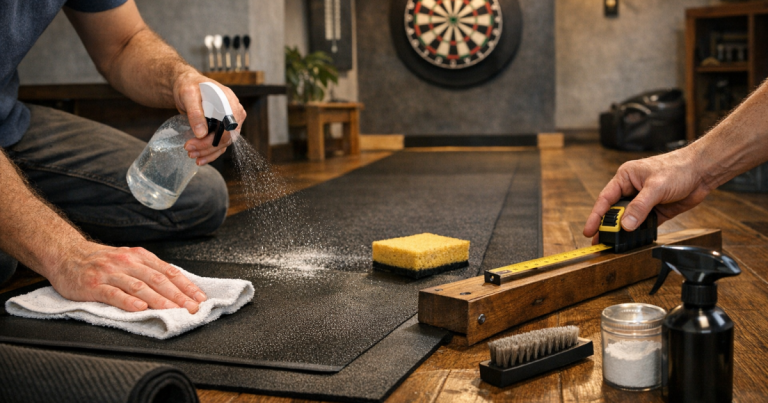
- Recheck the distance if the mat moves, curls or is lifted for cleaning.
- Avoid very narrow marks that disappear under the front shoe.
- Replace worn tape before it becomes fuzzy, torn or ambiguous.
The main weakness of a marked line is that it relies on discipline. Players can stand over it without feeling any physical resistance. For relaxed home games that may be fine, but for serious practice a raised boundary usually gives better feedback.
How they compare in real home setups
There is no single oche style that suits every room. The right answer depends on the balance between accuracy, convenience and how permanent your darts area is.
- Dedicated darts room: a raised oche or recessed oche usually makes most sense because the playing area is fixed.
- Spare bedroom or office: a marked line or removable mat keeps the room more flexible.
- Garage setup: a raised oche can work well if the floor is flat, dry and the mat does not slide.
- Family room: a low-profile marked line is often easier to live with, especially where children, pets or guests walk through the area.
- Serious home practice area: a raised oche gives the clearest repeatable stance reference.
If you are planning a multi-use room rather than just replacing an oche, the room layout matters as much as the marker. Door clearance, furniture, wall protection, storage and lighting all affect whether the setup feels comfortable. The guide to converting a spare bedroom into a practical darts room covers those wider planning decisions in more detail.
Measurement and placement checks before you settle on a style
Whichever oche type you use, measure after the dartboard is properly mounted. The distance is taken from the face of the board, so a cabinet, surround, backing board or wall depth can affect where the line should fall. Do not simply measure from the skirting board or wall and assume it is correct.
Use the same reference every time: the front of the oche. For a raised strip, that means the edge closest to the dartboard. For a marked line, it means the edge players must not cross. If you centre your measurement on a wide line, you can accidentally make the throw slightly short or long.
It is worth checking these points before fixing anything down:
- The bullseye is at 1.73 m from the floor.
- The front of the oche is 2.37 m from the board face.
- The diagonal from bullseye to oche is about 2.93 m.
- The oche is square to the board, not angled across the room.
- There is enough standing room behind and beside the thrower.
- The player can see the boundary clearly under the room lighting.
Lighting is easy to overlook. A dark line on a dark mat, or a raised oche sitting in shadow, can make foot placement less consistent. If shadows or glare are affecting the throw area, the advice on adding dartboard lighting without glare or shadows will help you tidy up the playing conditions.
Common oche mistakes at home
The most common mistake is measuring from the wall rather than the board face. This can be enough to throw off the whole setup, particularly if the board is in a cabinet or mounted on a thick backing surface.
Another frequent issue is treating a moveable mat as though it is fixed. If the mat creeps forward by even a small amount, the oche moves with it. On smooth floors, consider how the mat is held in position and recheck the measurement from time to time.
Wide tape can also cause confusion. If one player stands behind the near edge and another stands behind the far edge, they are not throwing from the same distance. Make it clear which edge is the boundary and use it consistently.
Finally, avoid placing the oche where it encourages an awkward stance. A player should be able to stand naturally, with enough room for their trailing foot and follow-through. If the thrower is squeezed between a bed, desk, radiator or doorway, the oche may be technically correct but practically poor.
FAQ
Which of the darts oche types is best for beginners?
A marked line is fine for starting out, but a raised oche gives better feedback because the front foot can feel the boundary. If the setup is temporary, a mat with a clear line or removable raised section is usually easiest.
Can I use tape as a permanent oche?
You can, but it needs checking. Tape can lift, wear, gather dust or leave adhesive on some floors. It is better as a flexible marker than a long-term finish in a serious practice space.
Should the oche be measured from the wall or the dartboard?
Measure from the face of the dartboard to the front edge of the oche. Measuring from the wall can be inaccurate because boards, cabinets and backing panels add depth.
Is a recessed oche worth it for a home setup?
It can be worth it in a dedicated darts room where the board will stay in the same position. For shared or rented spaces, a marked line or removable raised oche is usually more practical.
Does a raised oche need to be fixed down?
It needs to stay in the correct position during play. Some raised oches are part of a mat, while others are fixed separately. If it can move underfoot, recheck the distance before playing seriously.
Why it matters
A good oche makes home darts feel more settled. It keeps the throwing distance honest, helps players build a repeatable stance and gives the room a more purposeful playing area. Raised oches are best when you want a clear physical stop, recessed oches suit permanent rooms with a tidy finish, and marked lines work well where flexibility matters. Measure carefully, make the boundary obvious and choose the style that fits how the room is actually used.