Most home darts setups have to share space with normal furniture: a sofa, a coffee table, dining chairs, a TV unit or a sideboard that is not moving permanently. A darts mat zone only works well when it gives you a consistent throw, protects the floor and still lets the room feel usable when nobody is playing.
The trick is to plan the area as a temporary playing lane rather than treating the mat as a separate accessory. Get the throw line, foot space, furniture edges and walking routes right, and the whole setup feels far less awkward.
The short version
- Measure from the face of the dartboard to the oche line, not from the wall behind the board.
- Keep the throwing lane clear of coffee tables, pouffes, dining chairs and open cupboard doors.
- Leave enough standing space behind the oche for balance, not just the mat itself.
- Use furniture as a boundary only if it sits outside the throw path and does not distract the player.
- Plan how the room returns to normal after play, especially in shared living rooms and open-plan spaces.
Start with the board, not the mat
The mat should follow the dartboard position, not the other way round. For a standard steel-tip setup, the bullseye is normally set at 1.73 m from the floor, with the oche line 2.37 m from the face of the board. That face-of-board measurement matters because cabinets, backing boards and wall protection can all change the distance if you simply measure from the wall.
Before laying anything down, stand where the oche will be and look back towards the board. Ask whether a seated person, open door, pet bed, toy basket, plant stand or chair leg could realistically drift into that line. A mat can make the throw line clearer, but it cannot fix a poor board position.
If you are still deciding which wall should take the dartboard, it is worth checking the safety logic first. The guide on choosing the safest wall for a dartboard is a useful next step before committing to a mat layout.
Map the room as a playing lane
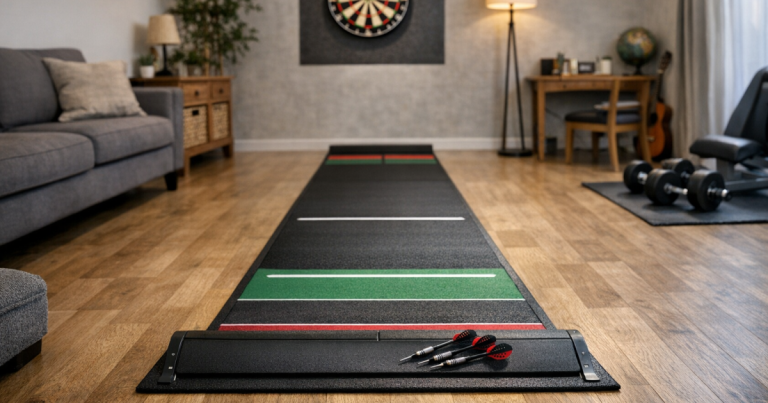
Think of the playing area as a long, narrow lane running from the board to the player. The mat sits within that lane, but the usable space is slightly wider and longer than the mat itself because players need to step in, stand square, retrieve darts and move around furniture without shuffling sideways.
A good home darts mat zone usually needs three areas to work together: the board end, the oche area and the reset space around it. The board end needs wall protection and clear access for retrieving darts. The oche area needs a clean standing position with no rug ridges, table legs or furniture corners near the player’s feet. The reset space is the bit behind and beside the thrower where the next player waits, a chair is pulled back, or someone walks through the room.
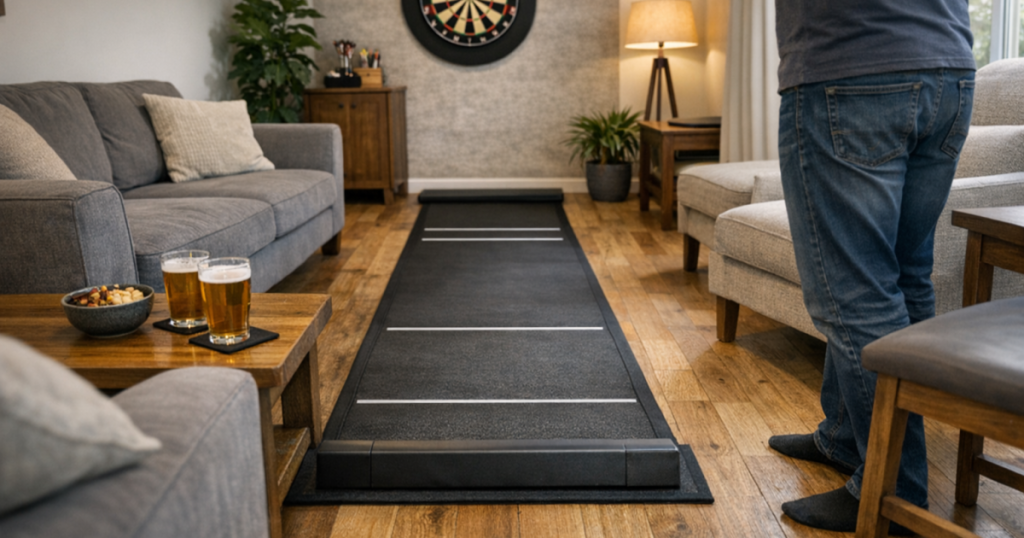
In a lounge, the most common clash is the coffee table. If it sits between the sofa and the dartboard, it may need to slide sideways during play. In a dining room, chairs are the usual problem because they move every time someone sits down. In a spare room, storage boxes and laundry baskets are the things that creep into the lane over time.
Furniture-by-furniture planning
Sofas and armchairs
A sofa can work well beside a darts setup because it gives waiting players somewhere to sit. It becomes a problem when it sits too close to the side of the throwing lane or encourages people to lean into the line of play. Aim to keep seated spectators outside the forward throw path, not just outside the mat edge.
If the sofa faces the board, be stricter. Nobody should be sitting beyond or close to the board end while darts are being thrown. A safer layout usually places seating behind the thrower or well to one side, with a clear rule that nobody crosses the lane until all three darts have been thrown.
Coffee tables and side tables
Coffee tables are awkward because they are low enough to forget about and hard enough to hurt if you step back into them. If the table has to move, give it a repeatable parking place. That might be beside the sofa, against a TV unit or tucked under a window, but it should not end up half in the throwing lane.
Side tables are easier to live with, but check lamp cables, coasters, drinks and glass tops. The oche is a footwork area, not a storage strip. Keeping nearby surfaces clear also reduces the chance of someone reaching across the player while they are lining up a shot.
Dining chairs
Dining chairs are rarely where you left them. If your mat runs through a kitchen-diner or open-plan living space, mark a chair-free position before play starts. It can be as simple as pushing all chairs fully under the table and checking that no chair back protrudes into the lane.
For more complex open spaces, the wider room plan matters as much as the mat. The article on planning a darts area in an open-plan room covers sightlines, shared traffic routes and how to stop the setup feeling like it has taken over the whole space.
TV units, bookcases and cabinets
Furniture near the board end needs a different check: bounce-outs and retrieval. A sideboard directly below or beside the board can collect fallen darts, damage points, or make people reach awkwardly around ornaments and framed photos. Bookcases and cabinets can also narrow the shoulder space when players retrieve darts.
If you use a cabinet around the board, make sure its doors do not clash with furniture when open. If you use a surround or wall protector, check that it does not push the board face out without you rechecking the oche measurement.
Protect the floor without creating a trip point
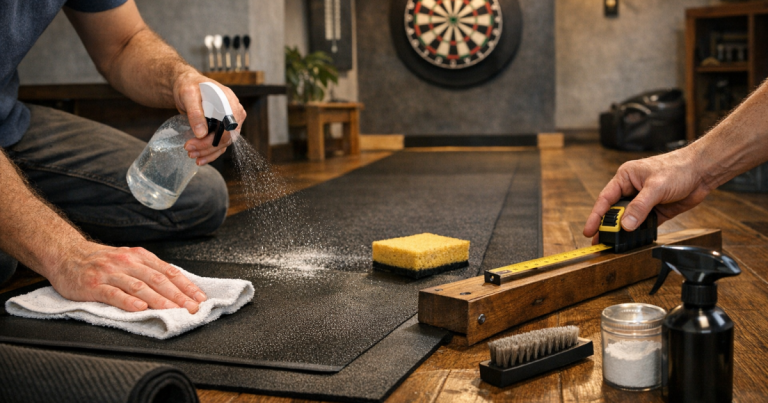
A mat is there to define the throw line, protect the floor from dropped darts and give the player a consistent standing surface. It should lie flat, with no curled corners or ridges where a player steps onto it. This matters more in homes with hard flooring, where a raised edge can catch a trainer, and in carpeted rooms, where thin mats can creep over time.
On wooden, laminate or vinyl floors, check whether the underside of the mat grips without marking the surface. On carpet, check whether the mat ruckles after a few visits to the board. A mat that moves even a little can gradually change the player’s foot position, which is frustrating during practice and messy during casual matches.
Rugs need special attention. Laying a darts mat over a thick rug can feel soft underfoot and make the oche less precise. If the rug is mainly decorative, it is usually better moved out of the lane during play. If it is too large to move, make sure the mat sits flat and that the oche line remains clearly visible.
Make the oche repeatable
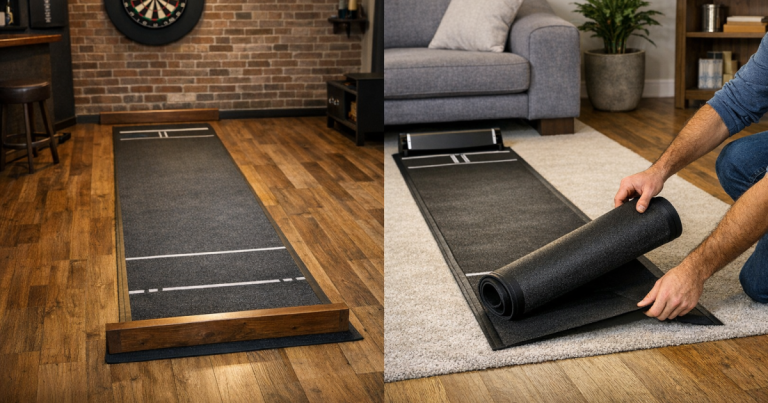
The best home setups are easy to restore. If you roll the mat away after every session, you need a simple way to put it back in exactly the same place. Small visual references help: the mat aligned with a skirting board joint, the edge of a cabinet, a floorboard line or a discreet mark that does not spoil the room.
Some players eventually move from a roll-out mat to a more permanent raised oche or fixed floor marker. That can improve consistency, but it also changes how the room behaves day to day because furniture and walking routes have to work around it. For a more committed setup, see the permanent oche installation and mat planning guide.
If the space is shared, avoid anything that creates a nuisance when darts are not being played. A low-profile marker, a removable mat or a mat stored behind the sofa may be more realistic than a fixed feature in the middle of a family room.
Set a simple pre-throw room check
A quick check before play prevents most layout problems. It should take less than a minute and become part of the routine, like chalking scores or switching on the board light.
- Is the mat flat and lined up with the board?
- Is the oche line measured from the board face and clearly visible?
- Are chairs, tables, footstools and pet beds outside the lane?
- Is there space behind the thrower for balance and player changeover?
- Are people, pets and breakable items away from the board end?
- Can players retrieve darts without squeezing past furniture?
This is not about making the room feel over-controlled. It simply gives everyone the same expectations, which is especially useful when guests, children or non-players are around.
Helpful questions
Can a darts mat sit under a coffee table when not in use?
Yes, if it lies flat and the table does not leave heavy dents or curl the edges. Before playing, move the table fully out of the lane rather than leaving it partly over the mat.
How much space should be behind the oche?
There is no single domestic rule, but leave enough room for a player to stand naturally, step back and swap places without hitting furniture. If someone has to twist round a sofa arm, the area is too tight.
Can I throw across a living room walkway?
Only if the walkway is clearly closed during play. A shared route between a kitchen, hallway or garden door is a poor choice unless everyone in the room understands not to cross while darts are being thrown.
Is a mat still useful if I already have carpet?
Yes. Carpet may soften dropped darts, but a mat gives a clearer oche, protects the carpet from point marks and helps keep your stance consistent.
Should the mat stay down all the time?
Only if it does not create a trip point or make the room feel cluttered. In many UK homes, a roll-away setup is the better everyday compromise.
Final thoughts
Planning around furniture is less about finding a perfect empty room and more about controlling the few things that affect every throw: distance, foot position, safety and movement. Once the sofa, chairs and tables have predictable places during play, the mat becomes part of a reliable home setup rather than something you constantly work around.
Keep the lane clear, make the oche repeatable, and choose a layout that the room can return from easily. That balance is what makes home darts enjoyable without turning everyday living space into a permanent obstacle course.