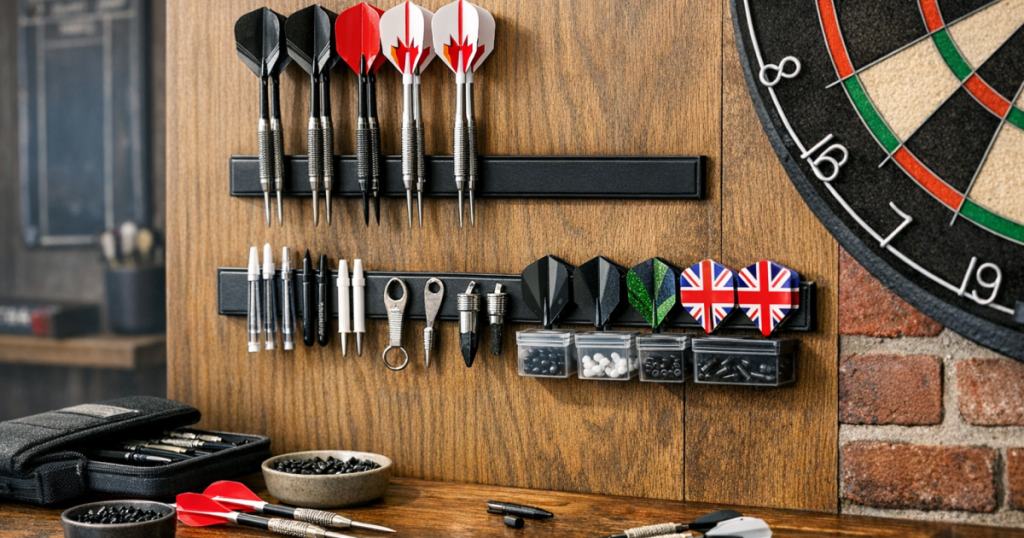
Small darts tools have a habit of disappearing just when you need them: a point tool in one drawer, spare rings in another, and a flight punch somewhere under the scoreboard. A small wall strip can turn scattered accessories into magnetic dart tool storage, keeping the useful bits visible without taking over the room.
The trick is not to treat it like garage storage. A darts setup needs neat access, safe placement and a layout that works around the throw line, cabinet, lighting and the people using the space.
The short version
- Use a magnetic strip for steel tools and small metal accessories, not as the main home for all your darts kit.
- Place it outside the throwing lane and away from where hands or sleeves can catch exposed points.
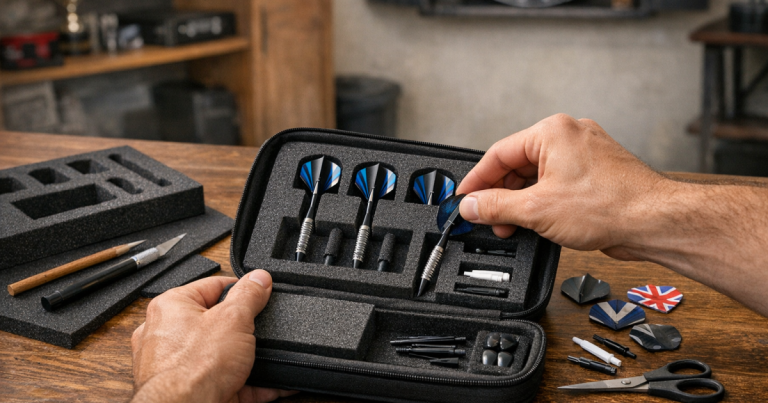
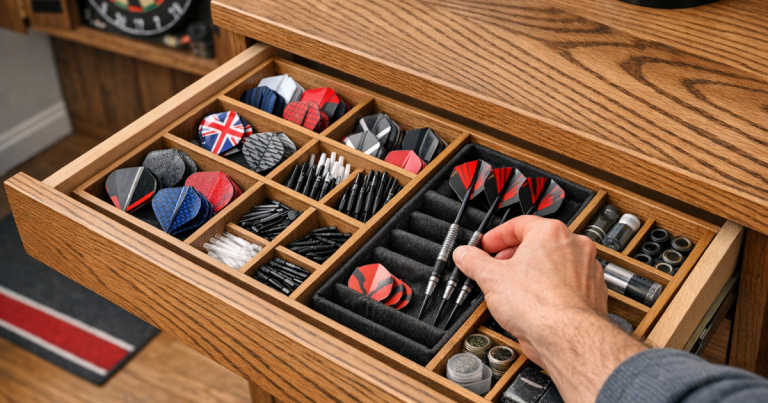
- Keep flights, stems and delicate spares in a case, tray or small box rather than relying on magnets.
- Group items by job: match setup, point care, shaft and flight changes, and scoring accessories.
- Check the strip after the first few sessions to make sure nothing slides, rattles or gets knocked off.
Why a magnetic strip can work well around a dartboard
A magnetic strip is useful because it gives small tools a fixed home. Instead of opening a drawer every time a stem loosens or a point needs attention, you can keep the tool within arm’s reach and return it to the same place afterwards.
It also helps stop the darts area becoming a dumping ground. Home setups often share space with a spare room, dining area, garage wall or converted corner of a lounge. A narrow strip uses vertical space and avoids adding another tub, shelf or caddy to the floor. If you are already trying to keep the room tidy, it fits nicely alongside broader storage planning; for more layout ideas, see how to plan dartboard storage without cluttering the room.
The limitation is that not everything in a darts setup belongs on a magnet. Many useful accessories are plastic, paper, aluminium or fabric, and some metal items are awkward or unsafe when exposed. Think of the strip as a tool rail, not a full storage system.
Step 1: Decide what should actually go on the strip
Start by emptying your current darts accessory box or drawer and separating items into three piles: magnetic tools, non-magnetic spares, and items that need protection. This prevents the strip becoming a novelty display that looks tidy for two days and then stops being useful.
Good candidates
- Small steel screwdrivers used for accessories or cabinet fittings.
- Allen keys or small hex keys used with relevant darts accessories.
- Steel-tipped point tools, provided the sharp ends are positioned safely.
- Metal flight punch tools if the body holds securely.
- Small pliers or tweezers used for rings, springs or stubborn components.
- A compact metal rule or checking gauge, if you use one for setup checks.
Better stored elsewhere
- Flights, because they crush, bend and collect dust when left loose.
- Plastic stems and spare shafts, unless they are in a small magnetic tin.
- Loose O-rings, springs and washers, which are too easy to knock off.
- Darts themselves, unless you have tested the hold and the points are fully protected.
- Score sheets, checkout cards and pencils, which are better in a clip, pouch or drawer.
It is worth testing every item before fixing your layout. Some metal-looking darts accessories are not strongly attracted to magnets, while some heavier tools may stick but slide if the strip is mounted vertically and the surface is smooth.
Step 2: Choose a position that does not interfere with play
The best position is close enough to reach between legs, but far enough from the board and oche that it never becomes part of the throw. Avoid placing the strip directly below the board where bounce-outs or missed darts may land. Also avoid the edge of a narrow walkway where someone could brush against tools.
Good locations include the side wall near the scoreboard, the inside edge of a cabinet, a short section beside a storage shelf, or a panel behind where the non-throwing player stands. If you use a cabinet, make sure any added strip does not pull the doors unevenly, foul the board, or change how the cabinet sits on the wall. Cabinet alignment matters more than squeezing in another accessory rail, so check how to fit a dartboard cabinet without misaligning the board before adding extras around it.
In a compact UK spare room, the neatest spot is often shoulder height on the side wall, not beside the skirting board. Tools stored too low are more likely to be kicked, bumped by a vacuum cleaner, or collected by children. Tools stored too high become annoying to use, which means they eventually end up back on the table.
Step 3: Fix the strip cleanly
Most strips are fitted either with screws or strong adhesive. Screws are more secure, especially on painted plasterboard, timber panels or rougher walls. Adhesive can be useful for lightweight setups, but it depends heavily on the surface: dust, textured paint, damp garages and uneven wallpaper can all reduce the hold.
Before drilling, check the area for hidden pipes and cables using a suitable detector, and avoid fixing into unknown wall sections. If you are using screws, mark the holes with a pencil, use a spirit level, drill neatly, and choose fixings that suit the wall type. A strip full of tools does not need to be heavy, but it does need to stay put when you remove one item at a time.
If you use adhesive, clean and dry the surface first, press the strip firmly in place, and allow the adhesive to cure for the time stated by the manufacturer before loading it. Do not test it immediately with your heaviest tool. Start with one or two light items and add more only after the strip feels stable.
Step 4: Arrange tools by the way you use them
A strip works best when it reflects your playing routine. Rather than lining things up randomly, create small zones from left to right. This makes it obvious where each item belongs and helps other players return things properly.
Before-play zone
- Flight punch or ring tool.
- Small screwdriver or accessory key.
- Stem-tightening tool if you use one.
During-play zone
- Spare point tool or tweezers.
- Small tin for O-rings, if the tin itself holds securely.
- Scoreboard pen clip nearby, but not necessarily on the strip.
Maintenance zone
- Point-care tool, kept with the working end facing away from hands.
- Compact pliers for stubborn fittings.
- Small metal rule or checking tool.
Leave gaps between sharper or heavier tools. A tightly packed strip looks efficient, but it makes every item harder to grab and increases the chance of pulling two tools off at once.
What not to hang on a magnetic strip
Flights are the biggest mistake. They are light, easy to misplace and tempting to leave near the board, but they should not be left exposed if you want them to stay square and usable. A small case, divider box or flight holder is a better answer; if that is a recurring problem in your setup, read how to stop flights getting crushed in storage.
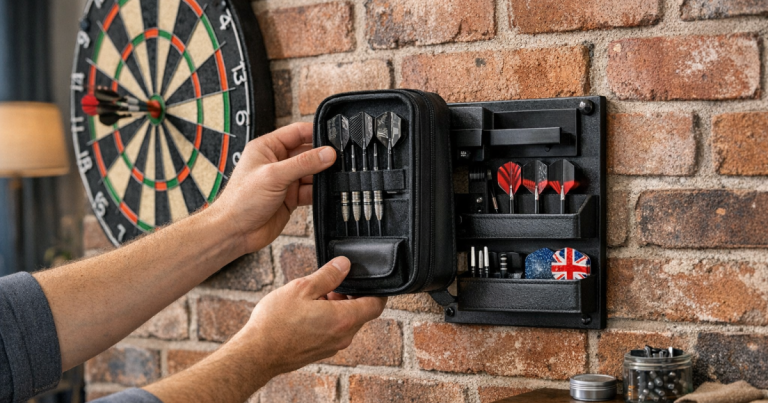
Do not hang loose darts point-out on a wall strip. Even if the barrels hold, the points are exposed and easy to catch with a sleeve or hand. If you want darts on display, use a dedicated rack or case that controls the angle and protects the points.
Avoid storing anything delicate, painted or easily scratched directly against the strip. Repeated sliding can mark finishes, and tools with small moving parts can pick up dust or grit from the wall. If an item matters enough to protect, it belongs in a case or compartment.
Layout examples for different home setups
Small flat or shared room
Keep the strip short and purposeful. Mount it near the scoreboard or on the inner side of a storage unit rather than making it a visual feature. Limit it to three or four tools so the darts area still looks tidy when the board is not in use.
Cabinet setup
A cabinet gives you natural storage boundaries. Use the strip beside the cabinet rather than above or below the board. If the cabinet doors are deep enough and the strip is very slim, an inside-door location can work, but only if the tools do not hit the board, surround or scoreboard when the door closes.
Garage or utility room
Garages often have more wall space, but they also collect dust and damp. Place the strip away from areas used for DIY, bikes or garden tools so your darts accessories do not get mixed into household hardware. Keep small spares in sealed tubs rather than leaving them open to the air.
Family room
Prioritise safe reach and a calmer appearance. Store sharp tools higher than small children can easily reach, and keep the strip away from doorways, sofas and walking routes. A short black or stainless strip on a side panel usually looks neater than a long tool rail across the wall.
Checks after the first week
Once you have used the strip for a few sessions, review it honestly. The first layout is rarely perfect, because you only find out what is convenient while playing.
- Does every item return to the same place, or are tools still ending up on the table?
- Does anything slide down the strip when the door closes or the wall is knocked?
- Can players reach the tools without stepping across the oche area?
- Are any sharp ends exposed where someone might brush past?
- Are non-magnetic items being balanced on top instead of stored properly?
If an item keeps falling, remove it rather than trying to make the strip do a job it is not suited for. A neat darts area is built from the right mix of storage: wall strip for tools, case for darts, small box for spares, and sensible room planning around the board.
Things readers ask
Can I store my darts on a magnetic strip?
You can test whether your darts hold, but it is usually not the best storage method. The grip may be unreliable, and exposed points can scratch surfaces or catch hands and sleeves. A case or dedicated rack is safer and tidier.
Will a magnetic strip damage darts tools?
For basic steel hand tools, it should not be an issue in normal use. The bigger risk is scratching from sliding tools on and off, so space them out and avoid hanging delicate finished accessories directly on the strip.
Is adhesive strong enough for a darts tool strip?
It can be, but only on a clean, smooth and suitable surface with light tools. Screws are usually more dependable for a permanent setup, especially on painted walls, timber panels or garage surfaces.
Where should the strip sit in relation to the dartboard?
Keep it outside the throwing lane and away from the area directly below the board. A side wall, cabinet side or nearby storage panel normally works better than placing tools under the doubles ring or near the oche.
What is the simplest useful setup?
Start with one short strip, a small tin for loose rings, and a separate darts case. Add only the tools you use regularly; if something has not been touched for several weeks, it probably belongs in a drawer or kit box.
In brief
A magnetic strip is a tidy, low-effort way to store the small tools that support a home darts setup, but it should not replace proper cases and compartments. Keep it close, safe and selective: the right items on the wall, delicate spares protected, and the playing area free from clutter.