Dart flights are small, cheap compared with barrels, and very easy to ruin in a crowded drawer or darts case. The easiest way to stop flights getting crushed is to keep fitted darts rigid, loose flights flat, and spare sets separated from points, barrels and tools.
The aim is not to build a museum display. It is to make your home setup easier to use, so the flights you reach for before a leg are still square, clean and consistent.
What to know first
- Do not store loose flights under barrels, tools, chalk, spare points or heavy wallets.
- Keep fitted darts in a case that prevents the stems and flights from being pressed sideways.
- Store spare flights in sets, not loose singles, so you can spot bends and missing pieces quickly.
- A small divider box, hard case or cabinet tray is usually better than one big accessories tin.
- Heat, damp and overfilled pockets can distort flights even when nothing looks obviously heavy.
Step 1: Separate fitted darts from spare flights
The first mistake is treating all darts accessories as one pile. Fitted darts need space around the flight shape, while loose flights need a flat, low-pressure compartment. If you store a complete set of darts with spare flights squeezed beside the barrels, the spare sets often take the damage first.
Use one of three simple systems:
- Ready-to-throw case: keep one set of assembled darts protected for regular play.
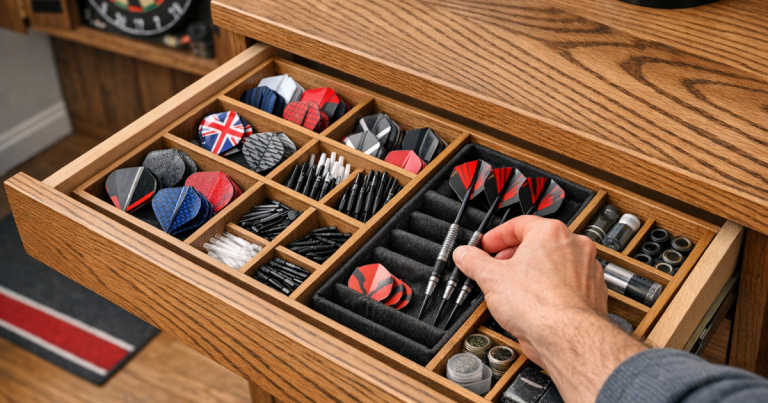
- Spare flight organiser: keep unused flights flat in small sections, sleeves or a shallow box.
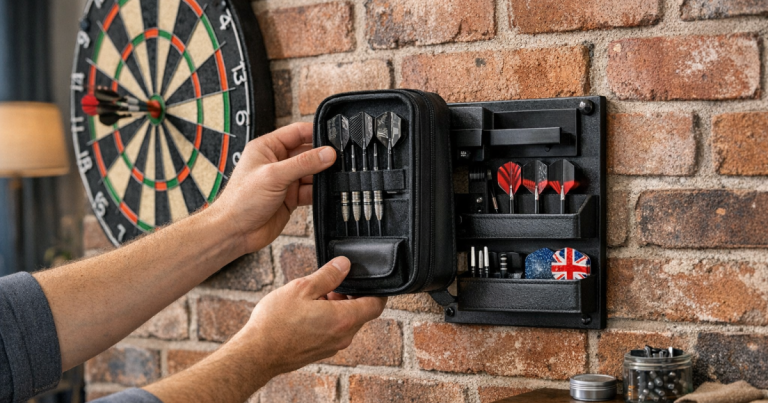
- Cabinet accessory zone: keep everyday spares near the board, but away from screws, tools and heavy items.
If your board lives in a cabinet, it is worth setting up a dedicated accessories area rather than dropping everything on the cabinet shelf. The wider approach to tidy storage is covered in the dartboard cabinet storage and organisation guide, which is useful if your flights, shafts and chalk are all competing for the same small space.
Step 2: Choose the right storage method for the way you play
There is no single perfect storage option because different players use flights differently. A casual home player might only keep two spare sets near the board. A league player may carry multiple shapes, colours and stem combinations. The right answer is the one that protects the flight without making it annoying to find.
For one main set of darts
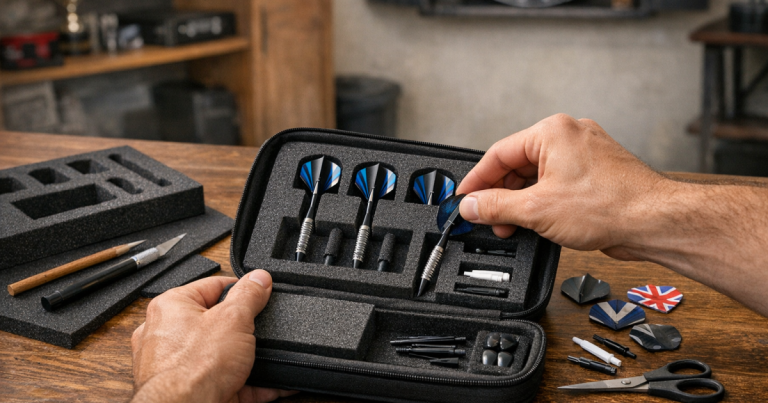
If you usually play with one set, keep the darts assembled in a case with enough depth around the flights. A hard or semi-rigid darts wallet, such as a Target Takoma Darts Wallet, can help stop the flights being squeezed in a bag, but check the internal layout against your dart length, stem style and flight shape before relying on it.
The key check is simple: close the case gently and look for pressure on the flight edges. If the case has to be forced shut, the flights are being bent every time you pack up.
For several spare flight sets
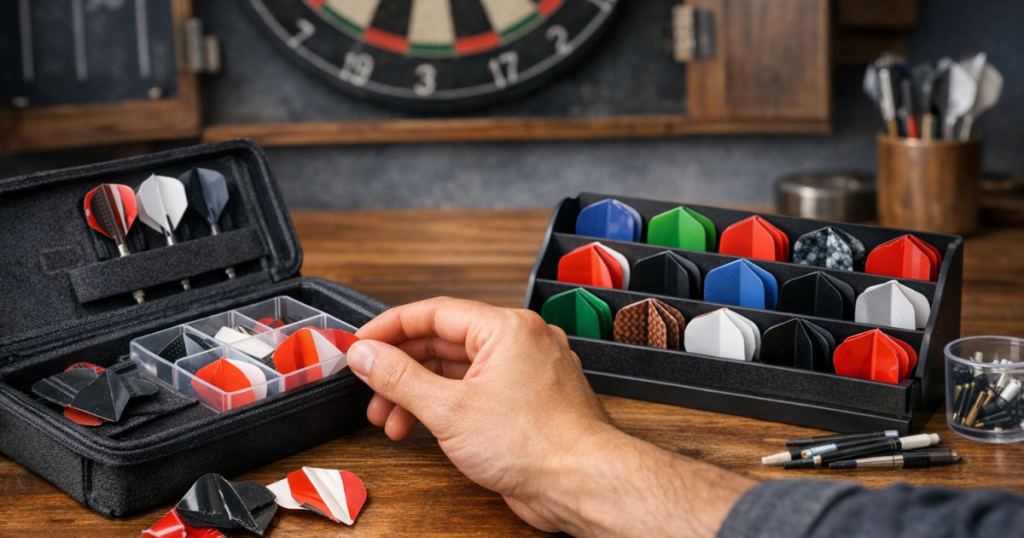
Loose flights are best kept flat and grouped. A small craft-style organiser, trading-card sleeve, flight box or divided accessories case can work well. The important detail is that each set has its own space. If five sets are crammed into one slot, the outer flights protect the middle ones but sacrifice their own shape.
Keep the storage shallow rather than deep. Deep tubs encourage stacking, and stacking encourages bent corners. A flat organiser also makes it easier to see which flights are standard, pear, kite or slim without tipping everything out.
For darts carried in a work bag or sports bag
If your darts travel with shoes, notebooks or other kit, soft pouches are the risky option. They may stop darts going missing, but they do not always stop pressure from the outside. A firmer case, such as a Mission Freedom Slim Darts Case, is a more protective style of storage to consider, provided it suits your assembled darts and the accessories you carry.
When carrying darts, avoid putting the case at the bottom of the bag. Store it upright or in a side pocket where it is less likely to be sat on, crushed under clothing or pushed against a laptop charger, flask or book.
Step 3: Store loose flights flat, not folded
Most standard foldable flights arrive flat and only open into shape when fitted to a stem. Do not pre-open spare foldable flights and then store them loose. Open flights take up more room and are more likely to be creased, twisted or crushed.
Keep foldable flights flat until you need them. If you use moulded flights or integrated flight-and-shaft systems, give them their own rigid section because they cannot be flattened in the same way. The goal is to store each type in the shape it was designed to keep.
For foldable flights, a good routine is:
- Keep each set of three together.
- Store them flat with the printed sides aligned.
- Avoid elastic bands, which can pinch corners and leave marks.
- Do not wedge them into stem slots, coin pockets or tool loops.
- Check for curling before match nights or longer practice sessions.
Step 4: Make your cabinet work harder
A dartboard cabinet can be more than a place to hide the board. With a little organisation, it can hold flights safely while keeping the playing area tidy. The trick is to avoid turning the inside ledge into a junk shelf.
Use small trays, labelled compartments or slim boxes inside the cabinet. Keep flights above or beside heavier items, not underneath them. Put spare points, rings, flight protectors and tools in a separate compartment so sharp or metal parts cannot press into the flight surface.
If you are adding hooks or small organisers, place them where they will not catch the flights when the cabinet doors open and close. For a neat way to add hanging storage without cluttering the main shelf, see the guide on fitting accessory hooks inside a dart cabinet.
Step 5: Avoid the storage spots that quietly damage flights
Flights do not only get damaged by obvious crushing. They can also warp from poor storage conditions and repeated small knocks. In a UK home setup, the usual problem areas are drawers near radiators, damp garages, overfilled sideboards and kit bags left in the car.
Try to avoid these common storage habits:
- Loose in a kitchen drawer: cutlery, batteries, keys and tools can crease the edges.
- On a sunny windowsill: warmth and direct light can encourage warping or fading.
- In a damp outbuilding: moisture is not friendly to darts gear, packaging or cabinet interiors.
- Under the board on the floor: flights can be stepped on, kicked or swept up with other clutter.
- In a packed darts tin: barrels and stems will usually win the fight for space.
If you practise in a rented home and need removable or low-mark storage, choose freestanding or cabinet-based organisers rather than adding random fixings to walls or furniture. The same thinking applies when planning the wider playing space; the guide to planning a darts setup in a rented home is a useful next step if you are trying to keep everything tidy without making permanent changes.
Step 6: Build a quick pre-play and pack-away habit
Good storage only works if it is easy to repeat. A 30-second routine after play prevents most crushed-flight problems before they start.
After a session:
- Remove damaged flights rather than returning them to the good spares.
- Put loose sets back into their own compartment.
- Check that fitted flights are sitting square before closing the case.
- Keep tools and metal accessories in a separate slot.
- Do not leave flights loose on the oche, cabinet shelf or sofa.
Before a session:
- Spin each dart lightly in your fingers and look for obvious flight wobble.
- Check the flight corners for curling or creases.
- Make sure all three darts are using the same flight shape and condition.
- Replace any flight that has a split, deep crease or badly flattened edge.
This is not about being fussy. A bent flight can change how the dart sits in the air and how it lands in the board. If one dart in the set is noticeably different, your grouping can feel inconsistent even when your throw is fine.
Step 7: Decide what to keep near the board and what to store away
Too much gear near the board creates clutter, and clutter crushes flights. Keep everyday items close and archive the rest elsewhere.
A sensible home setup might look like this:
- Near the board: one assembled set, two or three spare flight sets, a few spare shafts, a point-safe tool if used, chalk or marker.
- In a drawer or cupboard: bulk spare flights, older shafts, alternative dart sets, packaging and rarely used accessories.
- In a travel case: the exact darts and spares you take outside the house, kept separate from home-only gear.
This split keeps the cabinet useful without overloading it. It also makes it less likely that someone will push a scoreboard pen, keys or a spare set of barrels into your flights just to clear a surface.
Signs a flight has been damaged in storage
Some damaged flights are obvious, but others only show up when you throw. Look for these signs when checking your kit:
- One wing no longer opens to the same angle as the others.
- The flight rocks loosely in the stem even when the stem is intact.
- One corner curls upwards or downwards.
- There is a visible crease through the flight body.
- The dart lands at a different angle compared with the other two darts.
Minor cosmetic marks are not always a problem, but deep creases and twisted shapes are worth replacing. Flights are consumable parts, so the aim is not to keep every set perfect forever. The aim is to stop avoidable damage before the flight has even been used properly.
Common questions
Should I remove flights before storing my darts?
Not always. If your case protects assembled darts without pressing on the flights, leaving them fitted is convenient. If the case is shallow or tight, remove the flights and store them flat.
Are flight protectors enough to stop crushing?
Flight protectors can help keep the rear of a flight spread, but they do not protect the whole shape from side pressure. You still need enough room in the case or organiser.
Can I store spare flights in their original packaging?
Yes, if the packaging stays flat and is not bent in a drawer. Original sleeves are handy for grouping sets, but they still need a sensible storage spot.
What is the best small storage fix for a messy darts drawer?
Use a shallow divided organiser and separate flights from barrels, stems and tools. The biggest improvement comes from stopping heavy and sharp items sitting on top of flights.
How many spare flights should I keep by the board?
For most home players, two or three spare sets near the board is enough. Keep bulk spares elsewhere so the playing area stays tidy and the flights are not crammed together.
Final thoughts
Crushed flights usually come from simple storage habits rather than careless play. Keep fitted darts protected, store loose flights flat, separate them from heavier accessories, and avoid overfilling cases or cabinet shelves.
Once your storage has a clear place for everyday spares, travel gear and bulk accessories, your darts area feels calmer and your flights last longer. It is a small upgrade, but it makes every home session easier to start and easier to pack away.