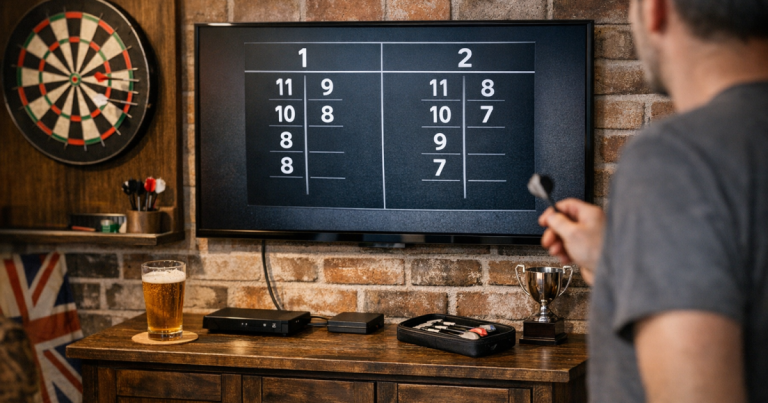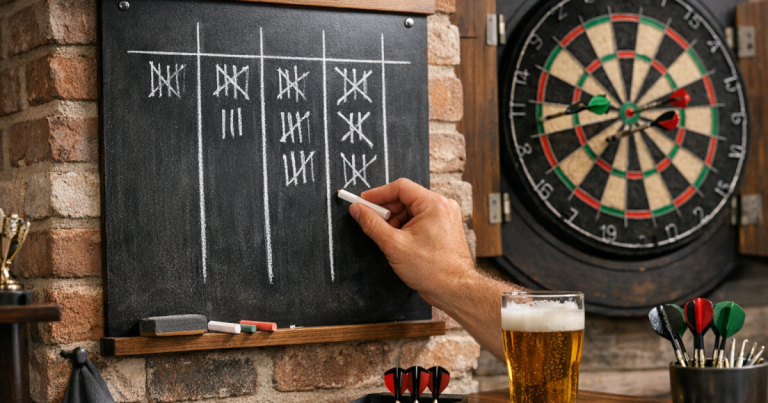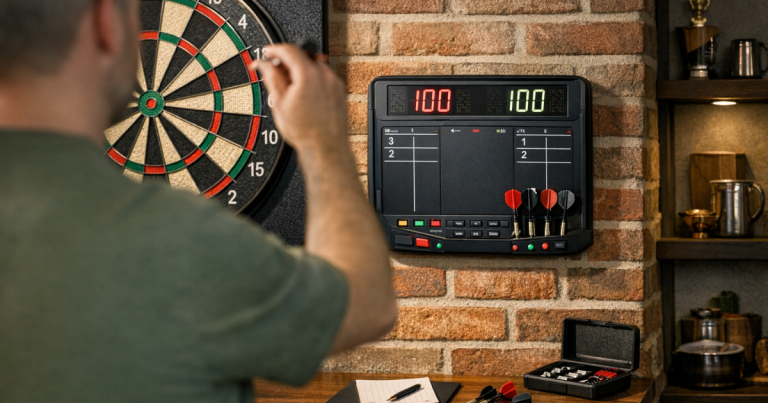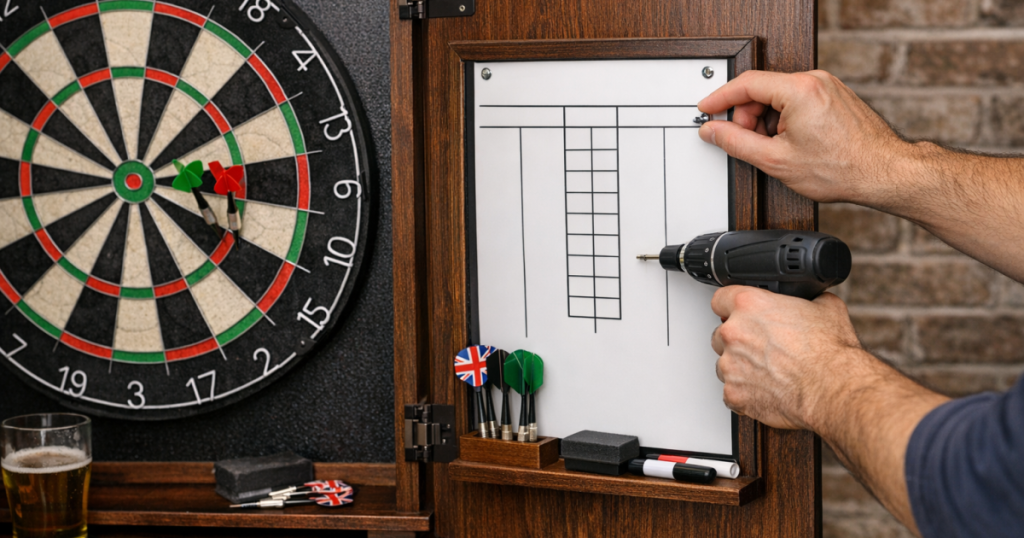
A dartboard cabinet scoreboard keeps the scoring area close to the board without adding another item to the wall. The trick is to fit it where players can write comfortably, read scores at a glance and still close the cabinet doors cleanly.
For most home setups, the best position is the inside face of one cabinet door, with enough clear space for names, legs, sets and running totals. Before sticking or screwing anything down, check door swing, lighting, writing angle and whether the board will be used by right-handed and left-handed players.
What to know first
- Use the inside of the left or right door, not the area directly behind the dartboard.
- Keep the writing surface thin so the cabinet closes without rubbing.
- Choose a surface that suits how you score: chalk, dry-wipe pen or printed score sheets.
- Leave a small border around the scoreboard so fixings and door edges do not interfere.
- Test the view from the oche before committing to the final position.
Step 1: Decide which cabinet door should hold the scoreboard
Start by opening both cabinet doors fully and standing at the throwing line. You are looking for the door that gives the clearest sightline without forcing players to step into the throw area after every visit.
In a compact spare room, garage or hallway-style setup, the door closest to the natural waiting position usually works best. If players stand to the left of the oche between throws, the left door is often easier. If the room has furniture, shelving or a tight corner on one side, use the opposite door.
If you are fitting the cabinet and scoreboard at the same time, get the cabinet alignment sorted before marking the scoring surface. A cabinet that is even slightly off can make the board look wrong and leave the scoreboard sitting at an awkward angle. The separate guide to fitting a dartboard cabinet without misaligning the board is worth using before you mark anything permanently.
Step 2: Check the available flat area
Measure the usable flat panel inside the chosen door. Do not measure right to the edge; leave space for the frame, hinges, magnetic catches and any raised trim. On many cabinets, the central flat panel is the safest area for a scoreboard because it avoids pressure points when the door closes.
A useful home scoring area does not need to be huge. It needs to be legible. As a simple rule, allow enough room for at least two player names and several lines of scores beneath them. If you regularly play pairs, legs and sets, or practice routines such as 100 darts at treble 20, give yourself more vertical space.
Before choosing the final dimensions, close the door gently while holding a piece of card in the proposed position. If the card bends, catches or leaves a mark, the surface is too thick or too close to a raised section. A thin scoreboard is usually better than a chunky one inside a cabinet.
Step 3: Choose the scoring surface
The main options are chalkboard film, a thin chalkboard panel, dry-wipe sheet, laminated score sheet or a painted panel. Each can work, but they suit different playing habits.
Chalkboard surface
Chalkboard surfaces suit traditional setups and casual scoring. They look natural inside a wooden cabinet and are easy to wipe between games. The downside is dust, which can build up around the bottom of the cabinet if you use standard chalk often.
Dry-wipe surface
Dry-wipe sheets are clean and quick, especially if you play lots of short legs. Use a fine or medium marker rather than a broad one so the numbers remain readable. Keep the pen capped and stored away from the board face so it does not fall into the throw path.
Printed or laminated score layout
A laminated layout is useful if you want fixed columns for 501, cricket, round the clock or practice routines. It can make casual games smoother because nobody has to draw the same grid every time. The trade-off is flexibility: a fixed layout may feel cramped when you switch games.
Step 4: Mark the position before fixing it
Use low-tack masking tape to outline the scoreboard on the inside of the door. Then stand back at the oche and check whether you can read the top and bottom of the scoring area without moving too far forward.
Next, stand where the scorer usually writes. The board should be high enough that adults do not have to crouch, but low enough that shorter players can still update scores comfortably. In a family setup, aim for a sensible middle ground rather than making the board perfect for only the tallest player.
Open and close the cabinet a few times with the taped outline in place. Check whether the scoreboard would clash with the dartboard surround, door catch, chalk holder or pen clip. This small test prevents one of the most annoying cabinet problems: fitting a neat scoreboard that makes the door awkward to close.
Step 5: Fix the scoreboard without adding bulk
For thin chalkboard or dry-wipe sheets, self-adhesive backing can be enough if the cabinet door is clean, flat and smooth. Wipe away dust first and let the surface dry fully. Press from the centre outwards to reduce bubbles.
For a lightweight panel, use low-profile fixings that do not protrude through the door or stop it closing. Check the door thickness before using screws, and choose a fixing method that suits the cabinet material. Many dartboard cabinets are not thick enough for heavy fixings, and over-tightening can split thin timber or fibreboard.
If you want the option to remove or replace the scoreboard later, consider removable mounting strips rated for indoor use. They are not ideal for every surface, especially textured or dusty cabinet interiors, but they can be useful when you are testing a layout before making it permanent.
Step 6: Add simple scoring guides
A blank panel works, but a little structure makes scoring quicker. You can add permanent or semi-permanent guide lines depending on the surface.
- For 501: create two name spaces at the top, then a vertical divider and enough rows for visits.
- For legs and sets: leave a small area above or beside the main score column for match tracking.
- For practice: reserve a corner for targets such as doubles hit, checkout attempts or three-dart averages.
- For group nights: keep a small notes area for handicaps, order of play or rotating partners.
Use a ruler and a light touch when adding lines. Thick permanent lines can make the panel look busy once scores are written over them. A clean, minimal layout tends to work better in a compact cabinet.
Step 7: Think about lighting and glare
A scoreboard inside a cabinet can be harder to read than one on the wall if the light hits it at an angle. Glossy dry-wipe surfaces are the most likely to reflect light, while matt chalkboard surfaces usually create less glare.
Open the cabinet as you would during a game and switch on your usual room or board lighting. Look at the scoreboard from the oche and from the scorer’s standing position. If the surface reflects too much, adjust the angle of the door slightly, move the scoring area inwards, or choose a more matt surface.
If your setup uses dedicated board lighting, dimmers or smart bulbs, make sure the scoring area is still readable once the board itself is evenly lit. The guide to dartboard lighting controls covers ways to make a home board easier to use without creating harsh shadows or distracting glare.
Step 8: Store pens, chalk and a cloth neatly
A cabinet scoreboard only stays useful if the writing kit is always nearby. Add a small pen clip, chalk holder or slim tray inside the cabinet, keeping it away from the dartboard face and the door edge.
Do not place loose chalk or markers on the lower cabinet ledge if the door movement can knock them out. They will eventually fall behind furniture, roll into the throw area or leave marks on the floor. A small fixed holder is tidier and stops scoring from becoming a hunt for the missing pen.
Keep a soft cloth or eraser with the scoreboard. For dry-wipe surfaces, avoid using rough cloths that can scratch the writing layer. For chalkboard surfaces, wipe gently and clear dust from the cabinet occasionally so it does not build up around the hinges.
Common mistakes to avoid
- Fitting the panel too close to the hinge: this can make writing awkward and may cause rubbing when the door moves.
- Using a surface that is too glossy: it might look smart when empty but become hard to read under board lights.
- Making the layout too small: cramped scores slow the game down and lead to mistakes.
- Forgetting left-handed scorers: check that the chosen door and pen position work for different players.
- Fixing before testing: tape the outline first, then test the view, reach and door closure.
When a cabinet scoreboard is not the best answer
Inside-door scoring works well for tidy home setups, but it is not always ideal. If you run mini tournaments, play with large groups or want spectators to see the score from across the room, a larger wall-mounted board may be easier to read.
It can also be awkward in very narrow spaces where the cabinet door cannot stay fully open without blocking movement. In that case, the better solution may be a slim external scoreboard, a side wall panel or a moveable scoring board that can be placed safely outside the throw area.
For mixed-ability nights, the scoreboard is also where fairness decisions show up. If you regularly adjust starting scores or give newer players a head start, the guide to adding handicaps fairly on a darts scoreboard will help you keep the system clear and friendly.
FAQ
Can I use a stick-on chalkboard sheet inside a dartboard cabinet?
Yes, provided the inside door surface is flat, clean and dry. Choose a thin sheet, smooth it from the centre outwards, and check that the cabinet still closes before pressing it down fully.
Which side of the cabinet should the scoreboard go on?
Use the side that gives the scorer the easiest access without stepping into the throw path. In most rooms, that means the door nearest the natural waiting position.
Will a dry-wipe board mark the inside of the cabinet?
The board itself should not, but pens can. Use a secure marker clip and wipe stray ink quickly, especially on unfinished or lightly coated cabinet interiors.
How big should the scoring area be?
Make it large enough for names, running totals and match notes without squeezing the writing. If you play doubles or group games, prioritise height over decorative space.
Can I put scoreboards on both cabinet doors?
Yes. One side can hold the active score while the other tracks legs, sets, practice targets or checkout notes. Just keep both surfaces thin enough for the doors to close properly.
Key takeaways
A tidy dartboard cabinet scoreboard should feel like part of the setup, not an afterthought. Pick the clearest door, use a thin writing surface, test the position with tape, and keep pens or chalk stored securely inside the cabinet.
The best result is simple: scores are easy to update, easy to read and always close to the board, while the cabinet still looks neat when the doors are shut.