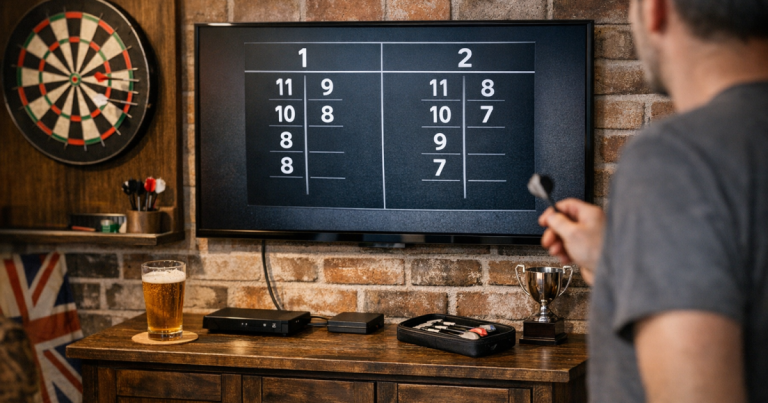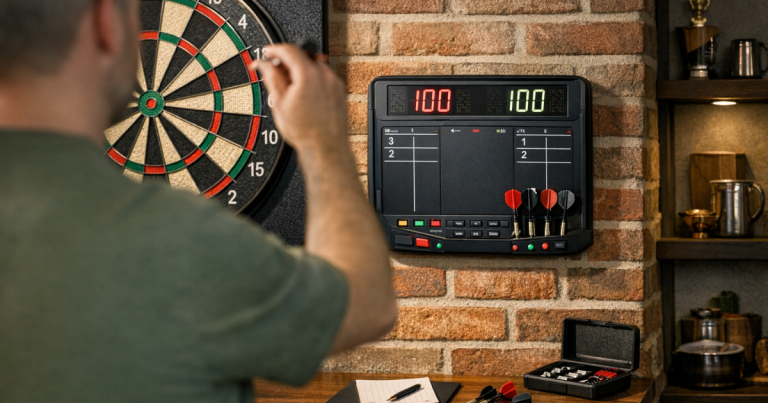
Handicaps work best when everyone can see the logic before the first dart is thrown. For home games, darts scoreboard handicaps should make mixed-ability legs competitive without changing the basic rhythm of 501, cricket, or practice games. The key is to choose a simple method, write it clearly on the board, and review it after a few legs rather than arguing halfway through.
A good handicap is not a favour and it is not a punishment. It is a way to keep both players interested, under pressure, and practising proper scoring habits.
The short version
- Base the handicap on recent results, not on reputation or who normally talks the best game.
- Use one clear scoring adjustment: a lower starting score, a head start in legs, or a marked allowance for a specific format.
- Keep the same finishing rule for both players unless you are deliberately running a beginner-friendly session.
- Write the handicap visibly before the match starts so nobody has to remember it.
- Review it after a short set, not after every unlucky leg.
Step 1: Decide what you are trying to balance
Before adding numbers to the board, decide whether the gap is about scoring power, finishing, consistency, or experience. These are not the same problem.
A player who scores heavily but misses doubles may not need a big starting-score adjustment. A newer player who regularly has visits of 11, 7, and 3 may need a larger head start because they are losing ground throughout the leg. For casual home games, the aim is usually simple: both players should feel they can still win when the game reaches the closing stages.
Try to use a recent sample. Three to five short sessions, a handful of 501 legs, or a regular practice night is enough for friendly play. Do not over-engineer it with tournament-level maths if the match is between family members or mates in the spare room.
Step 2: Pick the right handicap method for the game
The fairest method depends on the format you are playing. A scoreboard can handle all of these, but the cleaner the notation, the less confusion you will have mid-leg.
For 501 or 301
The simplest approach is to give the weaker player a lower starting score. For example, instead of both players starting on 501, one player might start on 451, 401, or 351. Because x01 is a race down to exactly zero, a lower starting score is an advantage.
Use sensible steps. A 25-point adjustment is minor, 50 points is noticeable, 100 points is significant, and anything beyond that should be tested rather than assumed. In most home matches, smaller repeated adjustments are better than one huge jump.
For legs and sets
If you are playing a longer match, you can give a head start in legs instead of changing every starting score. For example, in a first-to-five match, the newer player might start 1–0 up. This keeps each leg normal, which is useful if both players want proper practice on scoring, setup shots, and doubles.
For cricket-style games
For cricket, avoid complicated hidden allowances. Give the weaker player a small number of pre-marked hits on agreed numbers, or let them close one number in advance. Write it clearly before play starts, then score the rest of the game normally.
Step 3: Put the handicap on the scoreboard clearly
A fair handicap can still cause arguments if it is not visible. On a chalkboard, whiteboard, or dry-wipe scoreboard, give the adjustment its own small note rather than squeezing it into the running score.
For 501, write the starting totals first, then the players’ names. For example:
- Sam: 501
- Alex: 401
- Note: Alex receives 100-point start
For a leg head start, write the match score before the first leg begins:
- Best of 9 legs
- Sam 0
- Alex 1
- First to 5 wins
Do not rely on memory, especially if people are chatting, rotating turns, or playing in a busy room. A readable board matters as much as the maths, so it is worth checking your layout against the advice in how to position a darts scoreboard so everyone can read it.
Step 4: Use a simple starting-score guide
You do not need a perfect formula for friendly play, but it helps to start with a structure. Use the stronger player’s performance as the baseline, then adjust after a short set.
- Small gap: weaker player starts 451 in a 501 leg.
- Clear gap: weaker player starts 401 in a 501 leg.
- Large gap: weaker player starts 351, or starts 1–0 up in a short match.
- Beginner against regular player: consider 301 versus 501, but keep an eye on whether the beginner is reaching doubles too easily.
If you prefer to make the stronger player do more work, you can set them a higher starting score instead, such as 601 against 501. That can feel cleaner psychologically because the newer player still sees the familiar 501 on their side of the board. The practical downside is that not every casual scoreboard layout has enough space for larger starting totals and extra notes.
Step 5: Keep the throw, oche and rules consistent
A handicap should change the scoring challenge, not the physical conditions. Both players should throw from the same agreed oche, use the same board height, and follow the same order of play. If the setup itself changes between players, the result will feel messy even if the numbers are carefully chosen.
For a home setup, mark the throw line properly and keep it consistent from session to session. If you are still deciding between a raised oche, taped line, or mat, the guide to darts mat vs oche choices explains the practical differences. It is also worth checking the core setup basics in dartboard sizes, measurements and regulations if your room has been rearranged.
Step 6: Review the handicap after a set, not after one leg
One leg can be distorted by a lucky treble, a bounce-out, or a horrible spell on doubles. Review the handicap after a short set instead. A first-to-three or first-to-five format gives a better picture without making the evening drag.
Look for the pattern, not the drama. If the stronger player wins every leg comfortably, increase the allowance. If the weaker player wins without needing to hit many meaningful scores, reduce it. The best sign is a match where both players regularly get chances at doubles.
Make changes in steady steps. Move from 451 to 401, not straight from 501 to 301 unless the gap is obvious. For match handicaps, move from a one-leg head start to a two-leg head start only if the first version clearly fails.
Worked examples for common home matches
Regular player against occasional player
Two players both know the rules, but one plays most weeks and the other only throws now and then. Start with 501 versus 451. If the regular player is still winning by a wide margin, try 501 versus 401 for the next set.
Parent against junior beginner
Keep the scoring understandable. A junior might start on 301 while the adult starts on 501, with both still aiming to finish properly if they are ready for doubles. If finishing on a double is too much at first, agree a beginner rule before play starts and write it on the board.
Two regular players with different strengths
If one player scores better but the other finishes better, avoid a large handicap. Try a match head start instead, such as 1–0 in a first-to-five. This preserves normal leg rhythm and still creates pressure.
Scoreboard habits that keep it friendly
- Name the reason: write “401 start” or “1-leg head start”, not vague notes that need explaining later.
- Avoid mid-leg changes: once a leg starts, the handicap stays as written.
- Rotate the throw fairly: if you are giving a scoring head start, do not also give every advantage on throw unless agreed.
- Keep subtraction clean: call scores aloud and update the board after each visit.
- Separate practice from matches: a relaxed handicap game can still be serious practice, but agree the tone before you start.
Things readers ask
Should the weaker player start lower or should the stronger player start higher?
Both work. Starting the weaker player lower is easier to score, while starting the stronger player higher can feel more like an extra challenge for the better thrower. Choose the version your scoreboard and players understand quickest.
Do handicaps ruin proper darts practice?
Not if the main rules stay the same. Keeping the same oche, turn order, and finishing rule means both players still practise real scoring and checkout decisions.
How often should we change the handicap?
Review it after a short set or a few sessions. Changing it after every leg usually rewards luck and creates more debate than fairness.
What is the easiest handicap for a pub-style night at home?
A one-leg head start in a short match is usually the easiest for guests. It avoids custom starting scores and keeps every leg familiar.
Should beginners be allowed to finish without a double?
For learning games, yes, if everyone agrees before play starts. For competitive practice, keep double-out in place and use the starting score to balance the match instead.
Main lessons
The fairest handicap is visible, consistent, and easy to explain. Start with a modest adjustment, write it clearly on the scoreboard, and judge it over a set rather than a single leg. If both players are reaching meaningful darts at doubles, the handicap is doing its job.