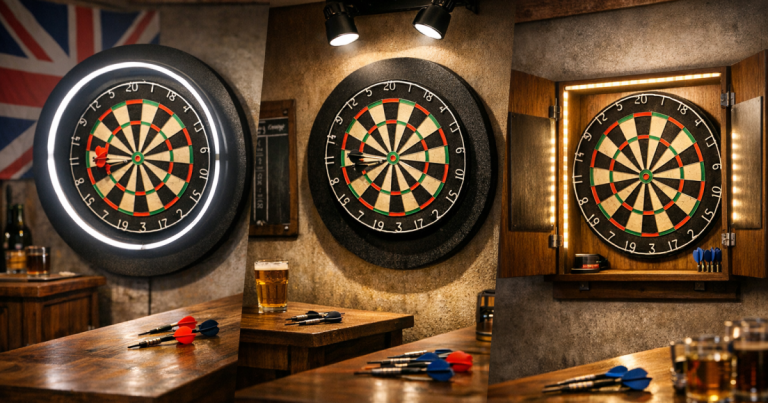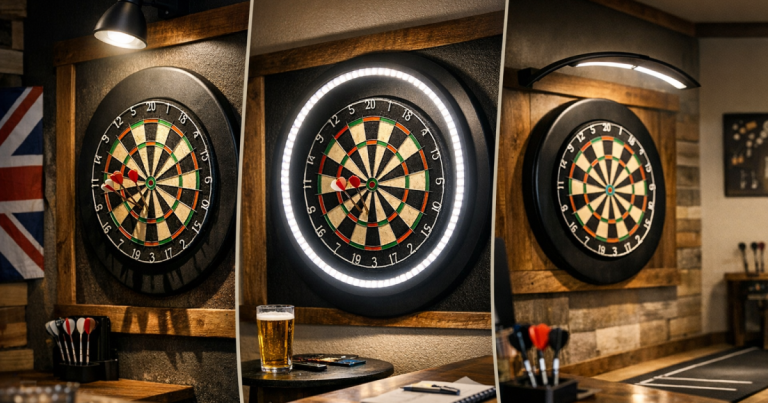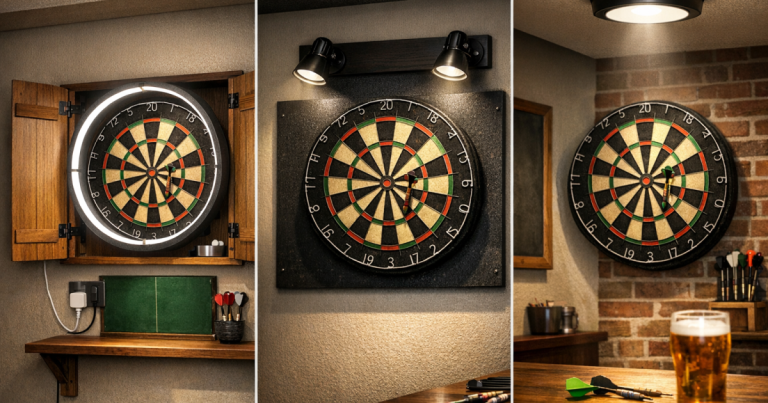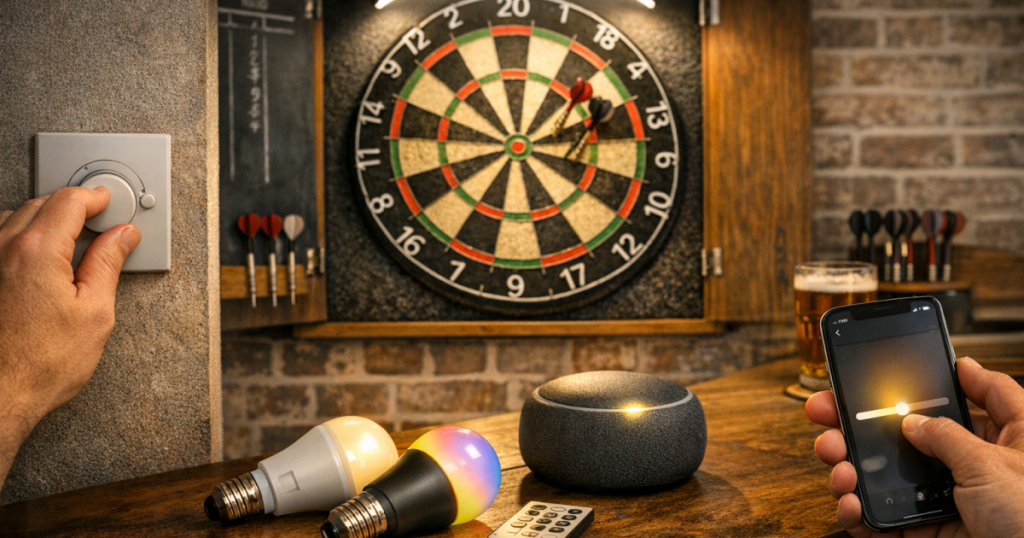
Good lighting is not just about making the dartboard bright. The way you turn it on, dim it, group it and adjust it can decide whether a quick throw feels effortless or fiddly. Well-planned dartboard lighting controls help you get clear visibility on the board without washing out the room, dazzling players or leaving guests hunting for the right switch.
Fixed wall switches, mains dimmers and any alteration to household lighting wiring should be handled by a qualified electrician to meet UK electrical safety requirements and applicable standards such as BS 7671.
The short answer
For most home darts setups, the simplest control arrangement is a dedicated on/off control for the board light, separate from the main room lighting. That gives you a consistent playing view without needing to change every lamp in the room.
Dimmers can work well when the fittings and bulbs are genuinely compatible, but they are not a cure for poor positioning or glare. Smart bulbs are useful when you want presets, voice control or colour temperature changes, although they usually need permanent power and should not be treated like ordinary bulbs on a traditional dimmer circuit.
If your main problem is shadows across the board, solve the light position first, then think about controls. A dimmer will not remove a shadow caused by a badly placed ceiling pendant. For the visibility side of the setup, the fuller dartboard lighting and eye strain guide is a useful next step.
Why controls matter in a darts room
A darts area often has two jobs. It needs enough focused light for scoring, doubles and trebles, but it also needs to feel comfortable as part of a spare room, garage, shed bar, games room or living space. Controls bridge that gap.
With one harsh ceiling light, you may see the board clearly but create glare on a cabinet door, surround or nearby framed print. With only soft room lamps, the space may feel pleasant but the twenty segment can look dull from the oche. A good control setup lets you move between everyday room use and proper throwing conditions quickly.
The aim is consistency. When you step to the oche, the board should look the same every time: no shifting shadows, no sudden brightness changes and no coloured light making wire numbers harder to read. That matters for casual play as much as league-style practice, because inconsistent lighting makes it harder to judge whether your darts are landing where your throw intended.
Simple switch setups that work well
A basic switch is still the most reliable control. If your board lighting is already well placed, a straightforward on/off switch is often better than a more complicated setup that nobody else in the house understands.
Dedicated board light switch
A dedicated switch for the dartboard light is the cleanest approach. It keeps the throwing area separate from general room lighting, so someone can still use a table lamp, bar light or ceiling light without changing the board view.
This is particularly useful where a board sits in a cabinet. The cabinet doors may be opened only during play, so it makes sense for the lighting control to match that routine: open the cabinet, turn on the board light, play, then switch it off when finished. If you are fitting or adjusting a cabinet, take care that the lighting and cabinet position do not pull the board out of line; the guide to fitting a dartboard cabinet without misaligning the board covers that part in more detail.
Two-zone room lighting
Two-zone lighting means one control for the board and another for the rest of the room. This works nicely in a multipurpose room because the board can stay bright while the surrounding area remains softer.
-
Use the board zone for the dartboard, number ring and scoring area.
-
Use the room zone for seating, drinks tables, storage and general atmosphere.
-
Keep the board zone consistent during play, rather than adjusting it every leg.
If you are planning from scratch, think about how people move around the room. Controls placed near the entrance are convenient for everyday use, while a secondary control near the oche or scoring area can be handy for practice sessions.
Where dimmers help and where they do not
Dimmers are useful when the room needs flexibility. A bright setting can suit serious practice, while a slightly lower setting may be more comfortable when people are chatting between legs. They can also reduce the stark contrast between a bright board light and a darker room.
The important word is compatibility. Not every LED bulb, fitting or driver behaves well on a dimmer. Poor matches can cause flicker, buzzing, limited dimming range or lights that refuse to turn fully off. Before using a dimmer, check that the bulb and fitting are dimmable and that the dimmer is suitable for the lighting load.
A dimmer should not be used to hide a bad layout. If your dartboard has a heavy shadow below the wire, uneven light across the doubles or glare at eye level, adjust the position and spread of the light first. Once the board is evenly lit, dimming becomes a comfort tool rather than a workaround.
Useful dimmer habits
-
Set a normal playing level and leave it there for practice, so your eyes are not constantly adapting.
-
Avoid very low settings if they make the number ring harder to read.
-
Check the board from the oche, not just from beside the wall.
-
Watch for flicker on slow-motion phone video if the light feels tiring but looks fine at first glance.
Smart bulbs and presets
Smart bulbs can be genuinely useful in a home darts setup when they are used for convenience rather than gimmicks. The biggest benefit is presets: one setting for darts, one for relaxed room lighting and perhaps another for cleaning or putting equipment away.
For darts, the most useful preset is usually a neutral or cool white setting that makes the segments, wires and numbers clear. Coloured scenes may look good in a games room, but they can make red, green, black and cream areas of the board less distinct. Save coloured lighting for before or after play, not while you are trying to hit double sixteen.
Smart bulbs usually need continuous power to stay connected and respond to controls. If somebody turns them off at the wall, they may not respond until power is restored. That is why smart bulbs often work best with clearly understood routines: leave the circuit on, control the bulb through the app, remote, voice assistant or paired button, and keep a manual fallback everyone can use.
Be cautious with traditional dimmer switches. Many smart bulbs are not intended to sit behind a conventional wall dimmer. If you want both smart control and dimming, check the manufacturer’s instructions for the specific bulb, fitting and control method rather than assuming they will all work together.
Choosing control points around the oche
The best control location depends on how the room is used. A switch by the doorway is practical when the darts area is part of a larger room. A control near the scoring area is useful if you often practise alone and want to switch modes without walking back across the room.
Think about the route from storage to board to oche. If you keep darts, stems, flights and chalk near the board, a control close to that storage area makes sense. If your setup is designed to disappear neatly between games, the lighting control should support that routine rather than add another awkward step.
Cabinets and surrounds can also change how controls feel in use. A cabinet may create a more formal “open to play, close to finish” routine, while a surround keeps the board visible all the time. If you are still deciding how the wall area should work, the comparison of dartboard cabinets and surrounds is worth reading before finalising the lighting layout.
Common setup examples
Spare bedroom or box room
In a small room, one board light plus the existing ceiling light may be enough. Keep the board light separately controlled if possible, because a ceiling pendant can throw awkward shadows when players stand at the oche. A simple wall switch or plug-in control for the board light is often easier than building a complex smart setup.
Garage or shed darts area
Garages and sheds often need brighter general lighting as well as focused board lighting. Use clear controls so the board light can be on for play while workbench or storage lighting is off. Avoid relying on a single overhead light behind the player, as that is a common cause of shadows across the board face.
Living room board
For a board in a shared living space, controls are about compromise. You may want strong, neutral board lighting during play and warmer, softer room lighting at other times. Smart presets can help here, provided everyone knows how to restore normal room lighting afterwards.
Cabinet setup in a social room
A cabinet setup often suits a dedicated board light with a simple control nearby. The room can stay atmospheric, while the board itself remains clear. Check that open cabinet doors do not block light, cast side shadows or reflect glare back towards the player.
Checks before changing your setup
-
Board clarity: stand at the oche and check the trebles, doubles and number ring, not just the bullseye.
-
Shadow direction: throw a few darts and see whether barrels or flights cast distracting shadows over common targets.
-
Glare: look for reflections on cabinet doors, picture glass, shiny surrounds or nearby mirrors.
-
Control logic: make sure guests can understand which switch or button turns on the playing light.
-
Smart fallback: if using smart bulbs, keep a simple manual way to get light back if a phone or voice control is not available.
-
Consistency: once you find a good setting, save it or mark it so practice conditions do not change every session.
Things readers ask
Is a dimmer worth it for a dartboard light?
Yes, if the bulb, fitting and dimmer are compatible and the board is already evenly lit. It is most useful for comfort and atmosphere, not for fixing shadows.
Can I use smart bulbs for proper darts practice?
Yes, provided you use a clear white setting and keep it consistent. Avoid coloured scenes during play because they can make the board segments harder to read.
Should the dartboard light be on the same switch as the room light?
Usually no. Separate control gives you a clearer board without forcing the whole room to be bright, which is better for shared spaces and social setups.
Why does my board look bright but still feel tiring to play on?
The issue may be glare, flicker, high contrast or uneven spread rather than brightness alone. Check the view from the oche and adjust the light position before increasing intensity.
Do I need smart controls in a simple home setup?
No. A reliable switch in the right place is often enough. Smart controls are helpful when you want presets or shared room modes, but they are not essential.
The big picture
The right control setup should make your darts area easier to use, not more complicated. Start with even board lighting, give that light its own clear control, then add dimming or smart presets only where they solve a real problem.
For many UK home setups, the best arrangement is simple: a consistent board light, separate room lighting and controls that guests can work out without a tutorial. Get that right and the board looks sharper, the room feels more comfortable, and every throw starts from the same visual conditions.