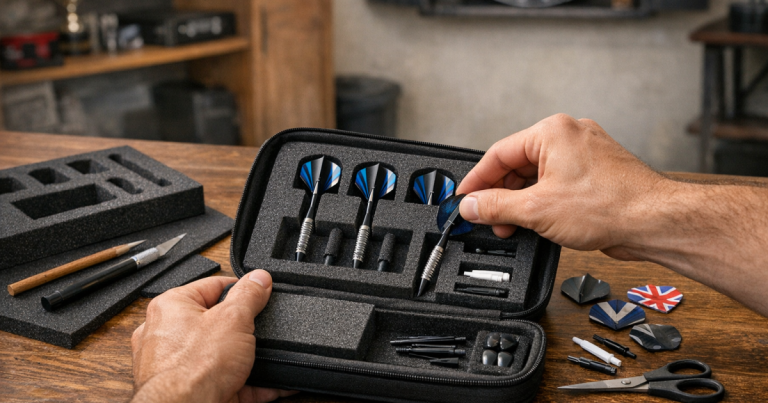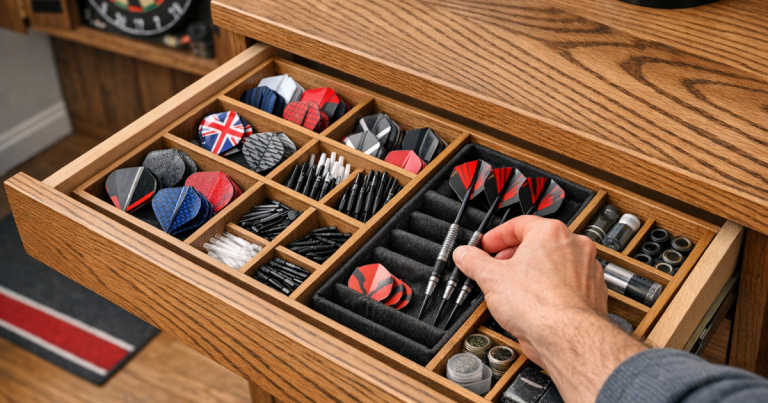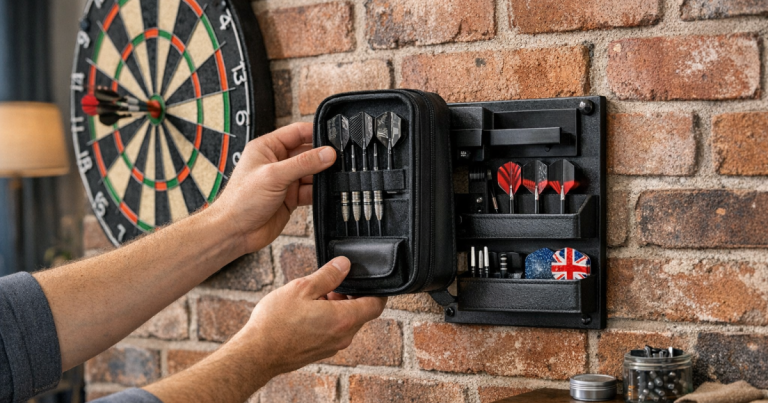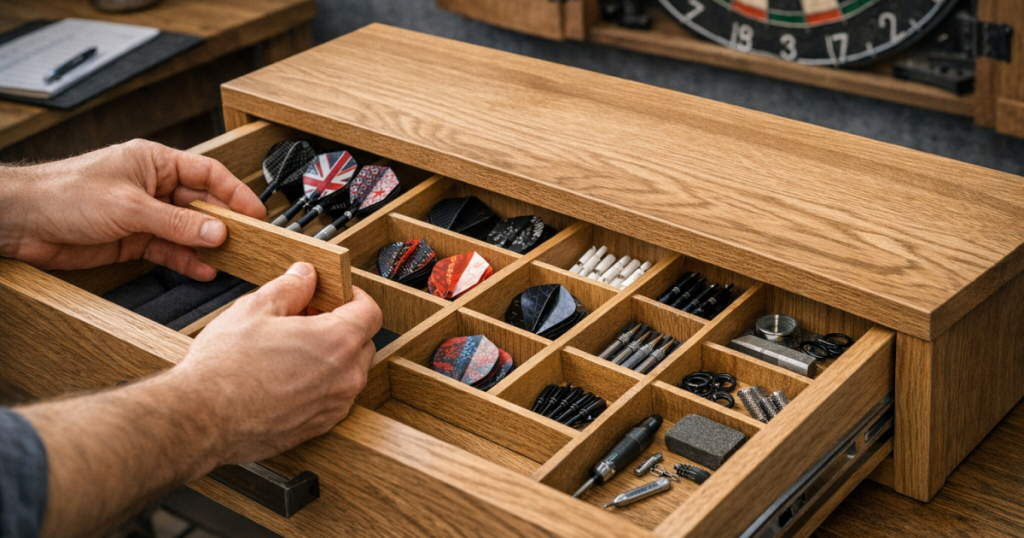
Fitting drawer dividers for darts accessories is one of the quickest ways to make a home darts area feel calmer, neater and easier to use. Instead of tipping out a box to find one flight, point protector or shaft ring, each small part gets a clear place. The key is to plan the drawer around your actual gear, not around a tidy-looking layout that becomes annoying after two matches.
A good divider setup should protect delicate parts, separate sharp items, and make your match-night routine smoother. You do not need a complicated cabinet build; a shallow drawer, a tape measure and a sensible layout are usually enough.
In brief
- Empty the drawer first and group your accessories by type: flights, stems, points, tools, chalk, markers and spares.
- Measure the usable internal width, depth and height before cutting or adjusting any dividers.
- Keep sharp, heavy and dirty items away from flights and soft accessories.
- Leave at least one flexible section for future extras, because darts storage always seems to grow.
- Test the layout with your hands, not just your eyes: you should be able to grab common items quickly.
Step 1: Empty the drawer and sort the gear properly
Start by removing everything from the drawer and wiping away dust, chalk, loose sisal fibres and old flight fragments. It is much easier to design a useful divider layout when you can see exactly what you own.
Group accessories into practical piles rather than broad categories. For example, put spare flights in one group, used-but-usable flights in another, stems by length if you keep several types, and tools separately. If you use both steel-tip and soft-tip equipment at home, keep the related parts apart so you do not grab the wrong spares mid-session.
Small items that often deserve their own sections include:
- Flights, including matched sets and loose spares.
- Stems or shafts, grouped by length or material if useful.
- Flight protectors, rings, springs and small locking parts.
- Point protectors and spare points.
- Oche tape, chalk, dry-wipe pens or scoreboard markers.
- Multi-tools, point tools and small maintenance items.
- Match cards, checkout sheets or folded practice notes.
If you are storing replacement points, keep them in a lidded tin, small tube or dedicated compartment rather than loose in the drawer. For more detail on matching points to your setup, see our guide to buying replacement dart points that suit your board and throw.
Step 2: Measure the drawer before choosing the layout
Measure the internal width, depth and height of the drawer in millimetres. Do not rely on the outside drawer size, because runners, side walls and curved internal corners can reduce the usable space.
Check the height carefully. Some divider kits look neat until you realise the drawer will not close once a flight case, point tin or taller tool is inside. If your drawer is shallow, use lower dividers and store taller items flat. If the drawer is deep, avoid making compartments so deep that small rings and springs disappear into the corners.
It also helps to measure your most awkward items. A standard set of folded flights needs less space than a rigid flight case. A multi-tool may need a longer slot than stems. If you store pens for a dry-wipe scoreboard, allow enough length so the caps are not pressed against the side of the drawer.
Step 3: Choose a divider type that suits darts accessories
Most home darts drawers work best with adjustable plastic dividers, interlocking board-style dividers, bamboo organisers or small removable trays. The right choice depends on how often you change your gear and how much small hardware you keep.
Adjustable plastic dividers
These are useful if your accessory collection changes regularly. They usually let you create narrow rows for stems, wider bays for flights and a longer space for tools. The main check is rigidity: flimsy dividers can bow when the drawer is opened quickly.
Bamboo or wooden organisers
These look tidy in a cabinet or sideboard drawer and suit a more permanent layout. They are less forgiving if you later add bulkier cases, but they can make a shared living-room setup feel less like a workshop.
Small removable trays
Removable trays are handy for match nights because you can lift out a tray of flights, stems and tools and place it near the oche. They are also easier to clean than fixed compartments, especially if chalk or marker dust builds up.
Step 4: Sketch a layout before fitting anything
Before cutting, clipping or sticking dividers in place, sketch a simple top-down layout on paper. It does not need to be neat; it just needs to stop you creating five perfect compartments that are all 10 mm too short.
Put your most-used items towards the front of the drawer. For many home players, that means spare flights, stems, a dart tool and a pen. Less-used items, such as older spare parts, checkout cards or spare oche tape, can sit towards the back.
A reliable layout for a medium drawer might look like this:
- Front left: current spare flight sets.
- Front middle: stems or shafts, separated by length.
- Front right: dart tool, rings, springs and flight protectors.
- Back left: point protectors and spare points in a small container.
- Back middle: dry-wipe pens, chalk or scorekeeping bits.
- Back right: occasional spares, cleaning cloth or folded practice sheets.
If you keep a dry-wipe scoreboard nearby, storing pens flat and capped helps prevent messy leaks and dried nibs. For the board itself, our advice on cleaning a dry-wipe darts scoreboard without ghosting is a useful next read.
Step 5: Fit the dividers and check the drawer movement
Once the layout makes sense, fit the dividers slowly. With adjustable systems, start by creating the larger sections first, then divide smaller areas afterwards. This avoids ending up with leftover gaps that cannot hold anything useful.
If the dividers need trimming, mark the cut line clearly and cut on a stable surface, away from the drawer itself. Keep fingers clear of the blade and make several light passes rather than forcing one heavy cut. Sand or smooth any rough edges so flights and stems do not snag.
For adhesive-backed dividers, clean and dry the drawer base before sticking anything down. Press each section firmly and let the adhesive settle before loading the drawer. If you are renting, using a valuable cabinet, or simply like to change layouts, removable trays or non-adhesive dividers are usually the safer choice.
After fitting, open and close the drawer several times while it is empty, then again once loaded. Listen for scraping, check that nothing jumps compartments, and make sure heavy tools do not slide forward every time the drawer moves.
Step 6: Load accessories by routine, not just by category
The most attractive drawer layout is not always the most useful one. Load the drawer in the order you actually use your darts gear. If you usually change flights first, keep them easiest to reach. If you regularly tighten stems, put the tool near the front rather than buried with rarely used parts.
Keep fragile and sharp items apart. Flights can crease or split if they are packed under metal tools. Loose points can scratch surfaces, catch in cloth bags or damage soft accessories. If you store both clean and used accessories, avoid mixing them: dusty chalk, marker residue and old adhesive can make a neat drawer grubby quickly.
For a garage or outbuilding setup, moisture matters as much as tidiness. Avoid storing darts accessories directly against cold external walls, and keep metal parts dry before putting them away. Our guide on keeping darts gear dry in a garage setup explains the wider room checks that help protect boards, darts and accessories.
Step 7: Add labels only where they genuinely help
Labels can be useful, but they are not essential for every compartment. They work best when several people use the same darts area, or when you keep similar-looking parts in different sizes.
Use small removable labels for stems, flights, tools and points rather than writing directly on the drawer. This keeps the setup flexible if your gear changes. If you prefer a cleaner look, use a simple colour system: one tray for match-ready spares, one for workshop bits, and one for older backups.
Avoid over-labelling tiny sections. If every 30 mm compartment has a label, the drawer can become visually busy and harder to use. The aim is to find things quickly, not create a museum display.
Step 8: Build in a five-minute reset habit
Drawer dividers only stay useful if the drawer gets reset regularly. After a match night or practice session, spend a few minutes putting loose parts back into their sections. Throw away cracked flights, bent stems and dried-out pens rather than letting them occupy space.
A simple monthly check keeps the drawer working well:
- Remove dust and small debris from each compartment.
- Check that sharp items are still contained safely.
- Move frequently used items closer to the front if needed.
- Clear out broken or mismatched spares.
- Check for damp, rust marks or marker leaks.
This is also a good time to make sure your storage still matches your playing habits. A drawer that worked for one set of darts may need adjusting once you add more stems, switch flight styles or start keeping extra tools nearby.
Questions people ask
What size compartments work best for flights?
Allow enough room for flights to sit flat or loosely stacked without being crushed. If you use rigid flight cases, measure the case rather than the flight itself and make that section slightly larger than needed.
Should dart points be stored loose in a drawer divider?
No. Keep spare points in a small lidded container, tube or tin inside the divided drawer. That keeps sharp parts contained and prevents them scratching tools, flights or the drawer base.
Are adhesive dividers worth using?
They can be useful in a dedicated darts cabinet drawer, but they are less flexible. For rented homes, shared furniture or changing setups, removable trays or pressure-fit dividers are usually easier to live with.
How do I stop small rings and springs moving around?
Use a tiny lidded box, pill-style organiser or small parts pot inside one compartment. Very small parts often escape open dividers when the drawer is opened and closed quickly.
Can I use kitchen drawer organisers for darts gear?
Yes, as long as the compartments suit the size of your accessories and the drawer still closes cleanly. Cutlery trays can work well for tools and pens, but they may waste space for tiny dart parts.
Key takeaways
A well-divided darts drawer should make your setup easier to use, not just tidier to photograph. Sort the gear first, measure the drawer carefully, and create sections around real habits: the parts you reach for most should be nearest the front, while sharp or occasional spares should be contained at the back.
Leave some flexibility, especially if you regularly try new flights, stems or point styles. Once everything has a proper place, your darts area becomes quicker to reset, easier to maintain and much less likely to turn into a pile of loose accessories before the next game.