A dart can feel completely different after a point change. The grip in the board, the way the dart leaves your hand, and even how confidently it stays put after a treble-bed hit can all shift. Buying replacement dart points is not just a case of picking the sharpest-looking set; the right choice needs to suit your sisal board, your throw, and the barrels you already use.
The short version
For most home players using a traditional bristle dartboard, start with a plain or lightly grooved steel point in a familiar length. Avoid going too aggressive unless you have a clear reason, because very grippy points can mark the board more quickly and may feel awkward to remove. If you are already happy with how your darts sit in the board, match the current point length and choose a similar finish.
The main buying checks are simple: confirm your darts are steel-tip barrels, check whether the points are standard press-fit or a brand-specific system, choose a sensible length in millimetres, then decide how much board grip you actually need. If you are unsure whether you need steel-tip or soft-tip equipment in the first place, our guide to steel-tip vs soft-tip darts is a useful starting point.
How dart points affect your throw
The point is a small part of the dart, but it changes three things that matter during a leg: how the dart enters the board, how firmly it stays there, and how the dart groups around other darts. A smooth point usually gives a clean, simple feel. A textured point can improve hold in the sisal, but it may also pull fibres more noticeably when you remove the dart.
Longer points can make tight grouping feel easier because the barrel may sit slightly further away from the board face. That can help when you are stacking darts into the same treble. Shorter points can feel more compact and familiar if you throw with a flatter landing angle. Neither is automatically better; the right choice depends on how your dart already enters the board.
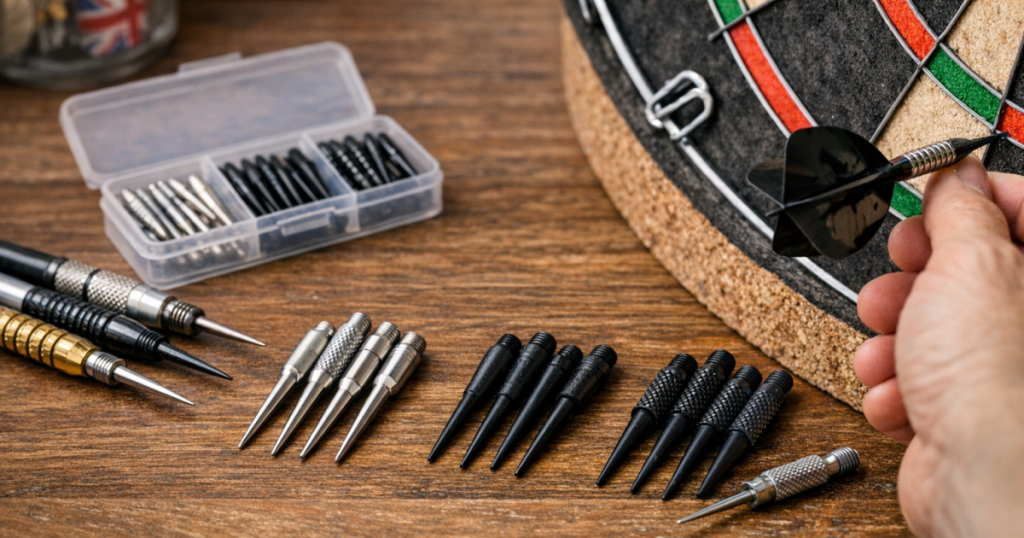
The finish matters too. Black-coated, silver, nano-grip, ringed and storm-style points all aim to solve slightly different problems. Some prioritise board hold, some aim for smoother entry, and some are designed to reduce deflections near the nose of the barrel. Before buying, think about the problem you are trying to fix rather than chasing the most technical-looking option.
Standard points, specialist points and fitting systems
Most steel-tip darts use press-fit points, which are fitted into the barrel with a repointing tool. The important detail is that not every point system fits every barrel. Some brands use their own fitting approach, so check the product listing and your barrel type carefully before ordering.
A standard smooth steel point is usually the safest replacement when you want your darts to feel close to how they did originally. It is also a sensible option for a shared home board, because it tends not to be as harsh on the sisal as heavily cut or deeply grooved alternatives.
Specialist points are worth considering when you have a specific issue. For example, ringed points can help when darts are dropping out of a firm board. Tapered nose designs can help reduce awkward contact where the point meets the barrel. A system such as Target Swiss Point can be convenient for compatible darts, but it is not a universal fit, so verify that your barrels are made for that system before you buy.
If you are fitting conventional press-fit points at home, you will also need a proper repointing tool. A tool such as the Designa Dart Point Repointer Tool is the type of kit home players look at for the job, but always check that the tool suits your barrels and the style of points you intend to fit.
Match the point to your dartboard
A good sisal board needs a point that enters cleanly without chewing up the surface. If your board is fairly new and firm, a smooth or lightly textured point is normally enough. If your board is older, dry, or has areas that reject darts more often, a little extra grip can help, but it is not a cure for a worn-out board.
Board protection is part of the same decision. Heavily grippy points can make missed darts more noticeable on nearby surfaces, especially in a compact spare-room or garage setup. If wall protection is part of your upgrade plan, a surround is often a more effective fix than changing to a different point style. Our dartboard surround fit and protection review explains what to look for around the board face.
Be careful with points marketed mainly around maximum grip. They can be useful for players whose darts regularly fall out, but on a home board they can also make dart removal feel rough and may accelerate visible wear. A balanced choice is usually better than the most aggressive cut.
Choose a length that suits your landing angle
Dart point length is normally listed in millimetres. The right length is less about appearance and more about how your dart sits in the board. If your darts land tail-up and block the treble bed, a slightly longer point may give you a touch more room to work around the first dart. If your darts already group neatly and feel stable, matching the existing length is the lower-risk move.
Players who grip near the nose of the dart should also be careful. A longer or more heavily textured point can change the feel under the front finger, especially if part of the point sits close to your grip position. If your index finger rests partly on the point, texture becomes a comfort issue as well as a board-grip issue.
For many home throwers, the best approach is to make one change at a time. Do not switch to a much longer, more textured and differently shaped point all in one go unless you are prepared for a very different feel. Change length first, or grip level first, then test properly over several sessions.
Point grip: smooth, ringed, grooved or coated?
Smooth points are simple, predictable and kind to most boards. They are a good default if your darts stay in the board and you mainly need to replace bent, worn or rusty points.
Ringed or grooved points add mechanical grip. They can help on firmer sisal or with a throw that does not drive the dart very deeply into the board. The trade-off is that they may tug more when removed, so they are not always ideal for a board you want to keep looking fresh for as long as possible.
Coated points can feel different again. Some black-coated points offer extra bite when new, although finishes can wear with use. That is not necessarily a fault; it is simply part of how darts equipment behaves over time. If you like a consistent feel, factor that wear-in period into your choice.
There are also more shaped options, such as Target Storm Points, which are designed with a smooth transition towards the barrel on compatible setups. They can be useful if you dislike the lip between barrel and point, but compatibility and preferred length still matter more than the look.
Check compatibility before you order
Before buying new points, work through a few quick checks. This avoids the most common mistake: buying a good set of points that simply does not fit your darts or does not suit your board.
- Confirm the dart type: steel-tip barrels need steel points; soft-tip darts use plastic tips and are a different category.
- Check the fitting system: standard press-fit points and brand-specific systems are not always interchangeable.
- Match or measure the current length: use the existing point as your reference if you like the current balance and board entry.
- Think about board condition: choose moderate grip for a healthy sisal board and avoid using points as a workaround for a badly worn board.
- Consider your grip position: if your finger touches the point, avoid sharp or uncomfortable textures near the nose.
- Plan the fitting method: decide whether you have the right repointing tool or whether you would rather use a darts shop or experienced fitter.
When should you replace dart points?
Replace points when they are bent, badly burred, rusty, loose in the barrel, or no longer entering the board cleanly. A point does not need to look perfect, but it should be straight, secure and consistent from dart to dart.
Small surface marks are normal. Rust is more of a concern because it can affect board entry and make the dart feel rough in use. If your darts live in a garage, shed or cool spare room, storage matters as much as the points you buy. For prevention tips, see our guide to storing steel-tip darts to prevent rust.
Also consider replacement after a heavy impact with a hard floor, skirting board or metal surround ring. A point can look only slightly marked but still affect how the dart lands. Roll the dart gently on a flat surface; if the point visibly wobbles, it is time to investigate.
Simple buying examples
You like your darts but the points are worn
Choose a standard point in a similar length and finish. This keeps the dart feeling familiar and avoids introducing new variables into your throw. It is the best route when your only complaint is wear, rust or a slight bend.
Your darts sometimes fall out of the board
Try a lightly ringed or textured point rather than jumping straight to the most aggressive grip available. Also check the board condition and your throwing angle. If the board is tired, new points may help a little but will not fully solve the problem.
You are trying to improve grouping
Look at slightly longer points or a tapered nose design if your darts crowd each other around the treble. Keep the grip level moderate so you do not create a new issue with board wear or awkward removal.
You use compatible quick-change barrels
If your darts are designed for a dedicated changeable point system, buy within that system. The convenience is useful, but only when the points are genuinely made for your barrels.
Questions people ask
Can I fit dart points without a repointing tool?
For standard steel-tip press-fit points, a proper repointing tool is the right approach. Improvised methods can damage the barrel, bend the point or leave the point insecure.
Are longer dart points better?
Not automatically. Longer points can help with grouping space, but they can also change the balance and landing feel. Match your current length unless you have a clear reason to change.
Do grippy points damage dartboards?
They can increase visible wear if they are very aggressive or pulled out roughly. Moderate grip is usually enough for a home sisal board in decent condition.
Can I use steel points on a soft-tip board?
No. Soft-tip boards are designed for plastic tips. Steel points are for bristle dartboards and suitable steel-tip setups.
How do I know if a point fits my barrels?
Check whether your darts use standard press-fit points or a named fitting system. If the listing does not clearly state compatibility, do not assume it will fit.
In brief
The best replacement choice is the one that solves your actual problem without changing everything you like about your darts. For most players, that means a straight, secure steel point in a familiar length, with only as much grip as your board and throw require.
If your darts are dropping out, look at light texture and board condition. If grouping is the issue, consider length and nose shape. If the current feel is already right, keep the specification close and focus on quality fitting. Small changes at the point end can make a noticeable difference, so buy with your board, barrels and throw in mind rather than choosing on appearance alone.