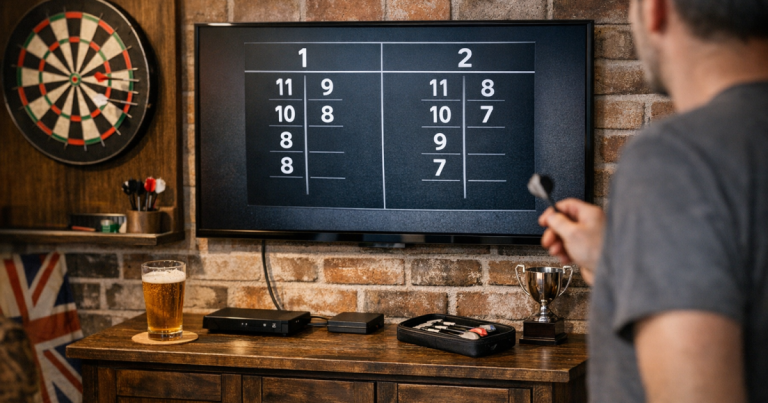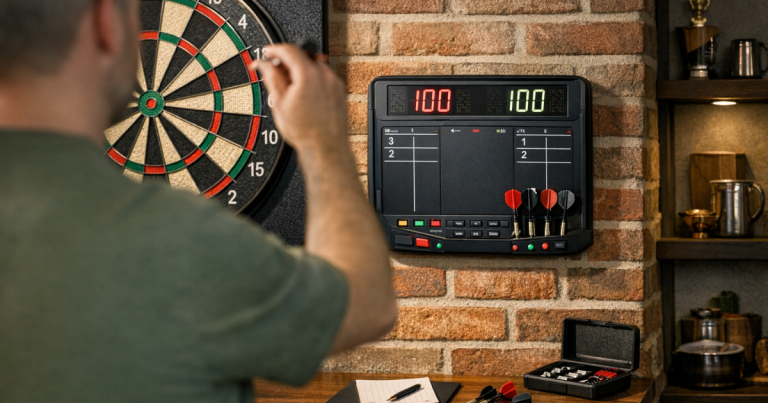
A scoreboard looks like a small detail until the first missed total, rubbed-out leg, or argument over who is on 32. The right choice depends less on gadgets and more on how you play, who shares the space, and how permanent your home setup is. For most home players, darts scoreboards fall into three practical camps: chalk, dry-wipe and electronic.
The short version
Choose chalk if you want a traditional feel, low running costs and a setup that suits a dedicated darts corner. Choose dry-wipe if you want quick cleaning, flexible scoring formats and an easy option for family games or mixed use. Choose electronic scoring if you want automatic arithmetic, visible totals and less pressure on the person doing the maths.
The key is to match the scoreboard to the room, not just the thrower. A fixed board in a garden room can be brilliant, while the same setup may be annoying in a rented flat or shared lounge. If your board, oche and storage move around, your scoring method should be just as easy to reset.
Step 1: Start with the way you actually play
Before choosing the format, be honest about the games you play most. A weekly 501 night has different needs from casual round-the-clock games with children, guests or housemates. The more often scores change quickly, the more important visibility and ease of correction become.
- For steady 501 or 301 legs, a simple two-column layout is usually enough.
- For cricket, round-the-clock and party games, you may want more writing space or a format that can handle marks and notes.
- For practice routines, space for averages, target numbers or running totals can be useful.
- For doubles practice, a small notes area helps track finishes without cluttering the main score.
If your setup is part of a larger room plan, think about where players stand while scoring. In a compact space, the scorer should not need to step across the throwing lane after every visit. For a more permanent setup, the advice in laying out a darts area in a garden room is a useful next step because the scoreboard position affects flow as much as the board and oche.
Step 2: Pick the right format for your room
Chalk scoreboards
Chalk is the traditional choice and still works well in a home darts space. It gives a clear, familiar match-night feel and does not rely on power, cables or menus. A chalkboard also encourages proper manual scoring, which many players value because it keeps checkout maths sharp.
The downsides are mess and maintenance. Chalk dust can collect on shelves, cabinets and carpets, and cheaper surfaces can become hard to read once they are worn. Corrections are easy, but they are not always tidy. If your darts area is in a lounge, spare room or shared family space, the dusty finish may become irritating over time.
Chalk suits players who like a classic setup, have a fixed wall area near the board, and do not mind wiping the surface properly after play. It is less ideal for people who need a clean-looking room straight after a session.
Dry-wipe scoreboards
Dry-wipe boards are the easiest everyday choice for many home setups. They are quick to write on, simple to correct and usually cleaner than chalk. They also suit flexible scoring because you can draw columns, add player names, mark legs and wipe everything back to blank afterwards.
The main issue is ghosting. If ink is left on the surface for too long, or the wrong pen is used, old numbers can leave faint marks. The fix is usually routine rather than complicated: use proper dry-wipe markers, avoid permanent pens, and clean the board before ink bakes in under room heat or sunlight. If your board already looks stained, follow the method for cleaning a dry-wipe darts scoreboard without ghosting before replacing it.
Dry-wipe is a strong fit for renters, shared rooms, family play and anyone who changes game formats often. It is also forgiving when new players are learning to score because errors can be corrected quickly without making the surface look scruffy.
Electronic scoreboards
Electronic scoring takes the arithmetic out of the equation. Depending on the setup, this might be a dedicated scorer, an electronic dartboard with built-in scoring, or a display used to track legs and totals. The main benefit is pace: players can focus on throwing while the device handles subtraction and shows the remaining score clearly.
The trade-off is dependency. You need a suitable place for the unit, readable positioning, reliable power where required and a setup that does not create trip hazards or awkward reaching. With electronic dartboards, the scoring system is part of the board experience rather than a separate wall accessory, so the whole playing area needs to be arranged around it. For that route, read the guidance on how to set up an electronic dartboard safely at home.
Electronic scoring is useful for mixed-ability households, players who dislike mental arithmetic, and longer match nights where fatigue leads to mistakes. It is less appealing if you enjoy the rhythm of traditional scoring or want the simplest possible setup.
Step 3: Match the scoreboard to the space
The best scoring method is the one that is easy to see, easy to reach and unlikely to be in the firing line. A scoreboard directly beside the dartboard feels natural, but it should sit far enough away from the board that stray darts are not a regular concern. It also needs to be visible from the oche so players can check totals without walking forward after every throw.
For a fixed wall, chalk and dry-wipe boards can look tidy when mounted beside a cabinet or backboard. For a room that doubles as a lounge, office or spare bedroom, a removable dry-wipe board or freestanding option may be more practical. For electronic scoring, the display should be readable without forcing players to twist away from the board between visits.
- In a dedicated darts room, fixed chalk or dry-wipe scoring feels natural and keeps everything in one playing zone.
- In a shared room, dry-wipe is usually easier to clean away and less visually dominant.
- In a rented space, avoid unnecessary wall fixings and choose something that can be moved or stored.
- In a family setup, electronic scoring can reduce arguments about arithmetic and missed totals.
Step 4: Think about scoring habits, not just neatness
Some players choose a scoreboard because it looks tidy, then discover it does not suit their routine. If you practise alone, you may want enough space to record targets and results. If you play doubles or team games, you need names, legs and turn order to stay clear. If guests play often, the simpler the format, the better.
Chalk rewards slower, deliberate scoring. Dry-wipe rewards flexibility. Electronic scoring rewards speed and clarity. None is automatically more serious than the others. A well-used dry-wipe board can support excellent practice, while a beautiful chalkboard can be frustrating if nobody enjoys keeping the score.
Also consider who normally writes. If the scorer stands close to the board, a manual surface is fine. If every player writes their own score after throwing, make sure the route from oche to scoreboard does not interrupt the next player or cross a cramped area.
Step 5: Check maintenance before committing
Maintenance is where small annoyances become long-term habits. Chalk needs a duster or cloth and occasional deeper cleaning. Dry-wipe needs the right pens, spare markers and regular wiping. Electronic scoring needs sensible cable management, a stable position and a habit of checking the display before play starts.
Dry-wipe markers are easy to lose, so store them with flights, points, spare stems and other small accessories rather than leaving them loose on a windowsill. Chalk can snap and create dust, so a small tray or box helps. For electronic scoring, avoid placing controls where players are likely to knock them while retrieving darts.
Lighting matters too. A glossy dry-wipe surface can reflect a bright room light, while a dark chalkboard can be hard to read in a dim corner. If the board looks clear from close up but not from the oche, reposition it or change the angle before blaming the scoring format.
Simple decision guide
- Choose chalk if you want a traditional match feel, a fixed darts area and a low-tech setup.
- Choose dry-wipe if you want clean corrections, flexible layouts and an easy option for shared spaces.
- Choose electronic scoring if you want automatic totals, faster games and less reliance on mental maths.
- Avoid chalk if dust or visible mess will annoy people using the room for other purposes.
- Avoid dry-wipe if you are unlikely to maintain the surface or keep the correct pens nearby.
- Avoid electronic scoring if you prefer a quiet, manual setup with no extra devices in the playing area.
Common questions
Are chalk scoreboards still worth using at home?
Yes, if you like traditional scoring and have a dedicated area where chalk dust is not a problem. They are simple, durable and good for practising checkout maths.
Do dry-wipe boards always stain eventually?
Not always. Staining usually comes from old ink, poor-quality markers or harsh cleaning. Use proper dry-wipe pens and clean the surface regularly to reduce ghosting.
Is electronic scoring better for beginners?
It can be, because it removes subtraction errors and keeps the game moving. However, beginners still benefit from learning common finishes and basic scoring patterns.
Where should the scoreboard go?
Place it where players can read it from the oche and update it without crossing the throwing path awkwardly. Beside the dartboard is common, but visibility and safety of movement matter more than symmetry.
Can I use more than one scoring method?
Yes. Many home players use electronic scoring for casual games and keep a chalk or dry-wipe board for practice, match-style play or when they want a simpler setup. Mixing darts scoreboards can make sense if the room supports it.
Key takeaways
Chalk, dry-wipe and electronic scoreboards all work well when they match the way the space is used. Chalk gives the most traditional feel, dry-wipe is the most adaptable for everyday home play, and electronic scoring is the easiest way to keep totals clear without relying on mental arithmetic.
If you are building a settled darts area, choose the format that supports your normal games, your room layout and the people who use the space most often. A scoreboard should reduce friction, not become another thing players have to work around.