A mat does more than mark the throw line. Getting darts mat size right means your stance feels repeatable, your floor has some protection, and your home setup looks more deliberate rather than improvised. The best choice depends on the room, the floor surface, how often you play, and whether you want a simple printed line or a raised oche you can feel underfoot.
At a glance
- Full-length mats suit players who want a clear run from board to oche and some floor protection in the main landing zone.
- Short oche mats or floor markers work better in tight rooms, multi-use spaces and rental homes where you do not want a permanent setup.
- Grip matters most on hard floors, where a mat that creeps forward will quickly become annoying and can spoil your routine.
- Raised oches improve consistency because you can set your lead foot by feel rather than looking down before every throw.
- Measure from the board face, not the wall, because cabinet depth, surrounds and board mounting can change the true throwing distance.
Start with the real throwing distance
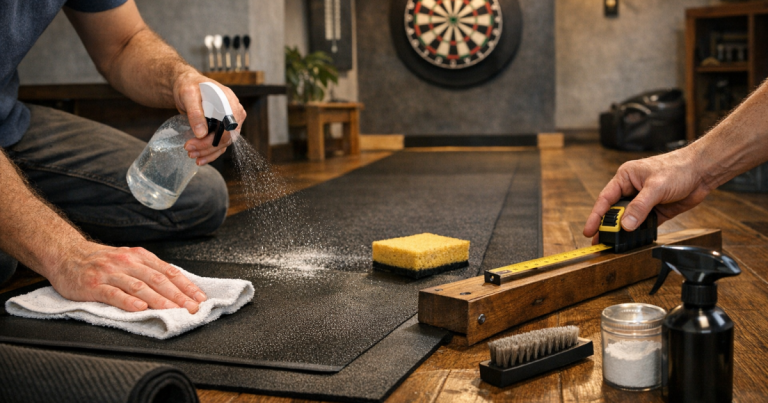
For a steel-tip home setup, the standard throwing distance is 2.37 m from the face of the dartboard to the oche line, with the bullseye centre 1.73 m from the floor. Those two measurements are the foundation of the whole setup. A mat cannot fix an inaccurate board height or a line measured from the skirting board instead of the board face.
If you are setting up from scratch, confirm the board position before choosing the mat. A cabinet, thick backboard or wall protection panel may sit behind the board, so the front face of the board may be several centimetres forward of the wall. For a deeper explanation of the correct measurements, use the guide to dartboard height and throwing distance before you mark anything permanently.
Once the board is correct, mark the floor temporarily with masking tape and stand at the line. Check that you have comfortable space behind your throwing arm, room for other players to pass safely, and enough clearance for retrieving darts without awkwardly stepping around furniture. This quick test often reveals whether a full mat is realistic or whether a shorter oche solution will be tidier.
Common mat sizes and what they mean in a home room
Most full-length darts mats are roughly long enough to run from near the wall or board area to the throw line, with printed markings for the oche. In many UK homes, especially spare rooms, garages and converted dining areas, the bigger question is not whether the mat reaches the line, but whether it fits without curling against furniture, radiators or door swings.
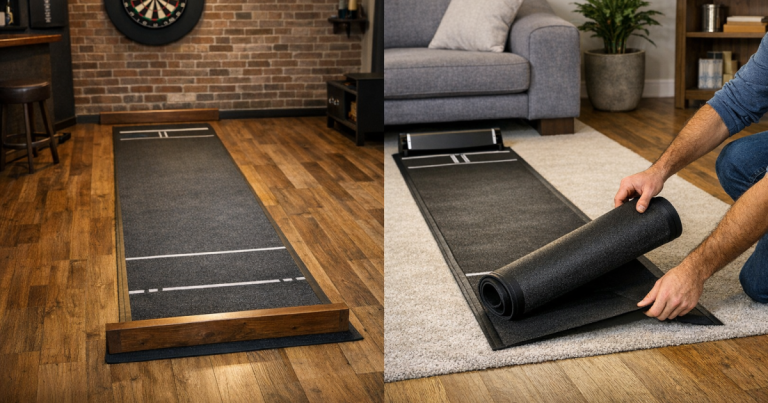
Full-length roll-out mats
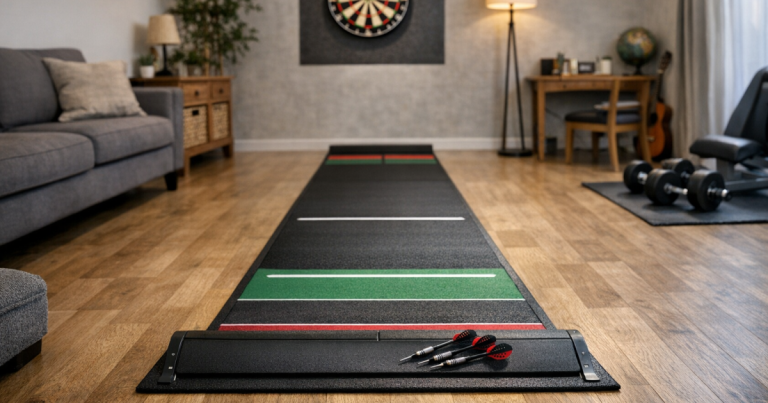
A full-length roll-out mat is the most complete option for a home oche because it gives the setup a defined footprint. It visually connects the board and the throwing position, helps players line up consistently, and offers some protection where darts may bounce out and land. It is particularly useful on laminate, vinyl, tiles or timber floors where repeated point impacts can leave marks.
The trade-off is space. A long mat left out permanently can get in the way in a shared room, while one that is rolled and unrolled every session needs to lie flat quickly. If the ends curl or the mat shifts after a few visits to the board, the setup starts to feel fussy rather than convenient.
Short mats and compact oche zones
A shorter mat focuses on the throwing area rather than the full floor path. It can work well where the board is in a narrow alcove, office, bedroom or garage bay and you only need a stable, visible place to stand. Short mats do less for bounce-out protection near the board, so they are usually better paired with separate floor protection if the surface is easily marked.
Floor markers only
Floor markers are the lightest-touch option. They are useful when you need the room to return to normal after a game, or when a mat would interfere with chairs, desks or storage. The limitation is that they do not change the feel of the floor, offer little protection, and give you no physical edge to brace against.
Grip: the feature you notice when it goes wrong
A good darts mat should stay still during normal play. That sounds obvious, but grip is one of the biggest differences between a setup that feels calm and one that constantly needs adjusting. The right backing depends heavily on the floor underneath.
- Carpet: thicker mats can feel stable, but very light mats may ruck up or sit unevenly on deep pile. A thinner, heavier mat can be easier to live with than a bulky one.
- Laminate and engineered wood: a non-slip backing is important. If the mat slides each time you step onto it, the oche line may move without you noticing.
- Tiles: grip and cushioning both matter. Hard surfaces can be unforgiving for bounce-outs, so think about the area in front of the board as well as the throw line.
- Garage concrete: durability is usually the priority. The mat may need to cope with dust, temperature changes and being moved around more often.
Grip also affects confidence. Many players plant the lead foot in the same place every throw. If the mat shifts slightly, the throw can feel off even when the measurement was correct at the start of the session. For more detail on protecting the surface beneath the setup, see the floor protection and oche positioning guide.
Oche features: printed line, raised edge or fixed marker?
The oche is where the mat becomes more than a floor covering. It sets the repeatable boundary for every visit, so the style of oche can change how natural the setup feels.
Printed oche line
A printed line is simple, neat and easy to understand. It is enough for casual games and works well when several people use the setup. The downside is that you need to glance down or develop a feel for where your foot should stop. Over time, some players creep forward slightly unless the line is checked regularly.
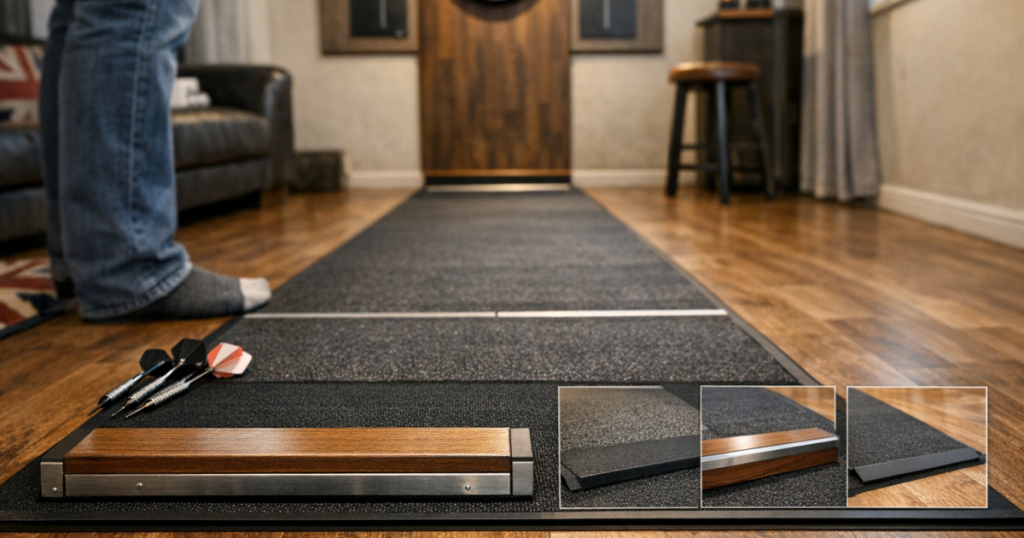
Raised oche
A raised oche gives a physical stop for the front foot. This is useful for practice because it removes doubt: you can settle into position by feel, keep your eyes up, and repeat the same stance more naturally. It also makes the home setup feel closer to a club or match environment.
The main consideration is convenience. A raised section can be annoying in a walkway, and it may catch feet if the room is shared with children, pets or general household traffic. If the mat is rolled away after every session, check whether the raised oche is removable, foldable or better suited to being left in place.
Fixed oche or separate toe line
A separate fixed oche can be the cleanest solution in a dedicated darts space. It keeps the throw line independent from the mat, so the mat can be changed or moved without losing the measurement. In a multi-use room, however, a fixed piece on the floor may be more intrusive than a roll-out mat. For a deeper look at these setup styles, read the comparison of roll-out mats, fixed oches and floor markers.
How wide should the mat feel?
Width is less discussed than length, but it affects comfort. A narrow mat can make players feel boxed in, especially if they stand slightly left or right of centre to suit their dominant eye, shoulder position or preferred angle into the treble 20. A wider mat gives more freedom without making the setup feel inaccurate, provided the oche line remains square to the board.
As a practical check, stand at your temporary oche mark and take your normal stance. Your feet should sit naturally on the mat without one foot half on and half off the edge. If you regularly practise doubles or move your line of sight across the board, a little extra width can make the setup feel more relaxed.
Material and surface feel
Most home darts mats aim to balance cushioning, grip and easy storage. A softer surface can be kinder underfoot during longer practice sessions, while a firmer mat may roll flatter and feel more stable. Neither is automatically better; the room decides a lot of it.
- Rubber-style mats often feel stable and protective, but can be heavier to move and may need space to lie flat.
- Carpet-style mats can look warmer in a living space, though they may collect dust or fibres around the board area.
- Hybrid roll-out mats can be convenient for occasional play, but check how well the edges settle and whether the backing suits your floor.
Surface texture also matters. Too smooth, and your shoes may slide slightly as you settle into the throw. Too grippy, and small stance adjustments can feel clumsy. The ideal surface lets you plant your feet confidently while still moving naturally between visits.
Fit the mat to the room, not just the rules
A regulation line in an awkward room is still awkward. Before committing to a layout, look at the whole playing area. Doors should not open into the throw, chairs should not sit behind the oche, and the route to collect darts should be clear. In garages, check whether the mat sits where bikes, tools or storage boxes are likely to be moved. In living rooms, think about whether the mat will live under furniture or be rolled away.
Noise and appearance can matter too. A mat can soften footfall in upstairs rooms and make the setup look more intentional, particularly when combined with a cabinet or surround. In a dedicated darts corner, aligning the mat neatly with the board and wall protection often makes the whole space feel sharper.
Checks before you settle on a layout
- Measure from the board face: use a tape measure from the front of the dartboard to the oche, not from the wall.
- Keep the oche square: the line should be parallel with the board face, not angled to suit the room.
- Test your stance: stand naturally at the line and make sure the mat width supports your normal foot position.
- Check movement: step on and off the mat several times to see whether it creeps, curls or bunches.
- Think about bounce-outs: if the floor in front of the board is delicate, a tiny oche mat alone may not protect the most vulnerable area.
- Plan storage: if the room is shared, decide where the mat will go when not in use and whether it rolls up easily enough.
FAQ
What darts mat size is best for a small room?
In a small room, a short oche mat or floor marker is often more practical than a full-length mat. The key is keeping the 2.37 m steel-tip throwing distance accurate from the board face while leaving enough space to stand and retrieve darts comfortably.
Does a darts mat protect the floor from bounce-outs?
It can help, but coverage matters. A full-length mat gives more protection in the landing area than a compact oche mat, although sharp steel tips can still mark some surfaces depending on the floor and dart angle.
Is a raised oche worth having at home?
Yes, if you practise regularly and want a repeatable stance. A raised oche lets you feel the line with your front foot, which can reduce creeping and make practice more consistent.
Can I put a darts mat on carpet?
Yes, but check that it lies flat and does not ruck up on deep pile. On carpet, weight and edge stability often matter more than aggressive non-slip backing.
Should the mat stay out permanently?
Only if the room allows it. A permanent mat is convenient in a dedicated darts space, but a roll-away setup is usually better in shared rooms where trip points, furniture and general traffic are part of daily use.
Why it matters
A good mat and oche setup gives you a repeatable throw without making the room harder to live with. Start with the correct board height and throwing distance, choose a mat that fits the actual floor space, then decide whether a printed line, raised oche or separate marker suits how often you play. When the measurements, grip and stance all feel right, home practice becomes smoother, tidier and far more consistent.