A stray dart, a bounce-out, or a tired carpet can quickly make a home setup feel messy. Getting darts floor protection right is not only about saving the floor; it also gives you a fixed, repeatable throw line so practice feels consistent every session. The best arrangement depends on your flooring, available space, whether you prefer a soft mat or a raised oche, and how permanent you want the setup to be.
The short version
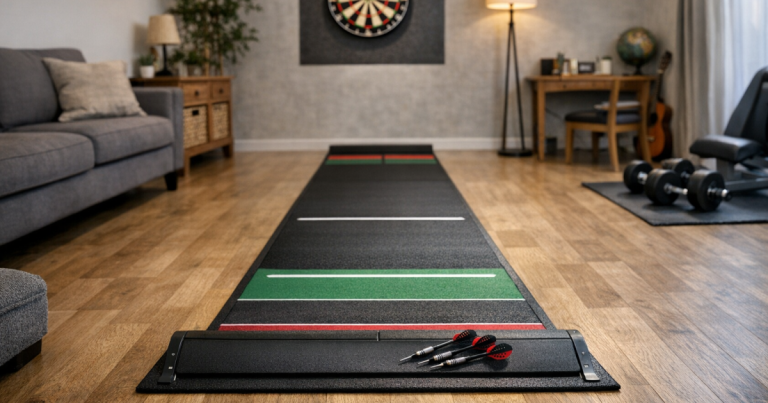
For most UK home darts setups, the simplest solution is a purpose-made darts mat with a clearly marked oche line. It protects the landing zone, reduces visible wear, and removes guesswork from positioning your feet. A raised oche feels more like a match setup, but it takes up more room and is less convenient if the space is shared with everyday household use.
- Set the bullseye at 1.73 m from the floor.
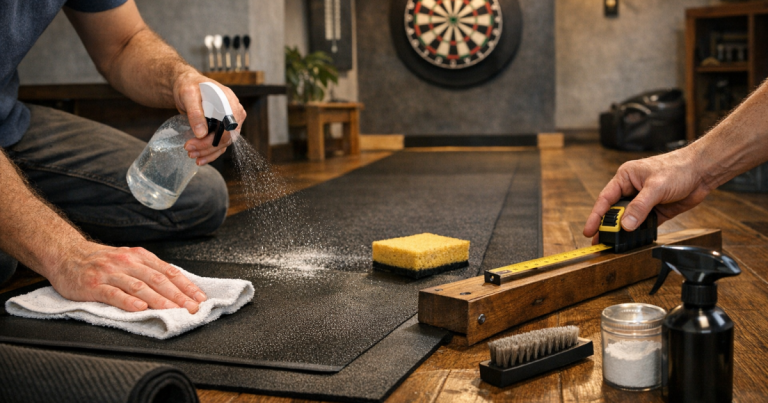
- For a standard steel-tip setup, measure 2.37 m from the face of the board to the front of the oche line.
- Protect the area directly below the board first, as this is where bounce-outs and dropped darts do most damage.
- Use a mat or marker that stays flat, does not slide, and is easy to remove if the room has another purpose.
- Check the line from the board face, not from the wall, cabinet, surround or skirting board.
Why the floor takes more punishment than you expect
The floor below a dartboard gets hit in three main ways: bounce-outs from the board, dropped darts while retrieving, and repeated foot placement at the throw line. Hard floors can pick up small punctures or chips, while carpet can show a worn standing patch after regular practice. Laminate and engineered wood are particularly unforgiving because a sharp point can leave a visible mark.
Darts floor protection matters most in the first metre or so under the board, but the oche area also deserves attention. If you always stand in the same place, especially in trainers, socks or slippers depending on the room, the floor can start to show a flattened or polished patch. A mat spreads that wear and gives you a visual lane between the board and throwing position.
If your board is mounted over a skirting board, cabinet or surround, remember that the dart lands forward of the wall line. A mat should sit far enough under the board to catch darts that fall almost vertically as well as those that kick out and travel forward.
Getting the oche position right
The key measurement for steel-tip darts is 2.37 m from the face of the dartboard to the front edge of the oche. That means the line your toes must not cross is measured from the playing surface, not from the wall behind it. A cabinet, thick backboard, or deep mounting bracket can shift the board face forward, so measuring from the wall can leave your oche slightly wrong.
A reliable method is to hang the board first, check the bullseye height at 1.73 m, then use a tape measure from the board face down to the floor and out to the oche line. If the board is already in place and access is awkward, use a plumb line or a straight edge to mark the point directly below the board face, then measure 2.37 m along the floor from that point.
You can also check the diagonal distance from the bullseye to the oche line, which is about 2.93 m for a standard steel-tip setup. This is useful in rooms where skirting, furniture or uneven flooring makes a straight floor measurement awkward. For soft-tip or electronic boards, the required throwing distance can differ, so check the board instructions or the format you play before fixing anything permanently.
Choosing between a mat, floor marker and raised oche
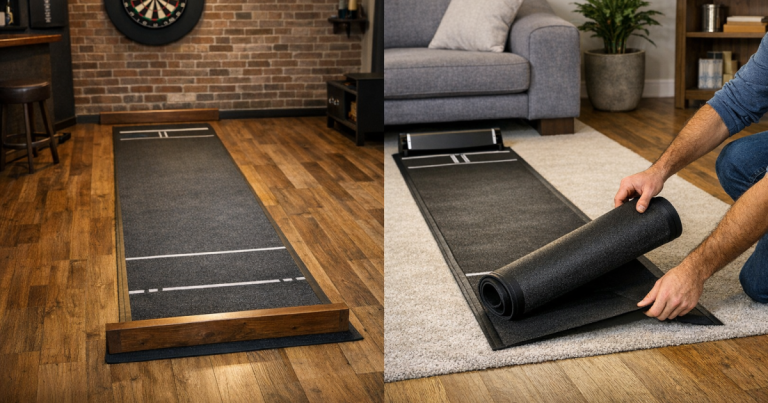
A darts mat is the most flexible option. It can be rolled out for play, stored after a session, and used on carpet or hard flooring. Some mats include multiple throw lines, which is handy if you use the same space for different formats or players. The main thing to verify is that the marked line matches your board type and that the mat length suits your room.
Named mats such as Winmau Xtreme Dart Mat and Target World Champions Dart Mat show the sort of purpose-made option many home players look at, but do not rely on the name alone. Check the material, grip on your floor type, marked distances and whether the mat lies flat after storage.
A floor marker is subtler. It works well in a room where you do not want a full-length mat visible, but it does not protect the landing area under the board. It is better as a throw-line solution than a protection solution. If you use one, pair it with a separate mat, rug, carpet tile or protective panel under the board.
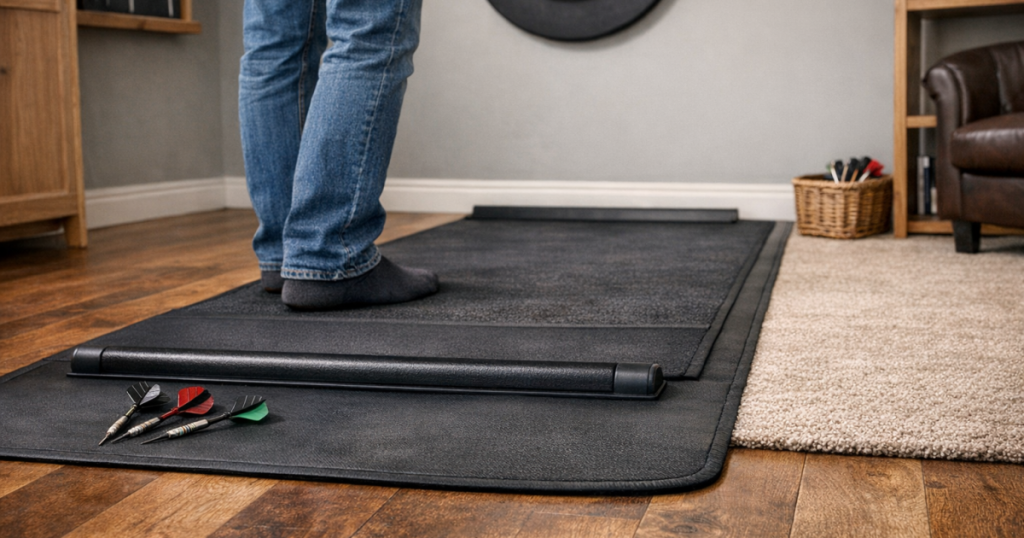
A raised oche gives the most definite foot stop. Instead of judging a printed line, you feel the front edge with your shoe, which can make practice more repeatable. The trade-off is space. A raised oche can be awkward in a living room, spare bedroom or hallway because it creates a physical obstruction when darts is not being played. For a fuller breakdown of the setup choices, see the mats, raised oches and floor markers explained guide.
Flooring-specific checks before you set up
Carpet
Carpet hides small dart marks better than hard flooring, but it can still wear at the oche and collect dust from sisal boards. A mat helps keep the throw area neat and gives you a more consistent standing surface. On thicker carpet, check that the mat does not creep forward during play, as that can gradually shift your throw line.
Laminate, vinyl and engineered wood
These floors are easy to clean but more likely to show puncture marks. Use a mat with enough thickness to cushion dropped darts and enough grip to avoid sliding. If the board is in a room with chairs or furniture nearby, make sure the mat edge does not become a trip point during normal use.
Tiles and concrete floors
Hard surfaces are tough on dart points and can make bounce-outs feel more dramatic. A protective mat is useful for both the floor and the darts. If the floor is slightly uneven, check that a raised oche sits stable and does not rock underfoot.
Small-room positioning: the details that matter
In a compact UK room, the oche distance is only one part of the layout. You also need safe clearance around the thrower, enough room to retrieve darts without stepping round furniture, and space behind the oche so your stance does not feel cramped. A mat can visually define the lane, which helps other people in the room understand the playing area.
If a door opens into the throwing lane, or if the oche sits close to a sofa, desk or bed, consider whether the setup will stay usable after the novelty wears off. A removable mat and low-profile floor marker often make more sense than a fixed raised oche in a shared room.
For a more detailed look at line placement, mat length and measuring methods, the darts mat and throw line guide covers the practical setup steps in more depth.
Do not forget the wall and skirting area
Floor protection works best when it is paired with sensible protection around the board. Many floor marks happen after a dart hits the wall, surround or wire and drops point-first. A surround, backboard or cabinet can reduce those impacts before the dart reaches the floor.
Skirting boards are easy to overlook. If your board is mounted above a skirting line and the mat starts too far forward, darts can still land in the narrow strip between wall and mat. Try to position protection so there is no exposed gap directly below the board. If the room has a cabinet, make sure the doors do not interfere with lighting, mat placement or the measuring point from the board face.
If the wall behind your board is already taking hits, it is worth reading about wall protection around a dartboard before changing the floor setup. Treating the wall and floor together usually gives a tidier result than solving one problem at a time.
Common setup mistakes
- Measuring from the wall: always measure from the board face. Even a small offset can change the feel of your throw.
- Letting the mat move: if the mat creeps during play, the oche line becomes unreliable. Use a grippier underside or reposition it on a cleaner, flatter surface.
- Leaving a gap under the board: bounce-outs often fall close to the wall, so protect the area directly below the board.
- Using a thick rug without checking the line: a household rug can help protect the floor, but it may not give an accurate or visible oche.
- Ignoring storage: if the mat is awkward to roll away, it may end up folded, curled or left in a place where it becomes a nuisance.
Things readers ask
Can I use a normal rug instead of a darts mat?
Yes, but it is a compromise. A rug can protect the floor under the board, but it will not usually give you a precise oche line. If you use one, mark the throw line separately and check the distance carefully.
Should the oche line be at the front or middle of the line?
The measurement is to the front edge of the oche line, closest to the board. Your foot should not cross that edge during a throw.
Is a raised oche worth it at home?
It is worth considering if you practise regularly and have a dedicated space. In a shared room, a flat mat or removable marker is usually easier to live with.
How far should the mat go under the dartboard?
It should cover the area directly below the board with no obvious exposed gap near the wall. Bounce-outs and dropped darts often land closer to the board than people expect.
Do I need different measurements for an electronic dartboard?
Possibly. Many soft-tip setups use a different throw distance from steel-tip darts, so check the board instructions or the rules for the format you play before fixing the oche.
What to remember
A good home setup does two jobs: it protects the floor where darts actually land, and it gives you a throw line you can trust. Start by mounting the board correctly, measure the oche from the board face, then choose a mat, marker or raised oche that suits the room rather than copying a pub or club layout exactly.
For most homes, a stable darts mat is the easiest all-round answer. It keeps the space tidy, protects the main wear zones, and makes practice feel more consistent without turning the room into a permanent darts venue.