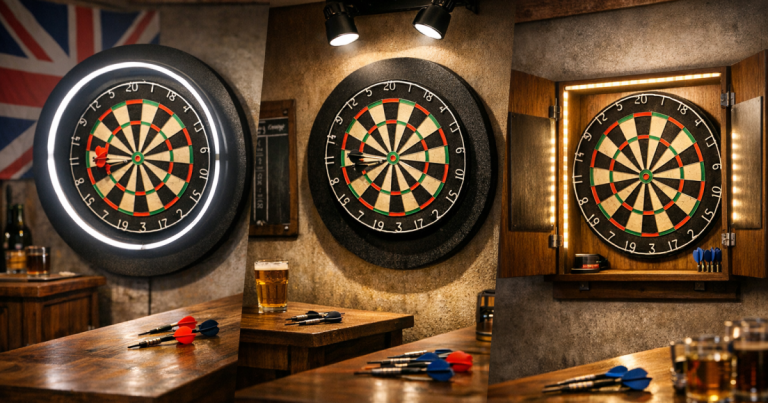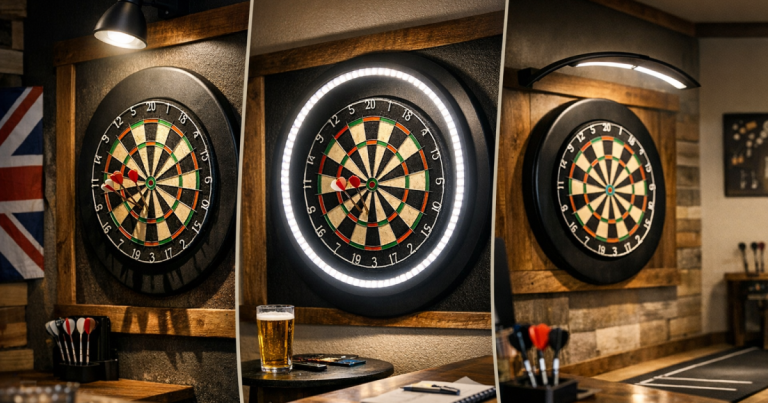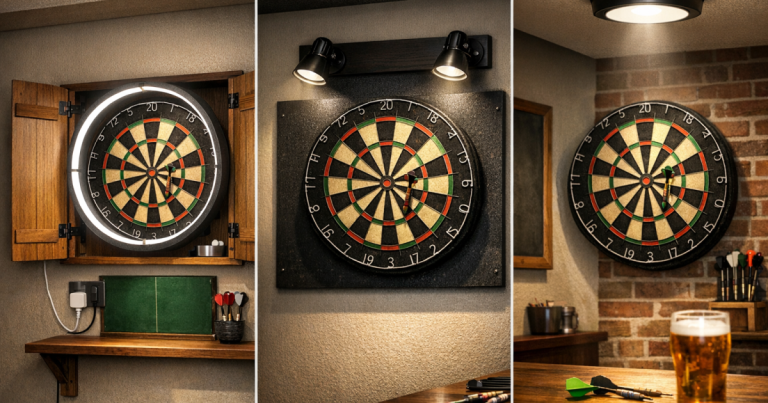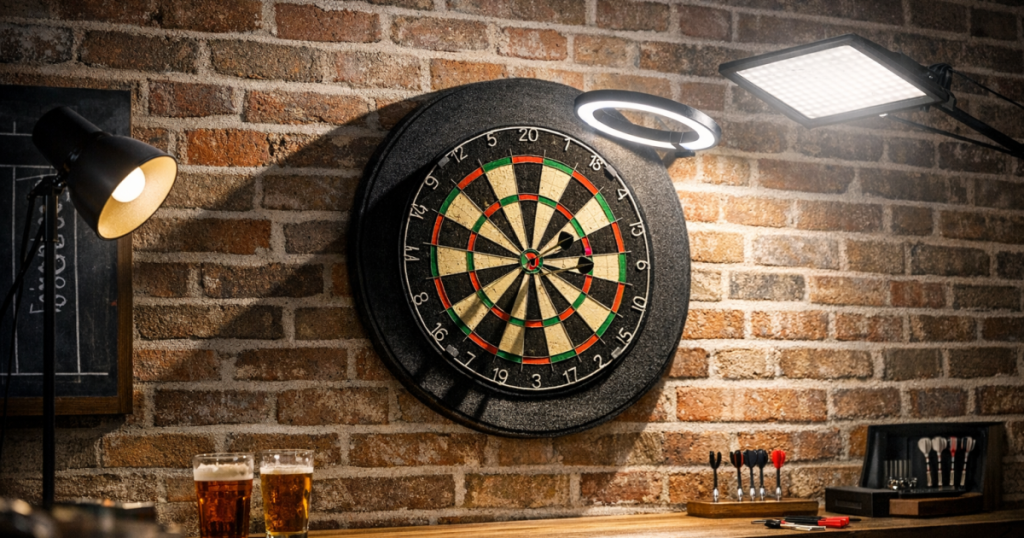
A bright board is only useful if the light lands evenly. dartboard shadows make trebles harder to read, exaggerate wire glare and can turn a tidy home setup into something that feels oddly tiring after a few legs.
The good news: most shadow problems come from predictable causes — light angle, player position, cabinet depth, wall colour and nearby room lighting — so they can usually be improved without rebuilding the whole darts corner.
Fixed mains lighting, new wall switches and any electrical alterations should be carried out by a qualified electrician to comply with UK electrical safety requirements and relevant Building Regulations.
Main points
- A single ceiling light behind the thrower is one of the most common causes of board shadowing.
- Side lights can work well, but only when the board is lit evenly from both sides.
- Cabinets, deep surrounds and nearby shelves can cast small but annoying shadows at the edge of the scoring area.
- Ring-style dartboard lights are popular because they reduce hard shadows from the darts and the player’s throwing arm.
- The simplest test is to stand at the oche, raise your throwing hand, and check whether the shadow crosses the doubles, trebles or bull.
Why shadows appear on a dartboard
Shadows usually happen because the light source is too narrow, too far to one side, or positioned behind the person throwing. In many UK homes, the board ends up under a central pendant, garage strip light or spare-room ceiling fitting that was never intended to light a vertical target on the wall. The result is a board that looks fine from across the room but becomes patchy once someone stands at the oche.
The player’s body is only part of it. A raised throwing arm, the barrel and flights of the dart, the number ring, cabinet doors, a thick surround and even a shelf above the board can all interrupt the light. If the main light comes from one direction, those interruptions create strong contrast. That is why a small change in angle can sometimes make a bigger difference than simply using a brighter bulb.
Board texture matters too. A worn sisal surface, dusty number ring or shiny wire can make the light appear uneven even when the room is reasonably bright. Good lighting will not fix a badly tired board, but it can make a decent home setup feel far more consistent during practice.
The quick shadow test at the oche
Before changing anything, test the board from the position that matters: the throw line. Stand naturally at the oche with the room lights set as you normally use them. Hold a dart or simply raise your throwing hand to your usual release area. If dartboard shadows move across the treble 20, bull or double ring, the main light is probably coming from behind you or too sharply from one side.
Next, look at the board from a slight crouch and then from your normal eye height. If the shadow changes dramatically, the issue may be vertical angle rather than brightness. Open and close any cabinet doors as well. A cabinet can be perfectly useful for storage and wall protection, but its frame and doors can change how the light reaches the outer doubles.
Finally, check the wall around the board. Dark paint, exposed brick, black acoustic panels and deep recesses can absorb light, making the board edge look gloomier. Pale, matt surroundings tend to reflect light more softly, while gloss surfaces can bounce glare back towards the thrower.
Lighting setups that usually work
Ring-style board lighting
A dedicated ring light sits around the board and throws light inwards from multiple directions. This is the most reliable approach for many home players because the light is close to the target and less dependent on where the ceiling fitting happens to be. Real examples include Target Corona Vision and Winmau Plasma, both of which are commonly associated with home dartboard lighting. Before using any ring-style system, check how it fits with your board, surround, cabinet and wall space rather than assuming every setup has the same clearance.
Ring lighting is not magic, but it tackles the main problem well: harsh single-direction shadow. It also keeps the board readable when the rest of the room lighting is modest, which is handy in garages, sheds and multipurpose rooms.
Twin side lights
Two matching wall or clamp lights, placed evenly to the left and right of the board, can produce a good result when aimed carefully. The aim is not to blast the board from both sides, but to balance the light so one side does not overpower the other. Uneven side lighting can make the number ring cast a wedge-shaped shadow, particularly around the outer singles and doubles.
This approach suits rooms where a ring light would clash with a cabinet or where the board is part of a wider games-room layout. Keep the fittings out of the throw path, avoid dazzling anyone at the oche, and make sure both lights are stable and aimed at the board face rather than the player.
Ceiling or overhead lighting
Overhead lighting can work if it sits in front of the board rather than behind the thrower. A central room light behind the oche often creates a moving arm shadow exactly where you need the cleanest view. If the room has a ceiling track or adjustable spotlights, angling light towards the board from the front can help. Keep the beam broad enough to cover the full scoring area, not just the 20 segment.
For a broader explanation of the main lighting formats, the guide to dartboard lighting types is a useful next step if you want to understand rings, spotlights and cabinet lights side by side.
Cabinets, surrounds and wall depth
Not every shadow is caused by the lamp. The area immediately around the board can create small, stubborn dark zones. A deep cabinet frame can shade the left and right edges. A thick surround can create a lip around the board. Cabinet doors can also reflect or block light depending on whether they are open during play.
If you use a cabinet, test the board with the doors fully open, half open and closed if your setup allows it. You may find the best lighting angle changes once the cabinet is in its normal playing position. Storage is handy, but a cluttered cabinet with flights, spare shafts, chalk or scoreboards hanging near the board can also interrupt light and distract the eye.
For players deciding how much wall protection and storage to keep around the board, the explainer on dartboard cabinets and surrounds covers the practical trade-offs without treating every home setup as the same.
Small fixes before changing the whole setup
Plenty of shadow issues can be improved with small adjustments. Move a freestanding lamp so it lights the board from the front quarter rather than from behind the thrower. Remove objects above or beside the board that block light. Clean dust from the number ring and surrounding wall area. If a cabinet door throws a hard line across the doubles, try changing the light angle before blaming the cabinet itself.
It also helps to standardise the room lighting you use for practice. If one evening you practise with the main ceiling light on and the next with a side lamp only, your sight picture changes. Consistency matters because darts is repetitive; the board should look familiar every time you step up.
Avoid solving the problem by making the room uncomfortably bright. Too much direct light can create glare on wires, dry-looking contrast on the sisal, and eye strain over longer sessions. Even, soft coverage is usually better than raw brightness.
Garage and shed setups need extra thought
Garages and sheds often exaggerate shadow problems because the lighting is practical rather than targeted. A single strip light down the centre of the ceiling may be fine for finding tools, but it can leave the board face uneven once a player stands in front of it. Bare blockwork, dark shelving and low ceilings can all make the board feel gloomier than it looks in daylight.
For a garage, think in zones. The throwing lane needs safe, clear floor space; the board needs even light; and the surrounding storage should not crowd the target. If the board is between shelves, test whether the shelves cast side shadows before fixing everything permanently. More detailed room-planning ideas are covered in the guide to planning a darts corner in a garage.
When the board still looks wrong
If the lighting has been balanced but the board still looks uneven, inspect the dartboard itself. Rotated, well-maintained bristle boards tend to present a cleaner face than boards with heavily compacted segments. A bent number ring, loose fixing or board sitting slightly proud of the wall can also make shadows appear in odd places.
Check the mounting height and make sure the board is sitting flat and secure. A board tilted away from the wall at the top or bottom will catch light differently across the scoring area. This is easy to miss because the board may still look straight from the oche.
Also pay attention to your darts. Large flights can briefly cast a visible shadow after landing if the light angle is shallow. That is normal, but it becomes irritating when the lighting is already marginal. Better board lighting reduces the effect because no single dart blocks the only useful light source.
Helpful questions
Why does my board look fine until I stand at the oche?
Your body and throwing arm are probably blocking the main light. This is common when the ceiling light is behind or directly above the throw line rather than in front of the board.
Are ring lights the only proper fix?
No. Ring lights are effective because they light the board from several directions, but balanced side lights or well-aimed front lighting can also work in the right room.
Can a dartboard cabinet cause shadows?
Yes. The frame, open doors and anything stored close to the board can shade the outer scoring area. Test the lighting with the cabinet in its normal playing position.
Is brighter always better for darts?
No. Excess brightness can create glare and eye strain. Even coverage across the whole board is more useful than a harsh beam aimed at one segment.
What is the fastest way to diagnose the problem?
Stand at the oche, raise your throwing hand, and watch where the shadow falls. Then move the light source or add a second light until the key scoring areas stay clear.
What stands out
The most dependable darts lighting is not about flooding the room with light; it is about controlling direction. Once the board is lit from the right places, the trebles become clearer, the wire glare settles down and practice feels more consistent. Start with the oche test, check the cabinet and wall area, then decide whether a ring light, balanced side lights or a better-positioned overhead light suits the room you actually play in.