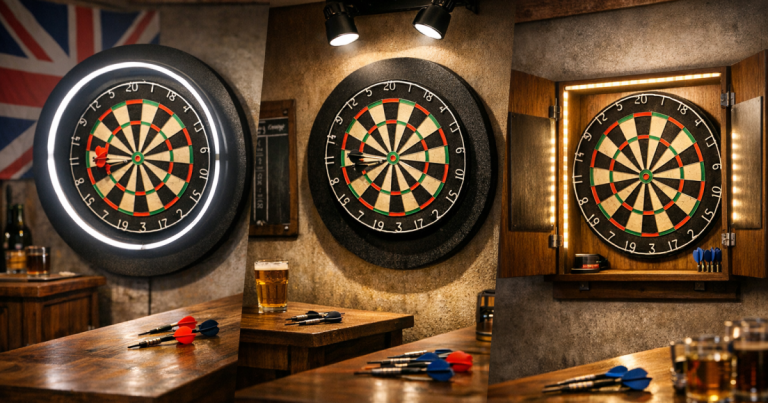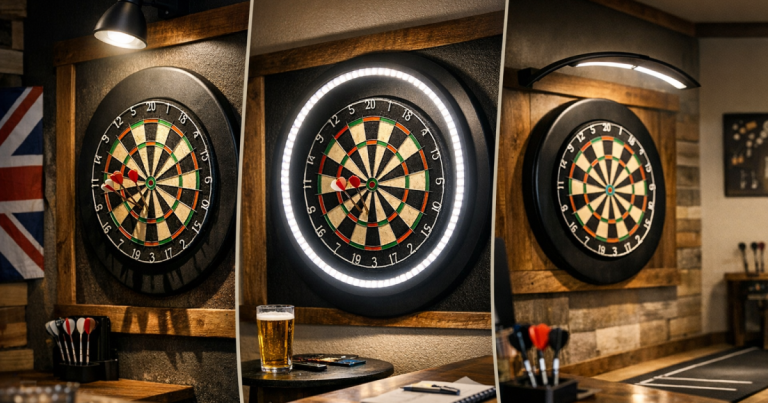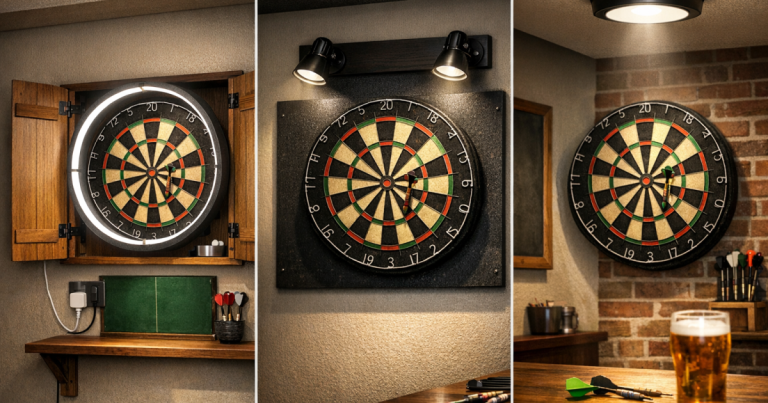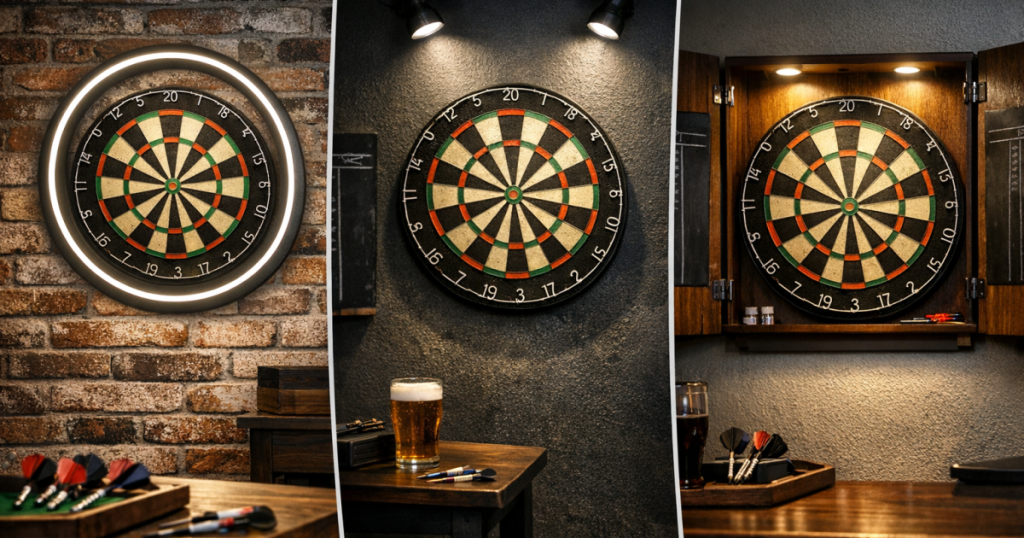
A bright ceiling light is rarely enough for a tidy home darts setup. The board needs even illumination across the doubles, trebles and outer numbers without throwing harsh shadows from your darts or cabinet. The main dartboard lighting types are ring lights, spotlights and cabinet lights, and each one solves a slightly different problem.
Mains wiring for fixed spotlights or permanent lighting connections should be carried out by a qualified electrician to ensure compliance with UK electrical safety requirements and relevant standards.
The short version
- Ring lights give the most even board coverage for most home players because they surround the board and reduce dart shadows from several angles.
- Spotlights can work well in a garage, games room or wider setup, but the angle and distance matter more than raw brightness.
- Cabinet lights are neat and traditional, although they usually illuminate from above and can leave more shadow at the lower half of the board.
- The best choice depends on whether your board is wall-mounted, inside a cabinet, on a stand, or fitted into a shared room where the setup needs to look tidy.
- Lighting should be planned with board height, oche position and wall protection, not treated as an afterthought.
Why darts lighting is different from normal room lighting
Darts is awkward to light because the target is vertical, detailed and often surrounded by darker wall protection or cabinet doors. You are not just trying to brighten a room; you are trying to make a numbered scoring surface easy to read from the oche.
The common problems are shadows across the bed, glare from shiny number rings, dark patches near the outer doubles, and a distracting bright spot near the bull. A single ceiling pendant behind the thrower can be particularly poor because your body may block light as you step into position. A ceiling light directly above the board can be better, but it still tends to create shadows from the darts already in the board.
Good lighting should make the board look consistent from top to bottom. You should be able to see the treble 20, treble 19, bull and lower doubles clearly without leaning, squinting or checking the score from closer range. For a more complete lighting setup walkthrough, the guide on how to light a dartboard properly at home is a useful next step once you know which style suits your room.
Ring lights: even coverage with minimal fuss
Ring lights are the modern default for many home steel-tip boards. They sit around the dartboard and throw light inwards from multiple points, which helps reduce the strong single-direction shadows you often get from ceiling lights or cabinet lamps.
The biggest advantage is consistency. A well-fitted ring light usually brightens the whole scoring area, including the outer doubles and the lower segments that often sit in shadow. It also keeps the lighting close to the board, which is handy in UK homes where the board may be in a spare room, garage, dining area or narrow alcove rather than a dedicated games room.
Examples such as the Target Corona Vision Dartboard Light and Winmau Plasma Dartboard Light show the general idea: a purpose-made lighting frame that sits around a standard bristle dartboard. Before using any ring system, check how it attaches, whether it works with your surround or cabinet arrangement, and whether there is enough clearance around the board.
Ring lights are not perfect for every setup. If your board sits inside a deep cabinet, the doors or cabinet frame may interfere with the light position. If your wall protection is unusually thick, you need to confirm that the lighting frame can sit correctly. A ring can also make the board area look more like a dedicated darts zone, which is positive in a games room but less subtle in a shared living space.
Spotlights: flexible, but less forgiving
Spotlights can be excellent when they are positioned carefully. They are often used in garages, bars, sheds and larger home games rooms where the board sits on a feature wall and the lighting can be aimed deliberately.
The key is angle. A spotlight aimed too steeply from above may brighten the top of the board while leaving the lower doubles dull. A light from too far to one side can cast dart shadows across the segments. A very narrow beam can create a bright centre and darker edges, which is annoying when scoring near the doubles.
Spotlights work best when they are adjustable and aimed at the face of the board rather than at the thrower. Two softer lights from either side can often feel more balanced than one harsh light from the centre, but the room layout decides what is practical. If the board is near shelving, a door frame or a sloping garage ceiling, small changes in placement can make a visible difference.
This is where testing matters. Before drilling, fixing brackets or committing to a permanent position, set the board and throw line temporarily and check what the light looks like from the oche. The same applies to board position: accurate height and distance affect how the setup feels, so it is worth using a proper method to mark dartboard height and oche distance accurately before making lighting decisions permanent.
Cabinet lights: tidy and traditional
Cabinet lights suit players who want a neat, self-contained board area. A dartboard cabinet can hide the board when not in use, store chalk or markers, and make the setup feel more acceptable in a dining room, office or spare bedroom. A small light fitted above or within the cabinet can add useful illumination without changing the whole room.
The trade-off is coverage. Cabinet lighting usually comes from the top, so it can leave more shadow below the darts, especially when several darts are grouped in the upper half of the board. It may be perfectly adequate for casual games, but it is less consistent than a good ring light when you want a clear view of every segment.
Cabinet lights also need room to work. If the cabinet doors sit close to the board, or the light is tucked too far back, the beam may hit the number ring unevenly. Reflections can be an issue on glossy cabinet interiors or bright white surfaces. A matt, darker backing often feels calmer, provided the board itself is still properly lit.
A cabinet light is usually the most discreet option. It suits players who value appearance and occasional play, while a ring light usually suits players who prioritise visibility and regular practice.
How each option behaves in real home setups
Spare room or home office
A ring light is usually the easiest route because it keeps the light close to the board and does not depend heavily on ceiling position. This matters in rooms where the existing ceiling light is placed for a desk or bed rather than a dartboard.
Garage or outbuilding
Spotlights can work well here because there is often more freedom to aim lighting and less pressure to keep the setup discreet. Watch for cold, uneven spaces, dark walls and clutter around the board, as these can all make shadows feel worse.
Living room or dining area
Cabinet lighting can look the neatest, especially when the board needs to disappear between games. The compromise is that visibility may not be as clean as a full ring system, so it suits casual play better than long practice sessions.
Freestanding board setup
A freestanding board can be trickier because the board position may change. Ring lights can still work, but you need to consider cable routing, stability and whether the light moves with the board. If you are still deciding where the setup belongs, it is sensible to test a darts layout before drilling so lighting, oche space and wall protection can be judged together.
Checks that matter before you commit
- Shadow test: Stand at the oche, throw three darts into different parts of the board, then check whether the darts cast distracting shadows over the scoring beds.
- Number visibility: Make sure the outer number ring is clear without glare. If you cannot read the numbers comfortably from the throw line, the light is not doing its job.
- Wall protection clearance: Surrounds, cabinets and backboards can all affect whether a ring or cabinet light fits cleanly.
- Thrower comfort: Lighting should not shine into your eyes as you address the board. If you notice the light more than the target, the angle is wrong.
- Room use: A dedicated darts room can accept a more visible lighting frame, while a shared room may need a subtler cabinet or adjustable room lighting.
- Cable route: Keep cables tidy and away from the throw area. A neat setup is easier to live with and less distracting during games.
Common lighting mistakes
The first mistake is assuming brighter always means better. A harsh beam can make the board look washed out and create stronger shadows. Evenness matters more than sheer brightness.
The second is lighting the board after everything else has already been fixed. Board height, surround thickness, cabinet depth, oche mat position and room furniture all affect the final result. Lighting should be part of the setup plan, not the last accessory added once the holes are drilled.
The third is ignoring how the board looks during an actual leg. A board can look fine when empty, then become harder to read once darts are sitting in the treble bed. Always test with darts in the board, not just by switching the light on and looking from close range.
Things readers ask
Is a ring light better than a spotlight for most home boards?
For most wall-mounted home boards, yes. A ring light usually gives more even coverage with fewer shadows and less adjustment than a spotlight.
Can I use a normal room light for darts?
You can, but it often leaves shadows or dark edges. It is fine for occasional casual play, but a dedicated board light usually makes scoring easier.
Do cabinet lights work for serious practice?
They can be usable, but they are rarely the most even option. If you practise often, compare the lower doubles and side segments carefully before relying on cabinet lighting alone.
Will a dartboard light fit with a surround?
Many setups can combine lighting and a surround, but compatibility depends on the light design, surround thickness and how the board is mounted. Check the fixing method before committing.
Where should I test the lighting from?
Test from the oche, not from beside the board. The view that matters is the one you have when throwing and scoring.
What stands out
Ring lights are the simplest answer for even visibility, spotlights are the most flexible when the room allows careful aiming, and cabinet lights are the neatest option when appearance matters. None is automatically right for every home setup.
The most reliable approach is to treat lighting as part of the whole darts area. Check the board position, oche, surround, cabinet depth and shadows together. Once those details line up, the right choice becomes much clearer. Among the main dartboard lighting types, the best one is the one that lets you read the board comfortably from the throw line without glare, clutter or constant adjustment.