A tidy darts area is easier to use, easier to live with, and much kinder to your walls. For home players, dartboard cabinets and surrounds are the two main ways to make a board feel more finished: one adds storage and a framed look, while the other gives simple, wider impact protection around the board. The right approach depends on the room, how often you play, how much wall space you have, and whether the setup needs to blend into daily home life.
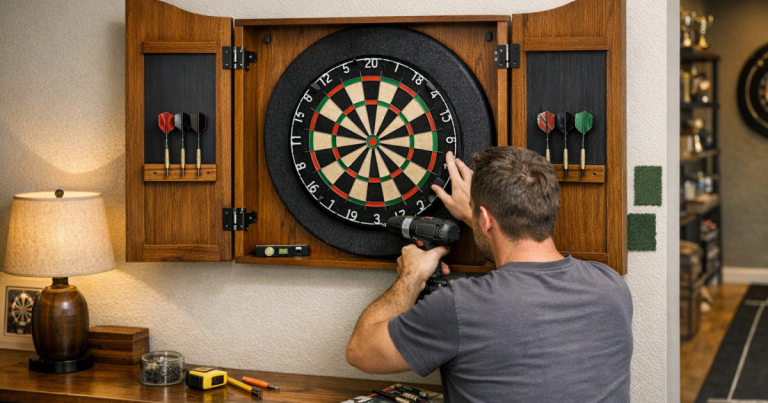
Drilling and fixing a cabinet into walls where concealed cables, pipework or uncertain wall construction are involved should be carried out by a qualified tradesperson to meet UK safety requirements and suitable fixing standards.
The short version
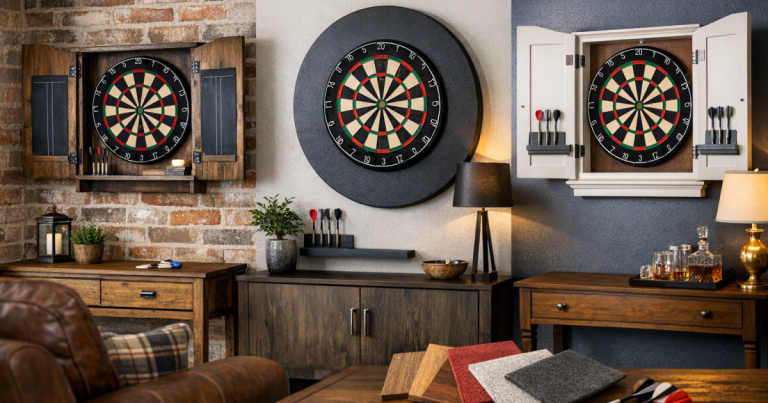
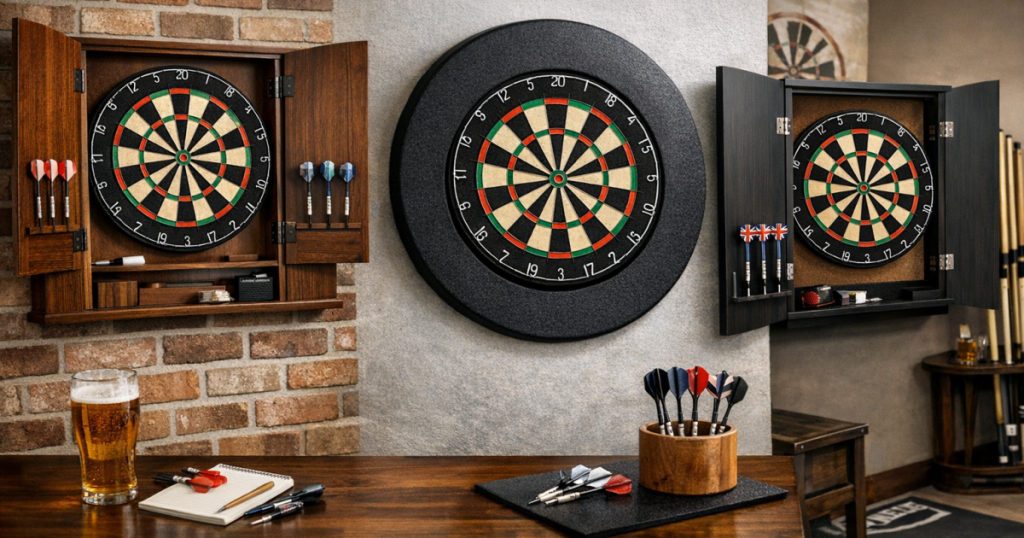
A dartboard cabinet is mainly about presentation, storage and hiding the board when it is not in use. A surround is mainly about protecting the wall from missed darts and bounce-outs. Many home players use one or the other, but a cabinet and a surround can also work together if the sizes are compatible and the doors still open properly.
If the board is in a lounge, dining room or spare room, a cabinet can make the area feel more deliberate and less temporary. If the board is in a garage, games room or practice corner where missed darts are more likely, a surround usually gives more practical protection. For beginners, family use and shared spaces, wall protection should usually come before appearance.
What a dartboard cabinet actually does
A cabinet is a wall-mounted box or frame that sits around the board. Most home cabinets have two doors, with space on the inside for chalkboards, whiteboards, score panels or small dart holders. When closed, the cabinet hides the board and makes the wall look neater.
The biggest benefit is organisation. Instead of leaving darts, chalk, spare flights and shafts on a shelf or windowsill, a cabinet keeps the essentials close to the board. That matters for daily practice because small interruptions make it easier to skip a session. If your darts area tends to collect clutter, it is worth reading more on how to organise a dart cabinet for daily practice.
Cabinets also give the setup a more traditional pub-style feel. In a living space, that can be a real advantage. A wooden cabinet can look more like furniture than sports equipment, while a plain black or grey cabinet can suit a modern games room. The trade-off is that cabinet doors do not usually offer the same wide protection as a full surround, so the wall beyond the cabinet edges can still be exposed.
What a dartboard surround is for
A surround fits tightly around the outside of the board and creates a protective ring. It is designed to catch stray steel-tip darts before they hit plaster, brick, painted walls or wallpaper. For many home players, this is the simplest upgrade after the board itself.
The main advantage is coverage. A surround sits directly around the scoring area and protects the zone where most missed darts land. This is especially useful for newer players, children playing under supervision, guests, or anyone practising doubles where darts often drift just outside the board. If wall marks are already becoming a problem, the detailed guide on how to choose a dartboard surround that protects your wall explains coverage and fit in more depth.
A surround is usually quicker to remove than a cabinet and does not normally require additional storage space. It also keeps the board more open, which some players prefer for practice. The downside is that it does not hide the board, store accessories or create the same furniture-like finish.
Where each one makes most sense at home
Living room or dining room setup
In a room used for more than darts, a cabinet often makes the setup easier to live with. Closed doors can hide the board between sessions, while internal scoring panels keep the area tidy. A surround can still be useful, but it may look more obviously sporty, especially in a decorated room.
Garage or utility space
In a garage, practicality tends to matter more than appearance. A surround, backing board or larger wall protection panel can be more useful than a decorative cabinet. Garages often have harder wall surfaces, exposed brick or colder conditions, so impact protection and reliable fixing matter. Storage is still helpful, but it can come from a nearby shelf, small cabinet or wall hooks rather than a formal dartboard cabinet.
Rented homes and temporary setups
If you rent, think carefully before drilling into walls. A freestanding stand, removable protection panel or carefully planned board area may be better than a fixed cabinet. A surround can reduce wall marks, but it will not protect skirting boards, floors or everything around the throwing area. Always consider the tenancy agreement and the finish of the wall before making permanent changes.
Family or beginner-friendly spaces
For mixed-ability play, a surround is usually the first priority. Beginners miss wider, and casual games create more unpredictable throws than solo practice. A cabinet can still be useful for keeping darts out of the way when not playing, but it should not be treated as full wall protection.
Using a cabinet and surround together
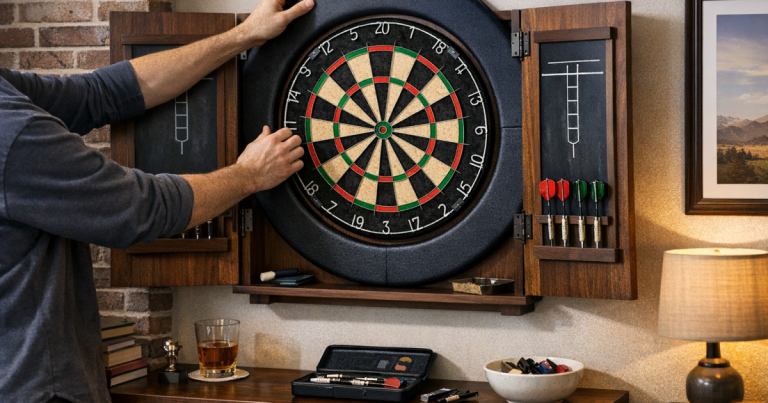
A combined setup can work very well, but it needs a little planning. The surround must fit inside the cabinet opening, or the cabinet must be wide enough to sit around both the board and the protective ring. If the surround is too thick or too wide, the cabinet doors may not close properly.
Before committing to a combined layout, check three things:
- The cabinet opening leaves enough space around the board for the surround.
- The board remains easy to rotate without removing half the setup.
- The doors open fully without hitting lights, shelves or nearby furniture.
Also think about depth. Some cabinets sit fairly close to the wall, while some surrounds stand proud around the board. If the board face ends up recessed too far behind the cabinet edges, it can feel awkward and shadows may become more noticeable.
Wall protection is not only about missed darts
Missed darts are the obvious issue, but bounce-outs can be just as frustrating. A dart can hit a wire, fall out at an angle and mark the wall or floor below. A good surround helps with the wall area close to the board, but it does not solve everything.
For a more complete home setup, think about the whole impact zone. That includes the area below the board, the floor near the oche and any furniture close to the throwing line. A mat can help define the oche and protect flooring, while a larger backing panel can make sense in a garage or high-use practice area.
Cabinets provide limited protection from bounce-outs because the doors and frame sit to the sides of the board, not all around the wider wall. They can catch some stray darts, but they are not designed to absorb repeated impacts in the same way as a surround or backing material.
Storage, scoring and everyday routine
Cabinets come into their own when the board is used regularly. Having darts, chalk, a duster and spare accessories in one place makes short practice sessions easier. It also stops darts being left loose where points can damage furniture or become a nuisance.
For players who practise structured routines, internal scoreboards are useful. You can keep a running tally, play legs without reaching for a separate board, or use one side for scores and the other for practice notes. If you prefer an app or separate scoreboard, the cabinet still works as storage, but the built-in panels may matter less.
Surrounds are simpler. They do not organise anything, but they keep the board area clear and focused. That can suit players who already have a nearby shelf, case or drawer for darts gear.
Lighting and shadows
Lighting can make or break a home board area. Cabinets can create side shadows if the room light is behind you or if the cabinet frame sits deep around the board. Surrounds tend to leave the board more open, but they still need even lighting to avoid shadows across the doubles and trebles.
If you are planning a neater permanent area, consider the light at the same time as the cabinet or surround. Ring lights, spotlights and cabinet lights all behave differently, and the right choice depends on the room layout. The guide to dartboard lighting types is a useful next step if shadows are already bothering you.
Fit, height and space checks
Cabinets and surrounds should not interfere with the basics of a proper throwing setup. For steel-tip darts, the bullseye is normally set at 1.73 m from the floor, with the oche 2.37 m from the face of the board. Measure from the board face, not the wall, especially if the board is mounted inside a cabinet or on a backing panel.
Check nearby doors, cupboards, radiators and walkways before fixing anything. A cabinet needs space for its doors to open. A surround needs clear wall area around the board. Both need enough room below for missed darts and bounce-outs to fall without hitting something fragile.
Also consider board rotation. Bristle boards last longer when rotated regularly, but some cabinets make access to the number ring more fiddly. The setup should allow you to remove or turn the number ring, rotate the board and refit everything without shifting the cabinet itself.
The big picture
A cabinet makes a dartboard area feel organised, traditional and more suitable for a shared room. A surround gives straightforward protection where stray darts are most likely to land. Neither is automatically the better choice; they solve different problems.
For a smart lounge setup, start with appearance, storage and door clearance, then add protection if missed darts are likely. For a garage or practice corner, start with wall coverage and durability, then add storage if you need it. For beginners, wider protection is usually more valuable than a polished look.
The best home darts area is the one you will actually use: clear oche, good light, protected wall, tidy accessories and no awkward furniture in the way.
FAQ
Can you put a surround inside a dartboard cabinet?
Sometimes, yes. It depends on the cabinet opening, the surround width and whether the doors can still close. Measure before fixing the cabinet to the wall.
Does a cabinet protect the wall enough on its own?
Usually not for beginners or busy home games. A cabinet protects some side areas, but a surround gives more direct protection around the board.
Is a surround suitable for a rented flat?
It can reduce wall marks, but it does not remove the need to think about fixings, tenancy rules and surrounding surfaces. Avoid permanent wall changes unless they are permitted.
Will either option make the dartboard quieter?
Not by much on its own. A surround may slightly soften some impacts around the board, but noise is more affected by the wall, mounting method, board backing and floor setup.
Do cabinets work well in garages?
They can, but garages often benefit more from wider wall protection and practical storage. A cabinet is most useful if you want doors, built-in scoring and a tidier finish.