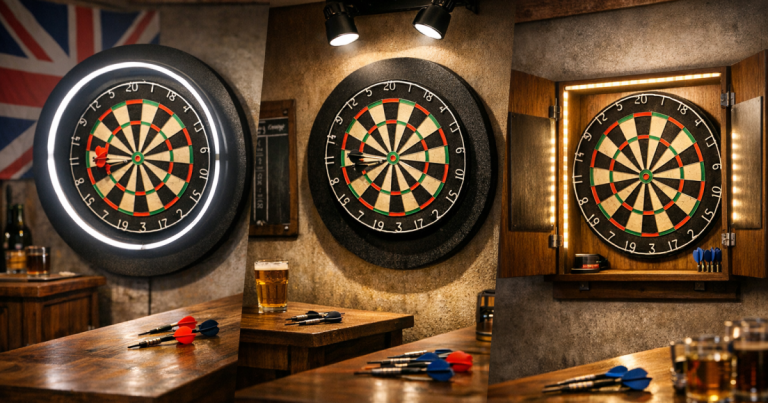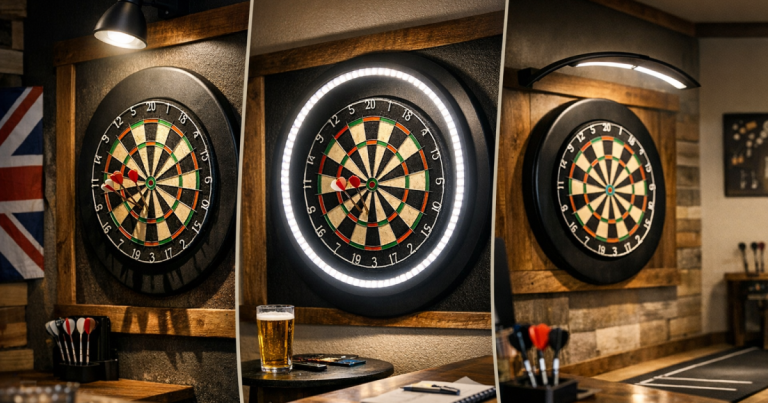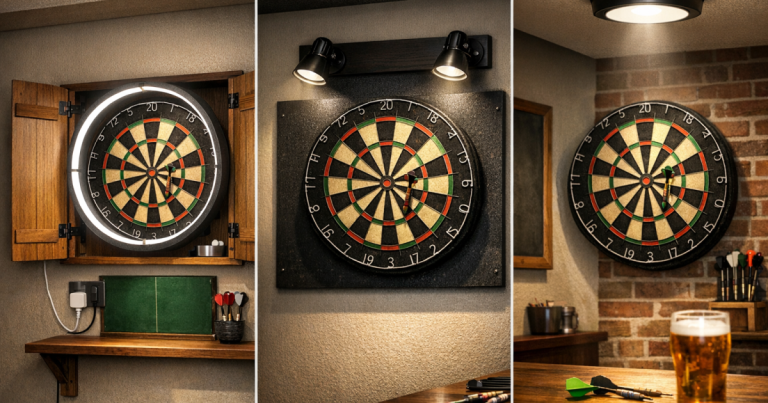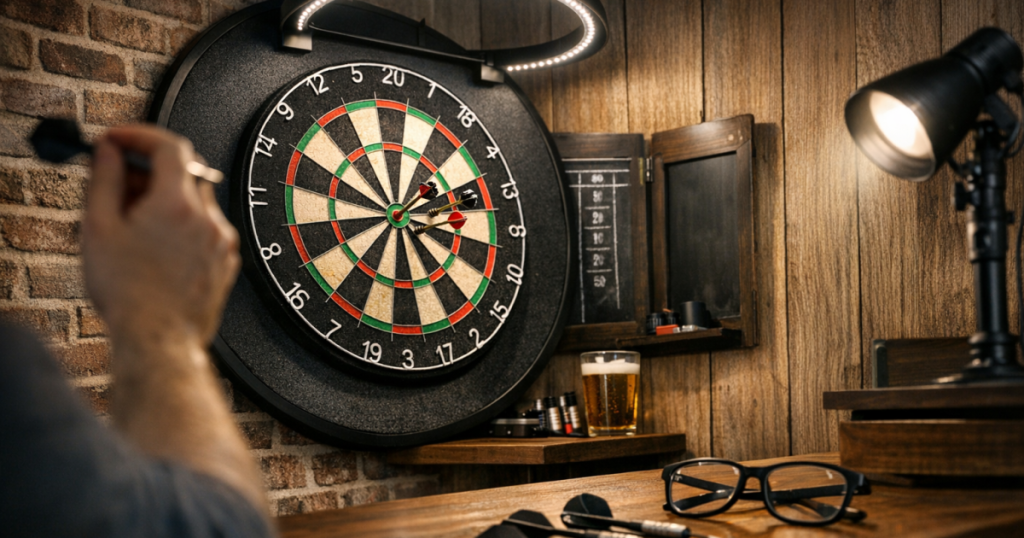
A home board can look perfectly playable until the trebles blur, shadows creep across the 20 bed, or the bull seems to disappear under glare. Good dartboard lighting should make the board evenly visible without forcing your eyes to keep adjusting between bright and dim areas.
Fixed light fittings, mains wiring and any electrical work around the playing area should be carried out by a qualified electrician to meet UK electrical safety requirements and relevant building standards.
Main points
- Eye strain around a board is usually caused by uneven brightness, harsh glare, shadows from darts, or a strong contrast between the board and the rest of the room.
- The aim is not to make the board painfully bright; it is to create clean, even illumination over the full scoring area.
- A light placed too far above, too far to one side, or directly in the player’s line of sight can make the setup worse.
- The surrounding room still matters. A pitch-dark room with a very bright board can tire the eyes because they constantly adapt between light levels.
- Check visibility from the oche, the scoreboard position and casual seating areas, not just from directly in front of the board.
Why the board feels harder to read than it should
Darts asks your eyes to do more than simply recognise a large object on a wall. You are aiming at narrow segments, reading wire divisions, tracking dart angles, and checking scores quickly between throws. Small lighting faults become noticeable because the target is detailed and the throwing rhythm is repetitive.
The most common problem is shadowing. When a single ceiling bulb sits behind the thrower or above the room rather than above the board, the darts themselves can cast shadows across doubles and trebles. A board can look fine when empty, then become harder to read after the first or second dart lands.
Glare is the other big culprit. A shiny cabinet door, glossy wall paint, framed print, glass-covered scoreboard or bright fitting pointing towards the oche can create reflections. Your eyes then work harder to separate the segment lines from the reflected light.
There is also the issue of contrast. A bright board in an otherwise dark garage, shed or spare room can feel dramatic, but it is not always comfortable. For longer practice sessions, the area around the board should have enough ambient light that the board does not feel like a spotlight on a stage.
What good dartboard lighting is trying to achieve
Good dartboard lighting is less about a single headline brightness figure and more about balance. The number ring, doubles, trebles and bull should all be clearly visible from the oche, with no obvious dark patch at the bottom of the board and no bright hot spot at the top.
A useful test is to stand at the oche and look at the 20, 3 and 19 beds in turn. If the 20 bed is crisp but the lower half feels dull, the light angle is probably too steep or too high. If one side of the board is brighter than the other, the fitting may be off-centre or the room’s main light may be pulling the eye in one direction.
For a deeper look at brightness levels and light placement, the separate guide to lumens, colour temperature and placement is a useful next step once you have identified the symptoms in your own room.
Set the board area first, then adjust the light
Lighting fixes work best when the board is already in the right place. If the board is too high, too low, tilted, or squeezed into a narrow recess, the light may be blamed for visibility problems that are really caused by the setup.
Start by confirming the board is mounted correctly, with the bull at the standard height and the throw line measured accurately. If you need to check the basics, use the guide to dartboard sizes, measurements and regulations before fine-tuning the light.
Once the board position is right, stand at the oche and check these four areas:
- The top of the board: the 20 bed and double 20 should be clear, but not washed out.
- The lower board: the 19, 3, 17 and bull area should not fall into shadow.
- The wire divisions: the spider should be visible without appearing to shimmer or reflect too strongly.
- The wall around the board: the surrounding area should not be so dark that the board feels harsh by comparison.
Common room scenarios and how to read them
Spare room with a central ceiling pendant
This is common in UK homes, but it is rarely ideal on its own. A central pendant usually lights the room rather than the board. Depending on the layout, the thrower may stand between the bulb and the board, creating movement shadows. A board-focused light can help, but avoid placing it where it shines straight back at eye level.
Garage, shed or outbuilding setup
Garages and sheds often have darker walls, bare bulbs and uneven overhead light. The problem is not always lack of brightness; it is patchiness. A softer general room light plus a board-focused light is usually more comfortable than one very bright fitting aimed at the board.
Dartboard inside a cabinet
Cabinets can look tidy, but the doors may block or bounce light depending on their angle and finish. Open the cabinet fully and check for shadows along the outer doubles. If the cabinet sits deep or has bulky side panels, the board face may need more direct, even illumination.
Board with a surround or wall protector
Surrounds are helpful for protecting plaster and paintwork, but thick or poorly seated surrounds can slightly affect how light falls around the outer ring. If you are also adjusting wall protection, check the advice on fitting a dartboard surround without blocking doubles so visibility and playability stay intact.
Reducing eye strain during longer practice sessions
Eye comfort is partly about the equipment and partly about how the room is used. A setup that feels fine for one leg can become tiring after 45 minutes of doubles practice if the board is too bright, the room is too dark, or reflections sit in your line of sight.
- Use layered light: keep some gentle room light on rather than relying only on the board light.
- Avoid visible glare: from the oche, you should not be looking directly into the bulb, LED strip or reflective surface.
- Keep the board clean: dust, worn sisal and marked number rings can reduce contrast and make the board look dull.
- Check the scoreboard: if you strain to read scores between throws, the problem may be the scoreboard position or its lighting, not the board itself.
- Take short breaks: repeated close aiming at a small target is tiring if you never look away from the board area.
If discomfort continues away from darts, or you regularly get headaches, blurred vision or eye pain, treat it as an eyesight or health matter rather than only a room setup issue.
Bright, soft or directional: the trade-offs
A very bright light can make the board pop, but brightness alone does not solve every problem. Too much direct light can flatten the board face, make wires glint, and create an uncomfortable contrast with the rest of the room.
Softer light is easier on the eyes, but if it is too diffuse or too far away, it may not reach the lower board evenly. Directional light gives control, but it must be aimed carefully to avoid strong shadows from darts and wires.
The most comfortable home setups usually sit between these extremes: focused enough to illuminate the board properly, soft enough not to glare, and supported by modest ambient light in the rest of the room. That balance matters more than chasing the brightest possible fitting.
A simple visibility check from the oche
You do not need specialist measuring tools to spot the big issues. Set the room as you normally play it, then run this quick check from the throw line:
- Look at double 20, treble 20, bull, treble 19 and double 3 without leaning or squinting.
- Throw three darts and check whether their barrels or flights cast shadows over likely follow-up targets.
- Step slightly left and right at the oche to see whether glare appears only from certain angles.
- Ask another player to stand at the oche while you view the board from the side; this can reveal shadows caused by the thrower’s body.
- Dim or switch off other room lights one at a time to identify which fitting is helping and which is causing glare.
Make one change at a time. Move the light angle, adjust the room lamp, change the cabinet door position, or alter the surrounding light level, then test again. Changing everything together makes it harder to know what fixed the problem.
Common questions
Should the board be the brightest thing in the room?
It can be the main focus, but it should not sit in a pool of harsh light while the rest of the room is dark. A small amount of ambient room light usually feels more comfortable.
Why do my eyes feel tired even though the board is bright?
The issue may be glare, uneven brightness or too much contrast rather than lack of light. Check for reflections, dark lower segments and visible bulbs from the oche.
Can a cabinet make eye strain worse?
Yes, if the doors or side panels create shadows or reflections. Open the doors fully and check the outer doubles, especially on the left and right edges.
Is warmer or cooler light better for darts?
Use a light that shows the segment colours clearly without feeling harsh. Extremely warm light can dull contrast, while very cool light can feel stark in a small room.
Do I need a dedicated board light?
Not always. Some rooms work well with a carefully placed main light and soft ambient lighting, but a dedicated board-focused light often gives more consistent visibility.
Final thoughts
The best setup is the one that lets you read the board quickly, throw without distraction and practise for longer without tired eyes. Start with correct board placement, remove obvious glare, soften the contrast between the board and the room, and check shadows with darts already in the board.
If your setup still feels uncomfortable, do not assume you need more brightness. Often, the fix is better direction, softer surrounding light, or moving a reflective surface out of the line of sight. Clear, even dartboard lighting should feel almost invisible once you start playing: the board is easy to read, and your attention stays on the throw.