Turning an unused box room or guest room into a spare bedroom darts room works best when you plan the throw line, wall protection and lighting before moving furniture. The aim is not to cram a board onto any spare wall; it is to create a small, reliable practice space where you can throw without awkward angles, clutter, glare or constant noise travelling through the house.
New sockets, fixed lighting or any alteration to mains wiring in the bedroom should be carried out by a qualified electrician to ensure compliance with UK electrical safety standards and local building requirements.
The short version
A practical darts room needs four things before anything decorative: enough length for the throw, a stable board position, a clear standing area and sensible protection around the board. Once those are right, you can decide how much furniture stays, where scoring goes, how to manage lighting and whether the room still needs to work as a guest bedroom.
- Set the bullseye at 1.73 m from the floor.
- Measure the steel-tip throwing distance as 2.37 m from the face of the board to the oche.
- Allow space behind the oche so the thrower can stand, step back and swap turns comfortably.
- Protect the wall and floor before daily practice starts.
- Keep wardrobes, beds, desks and drawers out of the throwing lane.
Step 1: Measure the room before choosing the dartboard wall
Start with the room empty on paper, not in reality. Measure the length and width of the bedroom, then mark the door swing, radiator, built-in wardrobe, windows, sockets, alcoves and any furniture that must remain. Many UK spare bedrooms are perfectly usable for darts, but the best wall is not always the widest one.
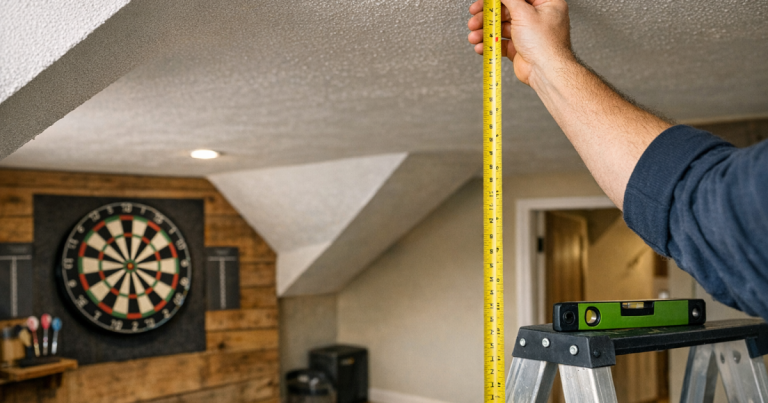
The critical measurement is the distance from the face of the dartboard to the oche. Because the board has depth, do not measure from the skirting board or plaster wall and assume that is accurate. Once mounted, the front playing surface sits slightly forward of the wall, and the 2.37 m steel-tip distance should be taken from that face.
In practice, you will usually want at least 3 m of usable room length. That gives you the official throw distance plus a little breathing room behind the oche. More space is useful if two players will stand near the line, if a chair remains in the room, or if the door opens into the throwing area.
Step 2: Pick the board position around flow, not just wall space
A dartboard wall should feel natural when you walk into the room. Avoid placing the board where someone entering the room steps directly into the throwing lane. If the bedroom door opens near the oche, position the board so the thrower has clear sight of the doorway and no one is likely to walk across the lane unnoticed.
Check the wall height as well as the width. You need the bullseye at 1.73 m, with room above and around the board for a surround, cabinet or lighting ring if you use one. A sloping ceiling, picture rail or high shelf can make an otherwise good-looking wall awkward.
Built-in wardrobes can be a mixed blessing. They are useful for storage, but mirrored doors may catch glare or reflect movement. Sliding wardrobe doors also need enough room to open without interfering with darts, mats or scoring gear.
Step 3: Mark the oche accurately
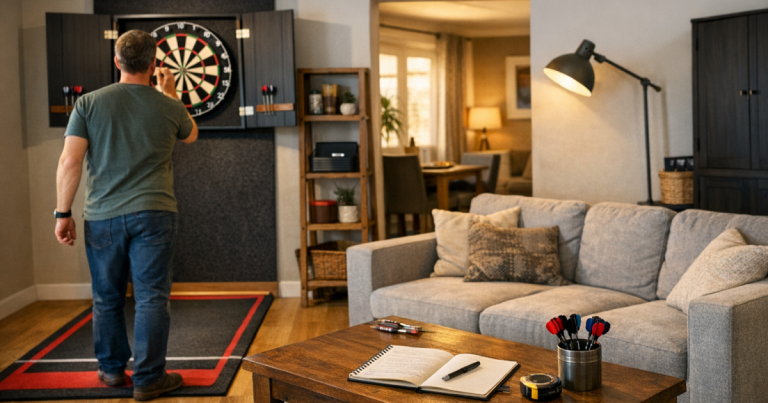
Once you have chosen the wall, mark the bullseye height lightly and confirm the throw line. If you are not ready to fit the board yet, use masking tape and a tape measure to simulate the layout. Stand at the proposed oche and go through a normal throwing action. You are checking whether your elbow, follow-through, rear foot and line of sight all feel natural.
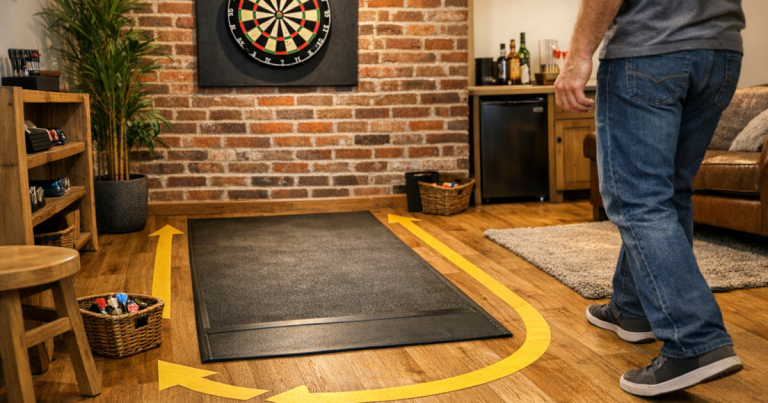
For steel-tip darts, measure 2.37 m horizontally from the board face to the oche. If you prefer a diagonal check after the board is mounted, the distance from the bullseye to the oche should be about 2.93 m. The horizontal measurement is normally the more useful planning figure because it shows how the room will actually function.
A mat can make the line obvious and protect flooring, but it should sit flat and stay aligned. Thick rugs, curling edges and loose offcuts are irritating at best and a trip risk at worst. For more detail on getting this part right, the guide to a good darts mat and oche setup explains the practical details that make the throw line feel consistent.
Step 4: Decide what furniture stays
Most spare bedrooms have to compromise. The room might still need to hold a guest bed, home office desk, clothes storage or ironing board. The trick is to divide the room into three zones: board wall, throwing lane and secondary use.
The throwing lane should be the clearest part of the room. Avoid placing a bed, chair or desk where someone has to lean around it to throw. If a bed must stay, a daybed, sofa bed or foldaway frame can work better than a full double bed because it keeps more floor free when the room is being used for darts.
A desk can sit behind or to the side of the oche if it does not crowd the thrower. However, avoid putting screens, glassware or fragile items anywhere near the board wall. Even decent home players miss occasionally, and visitors miss more often than they expect.
Step 5: Protect the wall without making the room feel makeshift
Wall protection is what separates a usable practice room from a bedroom with a dartboard temporarily attached. A proper surround, cabinet, cork area or backing panel helps absorb stray darts and reduces the chance of damaged plaster, wallpaper or painted surfaces.
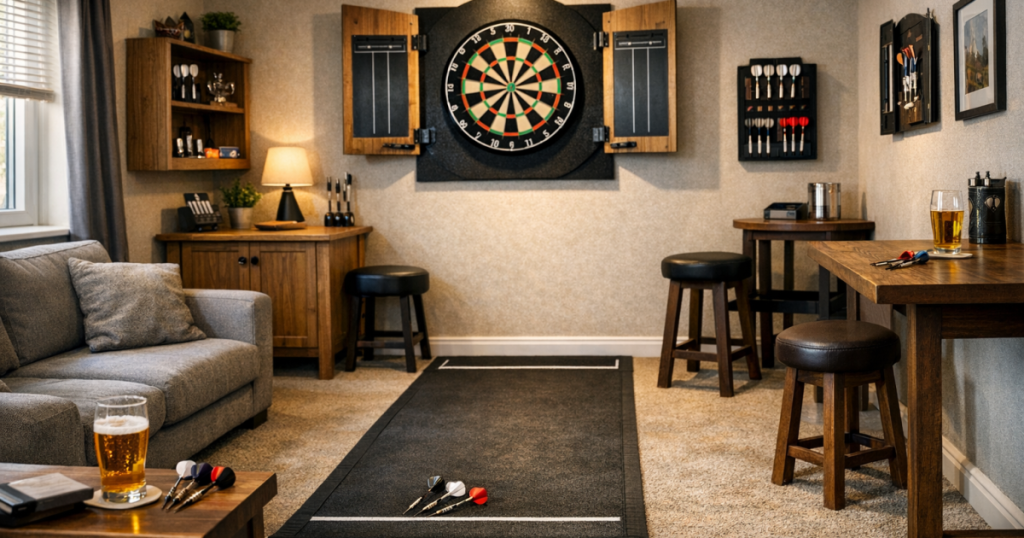
The neatest option is usually a dartboard surround or cabinet, depending on the look you want. A surround is simple and compact, while a cabinet gives you doors, a more traditional pub-style feel and sometimes space for small accessories. If the room still needs to look presentable for guests, a closed cabinet can hide the board quickly.
If you are planning a more permanent setup, think about the full miss zone. Newer players may miss well outside the treble ring, and group games can bring a wider spread of throws. A larger backing board can look tidy if it is cut square, painted to match the room or framed cleanly. The explanation of dartboard cabinets and surrounds for home players is useful if you are deciding how visible or discreet you want the board area to be.
Step 6: Sort the floor before it gets marked
Spare bedrooms often have carpet, laminate or engineered wood. Carpet is forgiving underfoot but can hide bounce-outs, especially with dark flights or points. Hard flooring is easier to sweep and spot darts on, but it is more likely to show point marks if darts land sharply.
A darts mat is the simplest fix because it protects the standing area and gives a clear oche. If the room has a high-pile carpet, check that the mat does not rock or creep as you throw. On smooth flooring, a mat with good grip underneath is more important than thickness.
Keep the space between board and oche free from loose storage boxes, laundry baskets and trailing cables. It sounds obvious, but spare bedrooms attract overflow clutter. A good darts room works because it remains playable without a ten-minute tidy-up every time you want to practise.
Step 7: Get the lighting right for the board
Bedroom lighting is often designed for relaxing, not for reading a dartboard clearly. A single ceiling pendant can cast a shadow from your arm or the dartboard wire. Bedside lamps create uneven light, and bright windows can cause glare during the day.
The board needs even light across the segments, with minimal shadow and no dazzling light in the thrower’s eyes. If you can, test the room at the times you normally play. A north-facing room, a room with a streetlamp outside, and a sunny loft-style spare room will all behave differently.
Plug-in lamps, clip lights and purpose-made board lights can all help, but cable routing matters. Keep leads away from the oche and avoid creating a trip line across the room. If you are struggling with dark wedges or odd shadows, the detailed guide to dartboard shadows and lighting setups goes deeper into positioning and common fixes.
Step 8: Plan scoring, seating and small storage
A darts room becomes much easier to use when everything has a place. Scoring can be as simple as a dry-wipe board, chalkboard or notepad placed to the side of the dartboard. Put it where players can update scores without stepping into the throw line or standing directly under the board.
Storage does not need to be elaborate. A small shelf, drawer or cabinet section can hold spare flights, shafts, points, chalk, a cloth and a measuring tape. If the room is shared with guests, choose storage that closes rather than leaving darts and accessories scattered on a desk.
Seating depends on room size. One chair outside the throwing lane is useful for longer practice sessions or friendly matches. Avoid chairs that naturally drift into the oche area. If there is no room for permanent seating, a folding chair stored behind the door may be enough.
Step 9: Reduce noise through the room, not just at the board
Spare bedrooms are often upstairs, next to another bedroom or above a living room. That makes noise worth thinking about from the start. The sound is not only darts hitting the board; footsteps, retrieving darts, chair movement and dropped darts all travel through floors and walls.
A solidly mounted board, a decent backing surface and a mat on the floor can make the room feel less sharp and echoey. Soft furnishings help too. Curtains, a rug outside the oche area, a fabric chair or a bed left in the room can reduce harsh room reflections.
Do not mount the board on a thin partition wall if there is a better option. A wall shared with a neighbour in a flat or terrace can be more sensitive than an internal wall within your own home. If evening practice is the plan, test the noise with someone listening from the next room before you commit to the final position.
Step 10: Make the room easy to reset
The most practical darts rooms are the ones that are quick to return to order. If the spare bedroom has to become a guest room at short notice, plan a simple reset routine. Darts go into a case or drawer, the scoring board is wiped, the mat is rolled or left neatly in place, and any chair is moved back to its normal position.
If the room is purely for darts, the reset is about practice discipline. Keep the oche clear, rotate the board regularly, put damaged flights aside and avoid letting general household clutter creep into the space. A room that stays ready encourages shorter, more frequent practice sessions.
Common layout mistakes to avoid
- Measuring from the wall instead of the board face: this can make the oche slightly wrong once the board is fitted.
- Ignoring the door swing: a door opening into the throwing lane is frustrating and can be unsafe during games.
- Using the prettiest wall rather than the most practical one: clear length, stable lighting and low interruption matter more than symmetry.
- Leaving fragile furniture near the board: lamps, mirrors, glass frames and monitors should stay well outside the miss area.
- Forgetting guests: if the room still has a bedroom role, make the board area easy to cover, close or tidy.
- Relying on ceiling light alone: shadows across the board can make practice less enjoyable and scoring less clear.
Example room layouts
The box room practice setup
In a small single bedroom, the cleanest approach is usually to remove bulky furniture and keep the board on the longest uninterrupted wall. A narrow shelf or wall-mounted storage can replace a chest of drawers. Use a compact mat and keep the scoring area to one side. This style suits solo practice more than group nights.
The guest room hybrid
If a bed needs to stay, position it along a side wall rather than between the oche and board. A sofa bed or daybed gives more floor space when not in use. A cabinet can make the dartboard area look neater when visitors stay, and a rollable mat keeps the floor from feeling permanently taken over.
The home office and darts room
For a bedroom that doubles as an office, keep the desk behind the oche or along the non-board side wall. Avoid having the desk directly beside the board, where bounce-outs or stray darts could hit equipment. A closed drawer for accessories helps the room switch between work and practice without feeling cluttered.
Final checks before you fit everything permanently
Before drilling, sticking, screwing or rearranging the whole room, run a final rehearsal. Tape the bullseye height on the wall, mark the oche, stand in position and mimic a full visit. Then check what happens when someone opens the door, sits on the bed, walks to the wardrobe or reaches the scoring area.
Ask yourself whether the room works when it is slightly messy, not just when it is perfectly staged. Real spare bedrooms have laundry, guests, work bags and seasonal storage. If the darts setup only functions after moving three things out of the way, it will be used less often.
The big picture
A spare bedroom can make an excellent home darts space if the layout is planned around the throw rather than the furniture already in the room. Get the board height, oche distance, lighting and protection right first, then build the rest of the room around those fixed points.
The best spare bedroom darts room feels easy to use: the line is clear, the board is well lit, the wall is protected and the room can still serve its other purpose if needed. That balance is what turns an underused bedroom into a practical practice area rather than a novelty setup that slowly disappears behind clutter.