Picking the right wall is one of the biggest decisions in a home darts setup, and it is worth checking before you make any holes. A good dartboard wall gives you the correct throwing space, safer clearance, better visibility and fewer problems with noise or damage.
The aim is not just to find an empty patch of plaster. You need a wall that works with the room, the way people move through it, and the type of board setup you plan to use.
What to know first
The right wall should let you stand at the proper distance, throw without feeling cramped, retrieve darts safely, and protect the surfaces around the board. In most homes, the strongest candidates are plain internal walls in spare rooms, garages, studies, utility spaces or larger hallways where foot traffic is predictable.
- Allow enough straight-line space from the board face to the oche.
- Keep the throwing lane clear of doors, sofas, stairs and walkways.
- Check that the board can sit at the correct height without clashing with shelves, sockets or radiators.
- Think about noise if the wall is shared with a neighbour, bedroom or living room.
- Plan wall and floor protection before regular play starts.
If you are still measuring the full lane, use our guide to setting out your darts throwing area and oche alongside the wall checks below.
Step 1: Confirm the throwing distance before judging the wall
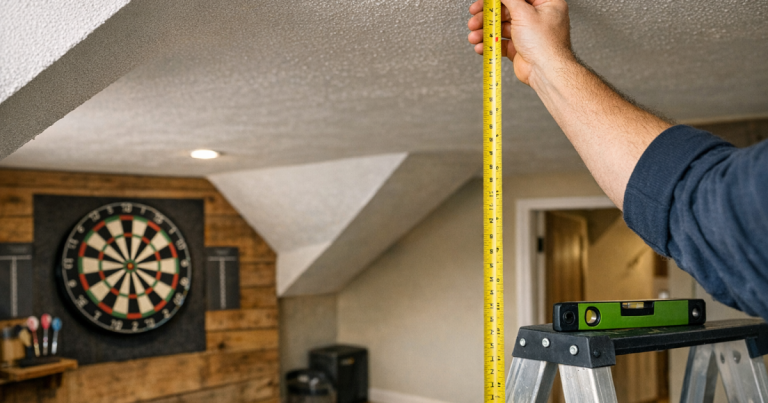
A wall can look perfect until you measure the lane. For a standard steel-tip setup, the bullseye is usually set 1.73 m from the floor, and the oche is 2.37 m from the face of the board. Measure from where the front of the board will be, not from the wall surface, because a cabinet, bracket or backboard can move the board forward slightly.
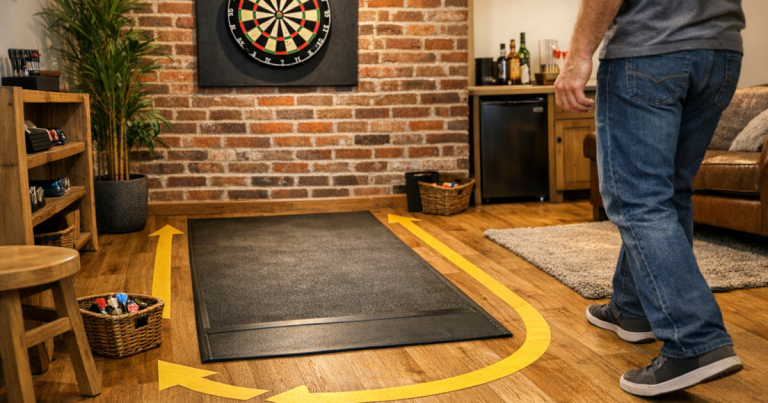
Stand where the oche would go and make a few slow practice motions without a dart. Your arm should have room to move naturally, and there should be no furniture within easy reach of your follow-through. Then walk from the oche to the board as if retrieving darts. If you have to squeeze around a table, step over storage boxes or cross a doorway every visit, the setup will become annoying quickly.
Step 2: Check side clearance and the shape of the room
The best dartboard wall is not always the widest one. What matters is how the surrounding space behaves while people are playing. Ideally, leave clear space on both sides of the board so missed darts are less likely to hit picture frames, light switches or narrow corners.
Avoid walls where the board would sit directly beside a doorway. Someone stepping through while a dart is being thrown is the main room-planning problem to remove. Also be cautious with walls at the end of narrow corridors. They may give enough measured distance, but they often feel cramped and make it harder for other people to pass safely.
In smaller UK homes, a spare bedroom wall can work well if the bed or desk does not sit in the throwing lane. Garages and garden rooms can be excellent, but check lighting, dampness and whether the floor is level enough for a stable stance.
Step 3: Choose a wall that can handle misses
Even tidy throwers miss the board. Beginners, visitors and children under supervision will miss more often. Bare plasterboard, painted walls and wallpaper can mark quickly, so think about the wider impact zone rather than only the board itself.
A surround, cabinet, backboard or larger protective panel can make a marginal wall much more workable. The area below the board matters too, because darts can drop or bounce out. If you are setting up in a decorated room, protect the skirting, floor and lower wall before the first proper session rather than after the first visible marks appear.
For a fuller damage-prevention plan, see our guide on how to protect floors and walls around a dartboard.
Step 4: Think about noise through the wall
Darts are not just visually intrusive; they can be noisy. The repeated thud of darts landing in the board can travel through light internal walls, especially in terraced houses, flats and rooms next to bedrooms. If the wall backs onto a neighbour, a nursery, a home office or a shared living area, test the sound before committing to it.
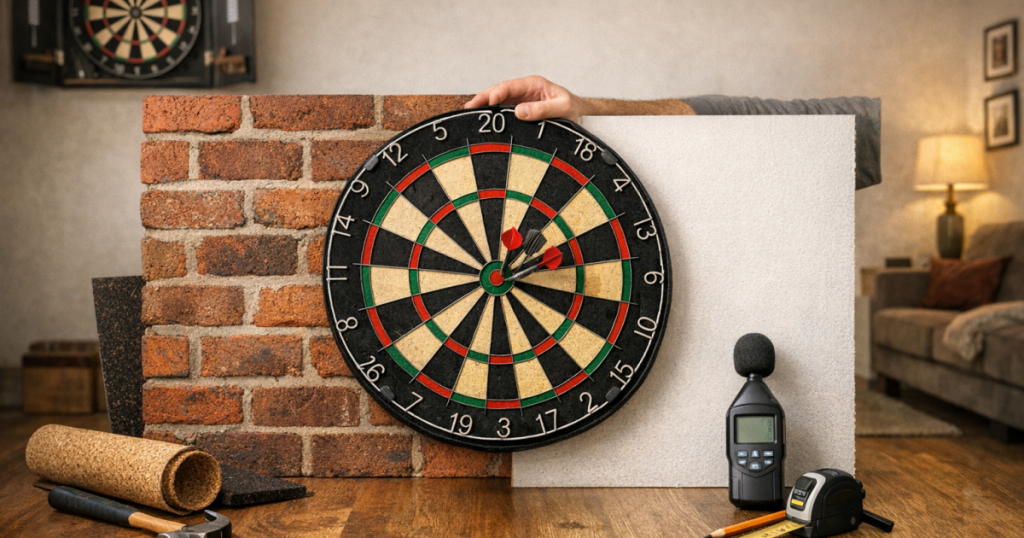
Ask someone to stand in the next room while you tap the proposed board position with your knuckles or press a board against the wall and throw a few gentle practice darts if you can do so safely. You are listening for vibration, not just volume. A wall that sounds hollow and resonant may be more irritating than a solid wall that absorbs the impact better.
If noise is likely to be an issue, consider a different wall, a more isolated room, or extra backing behind the board. Avoid mounting directly onto thin partition walls where quiet play is a priority.
Step 5: Look for lighting, glare and sightlines
The board should be easy to see from the oche without shadows across the trebles or glare in your eyes. A wall opposite a bright window can cause problems at certain times of day, while a wall beside a window may put one side of the board in shadow.
Before you fix anything, stand at the oche position in morning, afternoon and evening light if possible. Check whether ceiling lights cast your throwing arm shadow across the board. Also look at where a scoreboard, chalkboard or tablet stand might go, because the scoring area should be readable without players stepping into the thrower’s space.
If the best wall has awkward light, the answer may be a small layout adjustment rather than a new room. Shifting the board along the same wall by 20 cm to 30 cm can sometimes avoid a shadow line, a door swing or a reflective picture frame.
Step 6: Avoid heat, damp and awkward fixtures
Keep the board away from radiators, damp external corners, open windows and areas that collect condensation. Sisal boards and steel-tip darts do not benefit from moisture, and a board placed in a cold, damp garage corner may age faster than one in a dry internal room.
Also look for sockets, pipe boxing, shelving, wall lights and picture rails. You do not want the board so close to a socket that a missed dart could hit it, and you do not want shelves where darts may ricochet unpredictably. If a wall has a radiator below it, consider whether dropped darts could land behind it or whether the heat will be too close to the board.
Step 7: Decide whether drilling is realistic
Homeowners often have more freedom to use a wall bracket, cabinet or backboard. Renters need to think differently. A wall might be perfect for space and visibility, but unsuitable if the tenancy does not allow fixings or if the surface is likely to be expensive to repair.
Renter-friendly setups may use a freestanding stand, a door-based solution designed for dartboards, or a removable arrangement that spreads weight safely without relying on permanent fixings. The key is stability: the board should not sway, lean or move when darts land.
If drilling is not an option, read our advice on creating a no-drill dartboard setup for renters before choosing the final position.
Step 8: Test the wall with a temporary layout
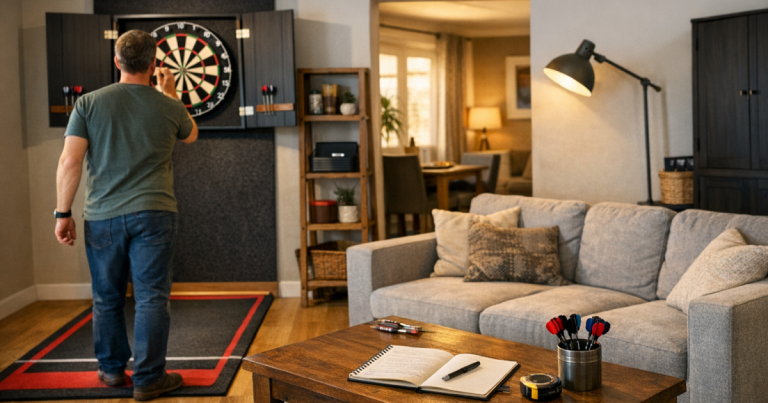
Before committing, mark the bullseye height with low-tack masking tape and mark the oche with another strip on the floor. Stand in position, mime throws, walk to the board and check how the room feels. Open doors, pull out chairs and move as people normally would in the space.
This temporary test often exposes problems that measurements miss. A door may clear the oche but still feel too close. A cupboard may block dart retrieval. A ceiling light may shine directly onto the board. It is much easier to adjust tape than to move a fixed board later.
Good wall choices in common UK homes
Spare bedroom
Often a strong choice because it is dry, quiet and easy to control. The main checks are whether furniture intrudes into the lane and whether the wall backs onto another bedroom.
Garage
Useful for space and casual play, but check damp, cold surfaces, uneven floors and lighting. Store darts properly if the room is not heated regularly.
Living room
Convenient, but usually harder to protect and more disruptive. It works best when the board can be hidden in a cabinet or placed away from main seating and walkways.
Hallway or landing
Only suitable when traffic is very low and the lane is genuinely clear. Many hallways measure long enough but are poor choices because people naturally walk through them.
Common questions
Can I put a dartboard on a plasterboard wall?
Yes, but plan the fixing and protection carefully. Use appropriate wall fixings for the load, consider a backing board, and make sure missed darts will not quickly damage the surrounding surface.
Is an external wall better than an internal wall?
Not automatically. External walls can be more solid, but they may also be colder or more prone to condensation. A dry, quiet internal wall with enough space is often the better choice.
How much space do I need beside the board?
There is no single side-clearance rule for every room, but aim for enough protected space that common misses will not hit doors, switches, shelves or picture frames. More clearance is better for beginners.
Should the board go in the centre of the wall?
Only if that gives the best lane. It is fine to place the board off-centre if it improves door clearance, lighting, sound or protection, as long as the throwing line stays straight and comfortable.
What if the only suitable wall is shared with a neighbour?
Test the noise first and avoid late play if impact sound carries. A different wall, extra backing or a quieter room is usually better than relying on goodwill once the board is fixed.
Why it matters
The right wall makes home darts easier to enjoy and easier to live with. You get a straighter throw, fewer distractions, less damage and a setup that other people in the house are less likely to resent.
Measure the lane, check the room flow, protect the impact area and think about noise before you fix the board. A careful ten-minute wall check can save you from moving the whole setup later.