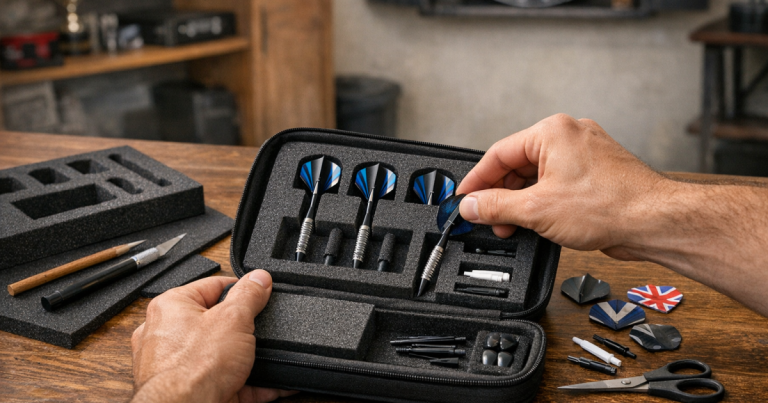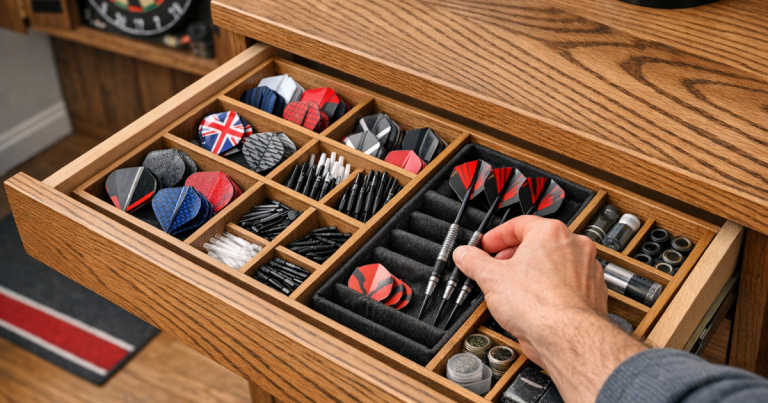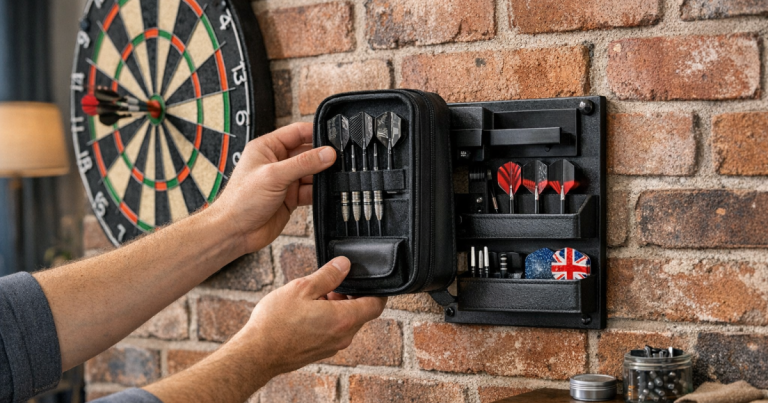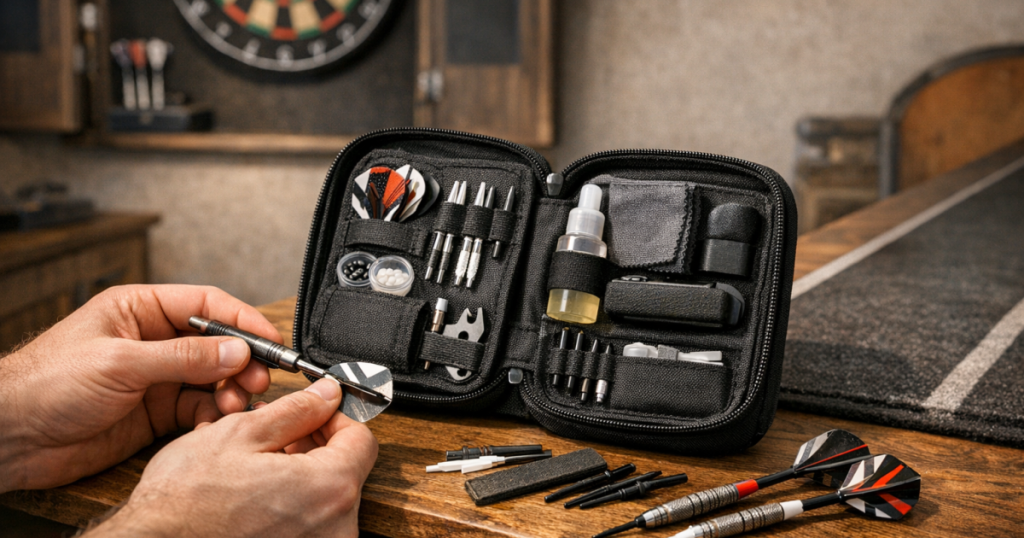
A dart maintenance kit keeps the small fixes close to hand: spare flights, shafts, tips, cleaning cloths and the few tools that stop a home match grinding to a halt. The trick is not to pack everything you own, but to build a compact pouch that follows you from the board to the garage, spare room or mate’s house.
Think of it as the darts version of a puncture repair pouch. It should be small enough to grab quickly, tidy enough to use mid-leg, and specific enough for the darts you actually throw.
The quick setup
- Use a small zipped pouch, tackle box insert or organiser case with separate compartments.
- Pack spares for the parts that fail most often: flights, shafts, soft tips or steel-tip point care items.
- Add a cloth, a small brush and grip-friendly cleaning bits for barrels and board area dust.
- Keep tools minimal: a flight punch, shaft removal aid, point tool only if your darts need one, and a compact sharpener for steel tips.
- Label or separate items so you can fix a dart without emptying the whole pouch onto the floor.
Build around the faults you actually get
The best grab-and-go kit starts with your real annoyances, not a long accessory list. If you play at home twice a week and the same flight keeps popping off, your kit needs flights and rings more than it needs obscure tools. If your garage board sees cold, dusty conditions, cleaning cloths and spare stems may matter more than decorative accessories.
Spend a few sessions noting what interrupts play. Common problems include split flights, bent shafts, loose soft tips, blunt steel points, dust on barrels, lost O-rings, and a scoring pen that has vanished when guests arrive. Those small delays are exactly what the pouch is there to solve.
Choose a container you will actually use
A maintenance pouch should be compact, visible and easy to open with one hand. A soft zipped case works well if it lives in a drawer or cabinet. A small compartment box is better if you like to see everything at once. For a garage or utility-room setup, avoid flimsy cardboard boxes because they pick up damp and split quickly.
A useful size is roughly the footprint of a paperback book, with enough depth for shafts and tools. If the kit is too large, it becomes another storage box; if it is too small, you end up cramming everything together and breaking flights before they reach the board.
Good container choices
- A small fishing tackle organiser for flights, rings and tips.
- A zipped darts wallet if you mainly need spares for one set.
- A pencil case-style pouch for a lightweight kit kept near the oche.
- A clear-lid organiser if several people use the same home setup.
Pack flights and shaft spares first
Flights and shafts are the parts most likely to interrupt a casual session. Keep at least two matching sets of flights and one full set of shafts for each regular dart setup in the house. If you rotate between standard, slim and shaped flights, separate them so you do not waste time rummaging.
A flight punch can make the kit more reliable if you use punched flights with rings or springs. Something like the Harrows Flight Punch is a recognisable example, but the important point is compatibility with the flight system you already use. If you are unsure how stem length, flight shape and dart behaviour work together, the guide to choosing dart shafts and flights for your throw is a useful next read.
Add point care without overloading the pouch
Steel-tip players should include a compact point sharpener or conditioning stone. You are not trying to make the point needle-sharp; you are trying to remove burrs and keep enough grip for the board. Over-sharpening can damage sisal more quickly, so use light, controlled passes and check the point by feel rather than grinding away at it.
A small dedicated sharpener such as a Winmau Dart Sharpener is easy to keep in a pouch. If you use a replaceable-point system, pack the correct tool for that system and keep it separate from general accessories. For example, the Target Swiss Point Tool is only relevant to compatible Target Swiss Point darts, so verify your darts before adding one.
Soft-tip players need a different setup. Keep spare soft tips in a small screw-top pot or labelled compartment, and remove bent or heavily worn tips rather than trying to rescue them indefinitely. If bounce-outs are your main issue, storage alone will not solve it; board condition, tip fit and throw angle all matter. The guide on how to stop soft-tip darts bouncing off electronic boards explains those checks in more detail.
Include simple cleaning and grip items
Barrels collect skin oils, chalk, dust and general handling grime. Add a microfibre cloth and a small soft brush, such as a clean toothbrush kept only for darts. For deeper cleaning, keep the process away from the board area so liquids do not end up on the floor, cabinet or sisal.
Dry cleaning is enough for most quick fixes. Wipe the barrels, brush the grooves gently, dry them fully and return them to the case. If you use grip wax, chalk or rosin, pack it in its own sealed bag so it does not coat flights and shafts. A kit that makes everything sticky is not doing its job.
Do not forget scoring and setup accessories
A grab-and-go pouch is not only for the darts themselves. Add a spare whiteboard marker, a small cloth, chalk if you use a chalkboard, and a couple of spare O-rings for accessories that tend to loosen. If your scoreboard is wall-mounted, keep the cleaning bits nearby rather than rubbing it with whatever cloth happens to be on the floor.
For renters or anyone avoiding holes in plaster, a removable scoring setup can work well alongside your maintenance kit. If that is your situation, see the guide to mounting a magnetic darts scoreboard without wall damage.
Decide what does not belong in the dart maintenance kit
The pouch should not become a dumping ground for every spare part you own. Keep heavy tools, wall fixings, spare surrounds, cabinet hardware and full dart collections somewhere else. Those belong in your main storage area, not in the quick-fix kit you reach for between throws.
Also avoid mixing sharp steel points loosely with flights, as they can puncture packaging and damage spares. If you carry spare points, keep them in a rigid tube or original container. The same goes for small screws, washers or magnets: if they are useful but tiny, they need a closed compartment.
Set a monthly reset routine
The kit only works if it is restocked. Once a month, open it and check what has been used. Replace missing flights, bin cracked shafts, remove blunt soft tips and clean out dust. If several people play at home, agree that the person who uses the last matching set of flights replaces it or moves a spare set from your main storage.
It helps to keep a small card inside the pouch with a simple checklist: flights, shafts, tips, rings, cloth, marker, sharpener. That makes it obvious what is missing before guests arrive or before you pack the darts for a league night or family visit.
Where to keep it
The ideal home for the pouch is close to the board but not in the firing line. A cabinet shelf, side table, drawer or wall storage station all work. Avoid leaving it on the floor near the oche, where it can be kicked, stepped on or mistaken for general clutter.
If your darts area already has a cabinet, the pouch can sit inside it, provided it does not press against the board or crowd the darts. For a more organised setup, a dedicated wall station gives you space for darts, spares, markers and cleaning gear in one predictable place. The step-by-step guide to building a wall storage station for darts gear is a good fit if your accessories are spreading across shelves and windowsills.
Helpful questions
How many spare flights should I keep in the kit?
Two matching sets is enough for most home setups. If several players use different shapes, keep one spare set per regular player and store bulk spares elsewhere.
Should steel-tip and soft-tip gear go in the same pouch?
They can, but separate them clearly. Steel point care, soft tips and electronic board accessories should each have their own compartment to avoid confusion during play.
Can I use a normal household toolbox?
For main storage, yes. For a grab-and-go darts kit, a toolbox is usually too bulky. A small organiser is quicker, lighter and less likely to collect unrelated clutter.
What should I remove from the kit first if space is tight?
Remove duplicate tools, decorative accessories and bulk packets. Keep the items that fix actual stoppages: flights, shafts, tips, cleaning cloth and the one or two tools your darts require.
In brief
A good dart maintenance kit is small, specific and easy to reset. Pack the spares that fail most often, add only the tools your darts genuinely need, and keep cleaning bits separate from flights and shafts. Store it near the board but out of the throw area, then check it monthly so it stays ready for the next session.