A magnetic darts scoreboard keeps the match moving without taking over the wall beside your board. The trick is to give the magnets a reliable surface, position it where players can write comfortably, and use fixings that release cleanly when the setup changes.
For most home darts rooms, the best no-damage route is either removable picture-hanging strips on the board itself or a removable steel backing plate that the scoreboard can cling to. The right answer depends on your wall finish, the scoreboard weight, and how often you want to move it.
The short version
- Magnets need a suitable metal surface; they will not grip painted plaster, wallpaper, timber or most standard plasterboard.
- Use removable picture-hanging strips if the board has a flat, rigid back and you do not need to detach it regularly.
- Use a removable steel backing plate if you want the score surface to lift off between games.
- Avoid wallpaper, flaking paint, dusty plaster, textured walls and freshly painted surfaces unless the fixing manufacturer says they are suitable.
- Test the position with paper first so the scoreboard is visible from the oche but not in the likely dart impact area.
Work out what type of magnetic setup you actually have
Before sticking anything to the wall, check how the scoreboard is meant to hold. There are two common arrangements in home darts setups.
The first is a magnetic dry-wipe board: the board itself is usually a steel writing surface, so small magnets can hold pens, erasers or score markers on it. That does not mean the whole board will magically stick to a normal wall. You still need a mounting method.
The second is a flexible magnetic score sheet or magnetic-backed panel. This needs a ferrous metal surface behind it. A thin aluminium sheet will not do the job, and some stainless finishes are not magnetic enough either. A simple steel backing plate is usually the more dependable route, provided it can be mounted safely without overloading the adhesive fixings.
Pick the least damaging mounting method
Method 1: removable strips on the scoreboard
This is the neatest method when the scoreboard has a rigid back, a frame, or a flat mounting area. Clean the back of the board and the wall surface, let both dry, then apply removable picture-hanging strips exactly as the pack instructs. Press the board into place evenly rather than pushing hard on one corner.
This approach works best on smooth, sound painted walls. It is less suitable on wallpaper, uneven plaster, dusty matt paint, textured paint or any surface where the top layer already feels loose. Removable does not mean risk-free: old paint can lift if it is poorly bonded, so a hidden test patch is worth doing if the finish matters.
Method 2: a removable steel backing plate
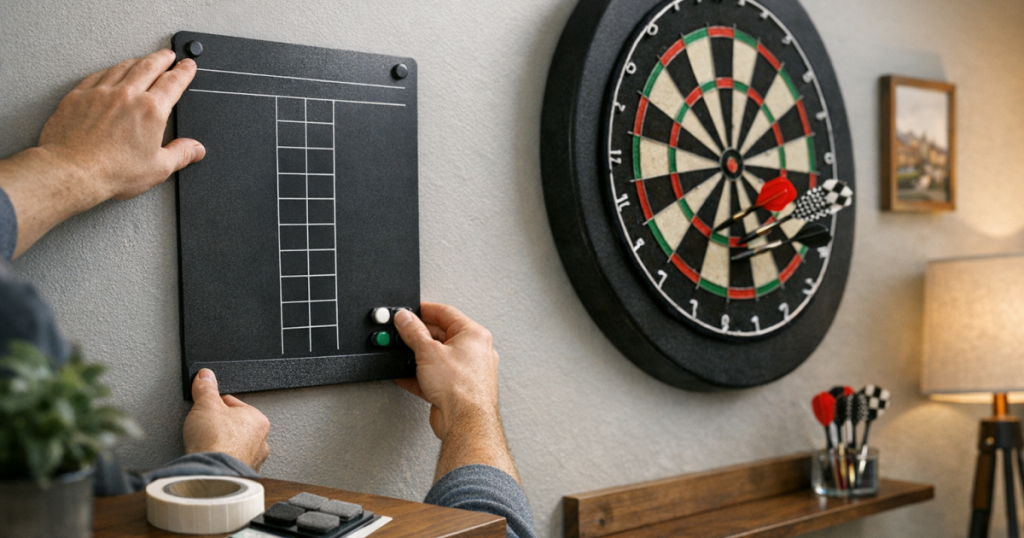
If the score sheet relies on magnets, mount a thin steel plate first, then place the scoreboard onto the plate. The backing plate should be flat, clean and large enough to support the magnetic area without leaving edges curling away.
Attach the steel plate using removable strips rated for the combined load of the plate, the scoreboard, pens and any accessories. Do not guess from appearance alone; weigh the pieces or check the product information, then follow the fixing manufacturer’s guidance. Spread the strips evenly so the plate does not peel from one side when the board is pulled away.
This is often the most flexible way to mount a magnetic darts scoreboard in a rented room or shared family space, because the writing surface can come down between games while the low-profile backing stays in place.
Method 3: use furniture instead of the wall
If the wall finish is too delicate, skip wall mounting altogether. A metal filing cabinet, freestanding metal noticeboard, side of a suitable shelving unit, or a stable darts storage station can hold a magnetic score surface without touching the wall paint. Just make sure the surface is not in the path of stray darts and will not wobble when someone writes on it.
If you are rethinking the whole corner around the board, a dedicated storage area can keep pens, spare flights, chalk and cloths together. The ideas in building a wall storage station for darts gear are useful if you want the scoring area to feel organised rather than added as an afterthought.
Find the right position before anything sticks
Scoreboard placement is more important than it first looks. Too close to the dartboard and it can get peppered by loose darts. Too far away and players drift across the throwing lane to write scores. Too low and you end up leaning on the board, which puts extra pressure on the adhesive fixings.
Use a paper template cut to the scoreboard size and tape it lightly in a few possible positions. Stand at the oche, check whether the scores are readable, then walk to the board as if you were marking after a visit. The most comfortable position is usually to one side of the dartboard, outside the throw line, with the writing area around chest to eye height for the people who use it most.
Leave enough space for the marker’s hand and elbow, especially in narrow alcoves, garages and spare rooms. If your darts area already feels tight, sort the layout before adding more kit; fixing a darts setup that feels too cramped will help you spot the usual pinch points around the oche, cabinet and side wall.
Prepare the surface properly
Most no-damage failures come from poor surface preparation or asking adhesive strips to do more than they are designed for. Take a few minutes here and the scoreboard is far less likely to shift during a match.
- Wipe away dust, chalk, grease and dry-wipe residue from the wall area and the back of the board or steel plate.
- Let the surface dry fully before applying strips; moisture weakens adhesion.
- Avoid mounting on new paint until it has properly cured according to the paint manufacturer’s instructions.
- Check that the wall is flat enough for the strips to make full contact.
- Do not bridge gaps, ridges or raised wallpaper seams with adhesive strips.
- Keep pens and erasers separate if their extra weight makes the mounted board feel marginal.
When using removable strips, follow the pack instructions on pressing time, waiting time and removal method. Different products vary, so the safest rule is not to improvise. Pull-release strips, for example, are designed to be removed in a particular direction; yanking the board away from the wall is how paint gets damaged.
Mount it step by step
1. Mark the top edge lightly
Once the paper template is in the right place, mark the top corners with low-tack tape rather than pencil if you want to avoid marks. Use a small spirit level if the scoreboard has a straight edge; a board that slopes even slightly can make the whole setup look untidy.
2. Apply the strips to the board or backing plate
Put the strips on the flattest, strongest areas. For a framed board, that is usually the frame rather than a thin flexible centre panel. For a steel backing plate, use enough contact points to stop flexing, but stay within the fixing instructions.
3. Offer it up once, then commit
Line up with the tape marks, press evenly and avoid sliding the board around on the wall. Sliding can smear adhesive or mark paint. If the placement is wrong, remove it as instructed and start again with fresh strips rather than reusing weakened adhesive.
4. Test gently before match night
Do not load the board with pens and accessories straight away unless the fixing instructions allow it. When it is ready, test by writing normally, not by pushing hard. If the board flexes, creaks or pulls away at a corner, take it down and reduce the load or switch to a freestanding option.
Stop the wall getting marked during use
Even when the mount itself is wall-safe, the way the scoreboard is used can still leave marks. Dry-wipe pens roll, erasers get dropped, and players sometimes lean into the board while counting under pressure.
- Use a pen holder attached to the board rather than sticking loose clips to the painted wall.
- Keep a small cloth or eraser on the board so people do not wipe scores with their hands.
- Place the board where players can stand square-on to write, rather than reaching across the dartboard.
- Remove the scoreboard between sessions if children use the room or if the area doubles as a hallway or family space.
- Check the strips occasionally, especially after changes in room temperature or humidity.
If young children can reach the darts area between games, the scoreboard is only one part of the tidy-up. The steps in childproofing a dartboard area between games are worth pairing with any removable scoring setup.
When a wall-mounted scoreboard is not the neatest answer
No-damage mounting is not always the right answer. If the wall is wallpapered, freshly decorated, damp, chalky or uneven, removable strips may be more trouble than they are worth. A freestanding board, cabinet-mounted score panel or converted whiteboard can be cleaner.
A spare whiteboard is particularly useful in garages and multi-use rooms because it can be moved, wiped quickly and stored away. If that sounds closer to your setup, see how to convert a whiteboard into a darts scoreboard without making the scoring area feel temporary.
Helpful questions
Will magnets stick directly to plasterboard?
No. Standard plasterboard is not magnetic. You need a ferrous metal surface, such as a suitable steel plate, or you need to mount the scoreboard itself with removable strips.
Can removable strips damage paint?
They can, particularly on weak, old, dusty or freshly painted surfaces. Use them only on suitable smooth finishes, follow the instructions, and remove them slowly in the correct direction.
Where should the scoreboard sit in relation to the dartboard?
Put it to one side, readable from the oche and easy to reach without stepping into another player’s throw. Keep it away from the most likely path of stray darts.
Is a steel backing plate better than sticking the board straight to the wall?
It depends on the board. A steel plate is useful for magnetic sheets you want to remove, while direct adhesive mounting suits rigid boards that stay in place.
What if the scoreboard keeps sliding or peeling?
Take it down rather than adding random tape. Reduce the weight, clean the surfaces again, use fresh suitable strips, or switch to a freestanding scoring surface.
The big picture
A clean no-damage scoreboard setup comes down to three checks: the magnets need the right surface, the wall finish must suit removable fixings, and the position has to work during real play. Get those right and your scoring area will feel like part of the darts setup, not a temporary note stuck beside the board.