Crushed flights are one of those small darts annoyances that can quietly ruin a decent throw. Good dart flights storage keeps each set flat, separated and easy to grab, whether you play in a spare room, garage or take your darts out for league night.
The aim is simple: stop pressure, moisture and loose points from bending the wings before you even reach the oche.
The quick answer
To stop flights getting crushed, store them in small groups, keep them away from loose barrels and points, and avoid piling heavy items on top of them. The safest routine is to keep match darts in a fitted case, spare sets in a divided box or flight holder, and damaged flights separate so they do not get mixed back into your playing kit.
- Keep each set of three together so you can spot damage quickly.
- Do not leave loose flights at the bottom of a darts case.
- Use dividers, small boxes or flight protectors to prevent pressure on the wings.
- Store spares away from damp walls, garage floors and direct heat.
- Check flights before and after league nights, not only when one looks obviously bent.
Why flights get flattened in the first place
Most crushed flights are not damaged during play. They usually suffer in pockets, drawers, overfilled cases or mixed accessory tubs. A flight is light and flexible, which is exactly why it stabilises the dart in the air, but that also means it bends easily when pressed under barrels, stems, tools or a folded mat.
Standard fold-out flights are particularly vulnerable when they are stored open but unsupported. Moulded flights hold their shape better, but they can still warp if they are forced into a tight compartment or pressed sideways for long periods. Even a small crease can make one dart sit differently from the other two, which is frustrating when you are trying to keep your grouping consistent.
Once your basic system is in place, dart flights storage becomes less about having a fancy organiser and more about having a repeatable routine: separate, protect, check, replace.
Step 1: sort your flights before you store them
Start by tipping out your spare flights onto a table and sorting them into three simple piles: match-ready, practice-only and damaged. This takes five minutes and immediately stops the worst habit: keeping a bent flight because it is mixed in with good ones.
- Match-ready: clean, flat and evenly opened, with no splits around the shaft slot.
- Practice-only: usable, but showing edge wear, light scuffs or slight softening.
- Damaged: creased, torn, curled, badly split or no longer sitting square on the shaft.
Do not keep damaged flights loose in the same box as good spares. They have a habit of finding their way back into your case just before a game. If you want to keep one as an emergency spare, mark it clearly or place it in a separate small bag.
Step 2: keep sets of three flat and separate
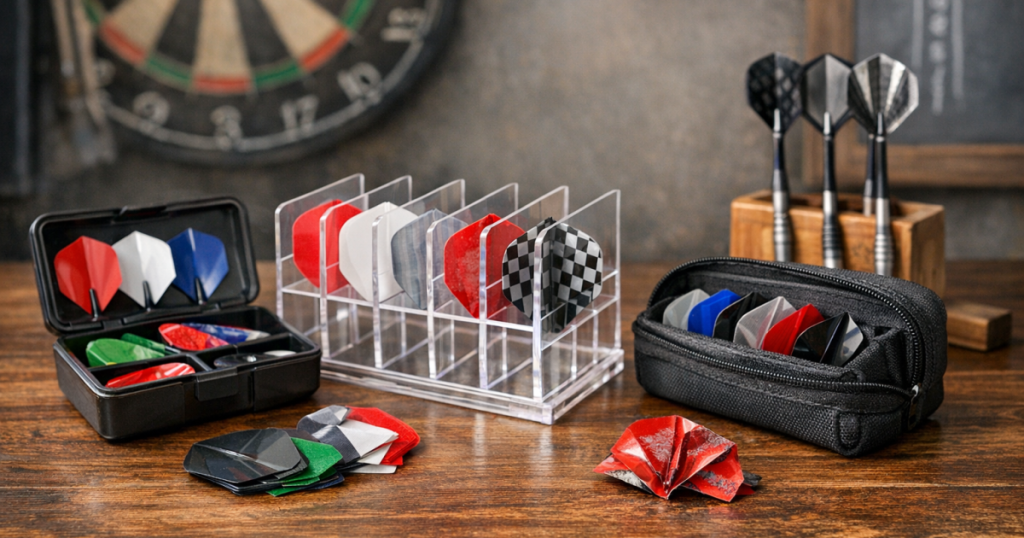
The easiest improvement is to stop storing flights as a loose pile. Keep each set of three together, ideally flat, in a shallow section of a case or a small compartment box. If you use several shapes, such as standard, kite or pear, give each shape its own section so the edges are not constantly rubbing together.
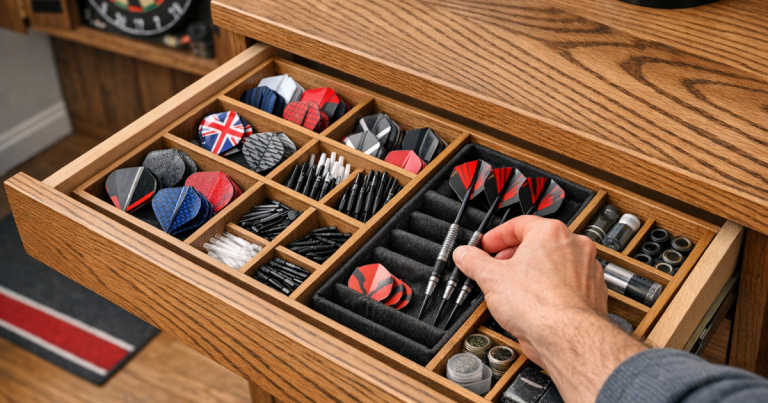
For home use, a small craft organiser, tackle-style compartment box or drawer insert can work well. The important part is not the label on the box; it is that the compartments are shallow enough that flights are not buried under other accessories. Avoid deep tubs unless you add smaller dividers inside them.
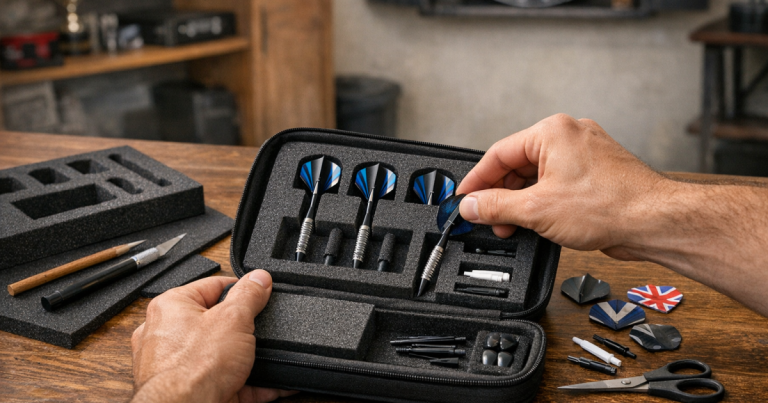
If you prefer dedicated darts gear, flight protectors and fitted dart wallets can help. Products such as Mission F-Protect Flight Protectors are examples of small accessories designed to protect the rear of a flight, while a case such as the Target Takoma Wallet shows the kind of fitted storage that keeps a complete set of darts from rattling around loose. Check the layout rather than assuming any case will suit your setup.
Step 3: stop points and barrels pressing into flights
The worst combination in any case is loose metal parts and unprotected flights. Barrels, points, repointing tools and spare stems can all press into the flight face or split the slot where the shaft fits. If you carry everything together, separate hard items from soft items.
A simple travel case layout works like this: assembled darts in the main fitted area, spare flights in a flat pocket or small protector, spare shafts in a separate tube or compartment, and tools in their own zipped or rigid section. If your current case has only one open pocket, use a small resealable bag or slim plastic box inside it so the flights do not sit directly against metal parts.
For a fuller match-night routine, use the packing principles in how to pack a dart case for league nights and apply the same separation rule to every accessory you carry.
Step 4: give home spares a fixed place
At home, flights often get damaged because they are stored wherever the last practice session ended: on the cabinet shelf, inside a chalk tray, beside the board, or in a garage drawer with screws and wall plugs. A fixed storage spot prevents that gradual build-up of clutter.
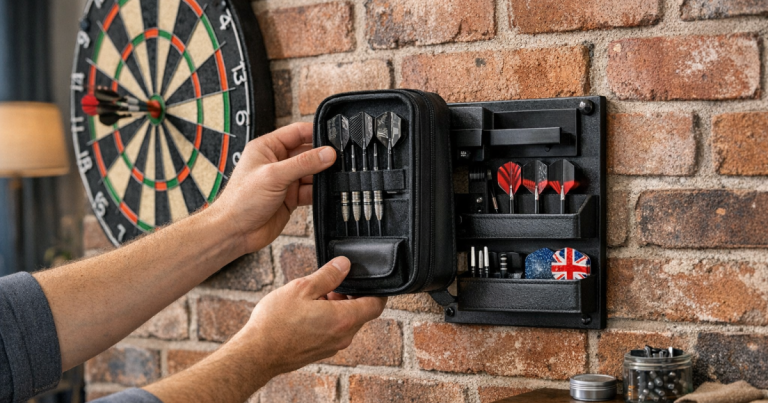
Keep your spare flights close enough to the board that you will use them, but not so close that they become part of the playing area mess. A drawer, small desktop organiser, cabinet shelf or labelled box works well. If your darts area doubles as a home office, utility space or garage corner, choose a lidded box to keep dust off the flights and stop them being knocked onto the floor.
It also helps to store flights by purpose. Keep your current preferred set at the front, alternatives behind it, and older practice flights in a clearly separate section. If you are already tidying shafts, points and spare accessories, the same logic in organising spare flights, shafts and points at home fits neatly with flight storage too.
Step 5: avoid damp, heat and compression
Flights do not need delicate treatment, but they do need sensible conditions. In UK homes, the common problem is not extreme heat; it is inconsistent storage. A garage darts setup, cold cupboard or damp utility room can leave accessories feeling slightly soft or grubby, especially if they are stored in open containers.
Keep flights off bare garage floors, away from leaking walls and out of direct sunlight on windowsills. If you store darts gear in a garage, use a lidded organiser and check it occasionally for condensation or dust. Do not wedge flight boxes under heavy items such as folded mats, toolboxes or board surrounds. Compression over time is what creates the awkward permanent bend that never quite opens square again.
Step 6: check flights before they go back in the case
A quick check after practice prevents damaged flights travelling with your good kit. Open each flight fully, look at it from above, and check that all four wings sit evenly. Then inspect the shaft slot. If the slot is split, the flight may wobble or fall off more often, even if the face looks fine.
For a set you use regularly, rotate flights out before they become a problem. That does not mean throwing them away after every session; it means promoting fresh sets to match use and moving worn sets to casual practice. This keeps your proper kit dependable without wasting flights that still have some life left.
Examples of storage routines that work
For a compact bedroom or spare-room setup
Use a small drawer insert or divided box on a shelf near the board. Keep one section for your current shape, one for alternative shapes, one for stems, and one for tools. If the board is near a desk or walkway, choose a lidded organiser so flights do not get knocked around while the room is being used for something else.
For a garage darts area
Use a lidded compartment box and keep it on a shelf rather than the floor. Store match flights inside the house if the garage gets cold or dusty. If your board area shares space with bikes, tools or laundry, build the storage into the same tidy plan you use for the oche and surrounding space. The layout advice in planning a garage darts area that stays usable is useful if accessories keep getting displaced.
For league nights
Carry fewer loose extras and protect the ones you do carry. One fitted case, one spare set of match flights, one practice set, a couple of shafts and a small tool are enough for most players. A case such as the Winmau Urban-Pro Dart Case is a recognisable example of a darts case style where the internal layout matters as much as the outside shell. Before using any case, check how securely it holds your assembled darts and where spare flights will sit.
Quick storage checks
- Can anything heavy press down on the flights? If yes, move them to a rigid or divided section.
- Are loose points or barrels sharing the same pocket? Separate them before they mark or split the flights.
- Are good and damaged flights mixed together? Sort them now so match-night spares are reliable.
- Are sets of three kept together? Keeping sets together makes it easier to spot odd wear or mismatched shapes.
- Is the storage spot dry and easy to reach? If it is awkward, you will eventually go back to dumping spares loose.
Helpful questions
Should I store flights on or off the darts?
If your case holds assembled darts securely, storing them on the darts is fine. If the darts rattle around or press against the lid, remove the flights and store them flat in a separate compartment.
Are moulded flights harder to crush?
They are generally more shape-stable than fold-out flights, but they can still warp if forced into a tight pocket or pressed sideways. Give them enough room rather than assuming they are indestructible.
Can I flatten a bent flight again?
Sometimes a lightly bent fold-out flight will open back up, but creases and curled edges usually affect consistency. Keep repaired or worn flights for practice rather than match play.
How many spare flights should I keep in my case?
For most home players and local league nights, one fresh spare set plus a practice set is enough. Keep the bigger stash at home so your case does not become overfilled.
Do flight protectors stop all damage?
No. They can help protect the rear of the flight and reduce some wear, but poor storage can still bend or crush the wings. Use them alongside sensible separation and case organisation.
What to remember
Preventing crushed flights is mostly about removing pressure points. Keep flights flat, grouped in sets, away from loose metal accessories and out of damp or cluttered storage areas. A tidy system also makes it easier to spot worn flights before they affect your throw.
You do not need an elaborate setup. One reliable case for travel, one divided organiser for home spares and a habit of checking flights after play will keep your darts kit neater and more dependable.