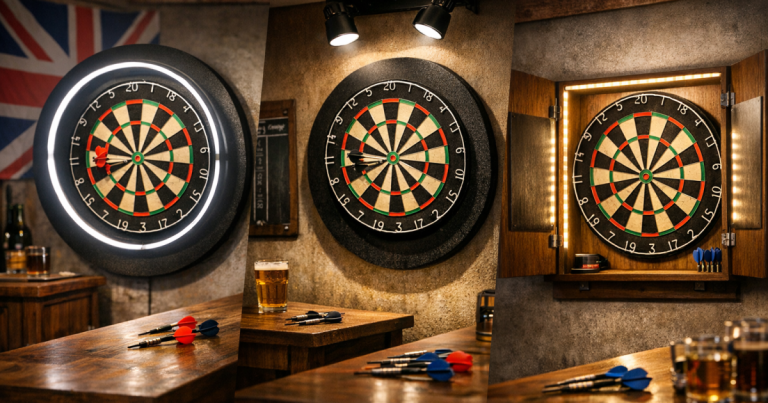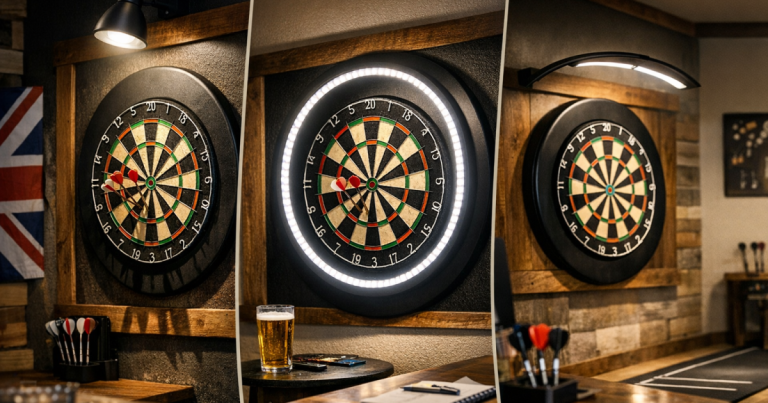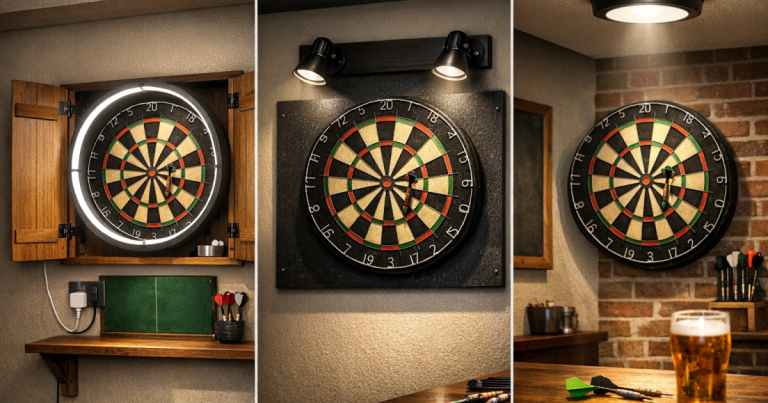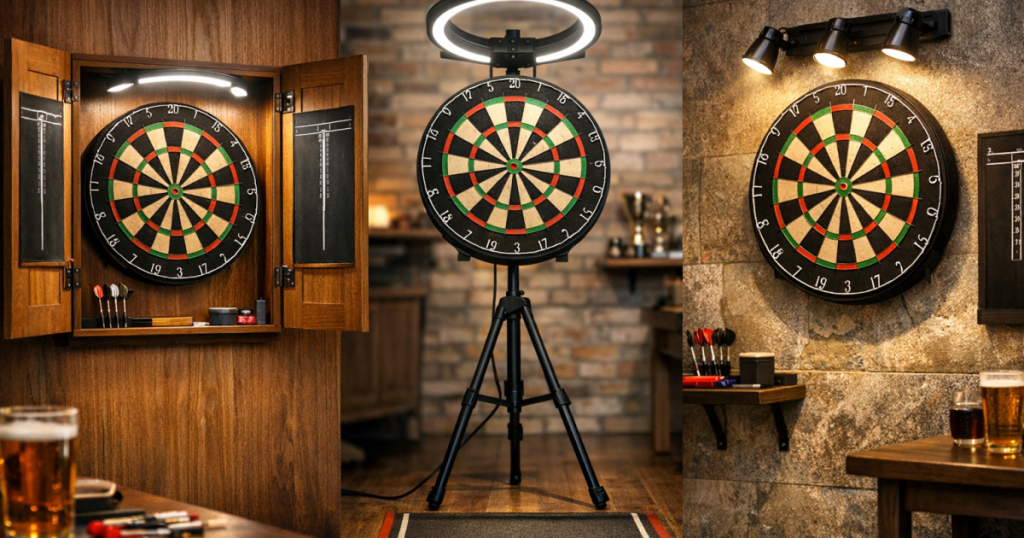
A neat home darts area can still feel awkward if the light is coming from the wrong place. The aim of dartboard lighting layouts is simple: keep the treble bed, doubles and wire edges clear without throwing glare back into your eyes or across the room. The right arrangement depends less on having the brightest lamp and more on where the board sits: inside a cabinet, on a stand, or flat against a wall.
Fixed lighting installation, mains wiring and new electrical connections should be carried out by a qualified electrician to meet UK safety standards and local requirements.
In brief
- Cabinets need light that reaches past the door line, not just the centre of the board.
- Wall setups usually work best with even, front-facing illumination around the board rather than a single ceiling light behind the thrower.
- Stands need portable lighting that moves with the board or sits consistently in front of it.
- Shadows from darts, hands and cabinet edges are usually a placement problem, not a brightness problem.
- Cables should never cross the throwing area or sit where they can be caught by feet, chairs or closing cabinet doors.
The baseline: light the board face, not the room
General room lighting helps the space feel comfortable, but darts needs task lighting. The target is the board face: the numbers, segments, wires and outer doubles should be easy to see from the oche without the player squinting or seeing a bright source in their peripheral vision.
A common mistake is relying on a central ceiling pendant. In many UK homes, the ceiling light sits behind or above the thrower once the board is placed on a convenient wall. That can push the player’s own shadow towards the board, especially in smaller spare rooms, garages and dining rooms where the oche line is close to furniture.
Dedicated board lighting is more controlled. A circular surround light, compact overhead bar, slim picture-light style fitting or carefully placed LED strip can all work, provided the light reaches the board evenly. The useful question is not “is it bright?” but “does every scoring area stay visible while someone is throwing?”
Cabinet setups: plan around doors, depth and side shadows
A dartboard cabinet looks tidy, but it adds a few lighting complications. The doors create side edges, the board sits slightly recessed, and any internal light can be blocked if it is too far back. When cabinet doors are open, they can also reflect light or cast a narrow shadow across the outer numbers.
The most reliable layout is usually a light source that sits just in front of the cabinet face or around the board opening. That keeps the light clear of the door line and reduces the chance of the cabinet itself shading the doubles. A light fitted too high inside the cabinet may make the top half look clear while the lower trebles and doubles stay dull.
Before fixing anything permanently, open both doors fully and stand at the oche. Look for three things: whether the doors interrupt the light, whether the number ring is readable, and whether the light source is visible enough to distract you during the throw. If the cabinet includes scoreboards or holders, check those areas too; a bright board with a dark side panel is not ideal for match play.
Cabinets also need careful cable planning. Keep leads away from hinges, magnetic catches and any area where a door could pinch them. If your current cabinet or surround is already causing awkward gaps, rubbing or blocked access, the advice in common dartboard cabinet and surround problems is a useful next step before adding more fittings around it.
Plain wall setups: keep the light symmetrical
A board mounted directly on a wall or backboard is the easiest format to light neatly. There are no cabinet doors to work around, so the main challenge is even coverage. A single light from one side may look acceptable at first, but it can exaggerate the wire shadows on the opposite side of the board. That becomes more noticeable around the treble 20, treble 19 and double ring.
A balanced layout is generally better: light above and slightly forward, or a surrounding light that throws illumination evenly across the face. If you use a dartboard surround, make sure the lighting still clears the outer edge. Large surrounds can be helpful for wall protection, but they can also change how shadows fall if the light sits too close to the wall.
Wall colour matters as well. A pale wall can bounce light back into the room, while a darker backboard or surround absorbs more of it. Neither is automatically better; the point is to check how the whole setup behaves from throwing distance, not just how it looks close up.
For bristle boards and electronic boards, glare behaves differently. A bristle board is mostly about wire shadows and segment visibility, while electronic boards can add reflections from display panels or plastic surfaces. For a broader explanation of board types, see the guide to choosing dartboard lighting for bristle and electronic boards.
Stand setups: make the lighting move with the board
A dartboard stand is ideal when you cannot fix a board permanently to a wall, but lighting becomes less predictable. The board may move between a living room, garage, garden room or shared space, and the room light will not always be in the right place. If the stand shifts even slightly, a once-good lighting angle can become uneven.
The simplest approach is to keep the light attached to, or aligned with, the stand rather than depending on the room. A compact clamp-style light can work if it is stable and does not wobble when darts hit the board. A freestanding lamp placed in front and to one side can also help, but it should not sit where a player might clip it during the throw or step-back.
Stands need extra thought around trailing leads. Run cables down the rear leg where possible, then away from the oche and walking route. In a shared room, it is worth treating lighting as part of the whole pack-away routine: board, stand, mat, darts and cable storage should all have an obvious place. If your darts area has to disappear between sessions, creating a foldaway darts area in a shared room covers the wider layout decisions.
Why shadows appear even with a bright light
Brightness does not remove shadows if the light is in the wrong place. Shadows usually come from one of four sources: the player standing between the light and board, the darts themselves blocking a narrow beam, cabinet edges cutting across the face, or the light sitting too close to the board surface.
If shadows appear below each dart, the light is probably too high and directional. If shadows pull strongly left or right, the light source is off-centre. If the outer doubles are harder to read than the middle, the light may be concentrated too tightly on the bull and trebles. Small adjustments can make a big difference, so test before drilling, sticking or clipping anything into its final position.
A good test is to throw a short practice leg and pause after a few darts land near the treble bed. Check whether the next target is still easy to see. Lighting that looks perfect on an empty board can behave differently once three darts are sitting in the scoring area.
Glare, atmosphere and comfort
Good darts lighting should make the board clearer without making the room feel like a workbench. Direct glare is tiring, particularly during longer sessions or league-style scoring at home. If a light source is visible from your normal stance, try changing its angle, moving it forward, or diffusing it so the board is lit without the lamp becoming the focus.
Some players prefer a brighter, more clinical setup; others like softer room lighting with a clear board highlight. Both can work. The important part is contrast: the board should stand out from the wall, but the surrounding area should not be so dark that players struggle to collect darts, read scores or move safely around furniture.
For cabinets, glare often comes from shiny door interiors, chalkboards, whiteboards or glossy finishes. For wall setups, it can come from picture glass, nearby mirrors or bright paint. For stands, it is often caused by a lamp placed too low and aimed back towards the thrower.
Layout checks before you settle on a position
- Check the view from the oche: judge the light from throwing distance, not from directly in front of the board.
- Test with darts in the board: shadows are easier to spot once darts are sitting in real scoring areas.
- Open cabinet doors fully: make sure the light still reaches the outer doubles and number ring.
- Walk the room route: look for cable snags near chairs, skirting boards, mats and doorways.
- Try evening conditions: many home setups look fine in daylight but struggle once curtains are closed.
- Keep scoring visible: if you use a scoreboard beside the board, avoid lighting the board well while leaving the scoring area dim.
Common questions
Can I just use the ceiling light?
You can if it lights the board evenly and does not put your shadow across the scoring area. In many home rooms, a ceiling light is better as background lighting than the main board light.
Should cabinet lighting go inside or outside the cabinet?
Outside or just forward of the cabinet face is often cleaner because the doors and cabinet depth are less likely to block the light. Internal lighting can work, but it needs testing with the doors open.
How do I light a dartboard stand without making the room messy?
Use lighting that stays aligned with the stand and route the lead down the rear side, away from the oche. The fewer separate items you need to reposition, the easier the setup is to keep consistent.
Does an electronic dartboard need different lighting?
Often, yes. The board still needs even illumination, but you also need to watch for glare on plastic surfaces, displays and scoring areas. Test it from your throwing position before fixing the light in place.
Is brighter always better for darts?
No. Excessive brightness can create glare and harsh shadows. Even coverage, comfortable contrast and a clear view of the doubles and trebles matter more than raw brightness.
Main lessons
The best lighting layout is the one that suits the way your board is actually mounted. Cabinets need light that clears the doors and reaches into the recess. Wall setups benefit from balanced, even coverage around the face. Stands need portable lighting that stays consistent when the board moves.
Before making the setup permanent, test it from the oche, with darts in the board, in the lighting conditions you normally play in. A few minutes of checking shadows, glare and cable routes can make the difference between a tidy-looking darts corner and one that feels genuinely comfortable to play on.